


What Does It Really Mean When Your Concrete Slab Floor Goes Uneven in New Castle County?
If your basement floor tilts toward one corner, or your kitchen tile cracks along the same line every winter, the slab is talking to you. It’s saying the ground beneath it moved.
I’ve been reading these signals across Delaware, Pennsylvania, and Maryland soils for over 25 years, with the last six spent buried in tri-state dirt full time. When homeowners in Wilmington or Newark call me about sloping floors, they usually want a quick lift. I have to slow that conversation down.
An uneven slab is a structural report card on the soil underneath. Grind the trip lip, pour a leveler, walk away, and you’ll be back on the phone within two winters.
The real question isn’t how to level the floor. It’s why the floor stopped being level.
The Soil and Water Story Beneath Your Floor
New Castle County sits on two very different geologic worlds stitched together. Up in the Piedmont zones around Hockessin, Pike Creek, and northern Newark, you’re on silt and clay loams that consolidate when they get wet, then leave voids as they dry out. Down toward Bear, New Castle, and Middletown, the ground shifts to Coastal Plain sands and gravels with clay lenses, and a water table that can sit only 2 to 8 feet down.
Add the watersheds. Christina River, Brandywine, White Clay Creek, Red Clay Creek. After a hard mid-Atlantic spring storm, groundwater rises fast in neighborhoods you’d swear were nowhere near a creek.
Then winter shows up. We get roughly 200 days of active freeze-thaw cycling in Zones 6a–6b. Saturated silt at your slab edge expands, contracts, and slowly opens gaps at every control joint and door threshold.
How This Shows Up Inside the House
- Baseboards separating from the floor along one wall, usually the exterior one
- Interior doors that latched fine last spring and now stick or swing on their own
- Hairline cracks in tile grout running in one consistent direction
- A marble that rolls when you set it down in the middle of the basement (old trick, still works)
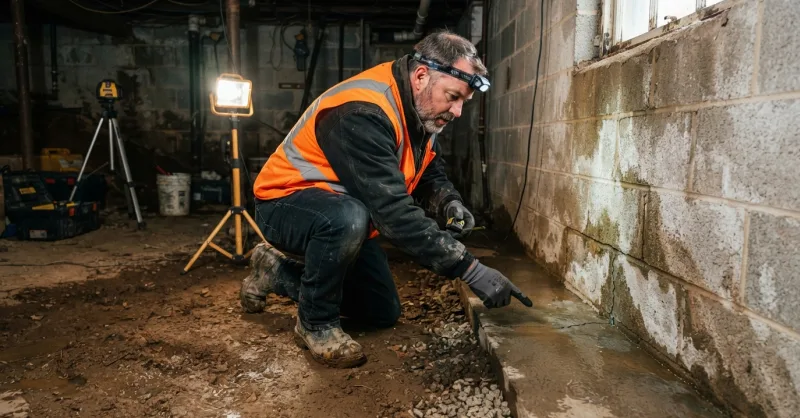
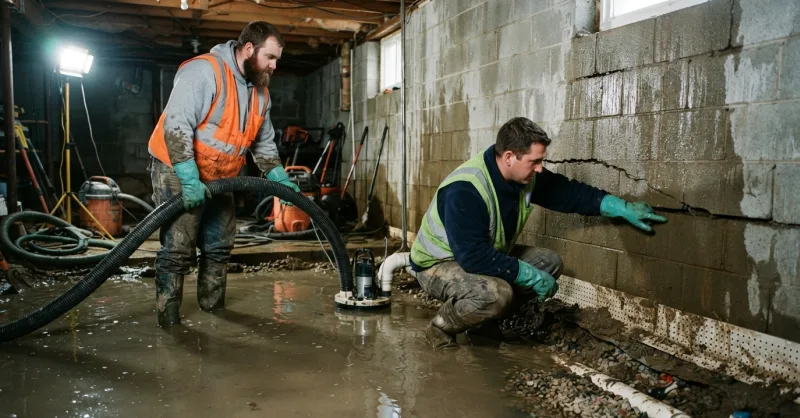
- Cove seepage where the basement floor meets the wall after heavy rain
None of that is cosmetic. All of it traces back to soil and water behaving badly under load.
The Questions a Real Local Expert Asks Before Quoting
Here’s how you separate a diagnostician from a closer in a branded polo shirt. Listen to what the contractor asks you before they talk price.
A legitimate structural person needs to know a handful of things right away:
- What soil sits under this slab? Piedmont clay behaves nothing like Coastal Plain sand over a clay lens. The repair is different.
- Where does your stormwater actually go? If nobody asks about your downspouts, grading, sump discharge, or the nearest creek corridor, they’re guessing.
- Is this a load-bearing slab? A garage floor and a basement slab fail in different ways and need different fixes.
- Will this repair need a New Castle County Land Use permit? Structural concrete work usually does, and unpermitted work can haunt a resale.
If they shrug at any of those, you’re being sold, not diagnosed. Our free structural inspection is built around exactly these questions, and it comes with zero commission pressure because I don’t run my crews that way.
Red Flags I See in Estimates Around Here
I’ve walked into houses in Bear, Elsmere, and Chester County where the previous “fix” was a can of waterproof paint and a tube of hydraulic cement. The homeowner paid a few thousand bucks. The wall behind that paint was rotting from the inside because the moisture had nowhere to go.
Watch for these specific pitches:
- “One-day mudjack and you’re done.” Lifting a slab without correcting the soil and drainage that dropped it is a cosmetic fix. Sometimes it drops again in a season.
- “We’ll paint the walls with a sealer.” That traps water inside masonry and accelerates spalling in our freeze-thaw climate. Hydrostatic pressure doesn’t disappear because you sealed the inside face; it finds another way in.
- “No permit needed, it’s just a floor.” Structural concrete work in New Castle County typically needs one. A contractor dodging that conversation is protecting their calendar, not your equity.
- Discount that expires Friday. Real structural work gets scoped by conditions on site, not by a timer.
If telling you the truth costs me the job, so be it. I’d rather sleep well than take a check for work I know won’t hold.
A Chester County House That Taught Me Patience
Last spring I was called out to a 1920s stone-foundation home just outside West Chester. The owner had a basement slab that heaved about an inch and a half near the center, and a sump running almost constantly after any rain. Two previous contractors had quoted her interior overlays and a paint-on sealer. Neither had asked about the drainage or the soil.
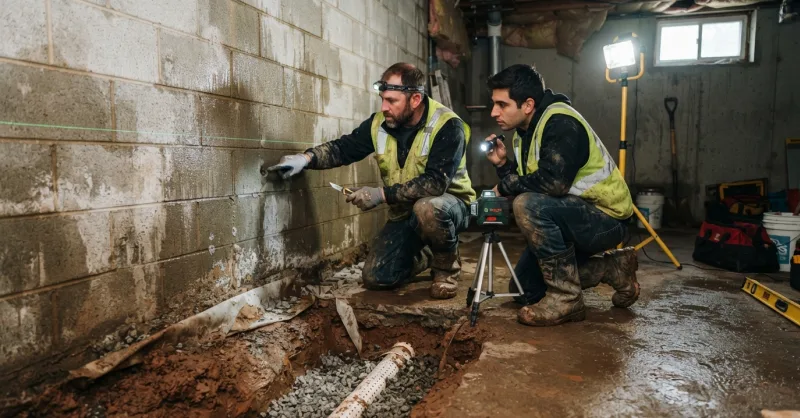
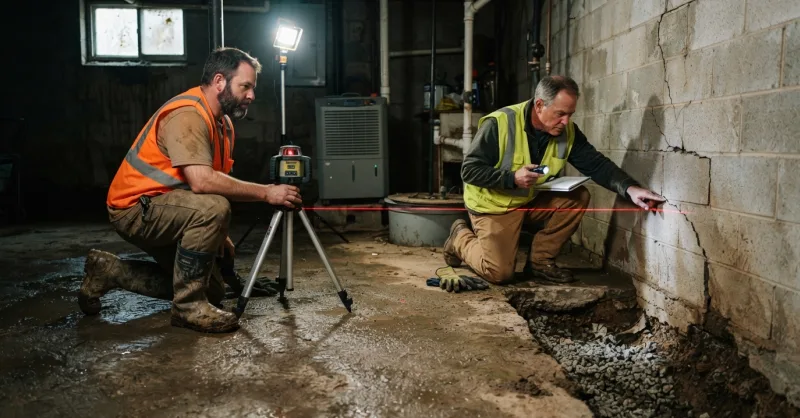
We pulled elevation readings across the slab and found the heave centered right where an old, collapsed clay drain tile ran. The clay-rich subsoil around it was holding water like a sponge, building hydrostatic head straight up through the slab.
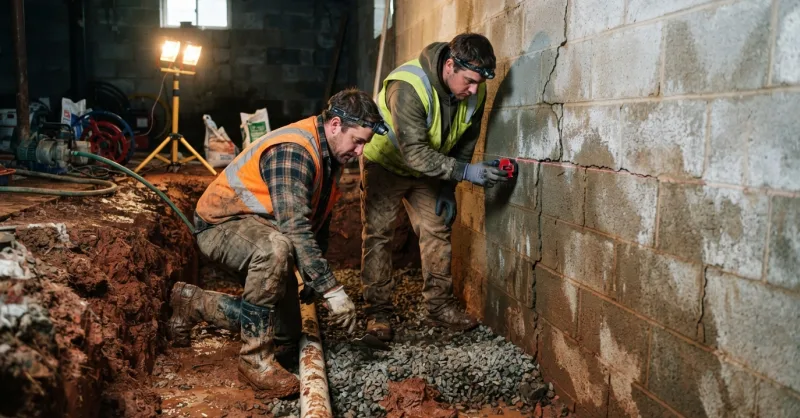
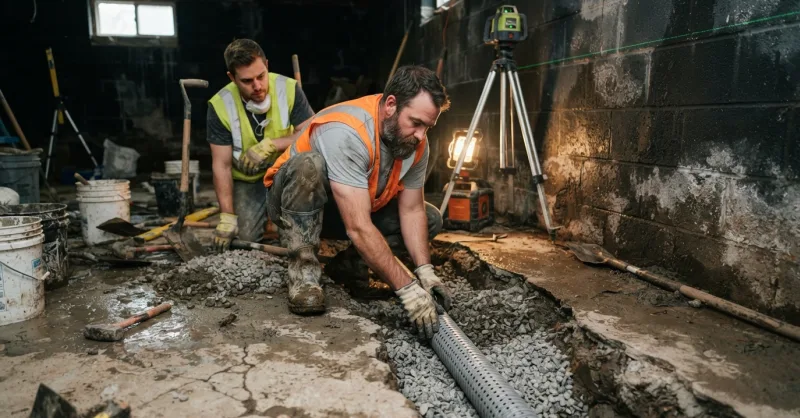
The repair wasn’t glamorous. We excavated to the footing on the wet side, installed an exterior membrane and a proper footing drain routed to daylight, tied in a new interior perimeter system with a real sump discharge, then addressed the heaved section with a structural overlay after the water was actually gone.
Took three weeks, not one day. Cost more than the paint job. The floor hasn’t moved since, and her sump runs maybe twice a month now instead of every hour.
(The frustrating part? She’d already spent almost eleven grand on the earlier band-aid work. That money was just gone.) If you’re staring at a similar situation, our page on permanent slab repair walks through what the actual sequence looks like.
What a Permanent Repair Actually Involves
Real slab remediation follows a sequence, and the order matters more than any single product anyone tries to sell you.
The Sequence, In Plain English
- Diagnose the cause. Elevation mapping, watershed and flood-zone review, subgrade evaluation, soil identification, hydrostatic assessment at footing depth. “It settled” is not a diagnosis.
- Fix the water first. Footing drains, perimeter drainage, sump and discharge corrections, grading and swale repair. No structural work survives a wet subgrade.
- Stabilize the soil. Where voids and settlement troughs exist, soil stabilization or underpinning piers restore bearing capacity. This is the step the patch crowd skips.
- Restore the slab. Structural overlays and crack-bridging systems come after the soil and water are handled, never as a substitute.
- Permit and document. Pull the New Castle County permits, pass inspection, keep the elevation data and photos. Future buyers and appraisers will ask.
A common question I get from property managers is whether every uneven slab job in Newark or Middletown actually requires a permit through the Land Use Department at 87 Reads Way. Load-bearing and structural concrete work almost always does, and skipping that step can trigger forced demolition during a future sale. If you’re weighing this against related settlement issues, our guide on foundation settling and soil movement covers the overlap.
Micro-Local Realities Along the I-95 Corridor
Housing stock matters here. Older Wilmington and central New Castle homes often sit on stone or block foundations with partial basements poured over irregular subgrade decades ago. Subdivisions built between 1970 and 2000 along Kirkwood Highway, US-40, and DE-1 are mostly slab-on-grade or standard poured basements over compacted fill with a mixed moisture history.
Newer builds toward Middletown are engineered better on paper, though I still see footing drain misdesigns and grading that funnels water toward the garage slab. Different eras, different failure modes, same root cause: soil and water.
Our shop at 500 Apple Rd, Newark, DE 19711 puts our crews within a short drive of most of the county, which matters when a homeowner in 19702 calls us on a Saturday morning after a storm. We run 8 AM to 7 PM Monday through Saturday and 8 AM to 3 PM Sunday.
Property managers sometimes ask how quickly we can respond to sudden slab movement in flood-adjacent zones near the Christina River. Same-day or next-day site visits are normal for us during active storm seasons. That radius is the reason we haven’t expanded beyond the tri-state footprint yet, even as we plan wider coverage heading into 2027.
Honest Talk About Scope and Cost
Homeowners want a number. I get it. But a straight-up quote before diagnosis is how you get burned.
Costs on slab work in this region depend on:
- How much of the drainage system needs to be rebuilt or added
- Whether soil stabilization or underpinning piers are needed beneath critical slab areas
- Whether the slab is load-bearing (basement, garage) versus a lighter interior pour
- Permit requirements and inspection sequencing through New Castle County Land Use
- Access, which matters more than people think; a finished basement adds real hours
You’ll see a spread from a few thousand for localized work up to five figures for full drainage and underpinning packages. Anyone who quotes you a flat number sight unseen is either padding to cover unknowns or planning to cut corners. Our breakdown on permanent slab leveling cost lays out what actually drives price.
A question I hear often from folks along the DE-2 corridor near Elsmere: whether homeowners insurance covers this kind of settlement work. Usually no, because insurers classify soil movement and hydrostatic pressure as maintenance, not sudden loss. Documenting the repair properly matters more for resale and appraisal than for a claim.
Hiring the Right Crew Without Getting Sold
My advice for anyone comparing contractors: ask each one to explain the soil, the water table, and the load path under your slab. If they can’t, keep looking. It’s really that simple.
You want someone who shows up with instruments, not a tablet full of financing options. Someone who talks about your grading and your gutters before they talk about their product. Someone who won’t flinch when you ask about permits.
A last question I get from Middletown homeowners near the US-301 bypass: whether it’s worth waiting a season before repairing an uneven slab to see if it stabilizes on its own. Almost never. Settlement in our soils doesn’t self-correct while the water table is still cycling and the subgrade is still consolidating. Waiting usually means paying more later for a bigger repair.
You can see how we handle related work on our foundation repair page, and follow the day-to-day on LinkedIn or Instagram where we post real site photos, not stock imagery.
Your slab is trying to tell you something. Hire someone who actually listens.
Written by: Alex Velasquez
AVG Waterproofing LLC