


What Does a Free Structural Foundation Inspection in Newark, DE Actually Uncover?
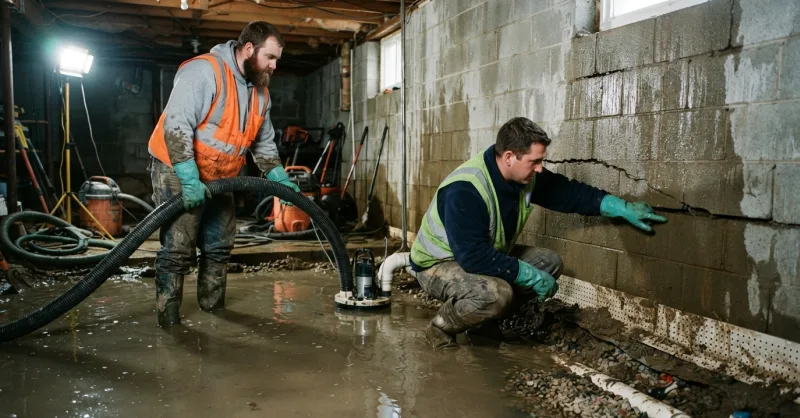
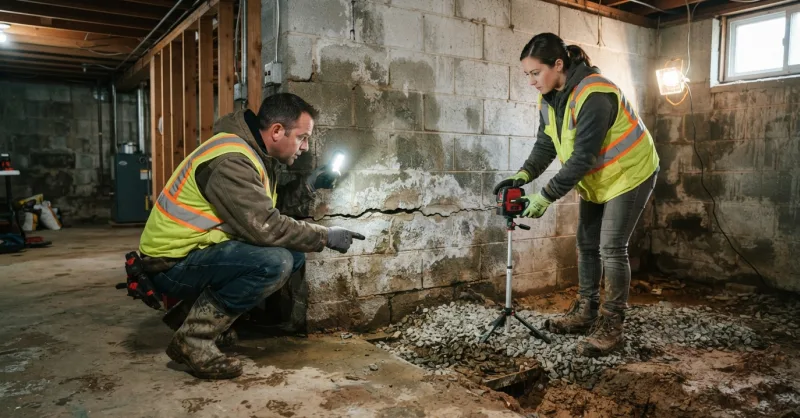
A free structural foundation inspection in Newark, DE is a non-commissioned, on-site diagnostic of cracks, settlement, and water intrusion caused by New Castle County’s clay-rich soils, mixed Piedmont and coastal plain geology, and stubbornly high water tables. My team documents root causes and code-aware repair options. Not paint. Not a pitch.
If your basement only leaks during heavy rain, that’s still a structural warning. Compacted clay and floodplain soils around Newark hold water against your walls, and hydrostatic pressure does the slow, patient work of opening cracks and shifting block courses over years. The leak is the symptom. The soil is the culprit.
My promise: I’ll tell you exactly what’s failing, what’s stable, and what doesn’t need me yet.
Why Newark Sits on a Geological Seam Most Contractors Ignore
Newark straddles two very different worlds beneath your slab. North of town, you’re on Piedmont gneiss and schist-derived soils, older rocky ground with pockets of loam and localized clay horizons. Head south or east, and you slide into Delaware Bay Basin coastal plain sediments, where sandy layers and clay lenses trade off drainage capacity in ways that surprise even seasoned builders.
Properties along DE 896 and DE 273 frequently sit right on that mixed transitional ground. One neighbor’s foundation drains fine. The next lot over, the clay holds water like a bathtub.
Two Things Clay Does Badly to Foundations
- It holds water. Saturated clay generates hydrostatic head, the vertical column of groundwater pushing sideways on your basement walls. Near the Christina River, White Clay Creek, and Red Clay Creek, water tables can sit as shallow as 2 to 8 feet.
- It moves. Expansive clay swells wet and shrinks dry. Mid-Atlantic freeze-thaw cycles plus summer storm seasons repeat that push-pull against your footings year after year.
The end result is structural foundation settlement in clay-rich soil: uneven downward movement that opens diagonal cracks, racks door frames, and slopes floors just enough to notice when a marble rolls across the kitchen. If you’re seeing that pattern, our expanding clay soil repair breakdown walks through what changes and what doesn’t.
What I Actually Look At During a No-Pressure Structural Assessment
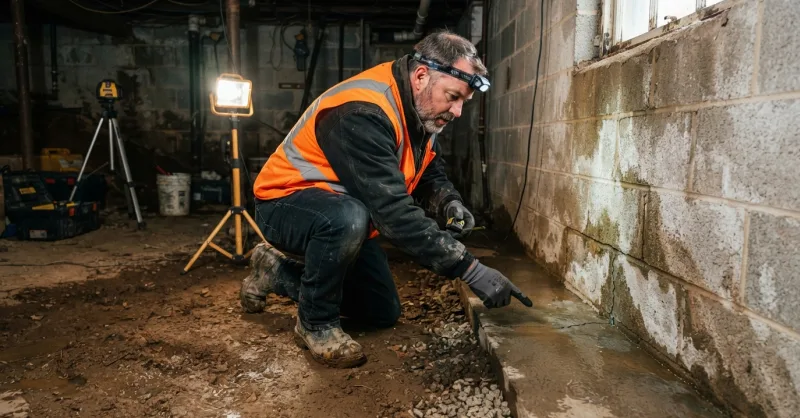
An honest inspection is a diagnostic, not a walkthrough with a quote stapled to it. Here’s what a real evaluation covers when I’m on your property.
Crack Morphology (The Story in the Wall)
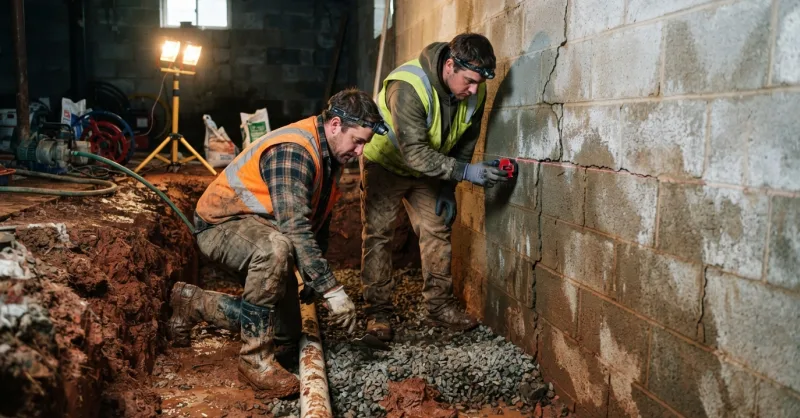
A vertical hairline in a poured wall tells a different story than a stair-step crack through cinder block, and both are worlds apart from a horizontal fracture in an old stone-and-mortar basement. Horizontal cracks and bowing point to lateral soil and water pressure. Diagonal cracks near corners suggest differential settlement. Each pattern points somewhere different, and reading them wrong wastes your money.
Wall Plumb, Floor Level, and What’s Moving Now
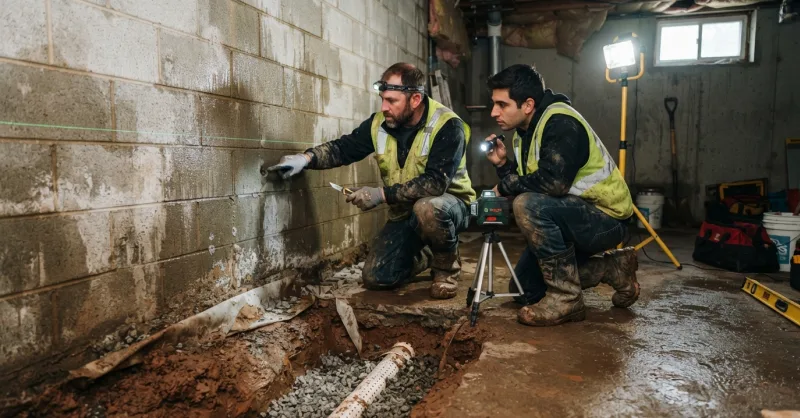
I check whether walls have shifted past serviceability and whether the slab is level to within reasonable tolerance. Some seasonal movement is normal in this region. Progressive movement (the kind where the crack is a little wider every spring) is not.
Grade, Downspouts, and the 90% Nobody Fixes
Ground should pitch away from the foundation at roughly 2%, about a quarter inch per foot over the first 10 feet. Downspouts need to discharge 6 to 10 feet out. On flat, clay-heavy lots in Bear, Glasgow, and along the Pulaski Highway (US 40) corridor, that’s where most chronic seepage begins. A common byproduct of the sloppy, cookie-cutter waterproofing installs I inspect: three grand of interior drain tile, and the downspout is still dumping two feet from the wall.
Wondering how quickly a footing drain can be scoped and estimated during a first visit? Usually within the same appointment, assuming your yard has enough access for me to trace the perimeter and check where water is actually collecting.
The Fixes That Don’t Work (And Why They Keep Getting Sold)
Waterproof paint on interior masonry traps moisture inside the block. It hides evidence and accelerates spalling. Surface caulking on an active crack fails within a season because the crack is still moving. Cosmetic patching without addressing hydrostatic pressure is a band-aid on a hydraulic problem.
These tactics sell because they’re cheap, fast, and easy to bundle into a commissioned pitch. They don’t change soil-structure interaction. They don’t lower the water table. They don’t relieve lateral load. If a contractor’s first move is a bucket of sealant, get a second opinion.
I had a call last spring from a homeowner off Elkton Road who’d paid a national outfit almost $8,000 for interior coatings and a “lifetime” warranty two years earlier. Water was back within 14 months. The warranty covered the paint, not the wet basement. Her real issue was a collapsed clay drain tile from the 1960s and a downspout buried under mulch. We fixed those. Cost her less than the second round of paint would’ve.
What Permanent Remediation Actually Involves
Real solutions get designed from the foundation out, not the basement in. That means:
- Grade correction to restore positive slope away from the structure
- Buried downspout extensions discharging 6 to 10 feet from the wall
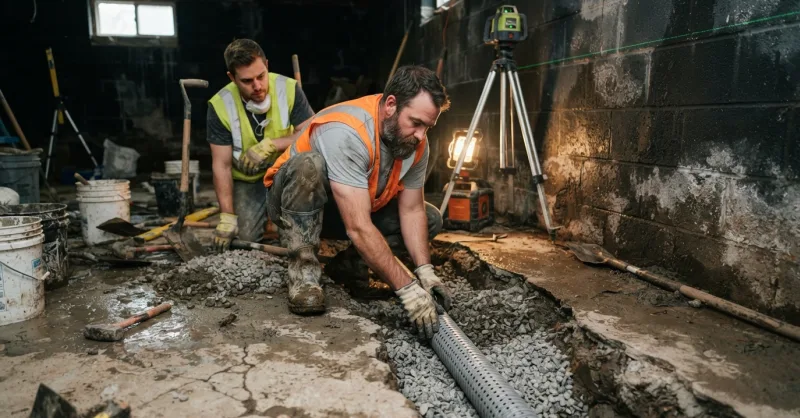
- Footing drains or perimeter French drains at footer elevation, tied to a properly sized sump. For a deeper look at that scope, our French drain and sump pump breakdown covers the mechanics
- Sump discharge routed away from the foundation with battery backup and a high-water alarm (during a serious storm, a $180 backup battery is the difference between a dry basement and a claim)
- Exterior membrane waterproofing from footing to grade in high-moisture soils
- 10-mil polyethylene vapor barriers in crawlspaces, paired with dehumidification where indoor RH keeps drifting past 50%
- Structural reinforcement, whether carbon fiber or engineered steel systems, only where walls have already bowed beyond serviceability. Our foundation repair services page covers when that threshold gets crossed
When grading or drainage work touches site conditions, New Castle County’s building department may require permits. Code-compliant work protects you at resale. Unpermitted band-aids become disclosure headaches. I’ve seen a Hockessin sale fall apart over a $400 permit somebody skipped in 2019.
Property managers often ask, whether a full exterior excavation is really necessary for a rental duplex along DE 2 with recurring tenant complaints? Not always. Sometimes exterior grading, buried downspouts, and an interior perimeter system get you 90% of the way there at a fraction of the cost.
What You Should Walk Away With After a Free Inspection
You should leave with a plain-language report. What’s stable. What’s marginal. What’s failing. Realistic thresholds for monitoring versus repairing right now. Photos. Crack measurements. A phased path that starts with drainage and only escalates to reinforcement if the wall data justifies it.
No commissioned sales rep in your kitchen. No today-only pricing. No lifetime waterproofing promises that pretend the soil under your house doesn’t exist.
My shop runs seven days a week, 8:00 AM to 7:00 PM Monday through Saturday and 8:00 AM to 3:00 PM Sundays, out of 500 Apple Rd, Newark, DE 19711. Being local along the I-95 corridor means I can be on your porch fast when a mid-Atlantic storm floods your basement, not three days later like a franchise dispatching from Philly.
One more thing property managers often ask: can inspection documentation actually hold up during an appraisal or refinance review on a Wilmington rowhome? Yes, when it includes measured findings, photos, and a written scope, appraisers and underwriters take it seriously.
Who Should Actually Book This Inspection
If you own property near the White Clay Creek watershed, along the Kirkwood Highway (DE 2) corridor, or anywhere in Newark, Bear, Glasgow, Pike Creek, Hockessin, or the Wilmington suburbs, and you’ve noticed cracks, damp walls, floors that have started to slope, or a musty smell that keeps coming back, the inspection is the honest first step.
It tells you what your foundation is doing, what will likely happen if you wait, and what I’d do about it. Nothing more. Nothing less. If telling you the truth costs me a project, so be it. I’d rather sleep well at night than sell you drain tile you don’t need.
Homeowners along Ogletown Road frequently ask, if a hairline crack in a poured basement wall is actually worth calling about or if it’s just cosmetic settling most houses get? Bring me a photo with a coin next to it for scale. If it’s under 1/16 inch and vertical without offset, we probably monitor it. If it’s wider, offset, or diagonal, we investigate.
A last question I get from Bear homeowners near US 40: does a slab-on-grade home built in the late 1990s need this kind of inspection at all, given there’s no basement to leak? Absolutely, slabs settle too, and floor slope, hairline slab cracks, and interior door binding all tell me whether the pad underneath is still doing its job.
Follow along on LinkedIn or Instagram for local repair walkthroughs and before-and-after work from around New Castle County.
Book your free structural foundation inspection. Bring your questions about a pending sale, a refinance, or that crack you’ve been watching for two years. I’ll give you the truth about your foundation, and I’ll tell you plainly when it doesn’t need me yet.
Written by: Alex Velasquez
AVG Waterproofing LLC