


What Actually Stops a Wet Basement in Cecil County MD and New Castle County DE?
Straight answer: you relieve hydrostatic pressure at the footing. Everything else is theater.
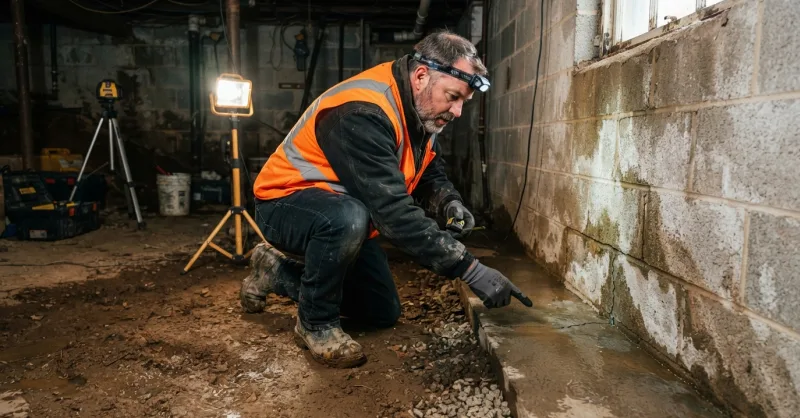
If your basement takes on water within 12 to 24 hours of a hard rain, that is not “humidity.” That is groundwater pushing against your foundation because the clay around it won’t drain. Paint won’t fix it. Hydraulic cement won’t fix it. A partial French drain that stops six inches above the footing won’t fix it either.
I’ve been diagnosing this problem across the DE, PA, and MD corridor for 25 years, and the mechanics don’t change. What changes is which contractors are willing to tell you the truth.
The Soil Under Your House Is the Problem
North of Wilmington, you’re sitting on Piedmont clay over metamorphic bedrock. Permeability under saturation runs below 0.5 inches per hour. Stormwater doesn’t percolate down. It stacks against your foundation wall and climbs.
South and east, running from Bear through New Castle and toward the Cecil County line at Elkton, you’re on Atlantic Coastal Plain sediments. Water tables in some pockets sit at 2 to 8 feet. In parts of 19701 near Pulaski Highway, I’ve measured groundwater already above the footing before the first drop of rain hits.
Then the Christina River Basin loads the whole system. Brandywine, White Clay, Red Clay, Naamans, Shellpot. A single nor’easter dumps enough runoff to raise groundwater a foot in six hours. Your cove joint becomes the path of least resistance.
That pressure is measured in pounds per square foot. A lifetime paint warranty is measured in laminated cardstock. Guess which one loses.
Why the Cheap Fixes Fail Every Single Time
I’ll go through the four I see every week in Newark and Elkton-adjacent neighborhoods.
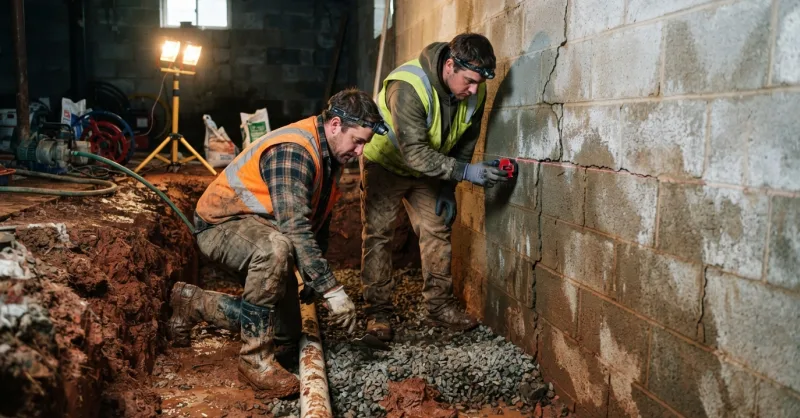
- Waterproof paint on cinder block. The block is hollow. Water enters the exterior face, fills the cores, migrates in. You paint the interior and now the water is trapped inside the block. Spalling starts. Mortar softens. The wall keeps bowing (and you don’t see it until it’s serious).
- Hydraulic cement in an active cove joint. Rigid patch, flexing joint. One or two freeze-thaw cycles and it cracks. Money gone.
- Cosmetic crack injection on a moving wall. If the crack is horizontal or stair-stepping, it’s a symptom of lateral earth pressure. Seal it and the wall keeps moving. The crack reopens two feet over.
- Partial interior drains that stop short of the footing. You’re collecting the easy water and leaving the pressure behind. Half a system is worse than none because it hides the failure.
I had a homeowner in 19713 last spring who’d paid twice for a “waterproofing” job: paint on the inside, then a partial drain a year later. Wall was still bowing an eighth of an inch. That’s when the bowing wall conversation actually starts, and it’s not fun to have.
Which brings me to the question I get most from Cecil County callers: can I really waterproof a cinder block basement from the inside only? Sometimes yes, if the wall is structurally sound and the drainage is engineered to footing level with proper discharge. Sometimes no, because the block is already saturated and exterior membrane work is the only permanent stop.
What Permanent Remediation Actually Looks Like
Four parts. Skip one and you’re paying twice.
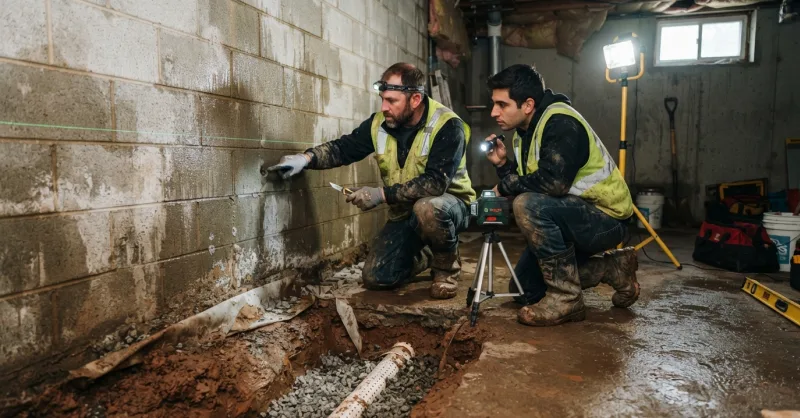
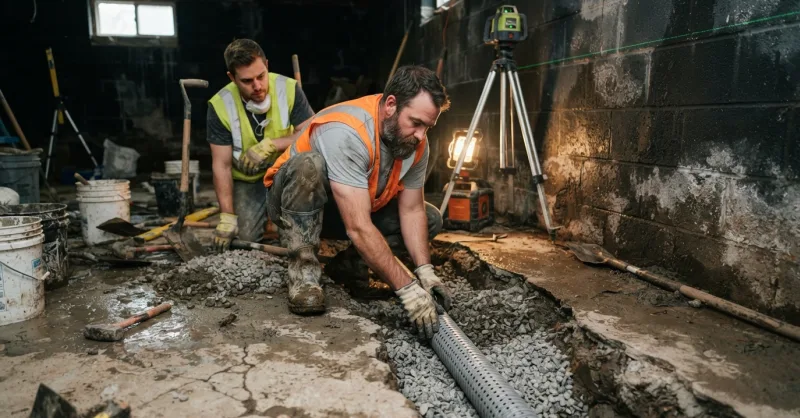
1. Footing-level perimeter drainage. Continuous channel at the footing, wrapped in washed aggregate, intercepting groundwater before it rises against the wall. IRC R405.1 exists because the physics isn’t negotiable.
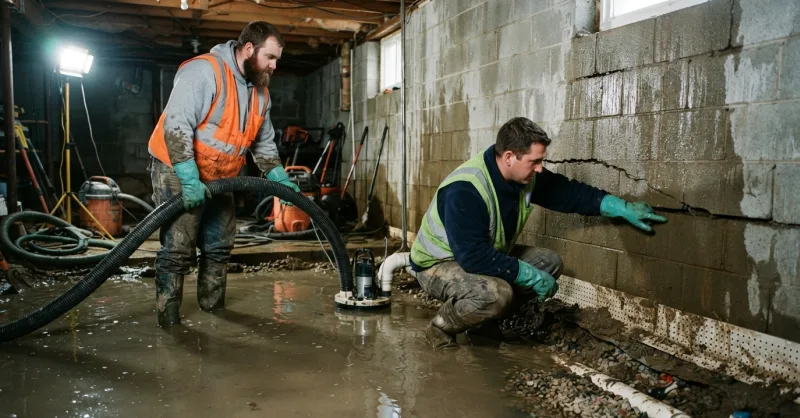
2. Sump system sized for local storm loads. Battery backup is not optional in this region. Nor’easters knock power out. A sump without backup is a decoration. Pit volume, pump capacity, check valve, and discharge route all get sized for Christina Basin storm intensity, not a generic kit from a box store.
3. Exterior membrane where the wall itself is compromised. Historic stone and rubble foundations in old Wilmington, washed-out mortar in mid-century block near Kirkwood Highway. ASTM D449 or C836 rated membranes stop lateral ingress at the source. Full exterior work isn’t always needed, but when it is, nothing else substitutes.
4. Structural reinforcement for walls already moving. Carbon fiber or steel. Drainage will not straighten a wall that has already failed. If you see horizontal cracking or inward bow, drainage is step two, not step one.
The Free Fix Most Homeowners Skip
Before anyone quotes you a system, three things need to be true outside:
- Grade slopes 2 to 6 percent away from the wall for the first 6 feet.
- Downspouts discharge at least 6 feet from the foundation, not into a splash block sitting against it.
- No negative-grade pockets where clay has settled against the wall over 30 years.
Fix those first. Sometimes that plus a working footing drain is the whole answer. I’ve told homeowners in Claymont to spend $400 on downspout extensions instead of $12,000 on interior drainage. If telling you the truth costs me a project, so be it.
The other honest question worth answering: how do I know if my Cecil County basement needs full excavation or just interior drainage? Depends on wall condition, soil profile at your specific address, and whether the water is entering through the wall face or the cove joint. Exterior work runs three to five times the cost of interior. Nobody should be quoting either without a real diagnostic.
Spotting the Sales Closer vs. the Structural Assessor
You’re talking to a closer when you hear:
- “Today-only pricing” after a flashlight walkthrough.
- A lifetime warranty on paint.
- “Humidity” as the diagnosis, with no mention of water table depth or soil type.
- Full-perimeter excavation quoted before your grade and downspouts were even checked.
- Zero reference to IRC R405.1, ASTM standards, or New Castle County permitting.
A real assessor measures footing elevation relative to nearby storm drains, identifies your soil type, correlates moisture to specific storm events, and tells you what does not need to be done. Our crew runs out of 500 Apple Rd, Newark, DE 19711, which puts us on-site along the I-95 corridor from Elkton to Claymont in usually under an hour.
One more question worth burying here: are the same wet basement solutions valid across Cecil County MD and New Castle County DE? The mechanics are identical. The soil profile shifts, water table depth shifts, but hydrostatic pressure doesn’t care about the state line. What changes is the permit process and the specific ASTM membrane spec we pull based on soil chemistry.
And the last one I hear from property managers running duplexes near Naamans Road: can hydrostatic pressure damage cinder block walls even if I already have a sump pump? Absolutely. A sump handles floor-level water. It does nothing for lateral pressure against a hollow-core wall. That’s a separate structural issue requiring wall reinforcement, not more pumping capacity.
Bottom Line
Wet basements from Elkton to Claymont are soil and water-table problems, not wall-coating problems. Diagnose the soil first. Relieve pressure at the footing. Reinforce walls that have already moved. Everything else is decoration.
You can see more of what we’re doing across the tri-state on Instagram or LinkedIn.
Written by: Alex Velasquez
AVG Waterproofing LLC