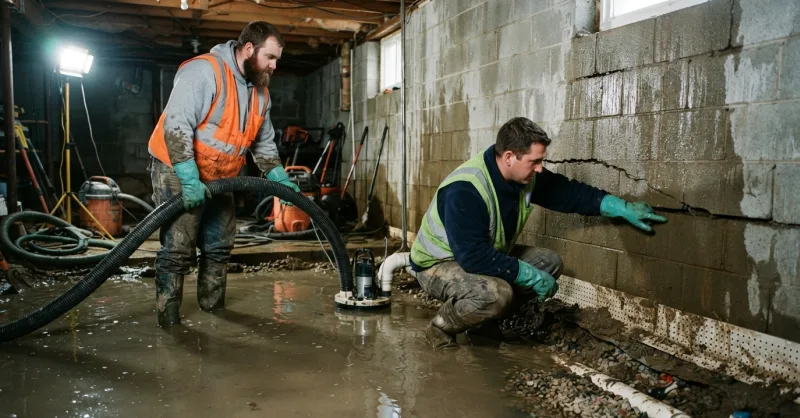



What Does It Really Cost to Permanently Fix Bowing Basement Walls in New Castle County, DE?
Straight answer: a permanent repair on a bowing basement wall in New Castle County usually lands between $4,000 and $15,000 per wall. Severe cases push higher. The number moves based on how far the wall has bent inward, what kind of dirt is shoving against it, and where your water table sits on a rainy Tuesday in April.
I’ve been diagnosing foundations for 25 years, six of them dug into the specific soils along the DE, PA, and MD corridor. So when I quote a wall in Newark or Wilmington, I’m not guessing.
Cosmetic paints and hydraulic cement? They hide the crack. The load stays. The wall keeps moving.
The Three Things That Actually Move the Price
- Deflection severity measured in inches, not eyeballed from across the room.
- Soil and groundwater behavior on your specific lot, which changes block by block around here.
- Wall material, age, and code work tied to Delaware’s 24 to 30 inch frost depth and IRC permitting.
Deflection Severity: How Far the Wall Has Traveled
Walls bend slow. They bend under sustained lateral earth pressure and hydrostatic head, and the inches of inward travel dictate the system I spec.
Under 1 Inch of Inward Bow
Carbon fiber straps typically handle this. We epoxy-saturate them and bond them vertically to the interior face, turning masonry into a tension-resisting member. The wall stops moving. It doesn’t get pushed back, and any contractor who promises that with straps alone is lying.
Budget: roughly $4,000 to $7,000 for a standard 25 to 30 foot wall with drainage tweaks.
1 to 2 Inches of Deflection
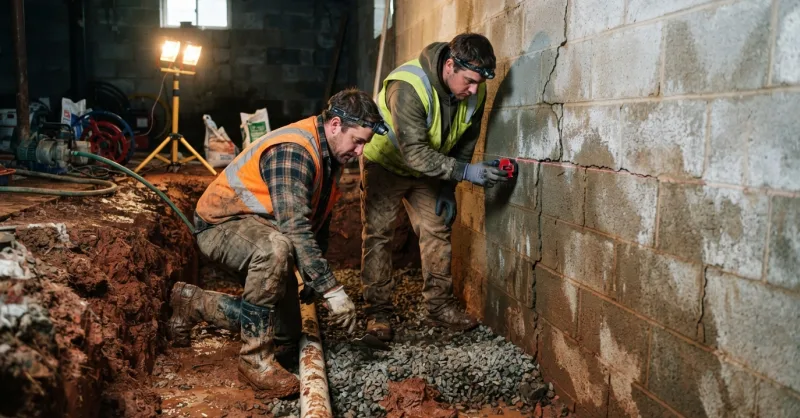
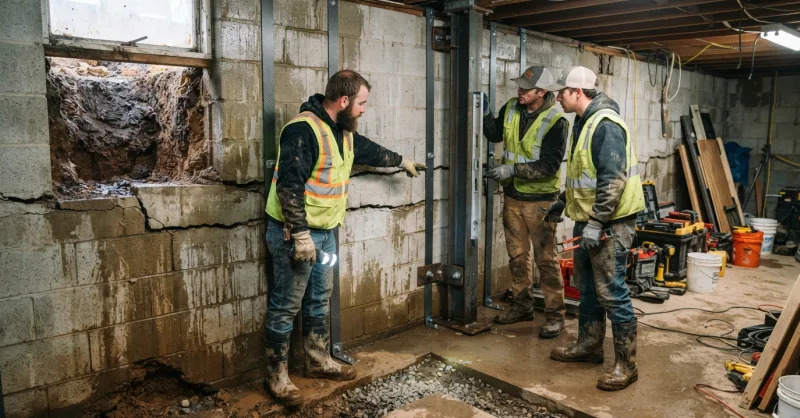
Now we’re talking wall anchors or helical tie-backs. Steel driven into stable soil past the active pressure zone, connected through the wall to interior plates. In some cases, we can gently coax the wall back toward plumb over time.
Budget: $7,000 to $12,000 per wall depending on anchor spacing and what the soil borings tell us.
Over 2 Inches or Top Rotation
Partial rebuild territory. If the wall has rotated at the top plate or shows shear failure, no strap on earth is bringing that back safely. Excavation, footing assessment, sometimes new block or poured concrete.
Budget: $12,000 to $20,000+. It’s not cheap. Neither is a wall collapse at 2 a.m. during a nor’easter.
Your Soil and Water Table: The Part Most Sales Reps Skip
New Castle County isn’t one geologic story. It’s two, and they push on your foundation very differently.
Newark, Bear, Pike Creek (19702, 19711)
Piedmont clay with rocky sublayers. High shrink-swell index. When it rains hard, that clay swells and shoves your cinder block inward with force most homeowners underestimate. When it dries out in August, the clay pulls back and leaves voids. Repeat that cycle for a decade near the White Clay Creek corridor and you get horizontal cracks at mid-height, right where the pressure peaks.
I had a homeowner off Route 4 last spring who’d repainted his basement three times in five years. Same wall. Same paint. He kept asking why the mildew smell came back every April (I didn’t have the heart to tell him the paint was probably trapping moisture inside the block, making the rot worse). We measured 1.75 inches of bow. Prior contractor never brought a gauge. Never asked about the creek 400 feet behind his fence line. Just quoted a drylok package and a French drain.
That wall needed anchors, an interior perimeter drain, and exterior grading correction. Total came in at $11,200. He’d already spent close to $4,000 on cosmetic work that did nothing. If you’re staring at that same pattern, our guide on clay soil foundation failures walks through the mechanics in plain English.
Wilmington and the River Corridors: Hydrostatic Head Never Sleeps
Older Wilmington neighborhoods near the Christina River and Brandywine Creek (think 19804, 19805, 19806) sit on coastal plain sediments with the water table commonly 2 to 8 feet below grade. During heavy mid-Atlantic rains it can rise within 18 inches of the slab. FEMA Zone AE and Zone A designations aren’t paperwork trivia. They mean the soil against your wall stays saturated for weeks at a time.
Stone and brick foundations from the early 1900s were never engineered for that constant hydrostatic pressure. You get step cracking along mortar joints, stone joints opening, and a slow bulge that’s easy to miss until it isn’t.
What Wilmington Repairs Actually Include
- Anchor placement custom-sized for irregular stone geometry (this is not a plug-and-play job).
- Repointing before or alongside reinforcement to make sure the wall behaves as a single unit.
- Exterior waterproofing membrane and weeping tile when we can access the outside face.
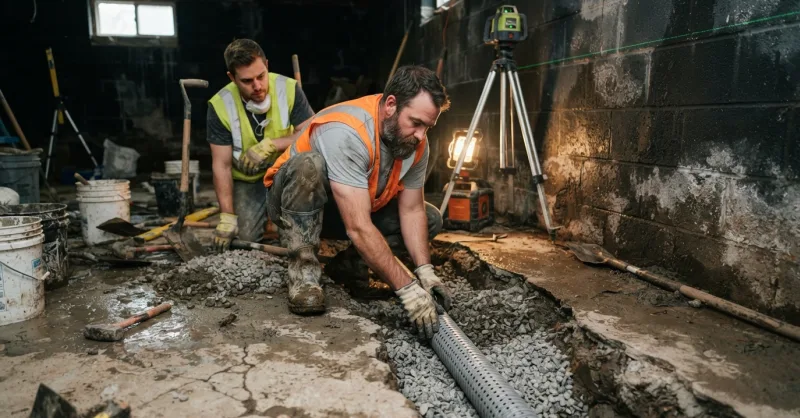
- Sump systems sized for actual peak inflow, not the standard 1/3 HP unit every big-box crew installs. If a nor’easter dumps four inches overnight, that undersized pump quits at 3 a.m. and you’re mopping.
Are Wilmington stone foundations even worth reinforcing, or should I just rebuild? In most cases reinforcement plus drainage runs 40 to 60 percent less than a full rebuild and preserves the historic character. Full rebuilds only make sense when the stone has lost cohesion or the mortar is essentially sand.
Permanent Repair vs Cosmetic Band-Aid: Where the Money Actually Goes
A permanent fix handles three things at once. Stabilize the wall. Relieve the pressure. Document the work so it holds up at resale, insurance review, or engineer sign-off.
If a quote skips the drainage component, you’re buying half a repair. Structural reinforcement without hydrostatic pressure relief is like installing a stronger dam without a spillway. The load doesn’t disappear, and eventually something gives.
| Scope | Typical Range | What You Get |
|---|---|---|
| Cosmetic paint and caulk | $800 to $2,500 | Hidden symptoms, moisture trapped in block, repeat in 18 to 36 months |
| Carbon fiber only (light bow) | $4,000 to $7,000 | Wall stabilized, no pressure relief, marginal on clay-heavy lots |
| Carbon fiber plus interior drain and sump | $6,500 to $10,000 | Structural and drainage handled, permanent on most Newark blocks |
| Anchors plus full drainage plus grading | $9,000 to $15,000 | Engineering-grade fix for moderate to severe bowing |
| Partial rebuild with excavation | $12,000 to $22,000 | Reset foundation section, new footing where required |
Property managers along DE-2 and DE-9 keep asking me for the cheapest option. I tell them the same thing every time: the cheapest permanent option is the one that doesn’t come back as a tenant complaint or a failed inspection next spring.
Code, Permits, and Why Documentation Protects Your Home Value
Delaware requires footings embedded 24 to 30 inches to reach frost depth. Any structural repair involving excavation or new footings has to meet that standard, with permits pulled under IRC/IBC. Unpermitted work creates two problems: it can void insurance and it triggers red flags during resale disclosure.
Do I really need a permit for interior wall anchors or carbon fiber? In most New Castle County jurisdictions, structural reinforcement requires a permit and inspection. Skipping it saves a few hundred dollars now and costs you thousands when the buyer’s inspector flags undocumented structural work.
If your lender or insurer has already asked for a structural engineer letter, that’s a separate cost (usually $400 to $900) but often required. We coordinate with independent engineers regularly. No kickbacks, no house-brand reports, just straight documentation.
What to Do Before You Sign Anything
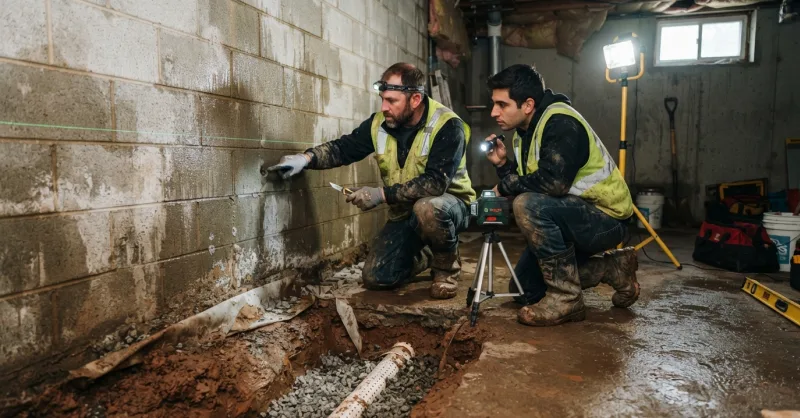
Measure. Or have someone measure. If a contractor walks your basement without a laser or a plumb bob, they’re guessing. If they hand you a package price before asking about your soil, your grading, or your sump discharge location, they’re selling.
How long does a permanent bowing wall repair actually last if it’s done right? A properly designed carbon fiber or anchor system with drainage should perform for the life of the structure. The systems themselves carry manufacturer warranties of 25 years to lifetime, but the real durability comes from addressing the load, not just the wall.
Will homeowners insurance cover any part of the repair? Almost never for gradual soil movement or hydrostatic pressure damage. Insurers classify these as maintenance issues. Sudden events like a burst pipe washing out soil around a footing sometimes qualify, but bowing from expansive clay does not.
Can I finance a $10,000 repair without a home equity loan? Yes, most legitimate structural contractors in the tri-state offer financing through third-party lenders with terms from 12 to 84 months. We do too, but I’d rather you understand the scope first than get sold on a monthly payment.
We run assessments seven days a week, from 8 AM to 7 PM Monday through Saturday and 8 AM to 3 PM Sundays, out of 500 Apple Rd, Newark, DE 19711. The I-95 footprint means we’re on-site fast, not dispatching from three states away.
You can browse our basement waterproofing services or the full foundation repair scope if you want to see how the systems fit together. We also post before-and-after job photos on Instagram and technical breakdowns on LinkedIn.
Pay once for the right repair. Or pay repeatedly for paint that doesn’t work. If telling you the truth costs me a project, so be it. I’d rather sleep well at night.
Written by: Alex Velasquez
AVG Waterproofing LLC