


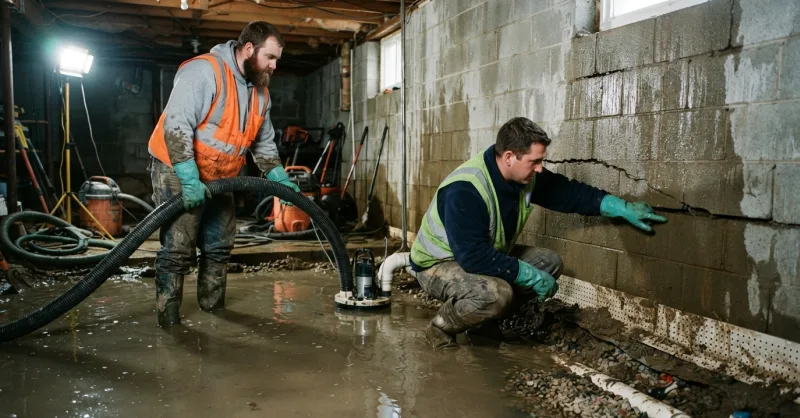
What Really Happens During an Emergency Flooded Basement Pump Out and Repair in New Castle County?
Your basement is holding water. The sump is either dead or drowning. And somewhere upstream, something failed weeks ago that finally caught up with you tonight.
I’ve been pulling water out of Delaware basements for a long time, and I’ll tell you the part nobody wants to hear first: the crack you’re staring at probably isn’t the source. It’s the exit wound.
Groundwater loading against the footing, a collapsed drain tile, an undersized basin, or roof runoff cycling back into the foundation soil, that’s usually the real story. Pump out the water, sure. But if we skip the diagnosis, you’ll be calling somebody again after the next storm rolls off the Christina.
The Quick, Honest Version
- Kill the electrical hazard before anyone steps in the water.
- Extract the water with a real trash pump, not a shop vac and prayer.
- Trace the entry path (wall-floor cove, cracks, sump failure, or surface).
- Fix the drainage physics, not the paint job.
Why New Castle County Basements Flood Differently Than Everywhere Else
The Brandywine-Christina watershed drains through a landscape of Piedmont silt loam with clay lenses that hold water like a wet sponge instead of releasing it downward. When White Clay Creek and Red Clay Creek push toward bankfull after a two-day soaker, the groundwater table under your slab rises with them.
That saturated soil creates hydrostatic head pressure against your foundation wall. Water doesn’t need a visible opening to get in. It finds the wall-floor joint, the mortar seams in block, the cold pour lines in poured concrete.
Older Wilmington row homes and Newark bungalows off Kirkwood Highway were built before anyone thought about proper footing drains. Freeze-thaw cycles across a Delaware winter widen every hairline path. A crack that seeped a cup in 2015 pushes gallons by now.
Which brings up the question homeowners always ask me on-site: is my house sinking, or is it just water? Most of the time it’s just water and a lousy drainage detail. But if the cracks are horizontal or the block courses are stepping, we’re looking at hydrostatic pressure pushing the wall inward, and that’s a different conversation entirely.
The Waterproof Paint Lie (And Why Hydraulic Cement Makes It Worse)
No coating stops groundwater. Full stop.
Waterproof paint changes what the wall looks like. It doesn’t relieve the pressure on the other side of the wall. Saturated soil pushes with the same force whether your basement is Sherwin-Williams beige or bare block. When you seal the interior face, water just picks the next weakest point, a mortar joint two feet over, the floor cove, a utility penetration you forgot about.
Hydraulic cement smeared over an active crack does something worse. It traps moisture inside the masonry, which drives efflorescence (that white mineral bloom) to migrate sideways, and accelerates spalling every freeze cycle.
The foam injection kits at big box stores? They fill a void. They don’t touch the hydrostatic load. If your footing drain is collapsed or your discharge line dumps two feet from the house, no interior product will change the outcome.
I had a homeowner in Bear last spring who’d bought three different sealant products over six years. Each one worked for about four months. He’d basically painted a museum of failed patches onto his west wall. The actual fix took a day and a half, once we found the buried downspout tile that had crushed under a driveway extension somebody poured in 2011.
The Emergency Pump Out and Permanent Repair Sequence We Actually Follow
Step One: Hazard Isolation and Extraction
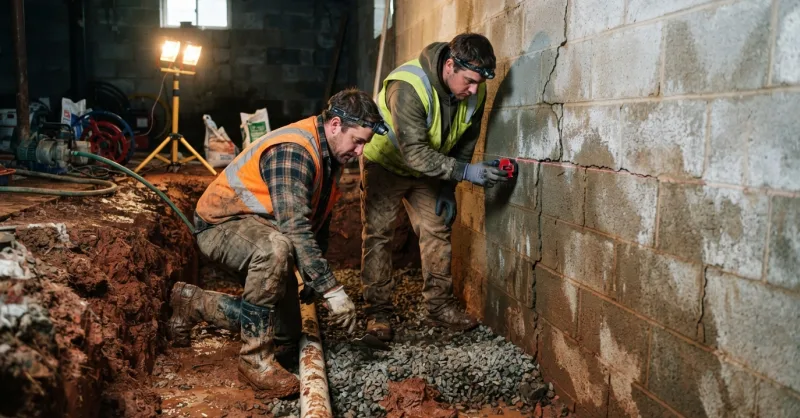
Standing water near a panel, an outlet, or a gas water heater gets addressed before anyone wades in. We kill circuits, extract with submersible pumps sized to the volume, and haul the water out to a legal discharge point. Homeowners trying to shop-vac contaminated flood water is how people end up in the ER.
Step Two: Source Tracing (This Is Where Most Contractors Skip)
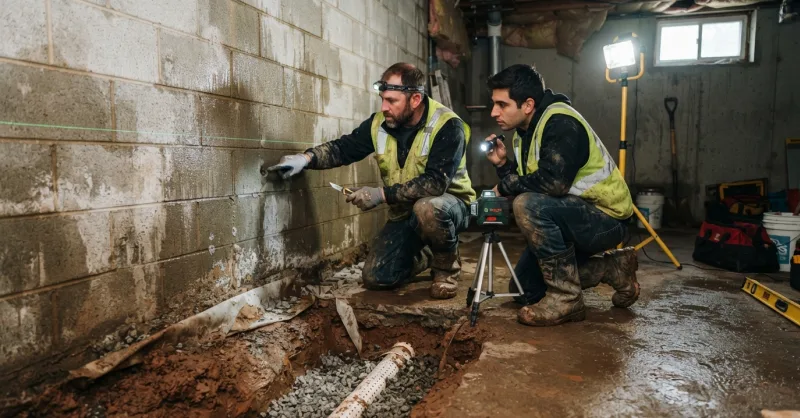
We map crack orientation because each pattern tells its own story:
- Vertical hairlines usually mean concrete shrinkage, mostly cosmetic.
- Horizontal cracks in block walls scream lateral soil pressure.
- Stair-step cracking points to settlement or shear stress at the corners.
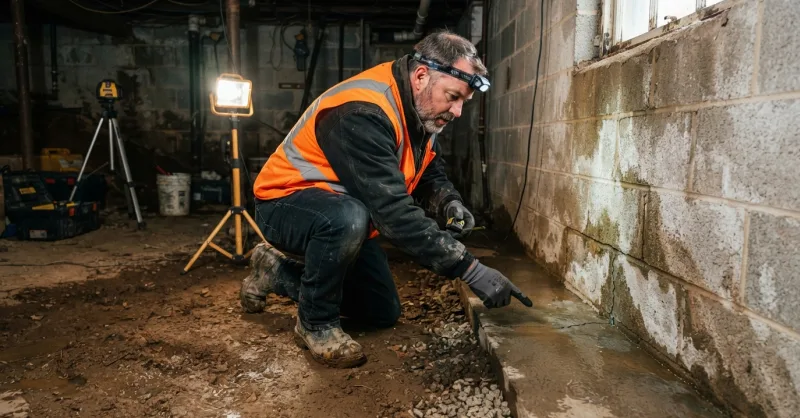
- Cove joint seepage (where slab meets wall) is almost always hydrostatic.
Then we test the sump under load, check the check valve, walk the discharge line to its termination, and evaluate grading plus every downspout. If your gutters dump within four feet of the foundation, we already know part of the answer.
Step Three: Drainage Correction Based on the Actual Failure
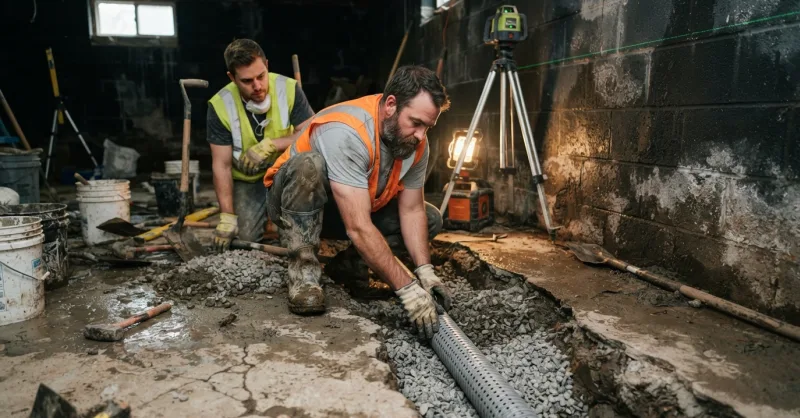
A dead sump gets a properly sized basin, a primary pump matched to the inflow rate, and a battery backup that actually cycles under real conditions (not the 30-second box store demo). Missing or collapsed footing drains get interior perimeter drainage tied into the sump system. Wall movement gets carbon fiber or, in the worst cases, exterior excavation.
Grade problems get fixed with dirt, not with more concrete. Something my old boss used to say (and he wasn’t wrong): “You can’t out-pump bad grading.”
Step Four: Verification Under Load
An untested repair is a guess with a receipt attached. We flood-test the perimeter, watch the pump cycle, confirm the discharge routing carries water far enough that it doesn’t recycle back through the same soil column.
What Actually Drives the Cost (And What Doesn’t)
Emergency pump out and repair pricing in this county comes down to four things: water volume, contamination level, site access, and the scope of drainage correction the diagnosis demands.
A single failed sump with clean rainwater and easy replacement runs one number. A collapsed footing drain feeding a bowing block wall with a discharge line that’s been recycling water into the same corner for fifteen years is a completely different job.
What shouldn’t move the price: fear tactics, “today only” discounts, or a package quoted before anyone measured anything. If a contractor writes a proposal without walking your discharge line and looking at your grading, you’re being sold a script.
A property manager in Elkton asked me last month whether her insurance would cover the repair. Honest answer, it depends on the policy language and the cause. Sudden pump failure often gets covered. Chronic groundwater seepage almost never does. Document everything with dated photos before you touch the water.
Micro Story From a Newark Job Last Fall
Homeowner off Route 896 called us at 6 AM after a Nor’easter dumped four inches overnight. Basement had eight inches of water. Their previous “waterproofing company” (one of those national franchise names, subcontracted out) had installed an interior drain three years earlier without ever checking the exterior discharge. The pump was faithfully moving water into a buried pipe that terminated (I’m not kidding) about eighteen inches from the foundation wall.
The water was going out and coming right back in through the same soil.
Watching that woman realize she’d paid $9,400 for a system that was basically a very expensive recirculating fountain, that stuck with me. She wasn’t angry. She was just tired. That’s the toll this industry takes on people, and it’s why we lead with the diagnosis every single time now.
The permanent fix was extending the discharge to a proper daylight termination 22 feet out with a check valve upgrade. Cost her a fraction of the original install. It hasn’t flooded since.
When to Call and What to Do in the First Ten Minutes
If your basement is actively flooding, cut power to the affected circuits at the panel (if you can reach it safely and dry), move anything valuable that’s still above the waterline, and call for emergency service. Don’t wait until morning hoping it drains on its own. Every hour the water sits, mold spores are colonizing your drywall bottom plates and your subfloor if you have a finished basement.
We run emergency crews seven days a week, from 8 AM to 7 PM Monday through Saturday, and 8 AM to 3 PM Sundays, based out of 500 Apple Rd, Newark, DE 19711, which puts us minutes from most of the I-95 corridor and across the state line into Cecil County when the calls come in.
Somebody asked me the other day whether a portable pump from Home Depot is enough to hold them over until morning. Sometimes yes, if the inflow rate is low and you can babysit it. But if water is coming in faster than a 1/3 HP utility pump can move it, you’re just delaying the inevitable and adding damage.
The Repair Options Layered by Severity
| Situation | Typical Corrective Scope |
|---|---|
| Failed sump, no wall damage | Basin replacement, pump upgrade, battery backup, discharge extension |
| Cove joint seepage across multiple walls | Interior perimeter drainage tied to sump, discharge correction |
| Active wall cracks with water intrusion | Structural crack repair, drainage relief, sometimes carbon fiber |
| Chronic groundwater under a finished basement | Full interior waterproofing system plus exterior grading correction |
| Bowing walls plus flooding | Wall stabilization, exterior excavation, membrane, and drainage rebuild |
One question that comes up on almost every estimate: how quickly can crews get on site from the Route 40 or Kirkwood Highway corridor during a major storm? Most emergency dispatches happen within a couple hours, though a widespread flood event across New Castle County can stretch that. We stage equipment and prioritize by hazard level, panels underwater get triaged first.
The Bottom Line From Someone Who’s Seen Too Much of This
If telling you the truth costs me a project, so be it. I’d rather sleep well at night than sell you a package that fails in eighteen months.
Your basement flooded for a physical reason. Water followed a path. Something either created that path or failed to close it. The permanent repair finds the path and closes it, then verifies the fix under real conditions. Everything else is theater.
We cover New Castle County DE, Chester County PA, and Cecil County MD with 25 years of U.S. structural experience and six focused years reading these specific soils. If you’re standing in water right now, call. If you’re staring at a wall that’s been weeping every spring for a decade, call before it becomes the emergency.
Follow along on LinkedIn or Instagram for real jobsite footage and diagnostic breakdowns. No stock photos, no sales scripts, just what we actually pull out of Delaware basements.
Written by: Alex Velasquez
AVG Waterproofing LLC