


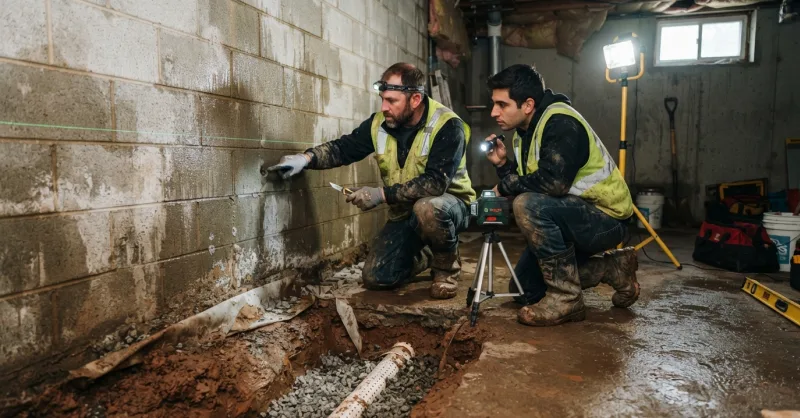
Why Does Your Basement Flood Every Time It Rains Hard in New Castle County?
Short version: you don’t have a damp basement. You have a water-management failure. Rain saturates the soil, the water table climbs, and hydrostatic pressure starts pushing water sideways into your foundation walls and up through the slab. Paint won’t stop it. Caulk won’t stop it. A bigger pump alone won’t stop it either.
I’ve been diagnosing this same failure pattern across Newark, Pike Creek, Hockessin, and Christiana for years. The Christina River watershed, fed by White Clay Creek, Red Clay Creek, and the Brandywine, sets the stage. When a storm parks over the corridor (and they do, repeatedly), the ground can’t drink fast enough. Your foundation becomes the drain.
Water doesn’t need a visible crack to get in. It migrates through mortar joints, cinder block cores, and capillary pores in poured concrete.
The Physics Nobody Explains at the Sales Pitch
An 8-foot foundation wall in saturated soil can face thousands of pounds of lateral pressure during a multi-day rain event. That’s the hydrostatic head at work. Older Newark 19711 and Christiana housing stock makes it worse, mid-century cinder block and stone foundations were never detailed for modern drainage loads.
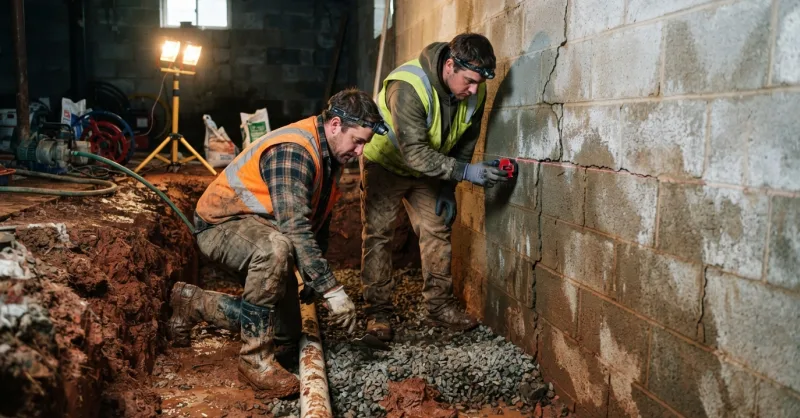
Block cores act like straws. Stone mortar lines erode. Add Piedmont clay pockets that swell wet and shrink dry, and you get seasonal movement, stair-step cracks, and permanent seepage paths at the wall-floor joint.
If a contractor walks your basement and quotes a “system” before checking your exterior grade, downspout discharge points, and footing drain condition, you’re being sold inventory. Not a diagnosis. That’s the whole game in this trade, and I’ll say it plainly even if it costs me a job.
The Fixes That Don’t Work (Sold Every Day Anyway)
- Waterproof paint and surface coatings. Traps moisture inside the wall. Paint blisters, efflorescence pushes through, spalling accelerates. You’ve hidden the evidence.
- Hydraulic cement on cracks. A crack is the symptom. Sealing the surface redirects pressure to the next weak spot, usually the wall-floor seam.
- A monster sump pump with no drainage feeding it. If your footing drain is silted or collapsed, the pump cycles dry while water sits against the wall. I’ve seen brand new pumps installed over dead drainage more times than I want to count.
- Cosmetic foam injections on bowing walls. That’s structural denial with a receipt.
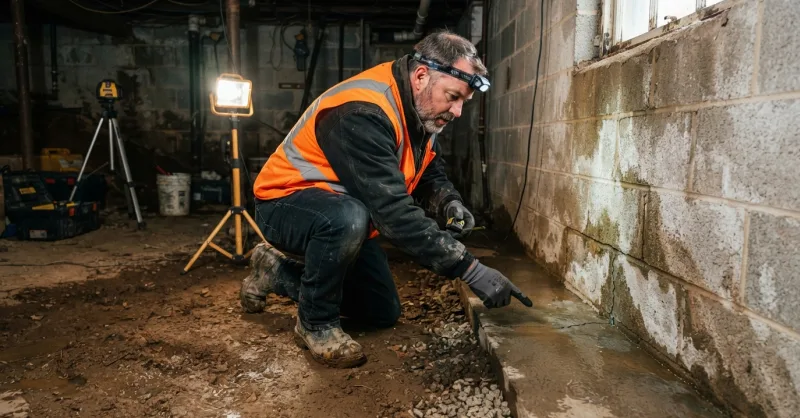
Does interior waterproofing actually stop water coming through the walls? Only when it’s designed as a pressure-relief system, not a bathtub liner. The interior channel has to intercept water at the footing and route it to a properly sized basin, otherwise you’re just decorating.
What Permanent Prevention Actually Requires
1. Intercept surface runoff before it touches the foundation. Downspouts discharging 6 to 10 feet out, ideally into a buried line that daylights downhill. Grade should fall roughly 6 inches over the first 10 feet away from the wall. Along the Route 273 and Route 7 low corridors near Christiana, that often means adding a swale or curtain drain uphill.
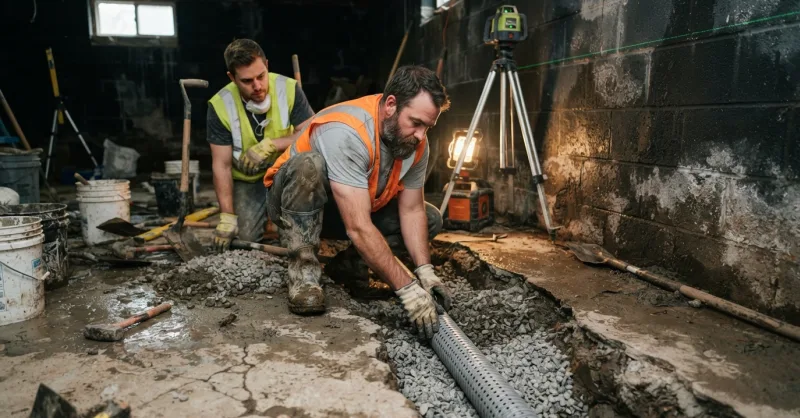
2. Relieve hydrostatic pressure at the footing. An interior drainage channel along the wall-floor joint, or an exterior perimeter footing drain with washed stone and filter fabric. Sometimes both. Depends entirely on the failure mechanism, and anyone who tells you before inspecting is guessing.
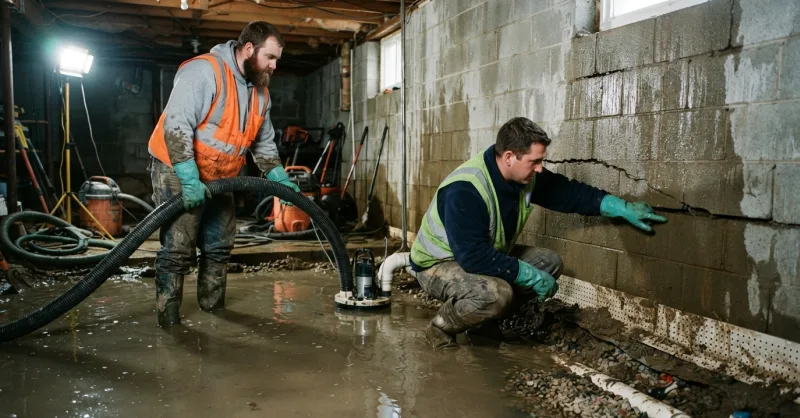
3. Build sump redundancy that survives the storm. Primary pump, battery backup, check valve, and a discharge line sized for peak flow that won’t freeze in January or clog with mulch in July. Storms take the power out. That’s when your basement floods.
4. Repair cracks correctly and know when it’s structural. Horizontal cracks, stair-step patterns at block corners, or wall bowing means carbon fiber reinforcement or pier and beam stabilization, not epoxy.
5. Verify with a water test. If the installer can’t demonstrate the system under load, you’re paying for faith.
What to Check Before You Call Anyone
Homeowners ask me all the time how they can tell whether the water is coming from surface runoff or hydrostatic pressure before spending a dollar. Walk the perimeter during a moderate rain. If water pools within 3 feet of the wall, that’s surface runoff. If water shows up 12 to 24 hours after the storm passes, that’s the water table rising and pushing in from below.
- Downspouts discharging at least 6 feet from the foundation?
- Ground sloping away, or dipping back toward the house?
- White powder (efflorescence) on the walls? That’s dissolved minerals riding moisture through concrete.
- Sump running during dry weather? High water table, not just storm surge.
- Horizontal cracks or bowing? Stop the waterproofing conversation. That’s structural.
One question I get from property managers in the Pike Creek and Limestone Road corridor is whether a battery backup sump pump is really worth the extra cost for a rental basement. Yes. Power outages during storm surges are the single most common cause of flooded basements I see, and the cleanup bill dwarfs the backup install every time.
The Local Soil Reality Nobody Talks About
New Castle County soils lean toward Hydrologic Group B silt loams (mostly well-drained on paper), but there are hydric and floodplain pockets scattered along the creek corridors that behave completely differently. A house two blocks off White Clay Creek can sit on saturated subgrade three days after the rain stops.
People often ask if French drain installation near older Hockessin and 19707 properties requires special permitting when the work touches structural components. When the drainage scope affects load-bearing elements or sits inside a mapped floodplain, county floodplain administration gets involved. It’s not automatic, but it’s not rare either. A contractor who’s never pulled a permit in New Castle County will tell you it doesn’t apply. It sometimes does.
Another one that comes up during real estate contingencies: whether efflorescence and musty odors are enough for a home inspector to flag the basement during a Newark 19711 sale. In my experience, yes. Buyers’ inspectors document both, appraisers note it, and negotiations stall until you produce a scope and a receipt from a qualified basement waterproofing contractor.
The Honest Bottom Line
Heavy rain basement flooding prevention in New Castle County isn’t a product. It’s a system that manages water at the footing, controls hydrostatic pressure, and keeps working when the Christina River watershed is running full and the power’s out.
If your basement has taken water more than once, get a root-cause assessment, not a sales walkthrough. Scope should follow the failure mechanism. Explanation should make mechanical sense before a dollar gets quoted.
Our crews cover the I-95 corridor from Newark through Christiana and out to Hockessin 7 days a week. Walk-ins and paperwork happen at 500 Apple Rd, Newark, DE 19711. Field notes and job photos land on our Instagram when the crew has a minute.
One last question worth answering directly: how long does a properly installed interior drainage and sump backup system typically hold up under repeated New Castle County storm cycles. Decades, when the discharge line and grade are maintained. Pumps get swapped every 7 to 10 years or so. The drainage tile itself, if it’s washed stone with filter fabric and clean-outs, outlasts most of us.
Written by: Alex Velasquez
AVG Waterproofing LLC