


Why Do Concrete Slab Floors Become Uneven in New Castle County, and What Actually Fixes Them for Good?
I’ve walked into enough warehouses along the I-95 corridor to know what a facility manager’s face looks like when they realize their third epoxy patch in two years just cracked again. That tight-jawed frustration. The stack of invoices for “repairs” that never held. The OSHA citation sitting on the desk.
The short version: uneven concrete slab floors in our part of Delaware sit on Potomac Group clay. This soil shrinks 3-5% during dry summers, swells when winter moisture returns, and creates subsurface voids that slowly pull your slab out of level. Freeze-thaw cycles punching 24 to 32 inches deep into unheated loading docks make everything worse. Mudjacking over unstable clay is like putting a band-aid on a broken pipe.
At AVG Waterproofing LLC, we fix uneven concrete slab floors permanently by engineering the repair from the soil up. We scan the subsurface with Ground Penetrating Radar, measure bearing capacity with a Dynamic Cone Penetrometer, then inject high-density hydro-insensitive polyurethane resin that stabilizes the clay matrix and lifts the slab to within 1/8 inch over 10 feet. The resin cures in 15 minutes. The warranty lasts 10 years, transferable, with annual flatness re-surveys included.
No sales scripts. No guesswork. We operate out of 500 Apple Rd, Newark, DE 19711, covering New Castle County DE, Chester County PA, and Cecil County MD with 25 years of structural experience.
The Real Reason Your Delaware Warehouse Floor Keeps Settling
Most contractors treat slab settlement like a surface problem. They show up, eyeball the floor with a four-foot level, and quote you for mudjacking or a cosmetic overlay. Nobody checks what’s happening six inches below the concrete.
That’s the problem.
New Castle County sits on expansive Potomac Group clays that behave almost like a sponge with a personality disorder. Summer drought pulls moisture out and the soil contracts. Winter precipitation and snowmelt saturate it, and the clay swells. Every cycle carves new voids under your slab. Poorly compacted backfill around your original foundation compounds the issue (something I see constantly in buildings constructed during the late ’90s boom along the Kirkwood Highway corridor, when speed mattered more than soil prep).
Freeze-Thaw Damage on Unheated Slabs
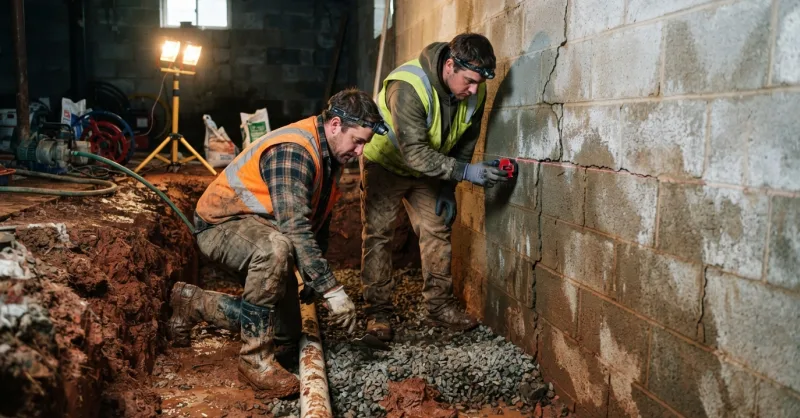
Loading docks, municipal garages, and exterior walkways along the Route 40 to Glasgow stretch take the worst beating. Frost penetration reaches 24 to 32 inches in our climate zone. Water migrates into sub-slab voids, freezes, expands, and physically pushes sections of concrete upward. Come spring, the ice melts, the support disappears, and the slab drops. Rinse and repeat every year until someone addresses the root cause.
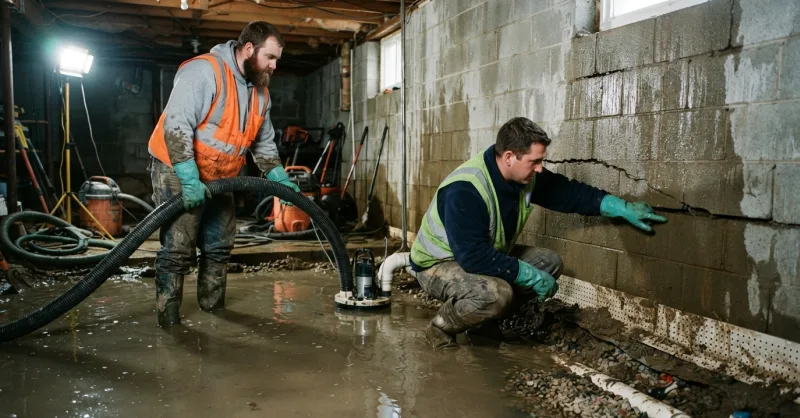
If your facility sits near the Brandywine or White Clay Creek watersheds, stormwater runoff actively undermines slab edges. I’ve pulled GPR scans at a distribution center near Bear that showed moisture channels running directly under the building’s main aisle. The floor looked fine on the surface. Underneath? Swiss cheese.
How We Diagnose Concrete Floor Settlement Before Injecting Anything
Every slab audit starts with data, not assumptions. We bring our own diagnostic gear to every site visit, and we don’t charge for the initial structural estimate.
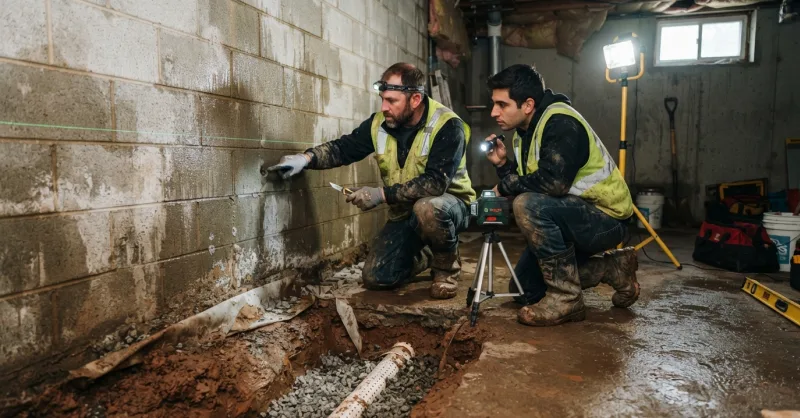
- Ground Penetrating Radar (GPR) maps subsurface voids, moisture channels, and soil density variations beneath the slab without cutting into your floor.
- Dynamic Cone Penetrometer (DCP) testing measures the actual in-situ bearing capacity of the soil at multiple points, giving us hard numbers on where the ground can support load and where it can’t.
- ASTM E1155 flatness readings produce F-min and F-max values that document exactly how far out of level your floor sits, which matters when you’re defending against a trip-and-fall claim or satisfying an insurance carrier’s loss control report.
We produce a forensic slab flatness map before proposing any repair. I had a facility manager in Pike Creek last spring who’d already signed a contract with another company for full slab replacement. Their estimate: $87,000 and three weeks of downtime. Our GPR scan showed the settlement was isolated to two zones near the loading dock where backfill had washed out. We stabilized those areas with polyurethane injection for a fraction of the cost, and his dock was operational by the next morning. (He was not happy about the money he almost spent. I don’t blame him.)
If you’re seeing racking misalignment in your warehouse or tenants complaining about uneven retail floors along Concord Pike, request a free structural inspection and get actual engineering data before committing to any repair scope.
Polyurethane Foam Injection vs. Mudjacking: Which Lasts in Delaware’s Climate?
I get this question weekly. The answer depends on your soil, your slab use, and whether you want to do this once or keep paying every few years.
| Factor | Mudjacking (Cement Slurry) | High-Density Polyurethane Injection |
|---|---|---|
| Weight added to soil | Heavy (can accelerate settlement on weak clay) | Lightweight, roughly 2 lbs per cubic foot |
| Water resistance | Absorbs moisture, erodes over freeze-thaw cycles | Hydro-insensitive, closed-cell structure |
| Cure time | 24-72 hours before load bearing | 15 minutes to full cure |
| Compressive strength | ~150 psi | 4,000-6,000 psi |
| Soil stabilization | None; fills void only | Expands into soil matrix, consolidates loose clay |
| Injection hole size | 1-2 inch diameter | 5/8 inch diameter |
Mudjacking fails in Delaware because the cement slurry adds dead weight to already-compromised Potomac clay, absorbs groundwater, and breaks down under repeated freeze-thaw. I’ve torn out mudjacking repairs that were less than 18 months old where the slurry had essentially turned back into wet sand.
Our two-part polyurethane resin is hydro-insensitive, meaning it cures properly even in wet conditions, and its closed-cell structure prevents water infiltration. We control the exothermic reaction during injection to prevent thermal expansion from creating high spots. The injection port spacing grid is calculated based on your slab thickness, flexural modulus, and the lift-to-weight ratio needed for your specific load requirements.
New Castle County Building Code and Permit Requirements for Concrete Leveling
This is where I see facility managers get blindsided. You hire a contractor who doesn’t pull permits, the work gets flagged during a routine municipal inspection, and suddenly you’re dealing with code enforcement on top of your original floor problem.
New Castle County adopted the 2018 International Building Code with local amendments. Chapter 18, Soils and Foundations, requires bearing capacity verification for fill material placed under structural slabs. When we inject polyurethane resin, we document the bearing capacity both before and after injection so the repair satisfies code requirements.
For outdoor slab lifts near sidewalks or curb lines, the City of Wilmington requires a Right-of-Way permit. Sites near the Brandywine or White Clay Creek watersheds trigger DNREC sediment and erosion control compliance. We handle all of this. If your property sits along the I-495 corridor or near the Wilmington Riverfront, there may be stormwater management requirements during resin injection that your average mudjacking crew won’t even know about.
Can you permanently level a concrete slab without tearing it out and pouring new? Yes, provided the concrete itself is structurally sound. If your slab has major fractures or rebar corrosion (something we occasionally find in older Riverfront condo garages), a partial replacement might be needed for those sections. We tell you exactly what we find. If telling you the truth costs me a project, so be it. I’d rather sleep well at night.
Stabilizing a Christiana Mall Area Loading Dock After Spring Thaw
Last April, a retail property manager near the Christiana Mall called us about a loading dock that had heaved unevenly after a particularly harsh freeze-thaw cycle. Three tenant spaces shared the dock. Two couldn’t receive deliveries because the dock lip had shifted almost an inch and a half, and the rollup doors weren’t seating properly.
We deployed within 90 minutes. The GPR scan revealed two distinct void pockets where post-thaw soil rebound had created air gaps roughly 14 inches below the slab surface. The DCP readings showed bearing capacity had dropped to about 40% of what the original pour expected.
What the Repair Looked Like
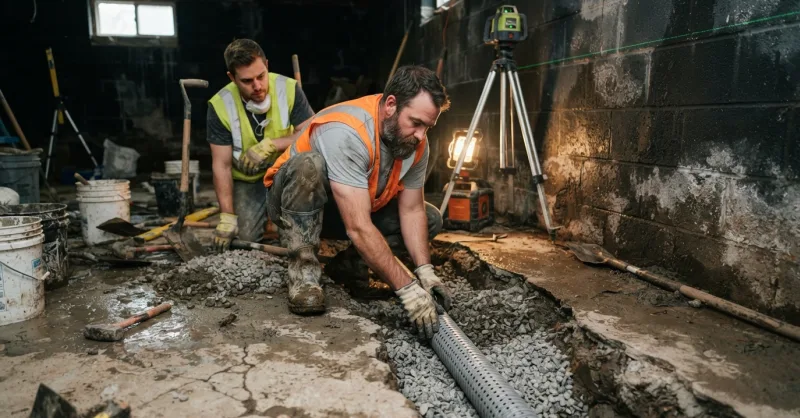
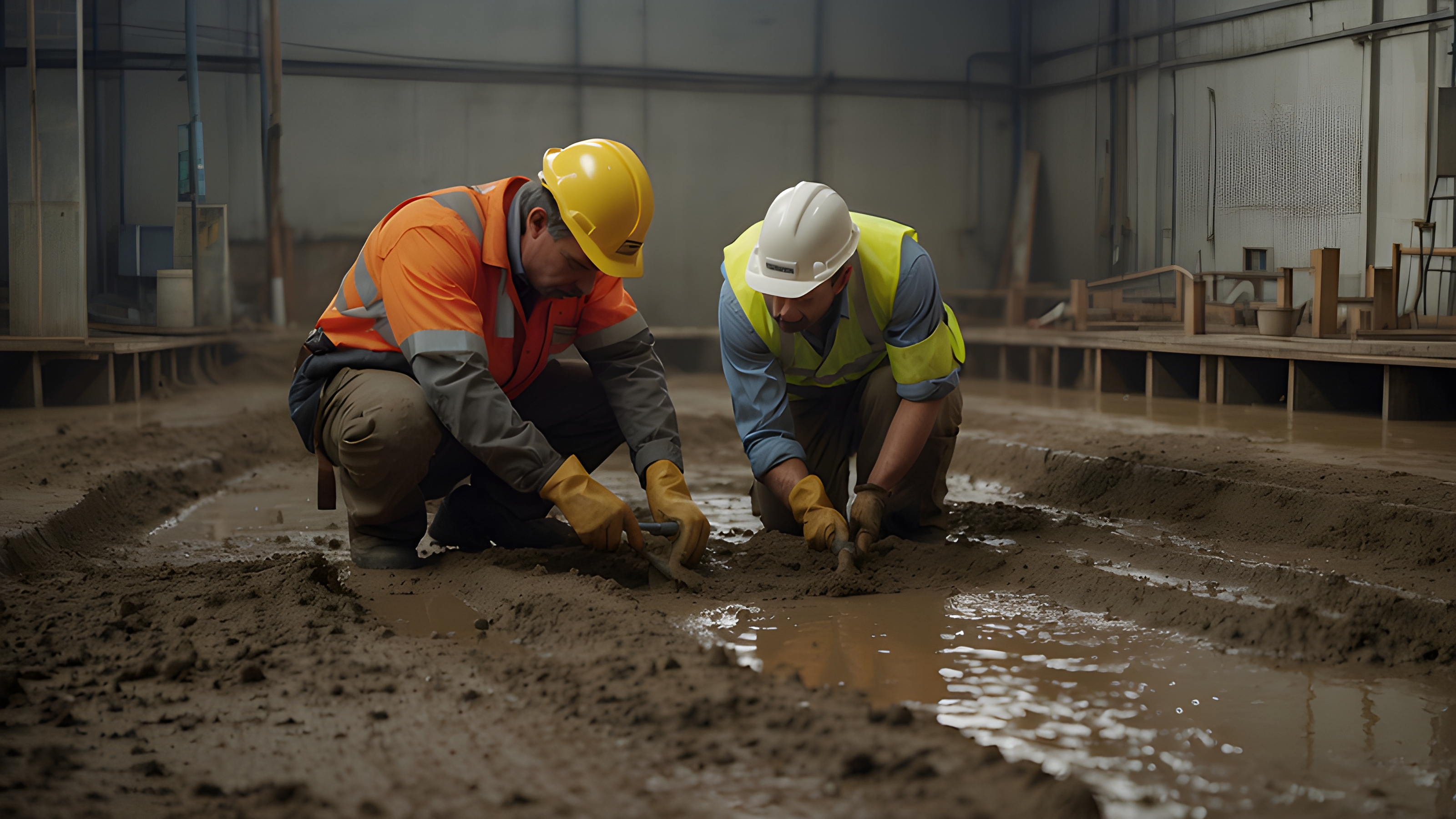
We drilled 5/8-inch injection ports on a 4-foot grid across the affected zones, pumped high-density polyurethane through a hydraulic manifold, and monitored lift in real time using laser levels. The exotherm stayed controlled. Total lift: 1.3 inches on the worst section, bringing the dock back to within 1/8 inch of spec across a 22-foot span.
The dock was operational by 6 PM that same day. The property manager told me her previous contractor had patched the same area twice in 14 months using a cement slurry mix. Both patches failed after the next winter cycle. (I didn’t say “I told you so,” but I did think it very loudly.)
For anyone managing commercial properties in our area, the connection between foundation settling from soil movement and slab-level failures is direct. You can’t fix the slab without addressing the soil underneath it.
What Does a 10-Year Slab Leveling Warranty Actually Cover in Delaware?
Most competitors offer a 1-year limited warranty on the lift itself and exclude “future settlement due to soil movement.” Read that again. They’re excluding the exact thing that caused your problem in the first place.
Every AVG Waterproofing slab repair carries a 10-year transferable warranty underwritten by a soil-stabilization bond. It covers total slab settlement and lift loss. We perform an annual flatness re-survey at no additional cost throughout the warranty period, specifically to catch seasonal clay rebound cycles before they become a problem again.
Why transferable? Because if you sell the property, the warranty follows it. That’s a real asset for commercial real estate portfolios. Asset managers in the DE-141 and US-202 corridor know that documented structural repairs with transferable warranties increase property value during due diligence.
How much does it cost to permanently level a sinking concrete slab versus full replacement? Polyurethane injection typically runs 50-70% less than tear-out-and-repour, with cure times measured in minutes instead of days. For detailed pricing specific to your situation, we cover that thoroughly in our slab foundation leveling cost guide.
Same-Day Slab Rescue Across New Castle County
When an insurance carrier issues a hazard abatement demand after a loss control inspection, you don’t have 48 hours to wait for a callback. We stage GPS-tracked service vehicles along DE-141 and US-202 and deploy within 90 minutes to any location from Hockessin to Odessa.
Does polyurethane slab injection work on older concrete near Delaware’s high water table areas? Absolutely. The hydro-insensitive resin cures properly in wet conditions, and we’ve injected slabs with active groundwater seepage along the Twin Spans industrial area near the Delaware Memorial Bridge. The key is proper port spacing and controlled injection pressure so the resin stabilizes the soil matrix without hydraulic fracturing of the surrounding clay.
Your home is in good hands. So is your warehouse, your retail space, and your condominium garage. That’s not a tagline we slap on a truck. It’s what 25 years of structural work and six years of diagnosing local tri-state soils actually looks like in practice.
Reach out for a free, no-pressure structural estimate. Follow our work on LinkedIn and Instagram to see real diagnostic scans, lift documentation, and job-site updates from across New Castle County and our full foundation repair service area.
Written by: Alex Velasquez
AVG Waterproofing LLC