


Permanent Slab Foundation Leveling in New Castle County Costs Between $3,500 and $25,000+ — Here’s What Actually Drives That Number
Permanent slab foundation leveling in New Castle County, Delaware typically runs $3,500 to $12,000 for most residential homes. When settlement is severe enough to require pier underpinning, that range climbs to $10,000 to $25,000 or more. Long-term foam-based or intensive leveling generally falls between $5 and $15 per square foot, depending on slab size, lift distance, method used, and site access.
Those numbers aren’t guesses. They come from 25 years of structural work across the U.S. and six years of diagnosing the specific soil conditions, drainage failures, and freeze-thaw cycles that drive slab movement in this tri-state corridor.
I’ve seen homeowners near Bear get quoted $18,000 for full underpinning when a targeted foam lift at $6,200 fixed the problem permanently. I’ve also seen the reverse — a garage slab off Kirkwood Highway that looked like a simple leveling job until we pulled the drill cores and found saturated fill sitting on top of old clay fill. That one needed piers. Knowing the difference before you quote is the whole job.
Five Things That Shift Your Slab Repair Estimate by Thousands
People ask me all the time why two houses on the same street get wildly different quotes. Honestly, it comes down to five things, and none of them are arbitrary.
Slab Size and Thickness
A 1,200 sq ft ranch slab requires more drill points, more material volume, and more crew time than a 400 sq ft garage pad. Thicker slabs (5 inches vs. 3.5 inches) hold up better during the lift but need slower injection rates to avoid cracking. More material, more time, higher cost.
How Much You Need to Lift It
Lifting a slab half an inch versus three inches is not the same job. A 0.5-inch differential might need a single pass of foam injection. A 3-inch drop near a load-bearing wall requires staged lifts with cure checks between passes. Deeper lifts push costs toward the higher end of that $5 to $15 per sq ft range.
Method Selection Matters More Than Most Contractors Admit
- Mudjacking (cement-sand-water grout injection): lower upfront cost, but it adds significant weight to already compromised soil. In saturated silts near the Christina River or low-lying areas off DE-9, that extra load can accelerate recompression.
- Polyurethane foam jacking (polyjacking): costs more per sq ft, typically $5 to $15. Weighs roughly 2 lbs per cubic foot vs. 100+ lbs for grout. Expands to fill voids and cures in 15 minutes. For New Castle County’s humid mid-Atlantic climate, this is almost always the smarter long-term call.
- Pier underpinning: used when the slab or the structure above it has differential settlement that foam can’t address structurally. Expect $1,500 to $2,200 per pier installed, with most residential jobs requiring 6 to 14 piers depending on load distribution and soil bearing capacity.
Soil and Site Conditions
This is where local knowledge earns its keep. Fill soils along I-95 near Wilmington behave differently from the silty clays you find in floodplain neighborhoods near the Delaware River off DE-9. Homes built on fill near the Port of Wilmington or along Governor Printz Boulevard sit on material that was never engineered for long-term structural support. When water saturates that fill, the slab moves. Fixing it permanently means addressing the cause, not just lifting the slab back up.
Access, Utilities, and Code Requirements
Tight urban lots near Elsmere or older Wilmington neighborhoods can limit equipment staging. Radiant heat lines, sewer laterals, or old cast-iron water mains embedded in the slab change the drill point layout entirely. Work that moves the structure beyond a certain tolerance threshold may require an engineering letter and a permit through New Castle County Land Use — that adds $500 to $1,500 in professional and inspection fees, which is real money and worth knowing upfront.
Foam vs. Grout vs. Piers: Which One Is Actually Permanent for Delaware Soils?
I get this question constantly, and the straight answer is: it depends on what’s causing the movement, not just what’s visible at the surface.
Polyurethane foam lifting works exceptionally well when the subgrade has voided or lost density but still has adequate bearing capacity at depth. In New Castle County’s suburban neighborhoods — ranch homes near Newark off DE-273, split-levels around Glasgow, newer slab-on-grade townhomes along the DE-1 corridor in Middletown — the underlying soils are often dense enough to support the slab once voids are filled and the surface is re-leveled. Foam injection through 5/8-inch drill holes, minimal mess, cure time measured in minutes, and the slab is back in service the same day.
Mudjacking can work in dry, stable conditions. The problem in this region is that we don’t get many of those. Four-season climate, freeze-thaw cycles from November through March, episodic heavy rain events that saturate the ground — adding heavy grout to already wet, compressible fill is a patch, not a repair.
Pier underpinning is the right answer when the soil at depth is soft, when the structure shows continuous differential movement rather than a single settlement event, or when the slab is attached to load-bearing walls that have shifted. If a homeowner near Wilmington’s Brandywine neighborhood has diagonal cracks running from window corners to the floor and doors that won’t latch anymore, those symptoms usually point to ongoing settlement. Lifting the slab without addressing the structural load path is a waste of money.
So when does it make sense to ask whether foam leveling is enough for your specific situation? If you’re seeing movement restricted to one area of the slab with stable sections elsewhere, foam is probably the right tool. If the cracking pattern is widespread and progressive, get a laser elevation survey done before anyone quotes you anything.
What Does Residential Slab Leveling Actually Cost in Newark, Bear, and Wilmington?
I’ll give you real numbers from real work in this market.
A 1,200 sq ft ranch slab in Bear, DE — older construction, built on moderate fill, showing about 1.5 inches of differential settlement near the exterior wall closest to the backyard grade — ran $6,800 using polyurethane foam injection. That included a laser elevation survey, 14 drill points, two passes of foam injection with a cure check between, and patching. No underpinning needed. The soil cores showed dense sand at 4 feet. Foam filled the void, the slab came up clean, and the doors stopped sticking the same afternoon.
A similar-sized slab in an older neighborhood off Kirkwood Highway cost $11,400. Same basic slab size, but the drainage situation was completely different — a downspout had been discharging against the foundation wall for years, saturating the subbase directly under a load-bearing interior wall. We ended up installing four helical piers at that corner before the foam injection could be done safely. (That’s the kind of thing you only find with a soil probe and a moisture reading, not a drive-by visual estimate.)
For homeowners getting ready to sell, or dealing with a home inspection report that flagged slab deflection near the Christina River area — that’s common in the low-lying neighborhoods south of Wilmington along DE-9 — expect the floodplain soil conditions to push your leveling cost toward the higher range. Saturated silts don’t compress back predictably, so the pier count goes up.
What about garage slabs and driveways?
Garage slab lifting along US-40 near New Castle or around the industrial stretch of US-13 typically runs $1,800 to $4,500 depending on size and lift required. Driveway sections with trip hazards — which are becoming a lender flag on inspection reports, by the way — often resolve in the $900 to $2,200 range per section. These aren’t structural jobs, but getting them done before listing a property is usually worth it.
Commercial and Warehouse Floor Leveling Along US-13, I-295, and DE-9: Pricing Structure for Facility Managers
If you’re managing a flex warehouse or light manufacturing space near the Port of Wilmington, along the US-13 / I-295 logistics corridor, or in one of the older riverfront industrial buildings off DE-9 — the cost model shifts considerably from residential work.
Large commercial slabs (1,000 to 10,000+ sq ft) are typically priced in tiers:
- 1,000 to 2,500 sq ft: $8,000 to $18,000 depending on lift requirements and void conditions
- 2,500 to 6,000 sq ft: $15,000 to $35,000 for comprehensive leveling with high-density foam
- Above 6,000 sq ft: phased pricing, often structured per-zone to allow partial operations to continue
Forklift paths and pallet racking zones have zero tolerance for differential movement. A 3/8-inch variance across a 20-foot span can throw racking out of plumb, void manufacturer warranties on the rack systems, and create OSHA exposure during safety audits. I’ve walked facilities near New Castle Corporate Commons where the floor looked fine visually but the laser survey showed 0.75 inches of differential movement across a main travel aisle. Nobody noticed until a reach truck started pulling to one side.
Phased scheduling is standard for commercial work. Most facility managers along the US-13 corridor need work done on nights or weekends to keep dock operations running. That’s built into our scheduling, not an upsell.
Water ponding inside bays after rain — increasingly common in older buildings near the riverfront where original slab slopes have reversed due to settlement — is a safety issue and a flooring damage issue. Correcting the slope through precision foam injection avoids the alternative of grinding or overlaying, which runs $8 to $20 per sq ft and doesn’t address the underlying void.
Why a Free Estimate Without a Laser Survey Is Usually Just a Sales Visit
I’ll be direct here. A lot of foundation contractors in this area send a salesperson to your house, do a visual walk-around, and hand you a proposal within 30 minutes. That proposal often includes more piers than you need, a fear-based explanation of what happens if you don’t act immediately, and no actual soil data.
That’s not a diagnosis. That’s a pitch.
Permanent slab stabilization starts with understanding where the slab actually is relative to where it should be. That means a laser elevation survey — reading multiple points across the slab surface to map differential movement and identify where voids are likely concentrated. It means soil probing to check subbase density and moisture content. It means looking at drainage patterns relative to the structure.
At AVG Waterproofing LLC, the structural estimate includes that diagnostic process. No sales script, no pressure, no salesperson. I do the assessment myself and tell you exactly what I see. If telling you the truth costs me a project, so be it. I’d rather sleep well at night.
Our office is based at 500 Apple Rd, Newark, DE 19711, and we cover all of New Castle County, Chester County, PA, and Cecil County, MD.
Well… I’ve also walked away from projects where the homeowner had already been given an $18,000 pier proposal that wasn’t justified. Pulled the laser survey, found a single 80 sq ft void under a corner section, foam-injected it for $2,100, and the problem was gone. The homeowner was stunned. I wasn’t. I’ve seen this enough times to know the pattern.
Local Soil Conditions Near I-95, Christina River, and DE-9 That Drive Up Repair Costs
New Castle County has more soil variability per square mile than most people realize. The difference between a $4,000 foam lift and a $14,000 underpinning job is often just a question of what’s sitting 4 to 6 feet below the slab surface.
Near the I-95 corridor through Wilmington and Elsmere, soils are frequently disturbed fill — road construction, grading activity from decades of development, compacted debris fills under older residential slabs. Traffic vibration from I-95 adds cyclic loading that gradually loosens the subbase over years. Those slabs show progressive edge settlement, hairline cracks near doors and windows, and uneven floors that get chalked up to the house “settling.” It’s not random settling; it’s fill consolidation under repeated vibration load.
The Christina River and Delaware River corridors are a different animal. Silty marsh soils and saturated organic fills near DE-9 have very low bearing capacity when wet. Hydrostatic pressure from seasonal groundwater fluctuations can heave slabs in winter and drop them again in summer. Leveling those slabs without addressing drainage is the definition of a temporary fix. We tie foundation repair work to drainage corrections in these zones because doing one without the other just accelerates the failure cycle.
Freeze-thaw cycles between November and March hit shallow slabs hard. Delaware’s frost depth runs around 20 to 26 inches depending on the winter, and slabs poured without adequate base preparation lift slightly every freeze cycle and drop again on thaw. Over 10 to 15 years, that movement opens cracks and shifts grade beams enough to cause real structural issues in older ranch homes near Newark and Glasgow.
What Real Estate Agents, Appraisers, and Home Inspectors Need to Know About Slab Settlement Costs
If you’re an agent working a deal near Middletown or Newark and the inspection report flagged slab deflection, you need a real number — not a range so wide it’s useless, and not a contractor’s worst-case scenario designed to scare the buyer into a credit demand.
Here’s a calibrated reference framework for New Castle County transactions:
| Settlement Severity | Typical Repair Method | Cost Range |
|---|---|---|
| Minor (under 1 inch differential, isolated section) | Polyurethane foam injection | $2,000 to $5,500 |
| Moderate (1 to 2.5 inches, multiple zones) | Foam injection with drainage correction | $5,500 to $10,000 |
| Severe (2.5+ inches, load-bearing wall involvement) | Pier underpinning + foam | $10,000 to $22,000 |
| Whole-house structural reset (rare, major fill failure) | Full underpinning program | $20,000 to $30,000+ |
We provide written scope and cost summaries for lenders and buyers when needed. If a deal near the DE-9 floodplain or an older fill development off Governor Printz Boulevard is contingent on a structural evaluation, we can turn a written assessment around quickly. All work satisfies New Castle County structural and permitting requirements, including engineering letter coordination when required for significant underpinning.
The worst deals I’ve seen fall apart were ones where nobody got an actual diagnosis before the negotiation started. Two parties arguing over a generic “foundation repair” line item when one side means foam jacking and the other means full underpinning. Different by $10,000. Get a laser survey done and the ambiguity disappears.
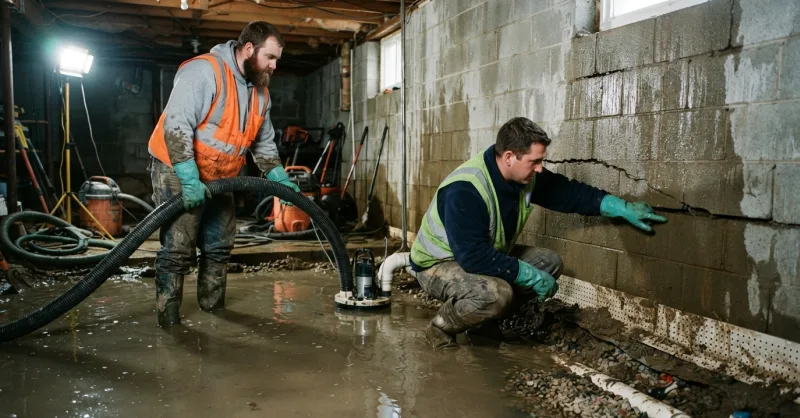
Slab Movement and Basement Water Intrusion Usually Share the Same Root Cause
This is something homeowners often miss. A settling slab and a wet basement or crawl space are frequently symptoms of the same drainage or soil saturation problem. Addressing one without the other is how you end up spending money twice.
If your slab is moving and you’re also dealing with water intrusion through the foundation walls or floor, those two issues almost certainly have the same origin — groundwater elevation rising against the foundation, surface runoff draining toward the house rather than away from it, or a failed perimeter drainage system. In those cases, interior basement waterproofing may need to be scoped alongside the slab leveling to produce a complete, permanent fix.
I’ve walked properties near Wilmington where the slab had been leveled twice in six years by two different contractors. Both times, foam injection only. Nobody looked at where the water was coming from. The subbase kept getting saturated, the void kept reforming, and the slab kept dropping. Third visit, we installed a perimeter drainage channel and a sump pump before touching the slab. That was three years ago. No movement since.
Anyway — the point is that slab repair cost shouldn’t be evaluated in isolation if there are visible signs of chronic moisture. The cost of a combined slab leveling and drainage correction is almost always less than two separate repair cycles separated by 18 months.
Exactly How We Arrive at a Permanent Slab Leveling Quote — No Markup Surprises
Our pricing breaks down into five line items, and we show all of them:
- Laser elevation survey and crack mapping: included in the free estimate
- Material cost: polyurethane foam runs approximately $28 to $45 per board foot installed, depending on density spec. Grout runs lower on material but higher on logistics for the volume needed.
- Drill points and labor: typically 1 drill point per 4 to 6 sq ft depending on void pattern and lift target
- Equipment mobilization: flat fee for the pumping rig, typically $350 to $600 for residential; higher for remote or access-restricted sites
- Permits and engineering letters: when required by New Castle County Land Use for structural modifications, these are listed separately and not embedded in the base price
For floodplain areas near DE-9 or saturated fill zones along US-13, there’s a soil surcharge that covers additional soil probing, closer pier or injection point spacing, and extended cure monitoring. We call it what it is on the estimate — not a vague “site conditions adjustment.”
Follow us on Instagram and LinkedIn where we post real job documentation, laser survey results, and cost breakdowns from completed projects across New Castle County.
Yikes — I know that list above looks like a lot of line items. It’s actually simpler than it looks in practice. Most residential jobs in this market come down to material volume, pier count if needed, and access. The rest is straightforward.
Written by: Alex Velasquez
AVG Waterproofing LLC