



What Exactly Happens During a Free Structural Foundation Inspection That Involves Zero Sales Pitches?
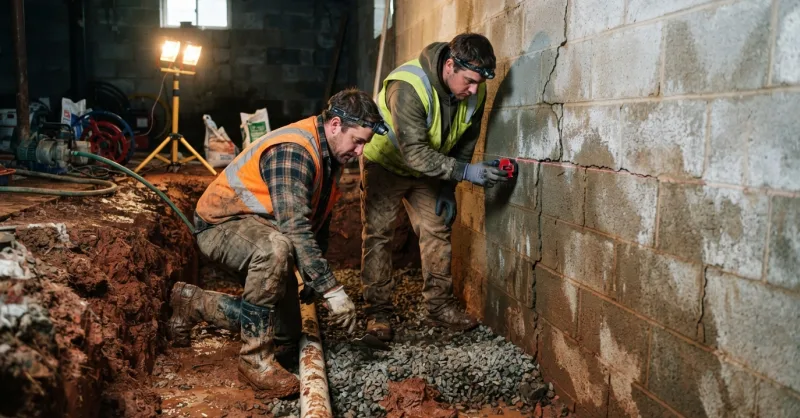
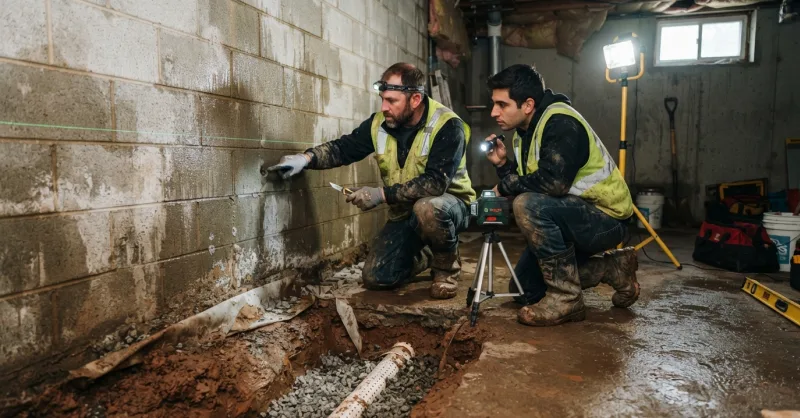
A technician walks your property with laser leveling equipment and moisture meters for roughly 90 minutes. They map crack widths on shear walls and slab perimeters using displacement gauges. They photograph everything. Within 48 hours, you receive a written deficiency report cross-referenced to NCC Building Code § 1807.2 and ASTM E2121 standards. No one calls you afterward to sell anything.
That’s it. No “let me get my manager on the phone.” No three-ring binder with financing options. No emotional pitch about your family’s safety while standing in your basement.
I run AVG Waterproofing LLC out of 500 Apple Rd, Newark, DE 19711, and I’ve spent 25 years crawling under homes and measuring settlement across the tri-state corridor. Six of those years focused specifically on New Castle County, Chester County, and Cecil County soils. The one thing that burns me up about this industry is how “free inspection” became code for “aggressive sales appointment.” We built our entire operation around killing that model.
The “Free Inspection” Trap Running Through New Castle County
Most foundation companies in the DE-PA-MD corridor operate on a lead-gen model. A salesperson shows up with a four-foot carpenter’s level and a generic checklist. They give you a verbal opinion, maybe scribble a number on a notepad, and then pivot straight into a contract discussion before they’ve even left your crawl space.
The report from that visit? Useless. No crack-width data logged to any measurable tolerance. No elevation survey. No reference to local soil behavior or building code provisions. Try handing that to your insurance adjuster or a lender’s underwriting desk and see what happens. (Spoiler: they’ll ask for a real one.)
What a Typical Competitor “Report” Actually Contains
- A handwritten note listing “recommended repairs” with a dollar amount attached
- No numeric measurements, no laser data, no photographic log tied to specific structural elements
- Zero code references. The document wouldn’t survive a review by NCC Department of Land Use, let alone an insurance claim file
I had a property manager from one of the Churchmans Road industrial parks call me last spring. She’d already had two companies come out for “free assessments” on a warehouse showing stair-step cracking along the east wall. Both left her with verbal opinions and quotes north of $40,000. Neither could tell her whether the cracking was from the expansive Potomac Group clay under the slab or from vibration settlement tied to the I-95/DE-141 interchange expansion happening a quarter mile away. That distinction matters enormously for insurance purposes, and neither “inspector” even asked about it.
How AVG Waterproofing Separates Diagnosis from Remediation
Our inspection data never touches a sales database. That’s not a marketing promise. It’s an operational firewall we built into how the company runs. The person who inspects your foundation does not generate quotes, does not carry pricing sheets, and has no financial incentive tied to whether you hire us for repairs.
The 48-hour digital report you receive contains:
- A laser-level elevation contour of your foundation plane measured against a fixed benchmark, accurate to 0.01 inches
- Crack-width data logged to 0.01 mm, classifying each crack as active or dormant based on ASTM E2121 protocols
- Sub-slab moisture intrusion assessment using thermal imaging (no demolition required, we trace migration routes through temperature differential mapping)
- A digital photographic log tagged to specific wall sections, floor zones, and exterior grade conditions
Every finding gets cross-referenced to local code. Can a property owner in the Route 9 corridor near Delaware City actually use a no-obligation foundation report for an insurance claim? Yes. We format reports to align with ASCE 11-99 standards, which means your insurer’s structural causation reviewer can work directly from our data. Same goes for NCC building officials reviewing code compliance under § 230-12 for nonconforming structures, or historic commission applications in Wilmington’s Cool Spring and Trolley Square districts.
New Castle County Soil Behavior: Why Generic Inspections Miss the Real Problem
The geology under your foundation dictates everything. New Castle County sits on the Piedmont-to-Coastal Plain transition zone (documented in Delaware Geological Survey Report of Investigations No. 23), and the soil behavior shifts dramatically within a few miles.
Bear-Glasgow Freeze-Thaw Cycling
Saturated silt-loam in the Bear-Glasgow corridor goes through pore-water expansion every winter. Between mid-January and February, dormant cracks can widen by 0.2 mm in 72 hours. I tracked one slab crack through three consecutive winter seasons using electronic tell-tales on a residential property off Route 40. The crack looked cosmetic in August. By February it was actively displacing the interior partition wall above it. A seasonal baseline elevation reading separates that kind of movement from progressive structural settlement, and skipping that step means you’re guessing.
Christiana River Tidal Zone and High Groundwater
Properties along the Route 9/New Castle riverfront corridor deal with hydrostatic pressure from a water table that fluctuates with tidal influence. We pull DGS well log data for your specific area and correlate it with what we’re seeing on-site. Is a wet basement in the riverfront corridor caused by hydrostatic pressure or by surface runoff from shrink-swell clay? The answer changes your entire repair strategy. Hydrostatic pressure calls for interior basement waterproofing systems with sump pump integration. Expansive clay issues often require addressing exterior drainage and soil-bearing capacity first. We isolate which one you’re dealing with before anyone talks about solutions.
Near the I-95/DE-141 interchange, we see a different animal. Construction vibrations from ongoing road expansion projects create settlement complaints that look identical to natural soil movement. Our protocol measures and documents both vectors separately so you know whether your foundation problem has an anthropogenic cause (which may involve third-party liability) or a natural one.
A Wilmington Historic District Inspection That Didn’t End With a Quote
Last fall, a real estate investor called about a stone-and-mortar rowhome near Trolley Square. He had a term sheet on the property and needed an independent structural report within 10 business days. No seller contamination of the data. No contractor’s opinion dressed up as engineering.
We found lintel deformation over two basement window openings. The mortar joints had eroded unevenly, which is common in Wilmington’s historic masonry when repointing gets done with Portland cement instead of the original lime mortar (a mistake I see constantly in pre-1920 structures). The floor plane showed 0.6 inches of differential settlement toward the southeast corner.
Here’s where it got interesting. The settlement pattern didn’t match what you’d expect from the local clay. It correlated with a disconnected downspout on the southeast elevation that had been dumping roof runoff directly against the foundation wall for what looked like years. That’s a drainage issue masquerading as a foundation issue. The repair cost difference between those two diagnoses? Roughly $22,000.
We delivered the report. The investor used it to renegotiate his purchase price. He didn’t hire us for repairs, and no one from my team followed up asking if he wanted a quote. That’s how this works. If telling you the truth costs me a project, so be it. I’d rather sleep well.
You can see the kind of work we document on our Instagram and LinkedIn pages.
Why We Refuse to Provide Repair Quotes During a Foundation Assessment
A quote delivered during an inspection creates a conflict of interest. The moment an inspector has a financial motive tied to the findings, the findings become suspect. I don’t care how ethical the individual is. The structural incentive corrupts the data stream.
Our process keeps these two functions completely separate:
- Inspection and reporting happen first. You get your data.
- You take that data to whoever you want. Your own engineer. Another contractor. A building official. Your lender.
- If you decide you want us to quote foundation repair work later, that’s a separate conversation initiated entirely by you.
Does a no-sales-pitch inspection actually cover the same diagnostic ground as a paid structural engineering evaluation? Our assessment covers elevation surveying, crack classification, moisture mapping, and code referencing. A licensed PE evaluation adds stamp authority and may include load calculations for specific remediation designs. We produce the diagnostic dataset. A PE stamps opinions about remediation. Different functions, both necessary depending on your situation.
I’ve seen enough $25,000 repair jobs sold off a 20-minute walkthrough to know that the industry standard is broken. Property managers budgeting deferred maintenance don’t need a sales pitch. They need a line item they can drop into next quarter’s CAPEX plan with documentation that holds up to scrutiny. Residential buyers need a report their lender won’t reject. We give you that, and only that.
Booking a No-Obligation Structural Assessment Across the Tri-State Corridor
We cover New Castle County DE, Chester County PA, and Cecil County MD. Inspection lead time runs under 5 business days within New Castle County. The I-95/US-13 industrial corridor from Wilmington down to Delaware City gets same-week windows most months.
What happens if a Nor’easter or tropical system opens new cracks in a commercial structure and you need documentation fast? We run 4-hour emergency response windows for active displacement events. Post-storm structural assessments documenting new crack propagation get the same 48-hour report turnaround, same firewall from sales follow-up. If your slab moved during yesterday’s weather event, we document it before anything shifts back or gets worse.
The actual cost of skipping a real foundation inspection runs steep. I’ve reviewed transaction files where a cosmetic crack got dismissed during a quick sales-style walkthrough, and the buyer discovered $15,000 to $30,000 in progressive settlement damage within 18 months. A proper baseline reading, one with laser elevation data and soil-bearing correlation from USDA survey records for your specific NCC parcel, would have flagged that before the deal closed.
Your foundation data belongs to you. Not to a salesperson’s commission structure. If you need a slab leveling cost breakdown later, that conversation happens on your terms. The inspection just gives you the facts.
Your Home In Good Hands. No quick fixes, no sales scripts, zero nonsense.
Written by: Alex Velasquez
AVG Waterproofing LLC