


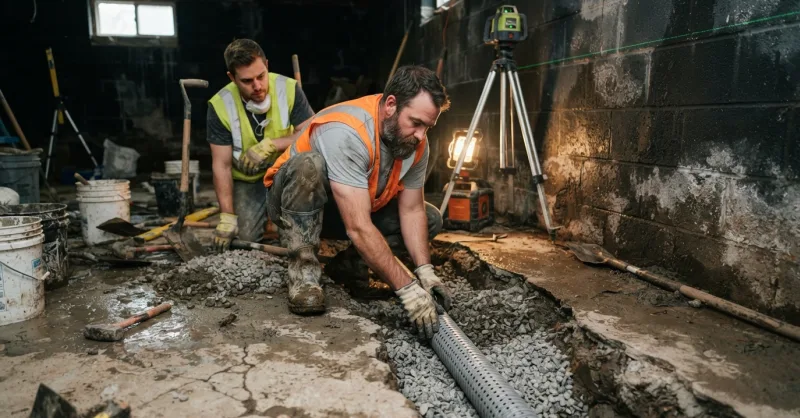
What Does an Interior French Drain System Installation Cost in New Castle County, DE?
Straight numbers first: a properly scoped interior French drain in New Castle County runs somewhere between $4,500 and $12,000+. That spread isn’t lazy math. It tracks linear footage, foundation type, sump capacity, discharge routing, and whether the wall itself is moving on you.
If a contractor drops a flat number over the phone before seeing your basement, they’re guessing. And you’ll pay for that guess twice.
I’ve spent 25 years in U.S. structural work, and the last six diagnosing tri-state soils across Delaware, Pennsylvania, and Maryland. So when I say the price tracks the scope, I mean it tracks something specific and measurable in your home.
The Price Follows the Scope, Not the Square Footage
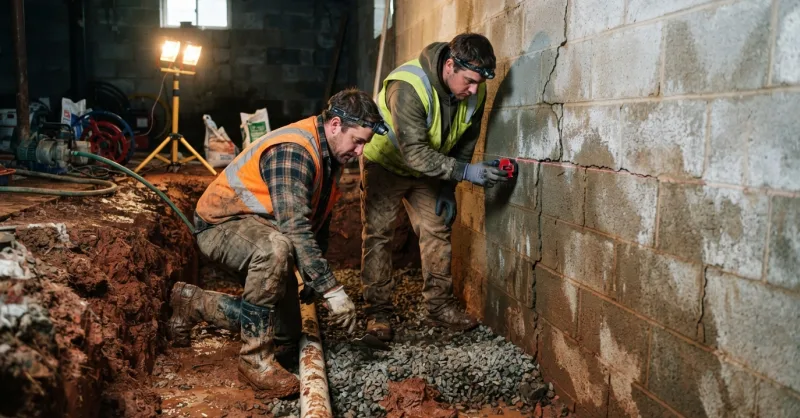
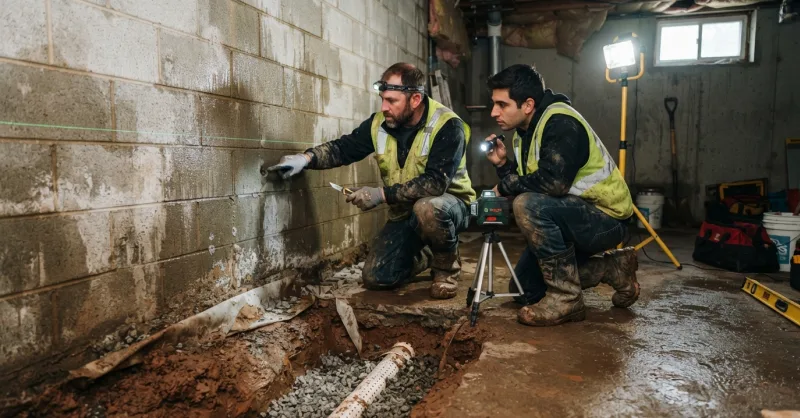
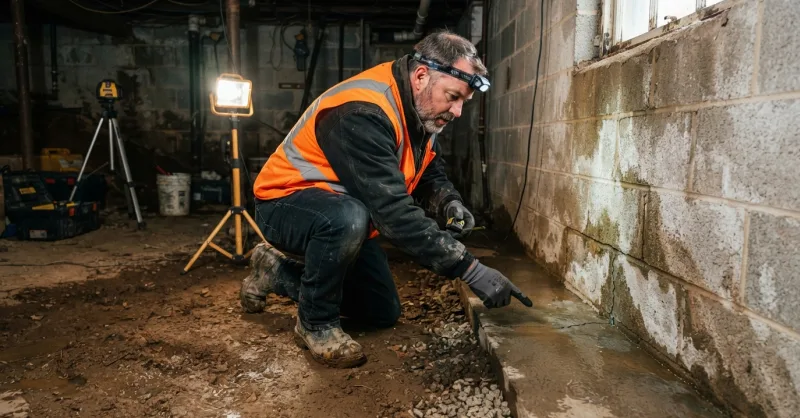
An interior French drain is a footing-level interception system. My crew breaks out a perimeter trench along the inside of the slab, removes concrete, digs down toward the footing line, lays perforated pipe in washed aggregate, then routes everything to a sump basin that pushes water out and away from the house.
Four variables move the number:
- Wall length treated. A 40-foot crawlspace run and a 180-foot full perimeter aren’t the same job, and they shouldn’t cost the same.
- Foundation type. Poured concrete cuts clean. Block walls wick water through mortar joints and hollow cores, which changes how we detail the wall side of the trench. Rubble stone (still common in older Wilmington row homes near the Brandywine) needs slower, more careful trenching because the footing is irregular and the mortar is soft.
- Slab thickness and what’s on top of it. A bare 4-inch pour is straightforward. A finished basement with tile, framing, and a mechanical room hugging the wall adds real labor for removal and restoration.
- Discharge routing. If the sump has to push water 30 feet uphill to a daylight outlet or storm connection, you need a bigger pump, a longer line, and sometimes freeze protection at the termination.
What Belongs in Every Line-Item Quote
Compare proposals item by item. If a quote skips these, it isn’t a complete scope, it’s a headline number designed to win the bid.
- Linear feet of perimeter trench and perforated pipe
- Sump basin size and pump horsepower (⅓ HP versus ½ HP matters a lot on long discharge runs)
- Check valve on the discharge line
- Battery backup or a secondary pump for power outages
- Cleanouts so the system can actually be serviced later
- Aggregate spec and filter fabric
- Vapor barrier or wall drainage matting where the design calls for it
- Crack repair or carbon fiber reinforcement if the wall is bowing (drainage alone won’t straighten a wall that already moved)
- Discharge destination and freeze protection
- Permit and inspection costs where the county or township requires them
- Concrete restoration and cleanup
A quote that reads “interior drainage system, $6,800” tells you nothing. A quote that itemizes the sump, backup, and discharge route lets you compare apples to apples. That’s the whole point of a real proposal.
How long does an interior French drain install take in a typical Newark basement? Most single-family jobs off Route 273 or near the University of Delaware corridor wrap in two to four working days, depending on slab thickness and whether we’re pulling a permit through the county.
Why New Castle County Pricing Isn’t Uniform
This isn’t one market. The county spans the Middle Atlantic Coastal Plain and the Northern Piedmont, and the Christina River Basin (fed by the Brandywine, White Clay, Red Clay, and Christina systems) drives groundwater behavior across most of it.
That plays out in three practical ways.
Soil drainage class shifts block to block. Piedmont clay up in Hockessin holds water and swells. Coastal Plain sands and silts closer to Bear and Glasgow drain faster but sit near a shallower water table. A block-wall seepage call in a Newark split-level near White Clay Creek and a poured-concrete cove joint leak in a Hockessin colonial can need different sump sizing and different discharge strategies entirely.
Freeze-thaw widens what’s already cracked. Late-winter movement in older foundations opens cove joints and reactivates settlement cracks, which is why calls spike in March.
Older foundations leak differently. Stone and block don’t fail the way poured concrete does. Water finds the mortar joints, the hollow cores, and the original clay footing drains that stopped working around the Nixon administration.
If you’re wrestling with pressure at the wall, our breakdown on how to relieve hydrostatic pressure pushing water through basement walls covers the mechanics honestly.
What Does Not Belong in the Quote
Waterproofing paint. Surface hydraulic cement. Foam injection sold as a permanent fix. These trap moisture inside the masonry, speed up efflorescence and spalling, and do absolutely nothing about the hydrostatic pressure building against the outside of the wall.
If a contractor leads with a coating, you’re buying a callback, not a repair. I’ve torn out enough painted block walls to know exactly what’s hiding behind that fresh gray coat (usually rot, sometimes worse).
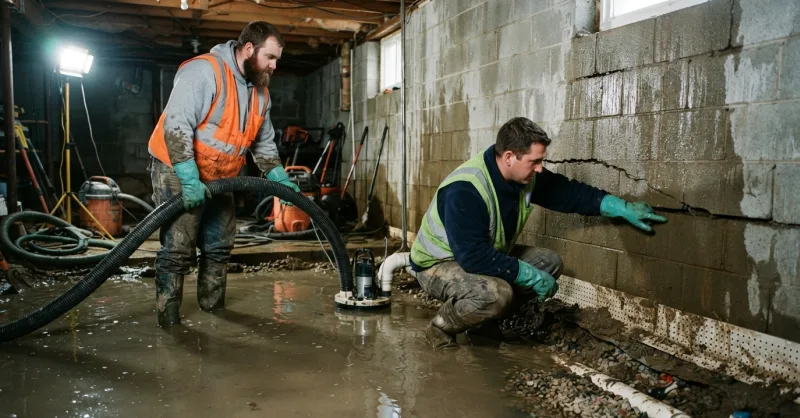
Do interior French drains actually stop basement leaks? Yes, when the leak is driven by groundwater and hydrostatic pressure at the perimeter. The drain doesn’t stop water from entering the soil around your house, but it intercepts that water at the footing, sends it to a sump basin, and moves it out before it floods your slab.
When the French Drain Isn’t the Whole Fix
An honest scope sometimes includes work beyond the trench. That’s just how it is.
- Bowing or shear-cracked walls may need carbon fiber reinforcement or, in serious cases, piering. If you’re seeing horizontal cracks in cinder block, our horizontal cinder block crack repair guide lays out when reinforcement is actually justified.
- Surface water problems. Failed grading, short downspouts, blocked gutters. These get corrected first or alongside the drain, otherwise you’re pumping water that never needed to reach the footing in the first place.
- A dead sump pump or a clogged discharge line is sometimes the entire problem. I’ve had calls in Bear where a $400 pump swap solved what another company quoted as a $9,000 system. If telling you that costs me the project, so be it. I’d rather sleep at night.
A real diagnostic looks at grading, downspouts, wall condition, and the water path before quoting a system. That’s the whole reason we offer free structural inspections without sales pitches.
A Real Newark Cove Joint Call (The Messy Version)
Last spring, a homeowner off Route 4 called after three separate contractors had already quoted her. All three pushed a full-perimeter interior system, sump, backup, the works. Around $11k on the high end.
I walked the exterior first. Her downspout on the northwest corner (the same corner where water was coming up at the cove joint every heavy rain) was disconnected below grade. Just spraying into the flowerbed six feet from the foundation.
We extended that discharge, fixed a low spot in the grading, and installed a partial interior drain along one wall where the block was already saturated. Total came in around $3,900. Not glamorous, and honestly kind of embarrassing that three “specialists” missed it. But her basement stayed dry through the next four storms.
Not every job ends that cleanly. Some homes really do need the full perimeter, the ½ HP pump, and the battery backup. The difference is the diagnosis. If nobody looked at your gutters before quoting a drainage system, they weren’t diagnosing, they were selling.
Are permits required for interior French drain work in New Castle County? It depends on the municipality and whether the basement is finished. Most unfinished residential jobs in unincorporated county areas don’t trigger a permit, but the City of Newark and City of Wilmington have their own thresholds worth checking before work starts.
The Number That Actually Matters
Budget $4,500 to $12,000 for a properly scoped interior French drain in New Castle County. Higher end for stone foundations, finished basements, long discharge runs, or added wall stabilization.
The number that matters isn’t the lowest bid. It’s the bid that names every component, explains what each does, and matches the actual water path in your basement.
We run our operations out of 500 Apple Rd, Newark, DE 19711, which keeps us close enough to reach jobs from Wilmington down to Middletown and across into Cecil County the same day when a basement is actively flooding.
If you want the full picture on our approach to basement waterproofing systems, or a straight quote on French drain and sump pump installation, we’re here 8 AM to 7 PM Monday through Saturday and 8 AM to 3 PM Sundays.
What’s the cost difference between a poured concrete and a stone foundation install? Stone foundations off the older stretches of Wilmington and New Castle typically add 20 to 35 percent to labor because trenching against irregular rubble requires more careful hand work and, sometimes, lime-compatible repointing along the exposed footing area.
Follow the work on LinkedIn or Instagram if you want to see actual jobsite footage instead of stock photos.
Written by: Alex Velasquez
AVG Waterproofing LLC