


What Actually Separates an Honest Foundation Contractor from One Who’ll Be Back in Three Years Charging You Again
I’ve been doing this for over 25 years. Crawled under houses in Claymont when the temps were in the teens, driven helical piers into the Potomac Formation marine clay south of Newark more times than I can count, and watched homeowners sign with the first guy who showed up with a glossy brochure and a “per pier” price that somehow tripled by the time mobilization fees got added.
Soil movement in New Castle County is not a generic problem. The Piedmont-Coastal Plain transition running roughly along the Kirkwood Highway corridor means one block can sit on weathered saprolite with angular slope creep, and the next sits on shrink-swell marine clay that moves two inches vertically between a wet March and a dry August. National franchise reps don’t know that. They run the same script here they run in Ohio.
I’m Alex Velasquez. I run AVG Waterproofing LLC, based out of 500 Apple Rd, Newark, DE 19711. We cover New Castle County, Chester County PA, and Cecil County MD. No quick fixes, no sales scripts, zero nonsense.
Why Foundation Settling in New Castle County Is a Soil Problem First, Not a Crack Problem
Stair-step cracks in drywall, doors that stick after every heavy rain, a floor that’s developed a noticeable slope near the front of the house — these aren’t random. They’re symptoms. The crack is never the root cause.
I walked a property in Pike Creek a while back. Homeowner had already paid someone to inject epoxy into three cracks in the foundation wall. Looked clean. Six months later the cracks were back, wider. The previous contractor never checked the shrink-swell index of the clay beneath the slab, never pulled a soil boring log, and just filled the visible damage. Classic. (Honestly, I see this so often it’s almost predictable — fill the crack, collect the check, ghost the customer.)
The actual problem was differential heave. The Coastal Plain marine clay beneath the north side of that foundation was absorbing groundwater from a failed downspout discharge line and expanding unevenly. No amount of epoxy touches that.
What “Differential Settlement” Actually Means for Your Property
When one section of your foundation drops or rises independently of the rest, the structural load paths shift. Beams bear weight they weren’t designed to carry. Door frames rack. Windows crack at the corners. If the movement is active, meaning it’s still happening, surface repairs are a waste of your money.
Per New Castle County Code Section 33.06.303, foundation inspections after grading events require documented verification of bearing capacity. I cite that code not to impress you, but because it means your county already knows this is a real risk — they wrote it into law.
3 Questions That Filter Out Every Contractor Who Shouldn’t Be Near Your Foundation
Before you let anyone quote your foundation repair, ask these three questions directly. Watch how they respond — not just what they say.
-
“Can you show me real-time digital torque logs and an engineer-signed affidavit for every helical pier installation?”
We drive each galvanized steel helix to 4,200 ft-lbs until refusal in competent bearing stratum. That torque is logged digitally and uploaded with the structural engineer’s affidavit. No log means you have no evidence the pier reached load-bearing soil — it could be sitting in the same shrinking clay that caused the problem.
-
“Do you run soil borings before quoting?”
The saprolite weathering zone north of Kirkwood Highway behaves completely differently from the Potomac Formation marine clay in Glasgow or Middletown. Groundwater table depth after a March nor’easter can shift the entire repair strategy. What happens if a contractor skips this step? You get the wrong solution, priced for the wrong soil, installed at the wrong depth.
-
“Is the estimate flat-rate, line-itemed, with county permit fees, soil disposal, and a deed-recorded warranty included?”
We break out cost per lineal foot of pier, laser-verified settlement monitoring baseline, engineering seal, permit expediting through the New Castle County Plan Review and Permitting Division, and soil disposal. All of it. Our 25-year transferable warranty links to the property deed — not to our business license, which means it survives a company change of ownership. Ask any national franchise if their warranty does that.
If a contractor stumbles on any of those three, that’s your answer. Call us at (302) 555-0187 and we’ll run a Foundation Settlement Audit — soil borings, digital laser benchmarking, and a fully itemized repair plan. No pitch, just data.
Helical Piers vs. Polyurethane Slabjacking: How We Actually Decide Which One Your Property Needs
Not every settling foundation needs deep underpinning. I turned down a full pier job in Claymont a couple years back. A competitor had quoted 12 helical piers for what turned out to be 0.3 inches of slab edge movement — verified by our laser benchmarking. The homeowner nearly signed. Three polyurethane injection points and corrected surface drainage fixed it. Total cost was a fraction of what that quote would have been.
If telling you the truth costs me a project, so be it. I’d rather sleep well at night.
Our decision framework runs like this:
- Laser-measure actual floor deflection against ASCE 7-22 tolerance limits for Delaware construction
- Compare deflection data against the soil boring log — clay plasticity index, groundwater depth, load-bearing stratum location
- Identify whether movement is active or historic
- Determine if the bearing stratum is reachable at a depth that makes helical piers cost-effective versus high-density polyurethane injection plus drainage correction
Active movement in saturated Coastal Plain clay south of Route 40 near Glasgow? That almost always requires deep pier underpinning to reach competent stratum. Minor monolithic slab edge settlement in a dry Hockessin neighborhood with stable metamorphic rock close to surface? Probably slabjacking and drainage. The soil drives the answer, not a price list.
You can dig deeper into the real cost variables for slab leveling at our permanent slab foundation leveling cost breakdown — no fluff, just the actual line items and what drives them.
The Geological Reality Beneath New Castle County That Most Contractors Never Bother to Learn
I’ve spent six years specifically focused on this tri-state soil corridor, layered on top of 25 years of broader U.S. structural work. The local geology here has quirks that genuinely matter.
North of Kirkwood Highway — think Hockessin, Greenville, the Red Clay Creek floodplain zone — you’re dealing with Piedmont saprolite. Weathered metamorphic rock that can feel solid under a probe rod but has no real bearing capacity once saturated. Slope creep is real here, especially on lots with grade changes. Angular settlement, not uniform sinking.
South and east — Newark near the University of Delaware, Bear, Glasgow along Route 40 — the Coastal Plain takes over. Potomac Formation marine clays with high shrink-swell indices. These expand when wet and contract when dry, sometimes by more than two inches vertically over a single seasonal cycle. Historic homes in Old New Castle sit on these soils too, and the differential movement in those older pier-and-beam structures is especially visible in sloping floors and sticking doors.
The 200-year floodplain maps along Brandywine Creek, Christina River, and White Clay Creek are not abstract planning documents. They show where French drain integration becomes non-negotiable alongside any pier system, because managing hydrostatic pressure relief is part of a permanent repair in those zones — not an upsell.
When seasonal groundwater tables rise after March nor’easter events, existing foundation cracks propagate fast. Pre-winter stabilization and drainage correction — before the ground freezes and heaves again — is the most cost-effective window. Especially in the Pike Creek Valley and Hockessin areas where freeze-thaw cycling is aggressive.
Foundation Repair Without Drainage Correction Is a Half-Measure — Here’s Why We Connect Them
I’ve seen this failure mode enough to know: you can install a perfect helical pier system, hit the right bearing stratum, log the torque, pull the permit — and watch the basement crack again two years later because no one addressed the hydrostatic pressure building against the exterior wall.
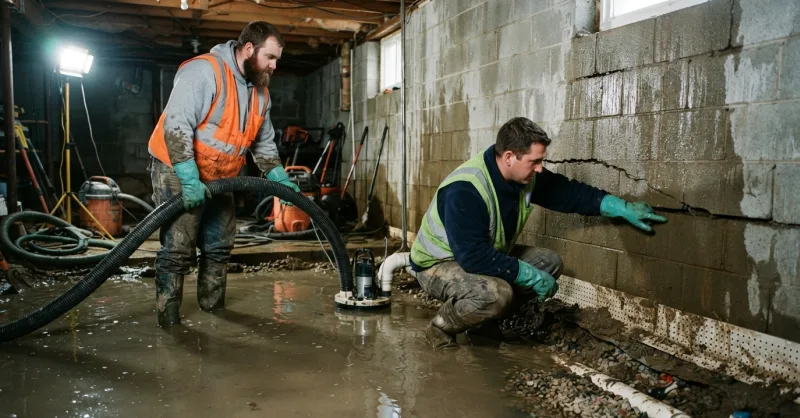
Water and soil movement are connected problems. Saturated soil expands, loads the foundation wall laterally, and drives differential settlement in the slab above. Our foundation repair services always include a drainage assessment, and our interior and exterior waterproofing systems are designed to work in coordination with structural repairs — not as separate jobs sold separately to pad revenue.
For property managers dealing with tenant complaints about wet basements in commercial buildings near the I-95 corridor through Wilmington, that integrated approach matters for liability reasons too. A dry basement with a functioning interior waterproofing system and a properly seated sump pump isn’t just comfort — it’s documentation that you addressed a known structural risk, which matters during lease renewals and commercial inspections.
Pier and Beam Foundations in Newark and Old New Castle: The Specific Challenges We’ve Actually Worked Through
A lot of contractors advertise pier and beam repair. Fewer have worked on the older stock of homes in Newark’s historic district or the pre-war houses along Delaware Avenue in Old New Castle, where original timber sills have partially decayed and the bearing pads have shifted over decades of clay movement.
The challenge with these structures is that the original construction assumed a certain load distribution. When one pier settles, the beam spans differently and the floor system picks up load paths it wasn’t sized for. Getting the re-leveling sequence right matters — you can’t just jack the low corner and call it done. We re-level incrementally, monitor for frame distress during the lift, and verify beam bearing at every support point before we consider the job finished.
I’ll be honest — on one job near the University of Delaware, we found a notched joist mid-span that somebody had cut decades ago to run a pipe. It wasn’t in any documentation. We had to sister the joist before we could safely complete the re-leveling sequence. That kind of thing happens. The question is whether the contractor stops and addresses it or keeps going and hopes nobody notices. (We stopped. Took an extra half-day. The homeowner appreciated the transparency, even if they weren’t thrilled about the delay.)
Dig into the details on what separates competent pier and beam repair contractors from the guys who just jack and shim.
What Foundation Settlement Repair Actually Costs in New Castle County — Real Numbers, Not Ranges Designed to Get You on the Phone
Polyurethane slab injection for an isolated settlement area: typically $4,200 to $7,500 depending on the number of injection points and the volume of material required to restore grade.
Full helical pier underpinning with engineered load transfer, digital torque verification, county permit, engineering seal, and soil disposal: $14,000 to $28,000+ depending on pier count, depth to competent bearing stratum, and access conditions. Corner lots with tight side-yard setbacks cost more to mobilize. Properties in the 200-year floodplain along Brandywine Creek or Christina River may require additional drainage integration.
The county permit fee, engineering seal, and soil disposal aren’t surprises buried in a change order when we quote. They’re line items on the estimate you receive before you sign anything.
Our estimates are free. No pressure, no sales script. We come out, run the diagnostics, hand you a fully itemized scope, and let you decide. If you want to take that document to another contractor for comparison, do it. We’ve seen enough inflated competitor quotes to know our pricing holds up.
Where to Find Us and How We Work
We’re active on LinkedIn where I post real project documentation, soil boring comparisons, and the occasional rant about why the foundation industry needs better transparency standards. If you prefer visual project walkthroughs, our Instagram shows active installs, before-and-after laser benchmarking, and real-time torque monitoring documentation from local jobs — not stock photos.
We serve New Castle County, DE as our home base, and extend our coverage into Chester County, PA and Cecil County, MD for residential and commercial structural repair. Free structural estimates, no obligation, no pressure.
Call (302) 555-0187 or reach out online. If your floor is moving, your walls are cracking after rain, or a home inspection just flagged a foundation concern before closing, we can typically get a field technician out to you same day in the New Castle County area.
Tagline: Your Home In Good Hands.
Written by: Alex Velasquez
AVG Waterproofing LLC