


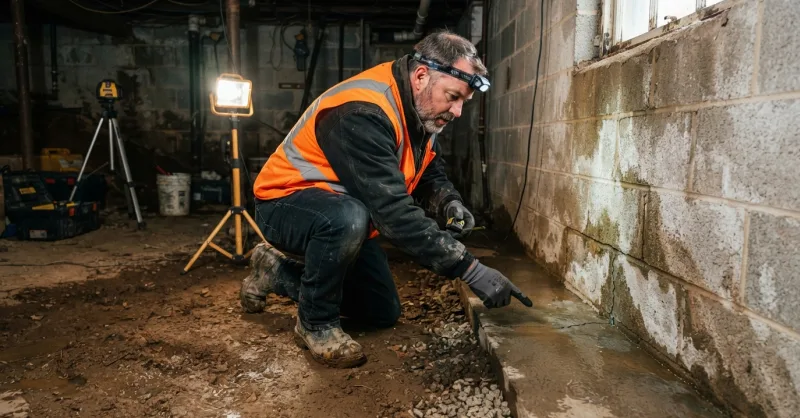
What’s Actually Causing Water to Seep Where Your Basement Floor Meets the Wall?
If water keeps showing up along that seam where your basement slab meets the foundation wall, you’re not looking at a mystery. You’re looking at hydrostatic pressure doing exactly what physics says it will do.
That seam is called a cold joint. It’s a construction transition point between the footing pour and the slab pour, and it was never engineered to be a waterproof barrier on its own. When the soil outside your foundation gets loaded with water, pressure builds against the wall and the footing. Water finds the weakest point. That joint is it.
I’ve been doing structural and waterproofing work for 25 years, and the last 6 have been focused specifically on the soils across New Castle County, Chester County, and Cecil County. When homeowners in Newark or Bear call me about a wet basement seam, they usually expect me to talk about sealants. I don’t. I talk about where the water is coming from and what force is moving it.
Why New Castle County Homes Deal With This More Than Most
Our region averages about 46 inches of rain a year. That’s a lot of water hitting the ground, and the ground here doesn’t drain the way sandier soils do further south.
Much of the county sits on Piedmont-influenced clay and silty loam. Clay holds water. It swells when saturated, releases moisture slowly, and presses laterally against anything vertical in its path (your foundation wall, in this case). If your home sits near the White Clay Creek corridor, the Christina River lowlands, or any of the older neighborhoods off Route 896, you’re already in a drainage-sensitive zone.
What the Ground Is Doing Under Your Slab
Groundwater doesn’t stay still. It rises with rain, sinks in dry stretches, and travels downhill through the path of least resistance. Your foundation footing is often that path. When water reaches the footing and the drain system either doesn’t exist or has silted in, the water table effectively rises above your slab elevation.
At that point, the joint leaks. Every time.
Why Paint, Caulk, and Hydraulic Cement Keep Failing You
I’ve walked into basements in older New Castle homes and seen three generations of patches stacked on top of each other. Waterproof paint peeling off the block. Polyurethane caulk jammed into the cove joint. Hydraulic cement smeared over cracks like frosting.
None of it worked. Not because the products are junk, but because they were being asked to do something they can’t do: hold back groundwater pressure.
A bead of caulk cannot resist several feet of saturated soil pressing against a wall. Hydrostatic head is a force, not a leak. You don’t seal a force. You relieve it, or you redirect it.
The Hidden Cost of the Quick Fix
Waterproof paint traps moisture inside the block. The wall stays wet on the inside face. Efflorescence blooms. Mold gets a food source. And the joint still weeps because the pressure never left.
I had a homeowner over near Bear last spring who’d spent close to $800 on DIY sealers over three years. His finished basement carpet was ruined twice. When I pulled back a section of drywall, the block was so saturated you could squeeze water out of it with your hand. That’s what happens when you seal instead of drain.
Which System on Your House Is Actually Broken
When water shows up at the wall-floor seam, one of these is failing (sometimes several at once):
- The footing drain. Most homes built with one have it clogged by now. Clay migrates into the pipe over decades, and eventually the drain stops draining. Water backs up around the footing and rises to the joint.
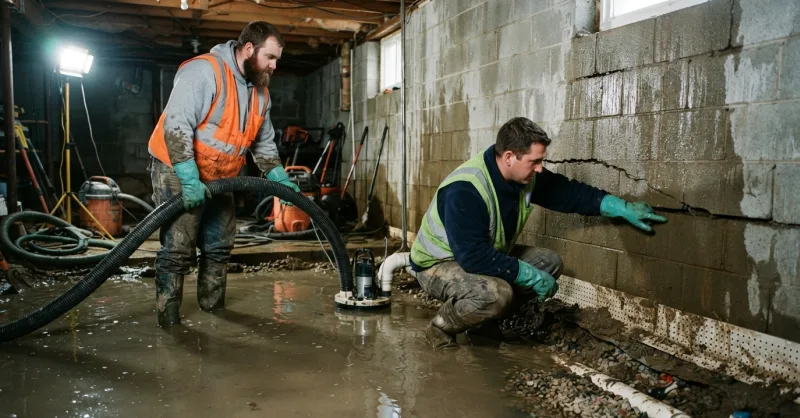
- The sump pump and basin. If it’s undersized, short-cycling, or running on a 20-year-old float switch, it can’t keep pace during a real storm.
- The discharge line. I’ve seen discharge pipes dumping water 2 feet from the foundation. That water goes right back into the same soil and returns to the sump within an hour. It’s a loop.
- Grading and downspouts. If your gutters dump at the corner of the house and the ground slopes toward the foundation, you’re irrigating your own basement.
- The wall itself. Cracks, step-cracks in block, bowing (any of these mean the drainage fix has to happen alongside structural crack repair).
What a Permanent Fix Actually Looks Like
The goal isn’t to seal the joint. The goal is to keep water from ever reaching it under pressure.
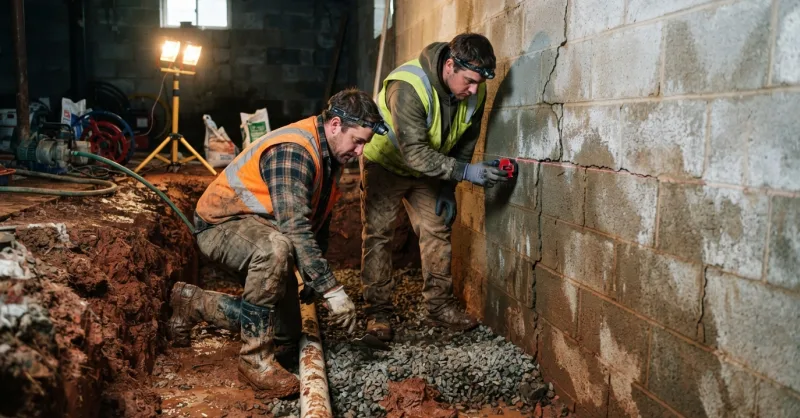
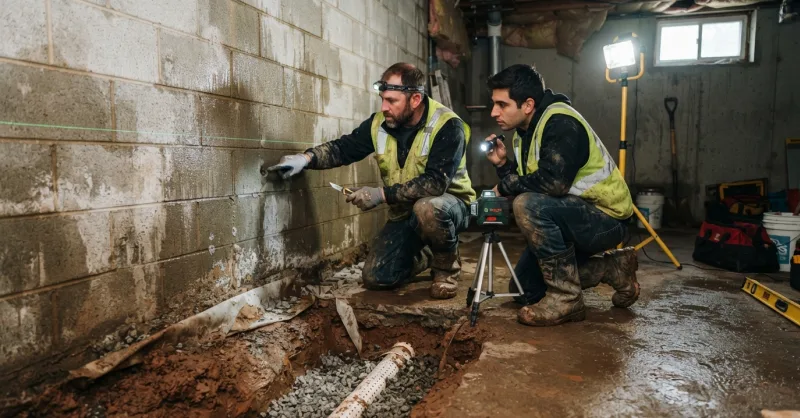
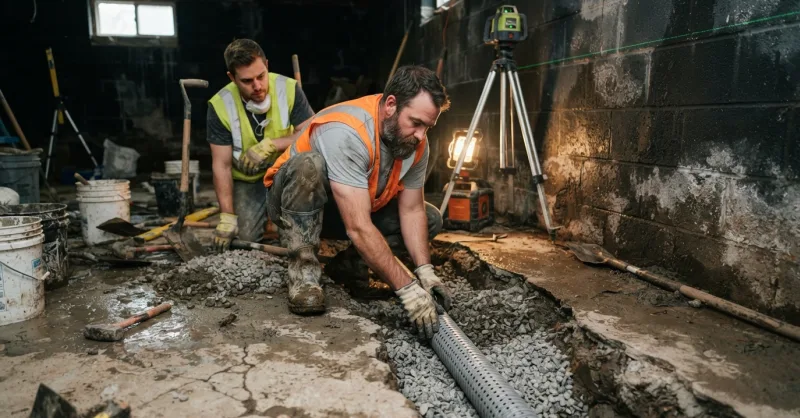
A real repair on a New Castle County home usually involves an interior perimeter drain installed at the footing elevation on the inside of the wall, tied into a properly sized sump basin with a reliable pump, a check valve, and a battery backup. The discharge line moves water far enough from the house that it doesn’t recycle back into the same saturated soil. Exterior corrections handle grading and downspout extensions. If the wall is moving or cracked, we address that with crack injection or carbon fiber before we close anything up.
A Real Job From Last Fall
Older Cape Cod off Route 40, block foundation, water at the cove joint every time it rained more than an inch. The previous contractor (one of those big franchise outfits) had quoted an interior system for around $14,000 without ever looking at the exterior. I walked the property first. Two downspouts dumped straight against the foundation on the uphill side of the house. The rear yard sloped toward the basement wall.
We extended the downspouts, regraded a 12-foot strip along the back, installed an interior perimeter drain on the two problem walls (not all four, because the other two were bone dry), and put in a new sump with a battery backup. Total came in under half of what the franchise wanted. If telling you the truth costs me a project, so be it. I’d rather sleep well at night.
The homeowner texted me during the next big storm. Bone dry.
Questions I Get Asked Every Week
When people call about basement seepage, a handful of the same questions come up. I’ll answer them the way I would on the phone.
How quickly can your team get to a Newark or New Castle property during an active storm? Our crews work the tri-state corridor 7 days a week, 8 AM to 7 PM Monday through Saturday and 8 AM to 3 PM Sundays. If you’re inside the county and water is coming in right now, we usually get eyes on it same-day or next-morning. Our office at 500 Apple Rd, Newark, DE 19711 puts us minutes from most of the county.
Do I need a permit for an interior drainage system in New Castle County? Interior perimeter drains typically don’t require a building permit through the county’s Department of Land Use, but electrical work for a sump pump often does. We handle the coordination so you’re not stuck navigating the paperwork.
Will homeowners insurance cover this repair? Almost never. Standard policies exclude groundwater intrusion and gradual seepage. Flood insurance is a separate product, and even that usually won’t cover a drainage repair. Budget for it out of pocket or through a home improvement loan.
Can I just install a bigger sump pump and skip the perimeter drain? No. A sump pump only removes water that reaches the basin. If there’s no drain collecting water along the footing, the pump has nothing to pump. It’s like putting a bigger bilge pump on a boat with holes below the waterline (the water still gets in).
What I’d Do If This Were My House
First, walk outside during the next rain. Watch where water pools. Check whether your downspouts extend at least 6 feet from the foundation. Look at your grading.
Then get a real diagnosis. Not a sales pitch dressed up as an inspection. We offer free structural assessments across New Castle, Chester, and Cecil counties, and we’ll tell you if the fix is a $400 downspout correction or a full interior waterproofing system. Sometimes the answer is genuinely small. Sometimes it isn’t. Either way, you’ll know.
If your walls show cracks or bowing along with the seepage, that changes the scope. Drainage alone won’t stabilize a wall that’s already moving, and you’ll want a structural specialist to weigh in before any waterproofing goes in.
You can follow our field work and see actual projects on LinkedIn and Instagram. Real basements, real repairs, no staged photos.
The water isn’t going to stop on its own. Pressure keeps building until something gives it a place to go. Give it that place, and the joint stays dry.
Written by: Alex Velasquez
AVG Waterproofing LLC