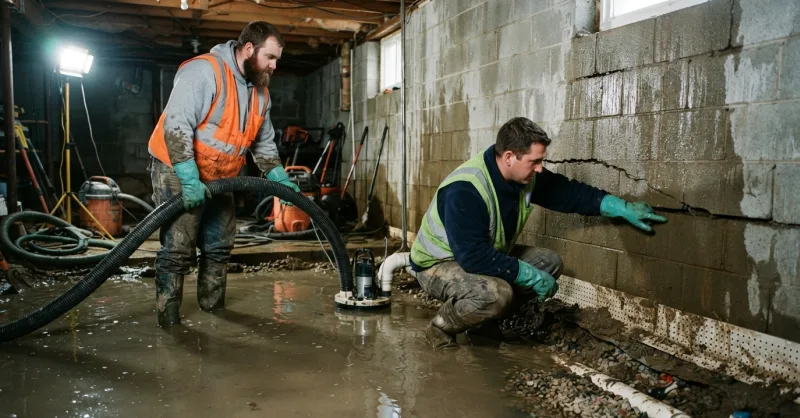



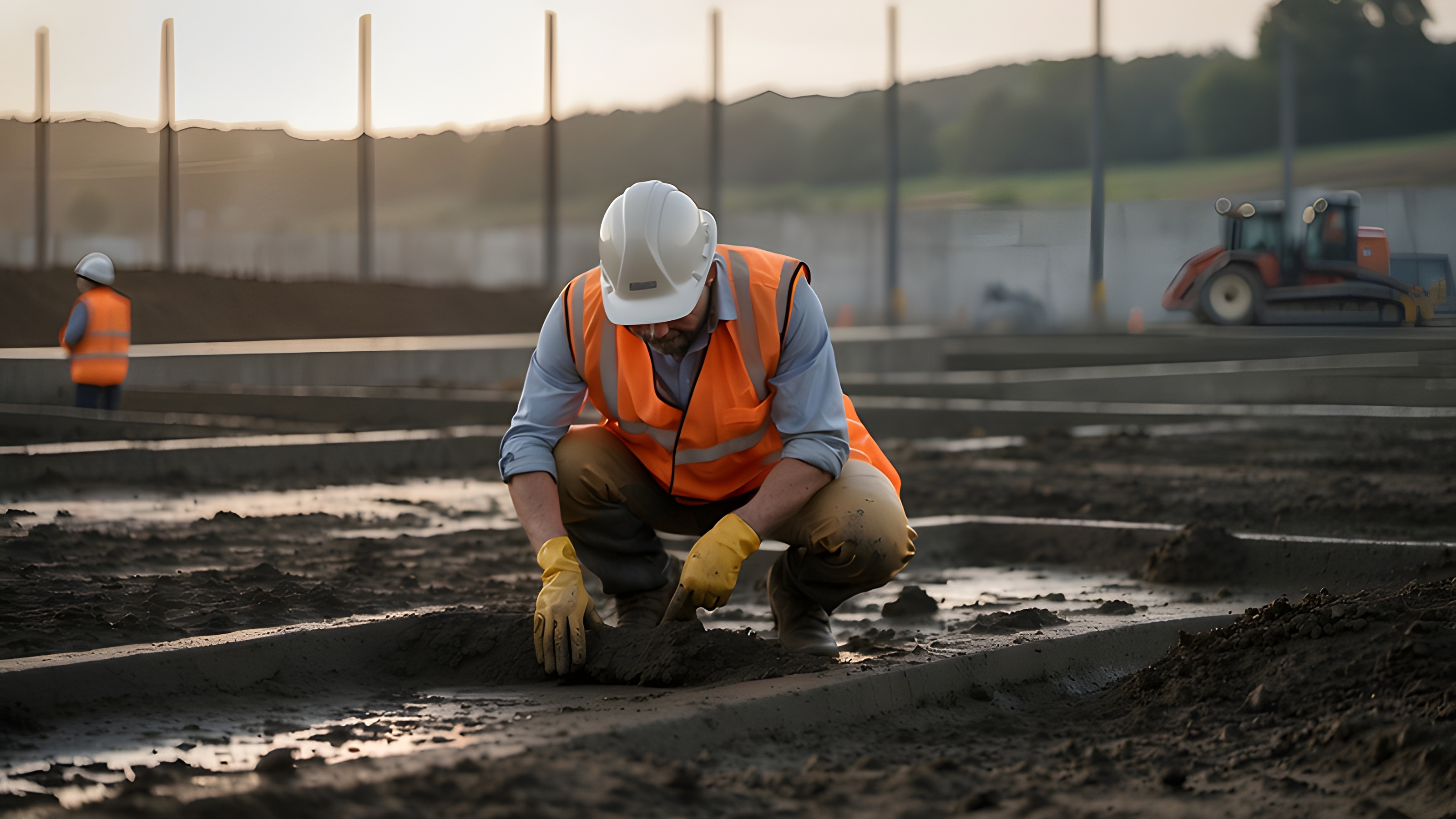
Who to Call First When Your House Foundation Is Actively Sinking in New Castle County
Call a foundation repair specialist who dispatches a licensed structural engineer on the first visit. Not a general contractor. Not a mudjacker with a truck-mounted grout pump. Not the guy who painted your neighbor’s basement last spring.
I’m Alex, and I’ve spent 25 years crawling under sinking footers across the mid-Atlantic, the last six of them focused almost entirely on the Potomac clay belt that runs through New Castle County. If your stair-step crack widened overnight, you need an engineer with a Ziplevel and a Schmidt hammer standing in your foyer within 90 minutes, not a salesman with a clipboard.
The single call that halts movement: AVG Waterproofing LLC’s emergency line. You’ll get a structural diagnostician, not a commissioned closer reading from a script.
Why the “who” matters more than the “how fast”
A misdiagnosed bearing failure is worse than no diagnosis. I’ve watched homeowners in Bear pay $18,000 for a full-perimeter lift that never should have been prescribed, because the actual issue was a 4-foot pocket of undocumented fill under the garage slab. That called for high-density polyurethane consolidation grouting, not piers.
The wrong specialist writes the wrong prescription. Then your permit gets rejected under NCC Code Section 1809.5, and you’re back at zero with a lighter wallet.
The Engineer-Led Crew vs. the Commissioned Salesman: A Blunt Comparison
Most competitors in the tri-state send a guy in a polo shirt with a flashlight and a fear script. He measures nothing. He quotes a lump sum over the phone before he pulls out of your driveway.
That’s not diagnosis. That’s a pitch.
What a real structural triage looks like on-site
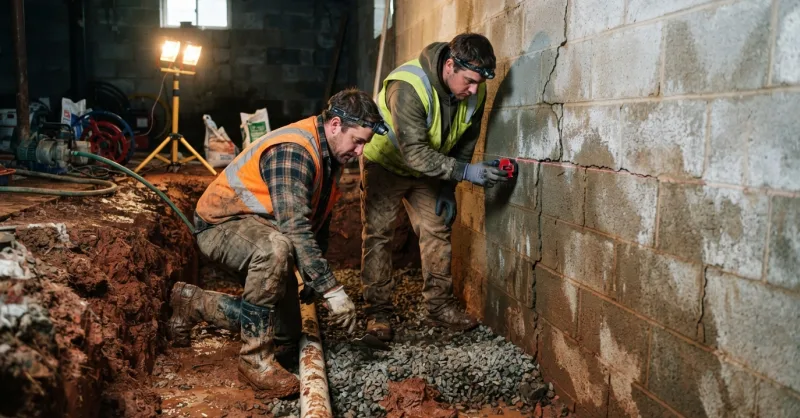
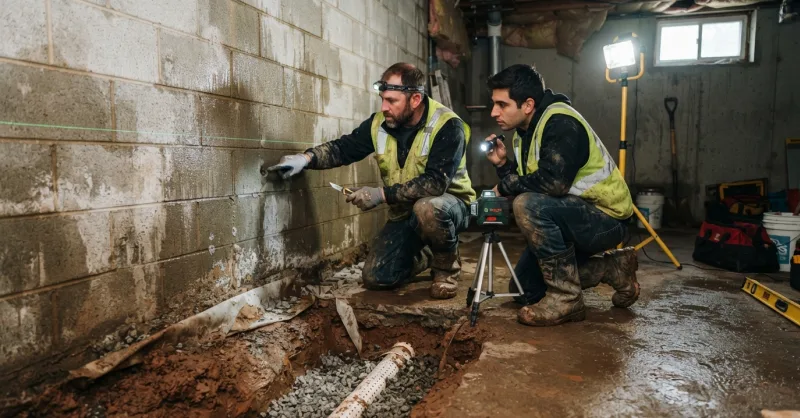
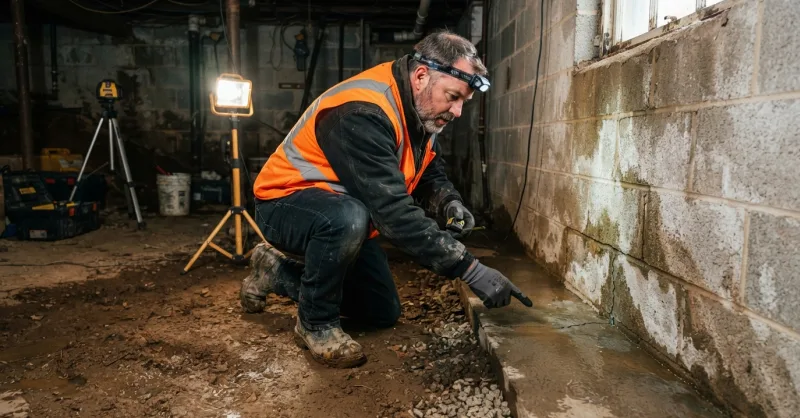
When my crew rolls up to a 1985 colonial off Milltown Road, here’s what happens in the first hour:
- Ziplevel digital altimeter floor survey in a tight grid pattern, referenced to a fixed benchmark, generating a planar deviation heat map you’ll see before we leave.
- Schmidt hammer rebound readings on the existing footing to check concrete integrity (sometimes the footer itself is the failure, not the soil).
- Digital inclinometer readings on any bulging wall segments, especially in older Hockessin hillside basements where lateral earth pressure compounds vertical settlement.
- A written line-item protocol before we mention price. No lump sums.
That’s the deliverable. A homeowner in Pike Creek told me last winter it was the first time in three estimates anyone had actually measured her floor. The other two had quoted her from the driveway.
The permit question nobody wants to answer honestly
New Castle County requires stamped engineering plans for deep foundation work under Section 1809.5. We pull the permit. We file the ICC-ES AC358 evaluation report for the helical piers. We coordinate the third-party special inspection before any bracket gets encased.
You never touch a form. If your contractor asks you to pull the permit, walk away.
Why Potomac Clay Punishes Shortcut Repairs
The dark gray silty clay under most of New Castle County has a plasticity index north of 30. It swells when wet, shrinks when dry, and heaves when it freezes below the 30-inch frost line. That active zone of seasonal moisture fluctuation is where band-aid fixes go to die.
Pumped grout (mudjacking) has no mechanical refusal. It re-compresses the next time the clay swells. I’ve seen the same slab in a Glasgow ranch get mudjacked three times in eight years by three different outfits before we finally installed piers to bearing strata at 22 feet. The homeowner had paid nearly the cost of the permanent fix, twice over, on temporary lifts.
What “bearing strata refusal” actually means for your house
Helical piers advance hydraulically. Segments couple as the shaft drives deeper. When the pier hits a stratum dense enough to resist further torque, that’s refusal. In our soils, that’s typically 15 to 25 feet down, well below the active zone.
Each pier gets torque-tested to 1.5 times design working load with a digital gauge. You receive the log. Torque versus depth, installation angle, refusal reading. No hand-waving.
A quick aside (and I’ll probably regret saying this): I’ve turned down jobs where the homeowner insisted on slabjacking against my recommendation. If telling you the truth costs me a project, so be it. I’d rather sleep well.
What a Real Emergency Dispatch Looks Like
Last February, a retired DuPont engineer in Hockessin called at 7:14 AM. His bay window wouldn’t latch. There was a 3/16-inch horizontal crack across his garage slab that hadn’t been there the night before. A nor’easter was forecast for Thursday.
We had an engineer, a Ziplevel, and a torque head in his driveway by 8:47 AM. By noon, he had a planar deviation heat map showing 1.2 inches of differential settlement across the northeast corner, a line-item protocol for six helical piers to a projected refusal depth of 19 feet, and a permit application already drafted for submission that afternoon.
The messy part nobody puts in the brochure
His insurance denied the claim under the earth movement exclusion. That’s standard. It stung. He had budgeted assuming coverage.
We restructured the protocol to phase the work: piers on the actively settling corner first (halting movement within 48 hours), then supplemental carbon fiber staples on two hairline foundation wall cracks the following month. He paid in two draws instead of one.
Not every story ends with a tidy percentage win. His floor is now within 3/16 inch of level across the entire slab, but there’s still a hairline cosmetic crack in the drywall above the foyer arch that he decided to leave alone. Real houses hold real scars.
If you’re wondering what should I actually do the morning I see a new crack near the I-95 corridor between Christiana and Claymont, the answer is: take a photo with a coin next to the crack for scale, mark the end of the crack with a pencil line and date, and call the emergency line. Don’t wait for the storm to hit.
Local Conditions That Change the Prescription
Every zip code in this county has its own quirks. A cookie-cutter protocol is a red flag.
Neighborhood patterns I’ve learned the hard way
- Bear and Glasgow subdivisions: 1970s slab-on-grade over undocumented fill. Sub-slab polyurethane consolidation grouting (3.5-lb density) often works better than piers if the footing itself is sound.
- Pike Creek ranches: Shallow footings vulnerable to adfreeze heave. Helical piers embedded well below the 30-inch frost depth are non-negotiable.
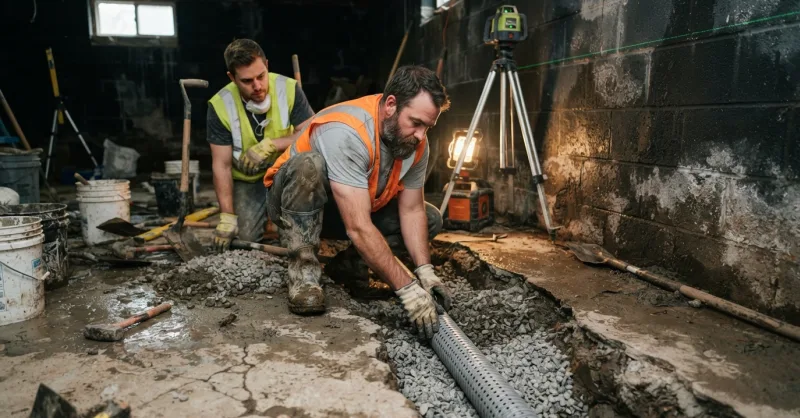
- Christina River terrace gravels (Fairfield Crest, parts of Newark 19713): Lateral spread cracking from seasonal water table swings. We couple interior drain systems with carbon fiber wall reinforcement.
- Old New Castle Historic Overlay District: Chapter 23 preservation standards prohibit high-vibration installs. Helical piers are the only compliant option; hydraulic push piers are ruled out.
- Hockessin hillside lots. These are their own animal, honestly.
Homeowners often ask how do I know if my Middletown home along the DE-896 corridor needs full underpinning or just void-fill grouting, and the honest answer is that it comes down to whether the footer has lost bearing or the soil beneath the slab has voided. The Ziplevel survey combined with a soil probe tells us in about 40 minutes.
What This Actually Costs, and Why We Refuse to Quote Over the Phone
A single helical pier installed in New Castle County typically runs in a range that depends on refusal depth, access constraints, and bracket type. A small job might involve four piers on one corner. A full perimeter lift on a 2,500 sq ft colonial could involve twelve to eighteen.
The line items you should see on any legitimate estimate:
- Permit fee (NCC flat rate, we handle submission)
- Engineer stamped plan and load-test protocol
- Pier cost per unit with ICC-ES AC358 certification
- Bracket assembly per ICRI guidelines
- Polyurethane seal injection at pier penetrations (radon compliance in EPA Zone 1, which covers northern Delaware)
- Third-party special inspection coordination
For deeper cost context on related work, we published a breakdown on permanent slab foundation leveling cost and another on finding pier and beam foundation repair contractors. If you have bowing walls alongside the settlement, this piece on bowing basement wall structural experts covers the carbon fiber protocol.
A question I get from Amazon MTN1 logistics folks in Middletown
They want to know whether the permit process near the Summit Bridge and municipal jurisdiction around DE-896 slows down the actual repair timeline. Honest answer: NCC turns around structural permits in about 48 hours when the ICC-ES documentation is submitted correctly on the first pass. Our plans have been through that office enough times that the reviewers know the pier systems by product number.
The Move to Make Today
If your foundation moved another 1/8 inch overnight, this is not a scheduled remodel. Call the emergency line. Our engineer, torque rig, and permit-ready plans are staged at 500 Apple Rd, Newark, DE 19711, ready to dispatch across Chester County PA and Cecil County MD as well.
If you’d like to see how we work between projects, we post real jobsite footage and diagnostic clips on Instagram and longer technical breakdowns on LinkedIn.
One last thing folks ask: can I get a diagnosis if I’m outside New Castle County, closer to the Chester County line or the Cecil County border. Yes. Our service area covers the tri-state corridor, and the 90-minute dispatch window holds for most of it, traffic depending. We also handle foundation repair across the full territory.
Don’t call a mudjacking cowboy. Don’t sign a lump-sum contract from a driveway. Don’t let a nor’easter arrive before an engineer does.
That’s the whole playbook.
Written by: Alex Velasquez
AVG Waterproofing LLC