


What Does It Actually Cost to Permanently Fix Structural Foundation Damage in New Castle County?
I get asked this question three or four times a week. And I refuse to give a vague answer.
Permanent structural foundation repair in New Castle County runs between $12,000 and $18,000 for a typical 6-pier residential stem wall stabilization. That number includes helical piers torqued to competent rock refusal, a PE-stamped design package, the county permit fee at $0.50 per square foot for repairs exceeding 500 square feet, prevailing wage labor at $58.75/hr, and third-party geotechnical verification. Every dollar accounted for. No buried line items.
A single helical pier installed to 35-foot bedrock refusal costs $1,200 to $1,300. Carbon fiber wall reinforcement lands around $450 per linear foot. Those numbers shift depending on your soil profile, and that’s where most contractors lose people (or mislead them).
I’ve spent 25 years doing structural work across the U.S. and six of those years diagnosing the specific soils in this tri-state corridor. The difference between a foundation sitting on Piedmont crystalline rock near Hockessin and one resting on Christina River basin silt loam near the Port of Wilmington is not a footnote. It’s the entire repair strategy.
We operate out of 500 Apple Rd, Newark, DE 19711, covering New Castle County, Chester County PA, and Cecil County MD.
Why a $2,000 “Foundation Repair” Ends Up Costing You $20,000
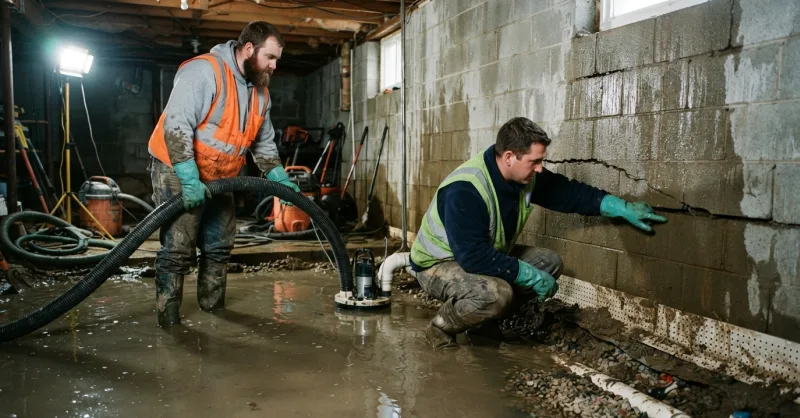
Last spring I walked a property in Bear where the homeowner had paid a competitor $1,800 for epoxy crack injection two years prior. The cracks reopened. Both of them. Wider than before.
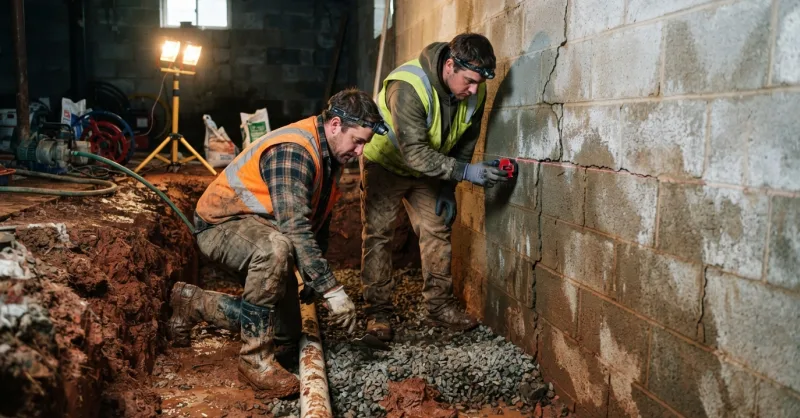
The original contractor never ran a soil profile. Didn’t bother checking whether the clay beneath that slab was in its shrink cycle or its swell cycle. Just pumped resin into a symptom and drove away. When I got there, the east wall had shifted almost a quarter inch past the original crack line. The “repair” had created a false monolithic bond that redirected the stress, and now there were two new fractures branching off the original.
(This is the kind of thing that makes me lose sleep. Not because the problem is complex, but because it was so avoidable.)
Here’s what temporary patches actually cost when they fail:
- Epoxy injection at $8 to $15 per linear foot ignores active soil movement. Cracks reopen within one freeze-thaw cycle in the Mill Creek Hundred frost zone.
- Surface parging at $3 to $5 per square foot masks hydrostatic pressure. It never qualifies as a structural repair under NCC code.
- Undersized sump pumps rated below 2,000 GPH don’t address the source. They just delay the flood.
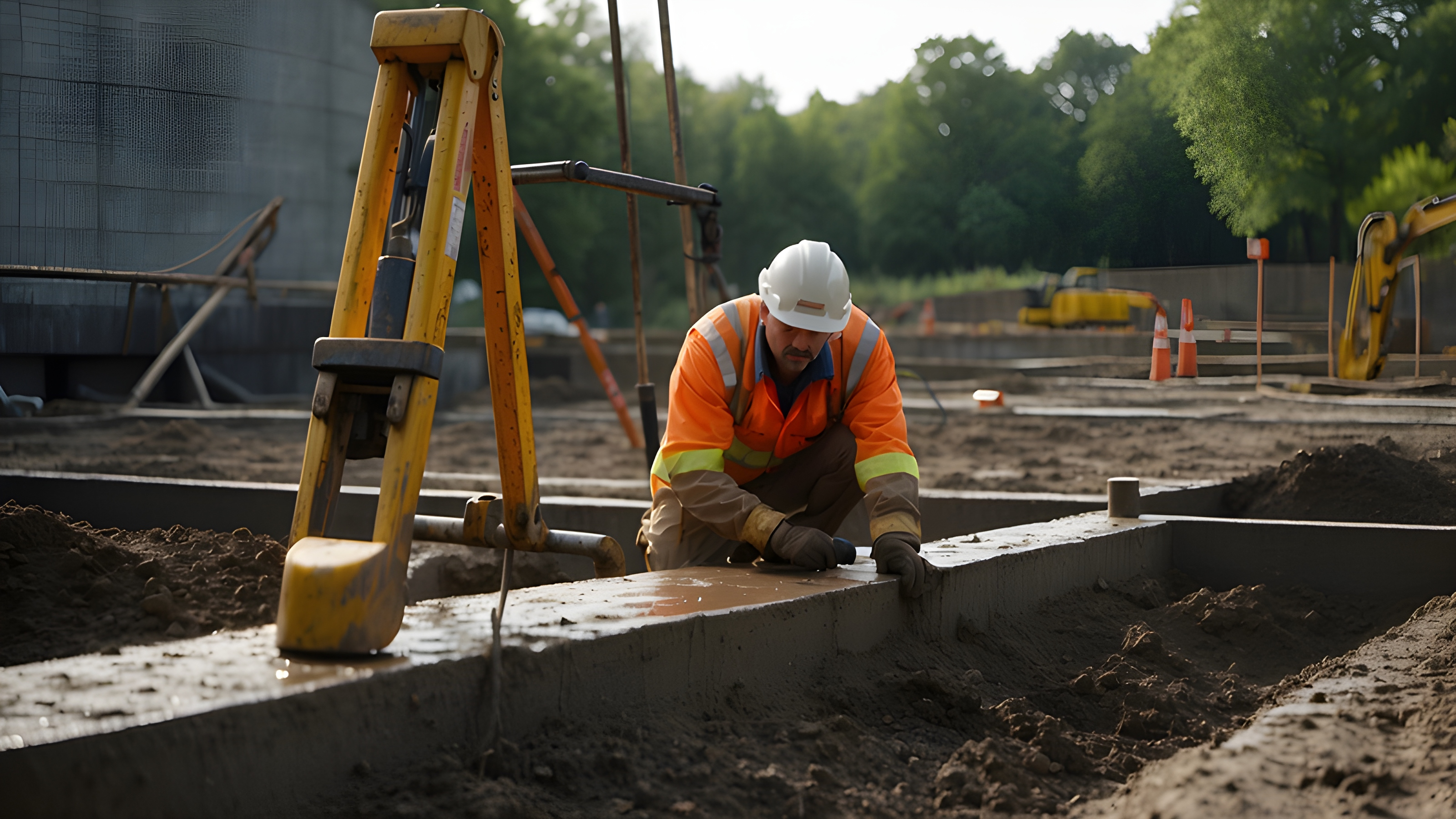
A permanent repair physically alters the load path. It transfers your structure’s weight onto a bearing stratum below the active clay zone. Anything short of that is decoration.
Line-Item Cost Breakdown for Permanent Underpinning in Delaware
I publish our pricing because I’m tired of watching property managers get ambushed by change orders. If you’re defending a capital expenditure to a board in Dallas or Philadelphia, you need hard numbers. So here they are.
| Cost Component | Unit Price | Notes |
|---|---|---|
| Helical Pier Mobilization and Excavation | $250 per pier | Includes rig transport from Kirkwood Highway staging |
| Helix Torque to Refusal (ICC-ES ESR-2794) | $950 to $1,050 per pier | Galvanization allowance of 0.0625 inch sacrificial thickness included |
| County Permit Fee per NCC Code 105.3.2 | $0.50 per sq ft | Triggered for repairs over 500 sq ft |
| PE Stamp and Engineered Drawing Set | $1,800 flat | Submitted via ePermit NCC |
| CPT Soil Sounding Adjacent to Footing | $2,500 to $3,200 | Produces digital friction ratio log identifying clay susceptibility |
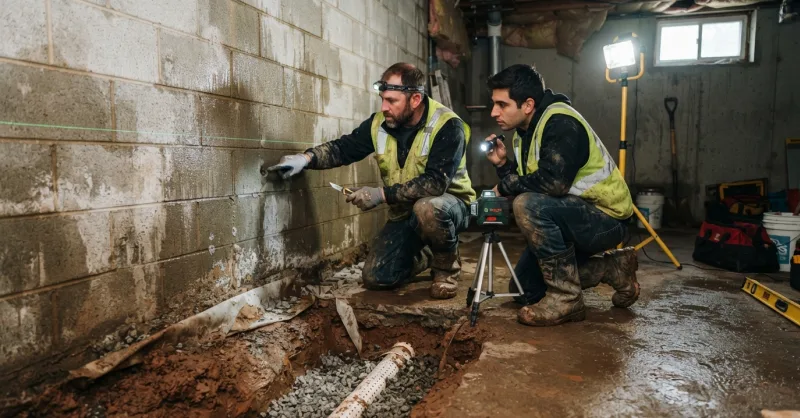
| Digital Level Survey (Trimble Robotic Total Station) | $850 | Maps out-of-plane deformation before any trench cut |
| Carbon Fiber Laminate (Sika CarboDur S512) | $450 per linear foot total | Includes surface prep, anchor, and installation |
| DelDOT Right-of-Way Bond | $1,200 to $1,500 | Required for row homes impacting public sidewalks |
| CSO Backflow Valve | $600 to $800 | Pre-requisite in Wilmington Ninth Ward combined sewer zones |
Those winter epoxy cure blankets and pre-heating rigs? $150 per injection port. Third-party load test records uploaded to NCC ePermit? $400. Most competitors never even mention these. You find out when the invoice arrives.
If someone hands you a lump sum without this level of detail, walk. You’re about to pay for guesswork. We break every foundation repair project into auditable line items tied to county milestones.
Your New Castle County Soil Profile Dictates the Entire Repair Strategy
The Fall Line runs right through our service area. It’s the geologic boundary where Piedmont crystalline rock meets the unconsolidated Atlantic Coastal Plain. If your property sits near the Kirkwood Highway to I-95 belt, your foundation straddles two completely different subsurface realities within a half-mile radius.
A warehouse slab on the US 13/Route 9 corridor near the Port of Wilmington sits on Christina River alluvial floodplain soils. The USDA classifies these as Fluventic Hapludolls, silt loam over stratified gravel. They compress. Unevenly. I’ve seen differential settlement exceed the L/360 serviceability criterion on 1970s tilt-up bays where nobody thought to check what was underneath before pouring.
Does that structural crack in your warehouse actually require permanent foundation underpinning, or is it a surface-level cosmetic issue? The only way to know is a CPT sounding. We push a cone penetrometer into the ground adjacent to the settlement zone and produce a friction ratio log that tells us exactly where the bearing stratum sits. No guessing. No rule-of-thumb pier counts. The data determines the pier embedment length, and it eliminates over-engineering waste that inflates your bid.
Out near Hockessin, the problem flips entirely. Carbonate rock dissolution creates sinkhole-prone conditions that demand a grout stabilization contingency baked into the scope. Two properties three miles apart can require fundamentally different permanent solutions. This is why the cost of permanent slab foundation leveling varies so much across the county.
What Separates a Permanent Fix from the Patchwork Most Contractors Sell
I inspected a triplex in Elsmere last January where the basement wall had bowed inward almost two inches during a single 48-hour Nor’easter. The previous contractor had applied surface parging and called it waterproofing. That parging cracked open like an eggshell under hydrostatic pressure.
A permanent structural repair does three things no temporary fix can:
- It moves the load path below the active clay zone, past the depth where seasonal moisture swings cause volumetric soil change.
- It meets the ICC-ES AC358 acceptance criteria for an 80-plus year design life, confirmed by galvanization thickness exceeding 3.9 mils for Delaware’s humid subtropical corrosion environment.
- It includes post-construction verification. We re-survey elevations at 90 days. Zero differential settlement delta, or we come back.
Our warranty runs 25 years, transferable, backed by NTPEP-approved pier testing. The payment schedule ties to county milestones: 20% at permit issuance, 30% when a third-party geotechnical engineer verifies pier tip elevation, 30% after the load test batch report, and 20% after the 90-day elevation re-survey. You pay for verified performance, not just completed excavation.
Can homeowners insurance actually cover permanent foundation damage repair in Delaware? Rarely. Most policies exclude earth movement and settlement. They might cover sudden water damage that caused the failure, but the structural underpinning itself almost never falls under a standard HO-3 policy. I tell people this upfront because I’d rather they plan financially than get blindsided by a denial letter three weeks into the project.
Defending a Foundation CapEx to Your Board When the Lease Is at Stake
If you manage industrial flex spaces along the I-95 corridor, you already know the nightmare scenario. A pre-acquisition structural report flags differential settlement in a tilt-up bay. Your cold-storage tenant’s FDA-regulated operations can’t tolerate vibration or dust. And your board wants a guaranteed maximum upset price before they’ll approve a dime.
We deliver that. A lump-sum fixed price backed by a bonded performance guarantee, with a project timeline designed around tenant operations. No asphalt disturbance, no environmental triggers that would force a Phase I re-assessment by Delaware DNREC.
How quickly can a contractor actually pull a New Castle County building permit for structural underpinning? We submit digitally via ePermit NCC and consistently secure approval within 10 business days. The permit package includes the PE-stamped drawings, soil boring logs, and the engineered pier layout. When more than one-third of a contiguous wall length requires underpinning, NCC code 105.3.2 triggers full engineered design review and third-party special inspection. We handle that entire sequence. You get a post-repair ALTA survey confirming the improvement doesn’t impact zoning height or impervious coverage limits under the Unified Development Code.
The IRS classification question comes up a lot. Whether the repair falls under Section 179 as a betterment or qualifies as a deductible repair depends on whether you’re restoring the property to its original condition or improving it beyond baseline. A forensic engineering report establishing the specific failure mechanism strengthens the argument for deductible repair classification. We produce that report.
No Foundation Fix Is Permanent Without Solving the Water
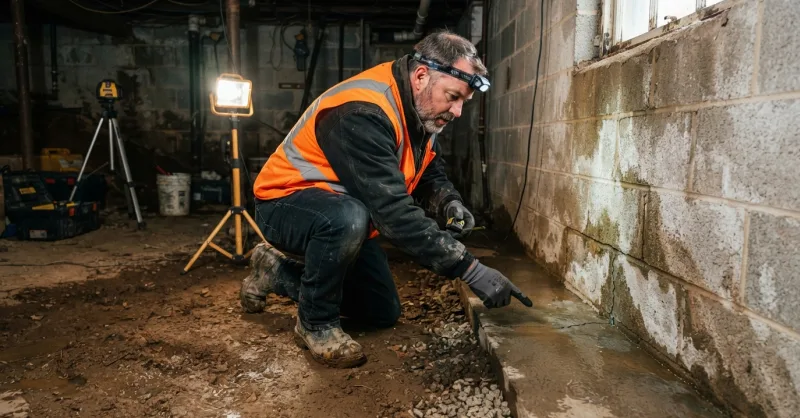
I can install the most perfectly torqued helical piers in the county, and if water keeps hammering the foundation envelope, you’ll have a new problem inside five years. That’s why our basement waterproofing systems get scoped alongside every underpinning project. Not as an upsell. As a structural prerequisite.
In Wilmington’s Ninth Ward, the city’s combined sewer overflow surcharge events directly cause hydrostatic basement wall failure. A backflow valve installation ($600 to $800) has to happen before the permanent wall repair, or you’re fighting the same water source that caused the bowing. Pike Creek valley slopes need French drains with battery-backup sump pumps. The Christina basin properties near ZIP codes 19701 and 19702 require exterior waterproofing membranes rated for constant groundwater contact.
What’s the actual difference between a helical pier and a push pier for permanent stabilization? Helical piers screw into the ground and achieve load transfer through torque-correlated capacity. We use them when we need to bypass expansive clay and reach competent rock or dense glacial till. Push piers use the structure’s own weight as resistance and get driven to refusal. The right choice depends entirely on your subsurface profile and the structure’s dead load. I’ve seen contractors default to push piers on lightweight residential structures where the building doesn’t weigh enough to drive them properly. That’s a recipe for incomplete refusal and future settlement. We match the pier system to the soil data, not to whatever’s cheapest on the truck.
Fixing Foundations in Wilmington’s Historic Districts Without Triggering a Regulatory Mess
Row homes along Delaware Avenue in Wilmington’s historic district carry a whole extra layer of complexity. The Historic Preservation Commission requires a Certificate of Appropriateness for any foundation work visible from the street. That means matching 8-inch Module 40 salvage brick for repointing, and the mortar has to be Type N to match the original early 20th-century spec.
Carbon fiber laminate strips (Sika CarboDur S512) work well here because they arrest lateral soil pressure on brick party walls without altering the exterior appearance. At $450 per linear foot installed, it’s not cheap, but it’s permanent and it satisfies the preservation review board.
Any excavation that impacts the public sidewalk requires a MUTCD-compliant traffic control plan coordinated with DelDOT District 6. In older neighborhoods like Elsmere and Newport, overhead utility clearance scanning by a Delmarva Power subcontractor has to happen before we position a telescopic mini-excavator. Nobody wants to talk about arc flash fatality risk, but it’s real in those low-clearance corridors.
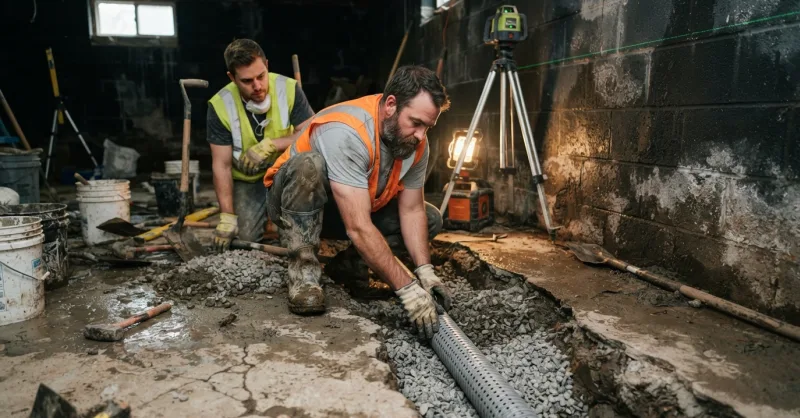
Can you permanently repair a bowing basement wall in a row home without full excavation? Yes. Carbon fiber reinforcement and structural wall bracing install from the interior. No trenching, no disruption to the neighbor’s foundation, no sidewalk closure. The laminate bonds to the concrete or masonry and provides passive post-tensioning that restores the wall section’s moment capacity per ACI 318-19 Chapter 10.
Stop Accepting Estimates That Hide the Real Numbers
I built AVG Waterproofing on a simple principle: tell people exactly what’s failing and fix it so they never pay for that crack or leak again. No sales scripts. No scare tactics. If telling you the truth costs me a project, so be it.
Every estimate we write includes the CPT sounding cost, the PE design stamp, the county permit fee, the prevailing wage labor rate, the third-party inspection, and the DelDOT bond if applicable. You see it all before you sign anything. Free, no-pressure structural estimates across New Castle County, Chester County PA, and Cecil County MD.
Follow our work on LinkedIn and Instagram to see real projects, real soil profiles, and real cost breakdowns from the field. Your home is in good hands.
Written by: Alex Velasquez
AVG Waterproofing LLC