



What Actually Counts as a Permanent Residential Foundation Crack Repair Solution in New Castle County?
A permanent fix stops water, restores tensile strength across the crack plane, and neutralizes the soil movement that caused it in the first place. Anything less is cosmetic.
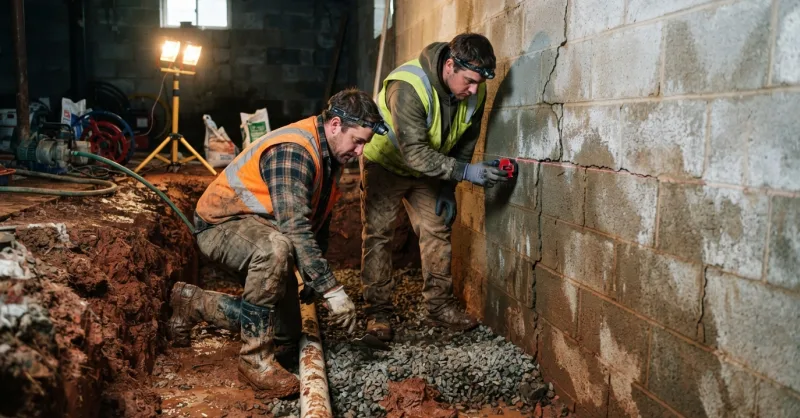
Here in Newark, that means three things working together on the same wall: polyurethane injection to seal the active leak, structural epoxy to weld the concrete back into a monolithic pour, and unidirectional carbon fiber laminate straps to carry future tensile load. All of it pinned to an engineer-stamped spec and a permit pulled through the New Castle County Department of Land Use.
I’ve walked enough basements from Bear to Brandywine Hundred to tell you flat out: if a crew shows up with a caulk gun and a smile, you’re buying a callback, not a repair.
The three-part protocol I stand behind:
- Polyurethane injection first, because you can’t bond epoxy to a wet substrate
- Two-component low-viscosity epoxy injected to refusal, restoring concrete tensile continuity
- Carbon fiber staples bridging the crack, sized per ACI 440 guidance for the wall’s unbraced height
That’s the protocol. That’s what gets the transferable warranty. That’s what survives due diligence when your portfolio hits refinancing.
Why Appoquinimink Clay Punishes Cheap Fixes
The soil south of the C&D Canal is not the same soil under a colonial in Hockessin. That matters more than most facility directors realize.
Appoquinimink clay lenses show shrink-swell pressures roughly 70% higher than adjacent loamy zones. Every wet spring, that clay expands against your foundation wall. Every dry August, it pulls away and lets the wall settle differentially. Rinse, repeat, and a hairline turns into a stair-step in about 18 months.
The freeze-thaw factor from late November through March is the accelerant. Water sits in a hairline crack. It freezes. It expands nine percent. The crack widens. Next storm, more water gets in.
I had a maintenance director from a portfolio off DE 896 call me last February. He’d paid a handyman crew $340 per unit to epoxy 22 basement cracks the previous fall. By March, 14 of them were weeping again. He wasn’t angry so much as tired (which honestly is worse to sit across from).
The problem wasn’t the epoxy product. It was that nobody addressed the soil pressure driving the crack open every seasonal cycle. Surface treatment on a soil-structure problem is like painting over a leaking pipe.
The Engineer-Stamped Difference Your Underwriter Actually Reads
When a rental portfolio hits refi, the lender wants a structural condition letter. Not a receipt. Not a “waterproofing warranty” printed on cardstock. A letter, signed, with a Delaware PE stamp on it.
I’ve watched deals stall at the closing table over this exact thing. A property manager thought his patch job on three units in Glasgow would clear inspection. The lender’s engineer flagged all three as non-permitted structural work. The portfolio owner had to retro-engineer the fix, pull permits after the fact, and pay us to redo two of them properly. That’s roughly $18K he shouldn’t have spent, plus a 21-day closing delay.
What a proper repair packet includes:
- Permit application filed with New Castle County Department of Land Use before work starts
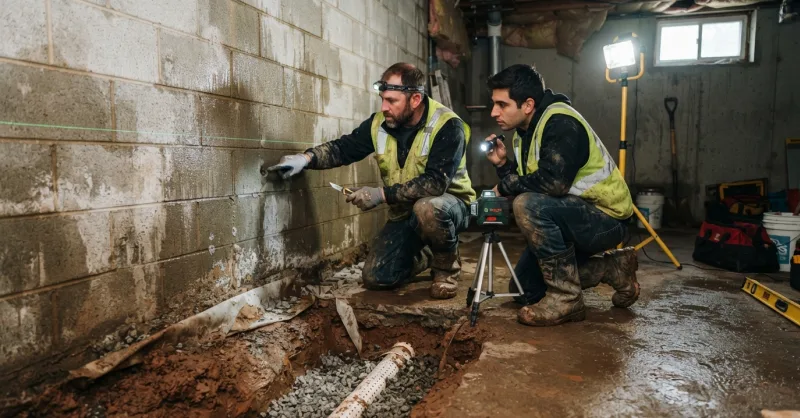
- Pre-repair diagnostic report with crack morphology classification and moisture readings
- Engineer-stamped repair specification citing ACI 440 for the carbon fiber design
- Post-repair inspection sign-off and Certificate of Structural Integrity
- Transferable lifetime workmanship warranty recorded in the property file
That packet is the asset. The repair is just the physical part. If you’re managing 400 to 700 units, the documentation is what protects your loan covenants, not the caulk bead.
Curious how this ties into full foundation repair scope across a portfolio? We handle diagnostics, repair, and paperwork under one roof, which is the point.
A Real Case File From the Route 40 Corridor
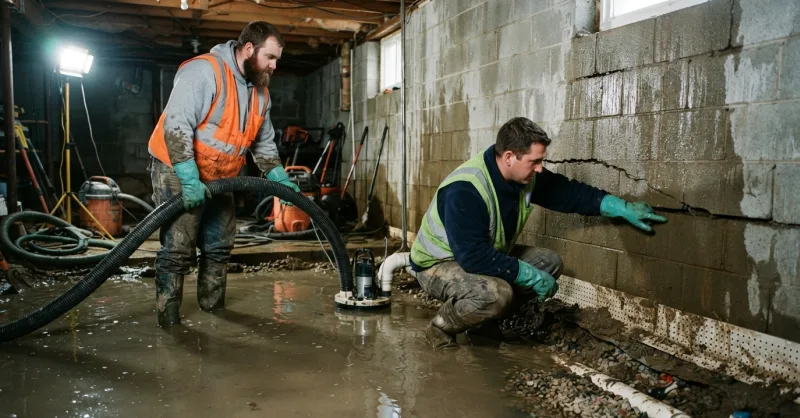
Last spring I got called to a 34-unit townhome cluster near Bear, off US 40. Twelve tenant work orders in six weeks, all “water in basement” complaints, all traced to vertical cracks in the poured foundation walls.
The original builder had used a standard 8-inch wall on Appoquinimink-influenced fill. No footing drain tile inspection on record. Downspouts dumping within four feet of the wall on 26 of 34 units. It was a slow-motion failure that had probably been developing since the second freeze cycle after occupancy.
What we actually did, in order:
- Ultrasonic pulse velocity readings on every crack to measure depth (four exceeded the wall thickness)
- Polyurethane injection on all 41 active cracks across the cluster
- Epoxy injection to refusal on the 27 non-hydrostatic cracks
- Carbon fiber staples on 19 walls where the crack pattern indicated ongoing tensile stress
- Downspout extensions and grading correction on 26 units
- Two helical piers on one corner unit where the footing had dropped an inch and a quarter
Nine months in, zero recurring work orders. The director told me his spring 2025 tenant complaint queue for that cluster was empty for the first time in four years. That’s the metric that actually matters to him, not our marketing copy.
Was it perfect? No. We hit a buried oil tank on unit 17 that nobody knew about, which cost us two days and required a separate DNREC notification. That kind of thing happens on 1970s Delaware properties. You plan for it.
When Carbon Fiber Alone Isn’t Enough
Sometimes the wall isn’t the problem. The footing is.
If differential settlement shows up in your diagnostic (uneven floor slopes, doors binding on the second floor, stair-step cracking that widens toward the top), you’re looking at a bearing capacity issue. Carbon fiber reinforces the wall, but it won’t lift a footing that’s sitting on soil that gave up.
That’s when galvanized steel helical piers come in, driven through the active zone to competent bearing strata. On the industrial-residential fringe near the Delaware Memorial Bridge, we’ve had to go 22 feet deep to hit refusal because of the fill history. Truck vibration from I-295 doesn’t help either, though I’d argue it’s a lesser factor than the soil itself.
A quick way to think about it: carbon fiber handles horizontal wall stress from lateral soil pressure. Helical piers handle vertical settlement from bearing failure. Most homes need one. Some need both. A handful need neither, and I’ll tell you that straight up during the free assessment. If telling you the truth costs me the job, so be it. I’d rather sleep well.
For portfolio-scale planning around slab foundations, our breakdown of permanent slab leveling costs is worth a look before you build next year’s capex.
Where Crack Repair Meets Full Basement Waterproofing
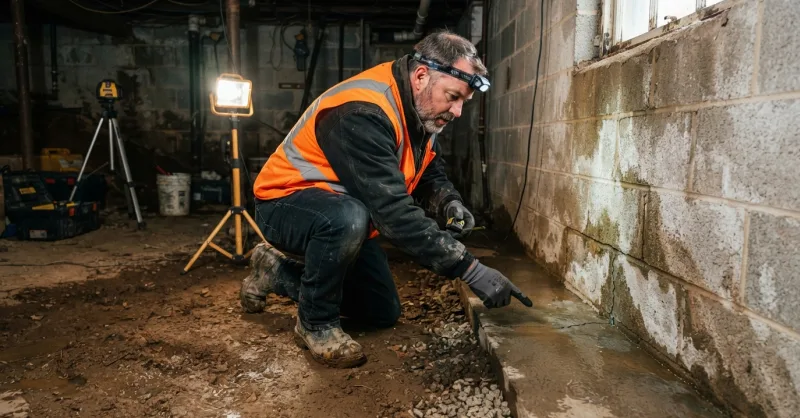
A sealed crack on a wall that’s still fighting hydrostatic pressure from a saturated footing is a temporary win. Water will find the next weak point, usually the cove joint or a form tie hole.
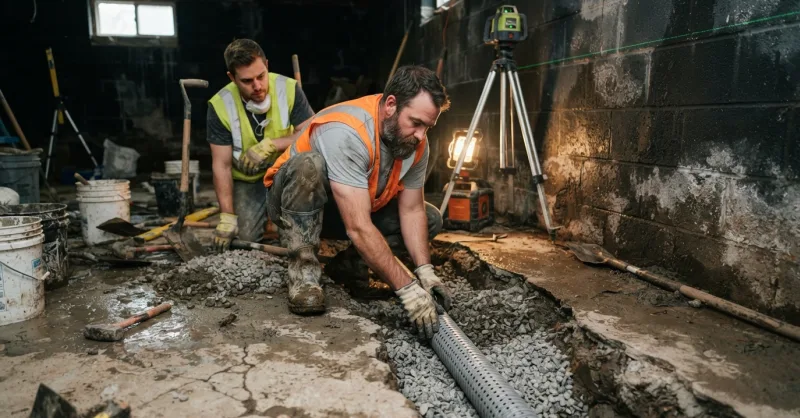
On properties near the Red Clay Creek floodplain or the I-295 industrial recharge zone, we often pair crack repair with interior drain tile and a properly sized sump system. That’s not upsell talk. It’s what the water table demands.
One property I looked at in Elsmere had eight sealed cracks and a sump that ran every 90 seconds during a March storm. The cracks weren’t the issue anymore. The perimeter drain had silted up in 2019 and nobody had rodded it. Fixed the drain, added a battery backup pump, and the sump cycles dropped to every twelve minutes. Same house.
Sometimes the bowing wall question comes up during these audits. How do I know if a basement wall is bowing enough to need reinforcement instead of just crack repair? If you can lay a four-foot level against the wall and see more than a quarter inch of deflection at the middle, or if the horizontal crack runs unbroken across more than six feet, you’re past crack repair territory. That’s structural, and it needs a proper engineered response, which is why some clients ultimately bring in a structural expert for bowing walls.
Full basement waterproofing scope matters when the crack is a symptom, not the disease.
Permits, Property Transfers, and the Paperwork Nobody Warns You About
New Castle County flags non-permitted foundation repairs during property transfer inspections. It’s in the county’s capital improvement disclosure requirements, and it will absolutely surface during a home inspection tied to an FHA or VA loan clearance.
I’ve seen deals lose 45 days because a seller couldn’t produce documentation for a “waterproofing” job done in 2021. The buyer’s inspector wrote it up. The underwriter froze the file. The seller had to hire an engineer to retroactively certify the work, which meant partial demo to expose the repair for inspection. Expensive lesson.
A common question from directors handling multi-property refis: does a permitted, engineer-stamped crack repair actually add resale value, or is it just a wash? On rental properties in the Christina School District feeder pattern, we’ve seen appraisers give measurable credit for documented structural repairs with transferable warranties, mostly because it removes an inspection contingency risk. It’s not a huge number per unit, but across 400 doors, it moves the needle on portfolio valuation.
The other one I hear a lot: how quickly can you turn around a diagnostic report for a property that’s already under refi contract? We can have a desktop analysis back within same-day for three photos plus a moisture reading, and a full on-site engineer report inside 48 hours for New Castle County properties. Chester County and Cecil County properties run 72 hours because of scheduling.
How We Actually Work, and Why That Matters
We’re a small operation running on 25 years of U.S. structural experience and 6 years dialed into DE, PA, and MD soils specifically. No sales scripts. No commissioned closers. If we don’t think you need the full protocol, we’ll tell you.
Our shop sits at 500 Apple Rd, Newark, DE 19711, which puts us inside a 40-minute drive of every property from Claymont to Middletown, and quick reach into Chester County PA and Cecil County MD.
A question that comes up during acquisition due diligence: can you handle a multi-property inspection sweep across a portfolio in a single scheduling window? Yes, we do this regularly for regional property groups, especially before spring thaw. We batch the diagnostics, produce individual reports per address, and roll them into a portfolio-level capital plan your CFO can actually use.
One more I get from newer maintenance directors: what’s the difference between polyurethane and epoxy injection, and why do you use both? Polyurethane is hydrophilic and flexible. It chases water and seals active leaks. Epoxy is rigid and structural. It restores tensile strength but won’t bond to a wet surface. Using both, in the right order, is what makes the repair permanent instead of cosmetic.
Find us on LinkedIn or Instagram for field photos and ongoing project docs. We post the real stuff, including the jobs that didn’t go smooth.
Last question worth answering here: is there a specific time of year when it’s smarter to schedule permanent foundation crack repair for a rental portfolio in the tri-state corridor? Late fall, before the ground freezes, is ideal for injection work because the walls are dry and the resin cures cleanly. Winter is fine for interior work. Early spring is our busiest season because that’s when tenant complaints spike, so booking pre-season gets you priority scheduling and often better pricing.
Written by: Alex Velasquez
AVG Waterproofing LLC