


What Actually Causes Bowing Basement Walls in New Castle County, and When Do You Need a Structural Expert?
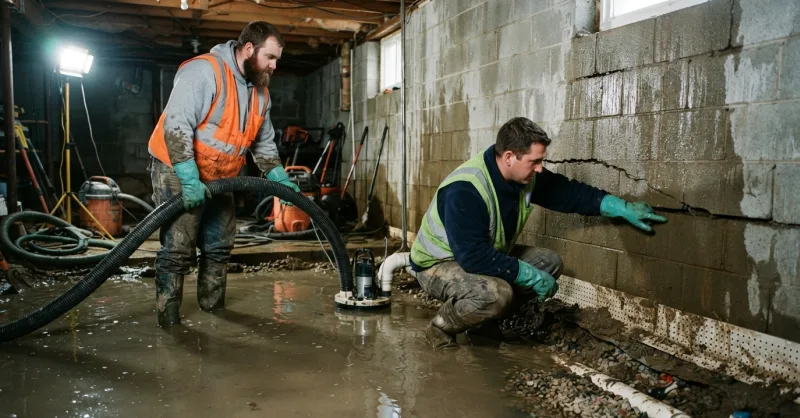
If you’re managing a multifamily portfolio in Claymont or overseeing facilities at a corporate campus off Route 202, you’ve probably seen it: a basement wall that’s no longer plumb. Maybe it’s a hairline crack running diagonally from a block joint. Maybe it’s a full inch of inward deflection at mid-span. Either way, your first instinct is probably to call someone who can fix it fast.
The problem is most people call the wrong someone.
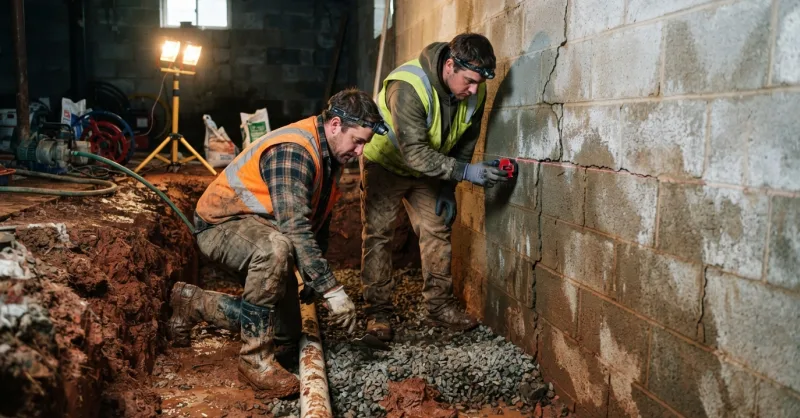
I’ve been diagnosing foundation walls across New Castle County for over six years, working specifically with the marine clay strata that runs from Newport through Elsmere and into Milltown. Before that, 25 years of U.S. structural work. And the number one reason I see bowing walls get worse after a repair? The contractor treated lateral soil pressure like a waterproofing problem.
These are not the same thing.
The Soil Nobody Talks About
Homes and commercial buildings sited on the Potomac Formation deal with high-plasticity smectite clays that expand significantly during seasonal saturation cycles. We’re talking 30 to 60 pounds per square foot of additional lateral load against your foundation wall, beyond what standard IRC 2015 design tables assume. That’s not a worst-case scenario on paper; that’s Tuesday in zip code 19808 after a Nor’easter rolls through.
In northern New Castle County, around the 19803 and 19810 zip codes, freeze-thaw lensing compounds the problem. Soil creep pushes outward over the course of two or three winters, and then one spring, the wall has moved enough to trigger your insurance carrier’s structural audit clause. (Yikes. That call is never fun.)
So when should you bring in a structural expert, not just a waterproofing crew? The honest answer: the moment you see measurable deflection. A visible bow is not a cosmetic issue. At AVG Waterproofing LLC, we show up same-day for active wall displacement anywhere along the I-95, Route 1, and Route 202 corridors covering all of New Castle County.
Why a Forensic Structural Assessment Beats a Verbal Ballpark Every Single Time
Here’s something I see constantly, and it genuinely frustrates me: a property manager at one of the Ingerman Group communities in Newark calls three contractors. Two show up, glance at the wall, and hand over a number on a sticky note. No documentation, no deflection measurement, no engineering analysis.
The third one subcontracts the job to a crew the original company has never verified.
None of that protects you under Delaware Landlord-Tenant Code Title 25 if a tenant displacement event occurs. None of it satisfies your insurer’s requirement for Professional Engineer oversight. And none of it gives you a defensible paper trail when your asset goes up for refinancing.
What a Real Structural Evaluation Looks Like
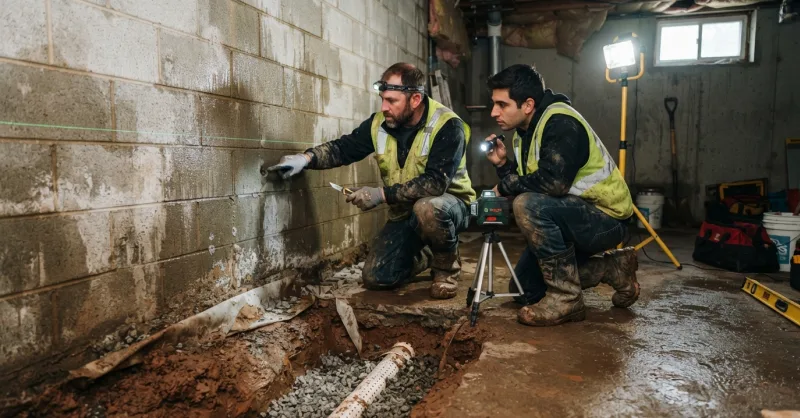
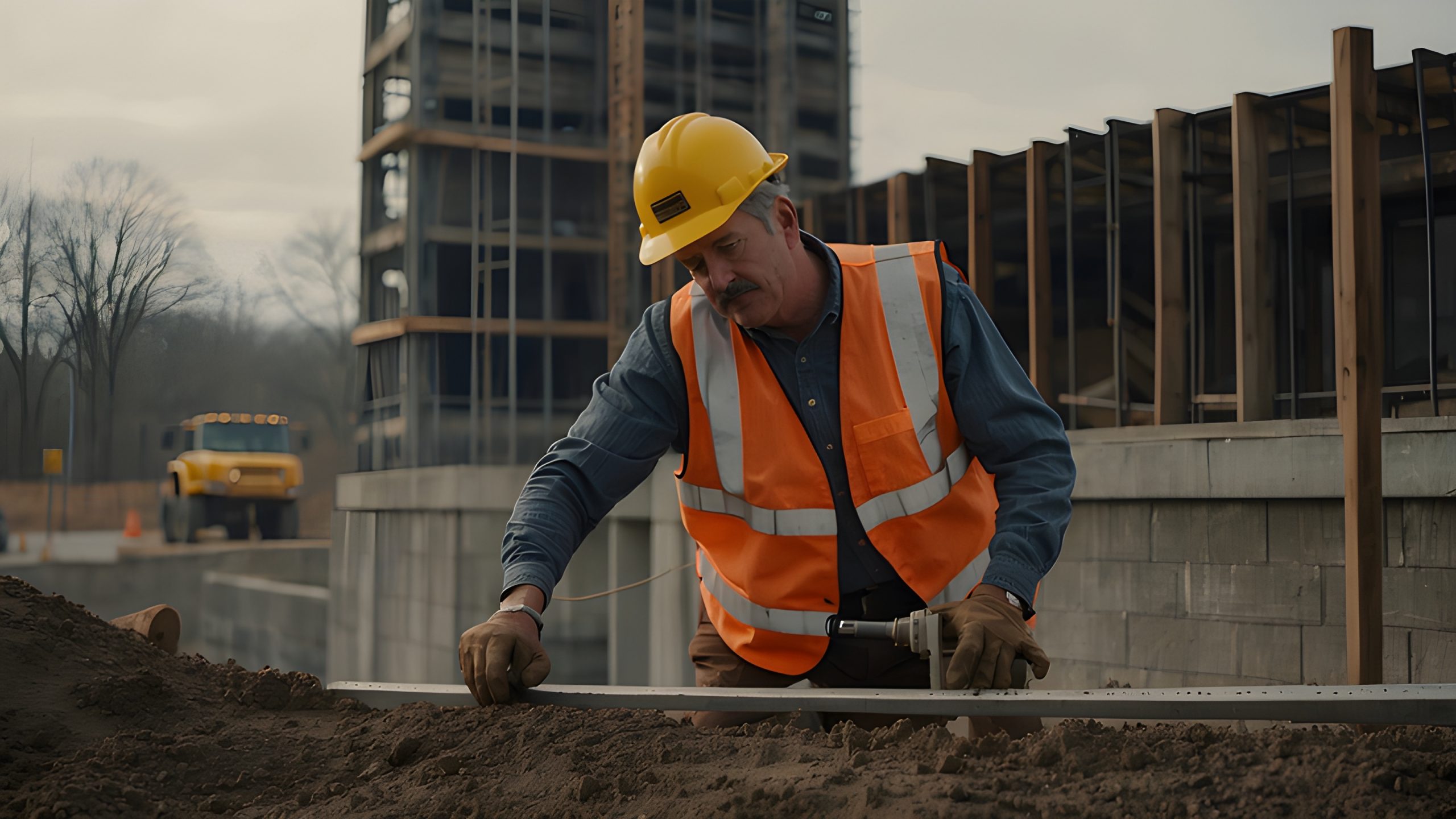
When I arrive on site, I’m carrying a digital inclinometer and a laser plumb-bob array. We map wall deflection quantitatively, not by eyeballing. The preliminary forensic report, with annotated photographs and a deflection profile, goes to you within four hours of arrival.
That report carries a Delaware-licensed Professional Engineer’s signature and seal. That’s not a luxury; it’s a non-negotiable requirement for any permanent wall stabilization method under the Delaware Association of Professional Engineers statute. If a contractor tells you they can permanently fix a bowing wall without a PE stamp on the design, walk away.
The question facility directors at ChristianaCare’s Newark campus or JPMorgan Chase’s Wilmington technology centers ask me most often: “How quickly can we get a signed, sealed condition assessment to release emergency capital reserve funds?” The answer is the same day we’re on site.
Naturally you’d want to know what methods we actually use to fix the wall once the assessment is done. Good. Let’s get into that.
Carbon Fiber Straps, Steel I-Beams, or Helical Tiebacks: Matching the Fix to the Soil
Not every bowing wall gets the same repair. That sounds obvious, but you’d be surprised how many crews carry one solution and apply it everywhere.
I once got called to a property off Kirkwood Highway in the 19808 zip code after a previous contractor had installed carbon fiber straps over a wall showing active lateral movement. The wall was still moving. The straps were delaminating. The homeowner had spent roughly $7,000 on a repair that wasn’t matched to the actual failure mode. (Honestly, I wasn’t surprised when I saw the soil conditions underneath. Classic Potomac Formation clay, fully saturated.)
The Method Comparison
| Method | Best For | Typical Cost Range (New Castle County) | Project Duration |
|---|---|---|---|
| Carbon Fiber Reinforced Polymer (CFRP) Straps | Minor inward deflection under 2 inches, stable soil conditions | $5,500 to $8,000 per wall | 1 day per wall, 24-hr cure |
| Wide-Flange Steel I-Beam Bracing (W6x12, hot-dip galvanized) | Active lateral movement, walls exceeding L/180 deflection limit | $12,000 to $18,000 per wall | 2 days including epoxy-set anchor rod installation |
| Helical Tieback Anchors (galvanized steel shafts to competent bearing strata) | Severe displacement, deep clay profiles, exterior excavation scenarios | $12,000 to $18,000 per wall, inclusive of PE design | 3 to 5 days; DNREC sediment control permit may add 48-72 hrs |
For properties in Wilmington’s Forty Acres or Cool Spring historic zoning overlays, exterior excavation triggers Art Commission review. Internal steel I-beam bracing often becomes the only practical path to stabilization without running into six-month municipal delays. We know the difference. We plan for it up front.
All three methods, when properly engineered to site-specific soil mechanics and designed per IRC 2015 Section R404 with Delaware state amendments, deliver permanent results. That’s the word we use deliberately: permanent. Not “long-term.” Not “effective.” Permanent.
If you’re overseeing foundation repair across a mixed-use portfolio and need a clear comparison of what each structural intervention actually costs and requires, that page breaks it down in practical terms.
Navigating DNREC, New Castle County Land Use, and the PE Seal Requirement Without Losing Six Weeks
Permitting gridlock is real. I’ve watched projects stall for weeks because a contractor didn’t understand that excavation work near the Christina River watershed or White Clay Creek triggers DNREC’s Sediment and Stormwater Program review. That’s before New Castle County Department of Land Use even opens the file.
If you’re a Real Estate Asset Manager holding a distressed property along the Wilmington Riverfront in zip code 19801, project stall isn’t just an inconvenience. It’s a direct hit to your disposition timeline.
How We Handle It
We hold a valid Delaware state-issued PE license and a New Castle County business license. We handle the DNREC sediment control permit application in-house. We submit to the Department of Land Use as the engineer of record. You don’t manage three separate moving pieces; you manage one point of contact.
Every repair design we issue gets a wet-stamped PE plan. Fixed-price scope. No change orders after the geotechnical assessment is complete. The line-item engineering budget covers the PE stamp fee, permit application, structural repair design, material specifications (galvanized W6x12 beams, CFRP laminate specs, helical anchor torque requirements), installation labor, and final deflection certification.
Directors of Facilities managing AstraZeneca’s campus or Chemours’ properties ask me how we guarantee price certainty once soil conditions are confirmed. The answer is straightforward: we don’t price before the soil assessment. We price after it. The number doesn’t change once we’ve signed off on the geotechnical baseline.
Sort of a boring answer, but it’s the only honest one.
Zero Subcontractors, 25-Year Transferable Warranty: What That Means for Your Asset
Every crew member working on your property under AVG Waterproofing LLC is a direct W-2 employee. OSHA-certified for confined space. Trained in ASTM-compliant material application. Discrete uniforms, NDA-respecting, safety-compliant on site.
I made this a policy because I’ve seen what happens when it isn’t. A Senior Property Manager at a Pettinaro Management community called me after a subcontracted crew from another company installed wall anchors without verifying the existing drainage board condition. The anchors pulled through saturated clay within 14 months. There was no warranty. The original contractor had dissolved the subcontract entity. (Real situation. Different company, obviously.)
The subcontractor communication vortex is exactly what it sounds like: you call the company you hired, they call someone they contracted, who calls someone else, and nobody owns the outcome.
Why Transferability Matters Right Now
If your property sits within five years of a sale or refinancing event, a 25-year transferable structural warranty attached to a PE-sealed repair design is a line item that directly supports your cap rate. Lenders and buyers want documentation. A signed warranty registered with the Delaware Better Business Bureau, backed by an engineer of record, closes that gap.
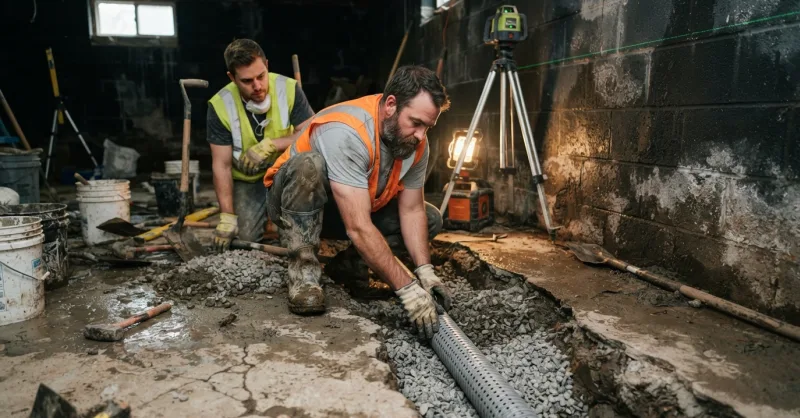
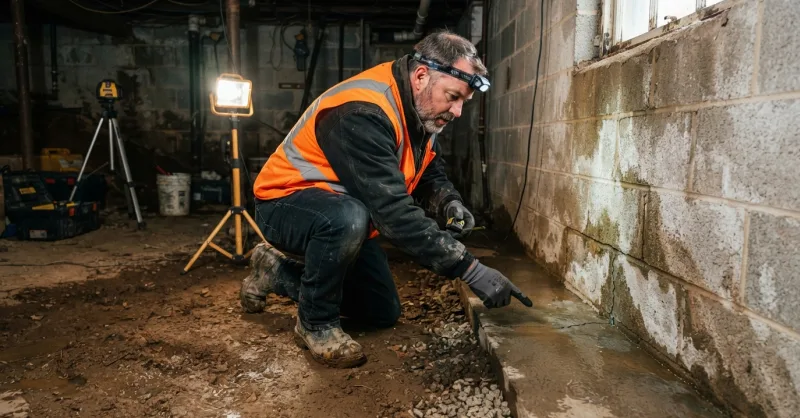
For any property touching the interior basement waterproofing scope simultaneously, we evaluate both systems together. A structurally repaired wall paired with an undersized or failing drainage system just moves the failure point downstream. We assess the full envelope.
We also see this scenario come up constantly with slab foundation leveling projects where lateral wall movement and differential settlement are occurring simultaneously. If the wall is bowing inward and the slab is settling at the perimeter, those aren’t two separate problems. That’s one geotechnical failure presenting in two places.
Working With AVG Waterproofing LLC Across New Castle County: What the Process Actually Looks Like
I run AVG Waterproofing LLC out of 500 Apple Rd, Newark, DE 19711. We cover all of New Castle County, Chester County in PA, and Cecil County in MD. No franchises, no white-label crews, no rotating subcontractors.
The process is direct:
- Same-day structural reconnaissance for active wall displacement, including digital inclinometer mapping and laser level settlement survey
- Preliminary forensic report with annotated photographs delivered within four hours of arrival
- Fixed-price engineering budget issued before any work begins, inclusive of all permit fees, PE stamp, materials, labor, and final deflection certification
- Repair executed by our direct-hire crew under PE oversight at every phase
- Final load-test verification and a 25-year transferable performance warranty
Free structural estimates, no pressure, no sales script. The tagline is “Your Home In Good Hands” and I mean it literally, not as marketing copy.
If telling you the truth about a repair costs me a project, so be it. I’d rather sleep well at night.
You can follow our diagnostic work and project documentation on Instagram or connect with us on LinkedIn where we publish technical field notes from local projects across the county.
Reach out. If your wall is moving, the clock is already running.
Written by: Alex Velasquez
AVG Waterproofing LLC