


Who to Call for a Sinking House Foundation: The Straight Answer for New Castle County Homeowners
If your house is sinking, you need a structural foundation repair and waterproofing specialist. Not a handyman. Not the guy who painted your neighbor’s basement last summer.
I’m Alex, and I’ve spent 25 years crawling under houses across the U.S., with the last 6 focused hard on the soils right here in the Tri-State. When someone in Newark or Wilmington calls me about a settling foundation, I tell them the same thing: your basement isn’t the problem. The dirt underneath it is.
Foundations don’t just decide to sink. They respond to what’s happening in the soil, the water table, and the freeze-thaw beating your footings take every February. A real specialist reads all of that before ever quoting a repair.
What Actually Qualifies as the Right Contractor
- Someone who measures floor elevations with a laser or manometer, not eyeballs cracks from the doorway
- A crew that talks about footing depth and bearing capacity before they talk about price
- A company willing to walk away from a job if the fix you want won’t actually hold
- References to New Castle County’s adopted 2021 IRC/IBC in the written scope
If the first conversation is a sales pitch dressed up as an inspection, hang up. I mean it.
Why Delaware Foundations Sink in the First Place
New Castle County sits on two different worlds geologically. Understanding which one your house is on changes everything about the repair.
The Piedmont Clay Problem
Up in Wilmington, Hockessin, and the northern edge of Newark, you’re on Piedmont clay sitting over schist and gneiss bedrock. That clay drains at less than half an inch per hour. When a big spring storm rolls through, it holds water like a wet sponge and gives up bearing capacity right where your footings need it most.
Then summer hits, the clay shrinks, and your foundation drops a fraction of an inch. Rinse and repeat every year. That’s how a hairline crack turns into a stair-step you can slide a quarter through.
The Coastal Plain Situation
Head east toward Bear, Christiana, and the river corridors, and the soil changes completely. Now you’re dealing with unconsolidated sands and silts, shallow water tables, and (if you’re near the Christina River or White Clay Creek) FEMA Zone A or AE flood mapping. Hydrostatic pressure builds against your walls during storms and pushes water through whatever weakness it can find.
The warning signs homeowners keep missing:
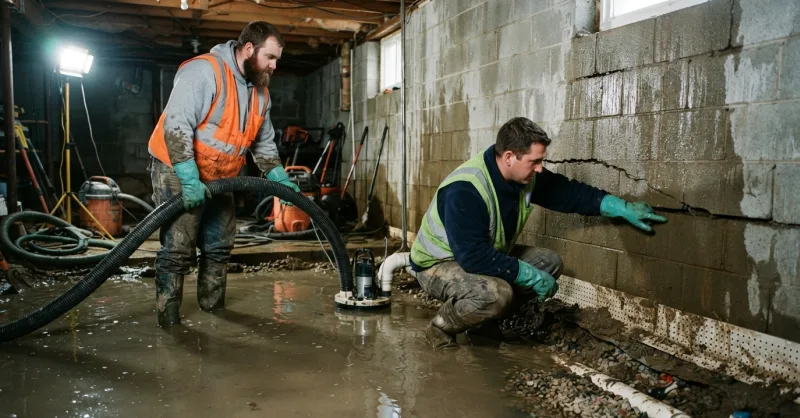
- Stair-step cracks in cinder block walls, especially near corners
- Doors that latch fine in January but stick by July
- A marble that rolls across the kitchen floor on its own
- White powdery efflorescence on basement walls (that’s a moisture signature, not cosmetic dust)
- Bowed walls with a horizontal crack running through them, which is lateral pressure and needs attention now
What Sinking Foundation Fixes Actually Fail
I had a call last spring from a homeowner off Route 7 near Christiana. Nice guy, semi-retired, bought his house in the late 90s. He’d already spent about $4,200 on waterproof paint and a couple of “crack injections” from a franchise outfit that door-knocked his neighborhood.
Water was still coming in. The floor near his laundry room had dropped almost three-quarters of an inch since the previous repair. He was furious, and honestly, I don’t blame him. (The sales rep who sold him the paint apparently promised a “lifetime guarantee” without ever measuring anything.)
Here’s what we found when we actually assessed it: his footing was undermined on the north side because the previous owner had regraded the yard toward the house. No drainage. Clay holding water against the wall for years. The paint job just sealed the moisture inside the block, which accelerated the freeze-thaw damage.
We ended up installing an interior drain tile system tied to a new sump with battery backup, and pushing two piers on the settled corner. Took eight days. His neighbor watched the whole thing and called us the following week (turns out half the block had similar issues, which tracks for that subdivision).
The lesson isn’t complicated. Cosmetic fixes treat symptoms while the mechanics keep failing. If you want to understand the difference, our breakdown on permanent residential foundation crack repair walks through why injections alone rarely hold.
What a Real Structural Inspection Looks Like
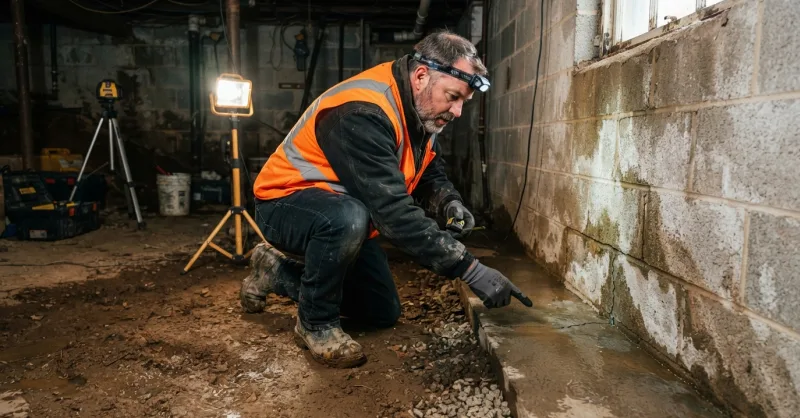
When I show up at your house, I’m not there to sell you a system. I’m there to figure out what’s moving and why. That means specific things happen in a specific order.
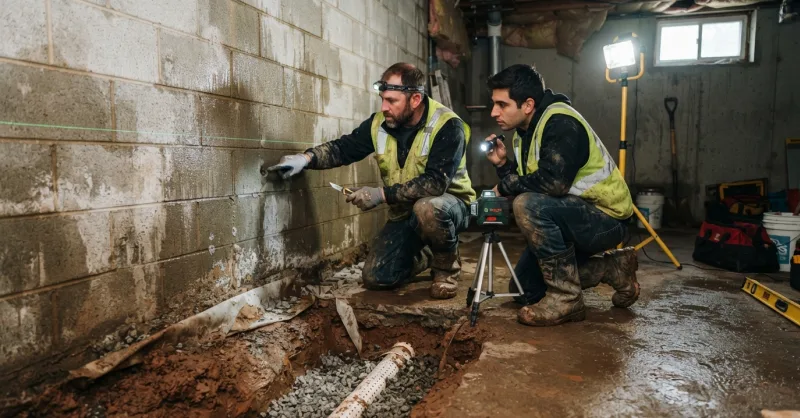
- Elevation readings across every accessible floor so we can quantify actual movement, not guess at it
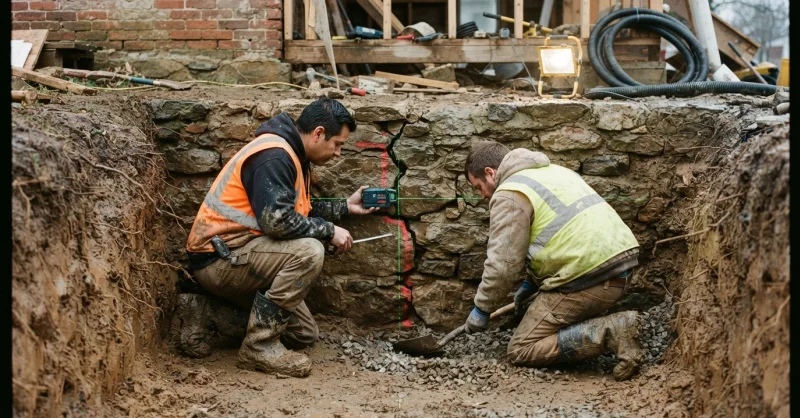
- Crack mapping to separate active cracks from ones that stopped moving a decade ago
- Checking footing depth against local frost line requirements and the soil profile under your specific lot
- Walking the exterior grade, gutters, and downspouts because half of what looks like a foundation problem starts six feet above the ground
- Assessing hydrostatic load if you’re anywhere near a mapped flood corridor
Should you hire a structural engineer first or a contractor first? For most residential settlement in New Castle County, a qualified contractor’s assessment is enough to start. If load paths are compromised or you’re prepping for a sale in a flood-aware ZIP like 19702, pair the contractor’s report with a licensed structural engineer’s letter. Lenders and appraisers want that documentation, and it protects your resale value.
Our free structural inspection process is built around this exact workflow. No pressure, no scripted upsells.
The Repairs That Actually Hold
Root-cause work in this region usually comes down to a combination of three approaches, matched to what the soil and water are actually doing.
Perimeter Drainage That Relieves Pressure
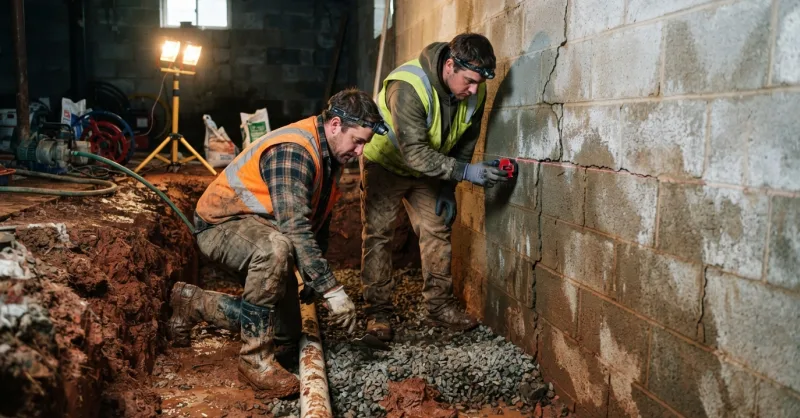
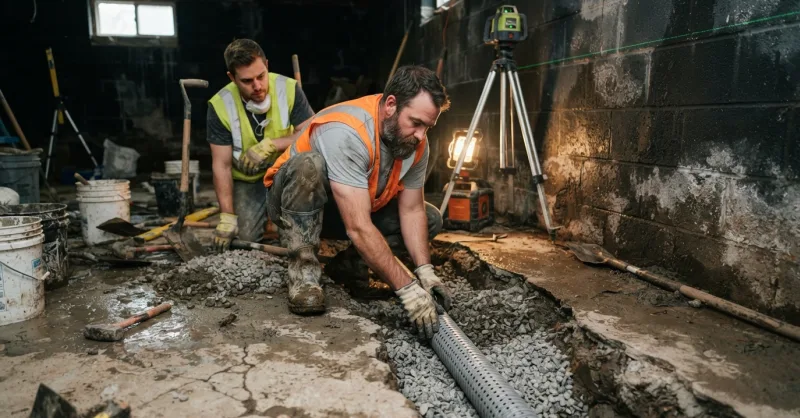
Perforated pipe at footer level, sitting in clean stone, wrapped in filter fabric, discharging to a properly sized sump with a battery backup. That’s how you drop hydrostatic head before it ever touches your walls. If your existing system was installed before the mid-2000s in a Wilmington rowhome, it’s almost certainly undersized for the storm intensities we’re seeing now.
Underpinning for Settled Footings
Helical piers, push piers, or drilled piers driven past the failing clay to stable strata below. This is how you actually stop settlement, not slow it. Our team’s approach to foundation underpinning and stabilization uses load-tested piers rated for your specific soil profile.
Wall Reinforcement for Lateral Pressure
Carbon fiber straps or steel I-beams for bowed walls fighting lateral soil load. Carbon fiber works well up to a certain deflection threshold; past that, you need steel. Anyone telling you carbon fiber fixes every bowed wall is either undertrained or hoping you don’t ask questions.
Is carbon fiber a permanent fix or a temporary patch? When installed correctly on a wall with less than about two inches of deflection, carbon fiber is a structural solution. Past that threshold, it’s a band-aid, and you need beams or excavation.
Cost, Timing, and What to Expect
Homeowners always want a number, and I get it. Nobody wants to book an inspection blind. Realistic ranges for New Castle County work look something like this, though the specifics depend heavily on access, soil, and how far things have moved.
| Repair Type | Typical Range | Common In |
|---|---|---|
| Interior drain tile + sump | $7,500 to $16,000 | Newark, Bear, Pike Creek subdivisions |
| Push or helical pier (per pier) | $1,800 to $3,200 | Wilmington, Hockessin clay zones |
| Carbon fiber wall reinforcement | $650 to $1,100 per strap | Block foundations countywide |
| Full exterior excavation + membrane | $18,000 to $45,000 | Historic Wilmington stone foundations |
If someone quotes you dramatically less, ask what they’re skipping. If someone quotes dramatically more, ask what they’re padding.
How long does a real foundation repair actually take in Newark or Wilmington? A typical interior drainage and sump install runs four to seven working days. Pier installations for settled footings usually finish in two to four days per side. Full exterior excavation on an older Wilmington property can stretch two to three weeks depending on utility conflicts and weather.
Local Response Along the I-95 Corridor
Our footprint runs the I-95 spine through New Castle County, which matters when a storm hits and your basement is filling. We’re not dispatching a truck from another state; our crews stage out of 500 Apple Rd, Newark, DE 19711, which puts most calls within a 25-minute drive.
We work seven days a week, 8 AM to 7 PM Monday through Saturday and 8 AM to 3 PM Sundays, because water damage doesn’t respect business hours.
Do you handle emergency response for active basement flooding during heavy storms? Yes. Same-day dispatch for active water intrusion across New Castle, Chester, and Cecil counties, with temporary pumping while we scope the permanent repair.
You can also see recent projects and homeowner walkthroughs on our LinkedIn and Instagram, along with some rough before-and-after shots from jobs in Bear, Hockessin, and Historic New Castle.
If telling you the truth about your foundation costs me a project, so be it. I’d rather sleep well at night than sell you a system you don’t need. Call when you’re ready for a real diagnosis, not a pitch.
Written by: Alex Velasquez
AVG Waterproofing LLC