


Who Are the Most Qualified Contractors Specializing in Foundation Underpinning and Stabilization in New Castle County, Delaware?
I’ve spent 25 years stabilizing foundations across the U.S. and the last six years specifically diagnosing the soils that run through Delaware, southeastern Pennsylvania, and northeastern Maryland. The answer to this question isn’t about who has the flashiest website. It’s about who understands the dirt under your building.
New Castle County sits on a geologic fault line of sorts, not seismic, but structural. The Fall Line cuts right through the I-95 corridor near Martin Luther King Blvd, and north of it you’re dealing with Piedmont clay over Wissahickon Schist bedrock. South of it, Coastal Plain sediments. Two completely different soil profiles, two completely different underpinning strategies, and most contractors around here treat them the same way.
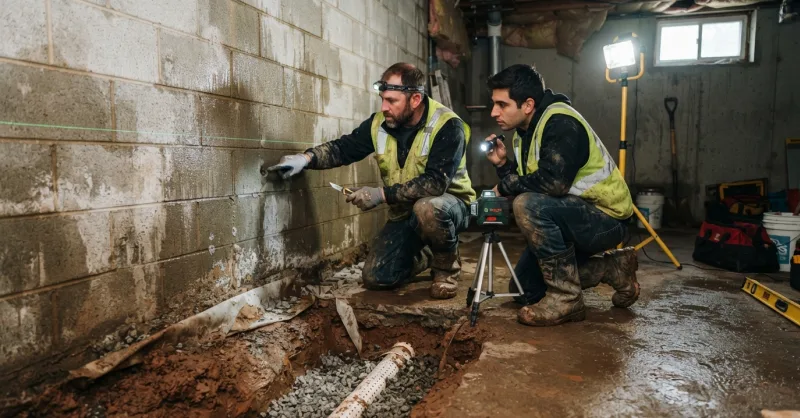
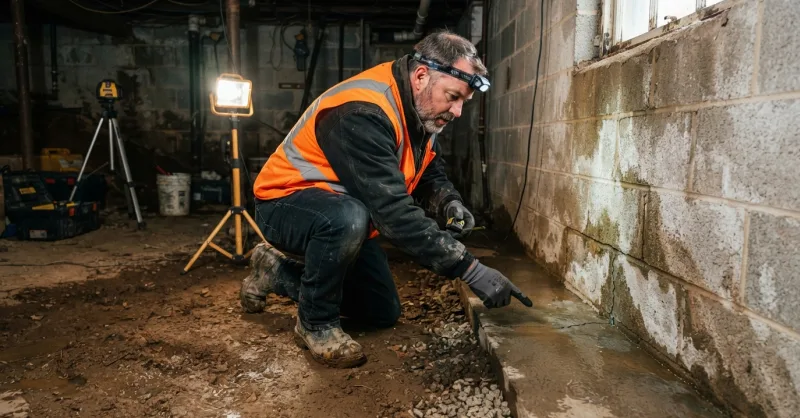
At AVG Waterproofing LLC, we run a soil-first diagnostic protocol before we quote a single pier. We operate out of 500 Apple Rd, Newark, DE 19711, covering New Castle County, Chester County PA, and Cecil County MD. No sales scripts. No commissioned reps upselling you drain tile leases. Just a structural assessment and a permanent fix.
Piedmont Clay and the Shrink-Swell Cycle That Destroys Warehouse Slabs
If you manage commercial properties along the Wilmington Riverfront or the South Market Street corridor, you already know the symptoms. Forklift tracking goes out of alignment every spring. Loading dock aprons near the Christina River bulkhead sink two inches a year. Tenants file OSHA complaints. Your appraiser flags deferred maintenance and suddenly your refinancing stalls.
The root cause is almost always the same: expansive montmorillonite clay beneath the foundation, exerting lateral pressure up to 15 psf per foot of wall height during wet seasons, then shrinking and pulling away from footings when it dries. The red clay hills around Hockessin and Pike Creek Valley see seasonal volumetric changes up to 12%. That’s not a crack repair problem. That’s a geotechnical stabilization problem.
What Happens When You Skip Soil Borings
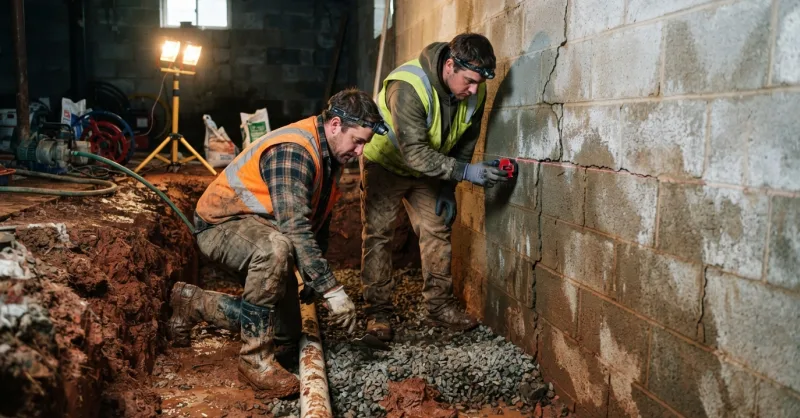
Last fall I looked at a 1950s warehouse conversion on the Riverfront, about a quarter mile from the Christina River. Previous contractor had installed push piers to 18 feet. Sounded reasonable on paper. The piers punched right through unconsolidated alluvial sediment and stopped in a decomposed mica layer that had zero bearing capacity. The building kept settling. (I’ve seen this exact mistake three times in that same zip code, which tells me someone’s using a rule-of-thumb depth chart instead of actual boring data.)
We correlate every property to USDA Web Soil Survey data and on-site probe results before specifying pier depth. In that area, competent bearing strata, usually the Wissahickon Formation bedrock or dense bearing sands, sit between 25 and 45 feet down. The acidic loess pockets common near the Pennsylvania border will corrode unprotected steel in under a decade if you don’t spec heavy-gauge galvanization.
Our foundation repair services account for all of this before we mobilize a crew.
Helical Piers vs. Push Piers vs. Micropiles: Choosing the Right Stabilization Method
I don’t believe in one-size-fits-all underpinning. The method depends on the soil profile, the structure’s load, access constraints, and proximity to vibration sources.
- Galvanized steel push pier systems (48 ksi yield, 0.312 wall thickness) work well for residential foundations where we can reach competent bedrock at moderate depth and the structure provides enough reaction weight for hydraulic driving.
- Helical pier underpinning using ASTM A572 Grade 50 shafts excels on lighter structures or new construction where we need precise torque-to-capacity correlation without relying on building weight. Does helical pier underpinning work near the Amtrak Northeast Corridor vibration zone in Newark? Yes, and we’ve done it, but you need to account for rail-induced vibration attenuation within 600 feet of the tracks, which affects grout cure times and pier group spacing.
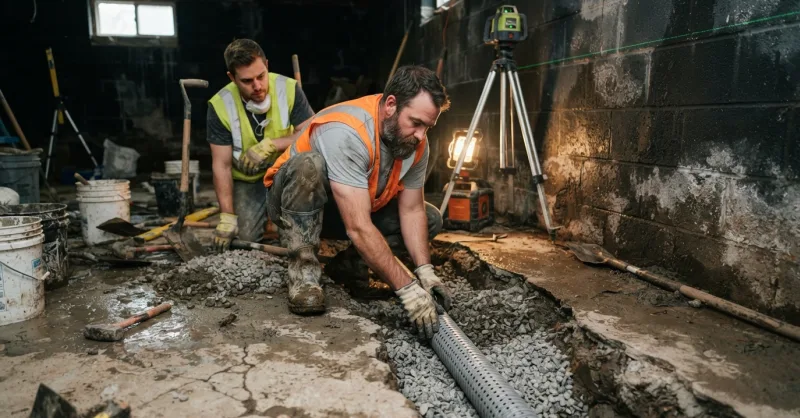
- Micropile stabilization with hollow-bar grouted shafts using Type III cement handles commercial loads, tight-access row homes in Wilmington’s historic districts, and brownfield sites like the Delaware City Industrial Park where subsurface conditions are unpredictable.
For the commercial asset managers reading this: if your engineer can’t explain why they chose one method over another based on your specific soil boring, get a second opinion. We stamp every proposal with a load analysis tied to the exact bearing stratum depth at your parcel. That’s what honest foundation stabilization looks like.
New Castle County Permits and Code Compliance for Foundation Stabilization
Here’s where most underpinning contractors lose your money before they even start digging. Does New Castle County require a permit for residential or commercial foundation underpinning? Yes. Any foundation load change exceeding 10% triggers a permit under NCCO § 23.02.105, which amends the 2018 IBC. The Land Use Department issues an OP-200 operational permit, and you need a stamped geotechnical report to get through review.
We pre-conference every submission with the county’s building official. That shaves the typical review timeline down to under 14 days. If you’re working near the White Clay Creek watershed, DNREC’s sediment and erosion control plan review (SEP-401-07) adds another layer, a 50-foot buffer requirement during any excavation. Our sediment containment systems meet those specs. We also handle DelDOT right-of-way encroachment permits when staging materials along Route 40 or the I-95 corridor.
I had a commercial client near the Delaware Memorial Bridge last year who’d been quoted by two other contractors, neither of whom mentioned the DNREC buffer or the DelDOT encroachment permit. They would have started work, gotten a stop-work order within 48 hours, and my client would’ve been stuck paying for idle crews and re-mobilization. Permit ignorance isn’t a minor oversight. It’s a budget killer.
Historic District Restrictions in Wilmington
Underpinning a Philadelphia-style brick row house in Trolley Square means working under Article 5 overlay district restrictions. We execute sequential alternate bay excavation with flush-cut steel needle beams to preserve shared party wall integrity. We flag lane closures and maintain 4-foot continuous pedestrian passage on sidewalk-street row fronts. It’s slow, deliberate work. There’s no shortcut that doesn’t risk the neighbor’s wall.
What a Real Foundation Stabilization Warranty Covers (and What Most Don’t)
Most foundation repair warranties in this market cover materials only, exclude settlement-related movement (which is the entire point), and expire in five years. That’s not a warranty. That’s a brochure.
We provide a 25-year transferable performance warranty covering workmanship and pier settlement beyond 0.25 inches. Every installation includes a baseline 3D scan. For the first 18 months, you get real-time crack gauge telemetry through a client-accessible app. Annual recalibration visits confirm differential floor deflection across the entire stabilized footprint.
How long does properly engineered underpinning actually last in New Castle County’s variable soils? When corrosion-protected with heavy-gauge galvanization and seated below the water table fluctuation zone in low-oxygen clay strata, helical and push pier systems last 75 to 100 years. The lifespan hinges on bypassing the active shrink-swell layer entirely and embedding into confirmed bedrock or bearing sands identified in geotechnical borings.
If your current contractor can’t show you a completed job with year-one scan data, they can’t prove their work holds. We can. And if telling you the truth about another contractor’s warranty costs me the project, so be it. I’d rather sleep well at night. That’s how we operate at AVG Waterproofing. Your home in good hands, or your commercial property, for that matter.
Commercial Foundation Underpinning Without Vacating Your Tenants
The number one concern I hear from portfolio managers and facility directors: “Can you do this without shutting down operations?” The answer is yes, but it requires a CPM schedule, not a guess.
We commit to no more than 3 working days per 80-foot wall section. Crews work in sequenced bays so tenant operations continue on the opposite side of the structure. When we’re underpinning near an active railroad spur monitored by DelDOT, like several properties along the Riverfront, we coordinate vibration windows with rail schedules to avoid disrupting either the spur line or our grout cure.
(I’ll be honest, the logistics on some of these Riverfront warehouse jobs are a headache. Between the Christina River alluvial plain, the old bulkhead conditions, and groundwater infiltration through cold joints during high-water events, you’re solving three problems simultaneously. But that’s what 25 years of doing this buys you: the ability to sequence it without panicking.)
What should a commercial asset manager require from a foundation stabilization contractor before signing? Three things: proof of similar industrial underpinning projects within 5 miles of your property, a bonded crew with latent defect coverage, and a stamped load analysis that your lender’s due diligence team will accept. If the contractor can’t produce all three, they’re not ready for commercial work.
Your next capital improvement cycle or tax depreciation deadline shouldn’t be held hostage by a contractor who can’t pull permits or maintain schedule. Reach out to us for a transparent cost breakdown tied to your specific property and soil conditions.
Get a Soil-First Structural Assessment, Not a Sales Pitch
We diagnose the soil, arrest the movement, and walk away with your property stabilized permanently. No second visits. No upcharges. No nonsense.
AVG Waterproofing LLC serves New Castle County DE, Chester County PA, and Cecil County MD with free, no-pressure structural estimates backed by 25 years of U.S. structural experience.
Connect with us:
Call us today or request your customized underpinning feasibility analysis. We’ll correlate your property’s tax parcel to bearing strata data before we ever set foot on site.
Written by: Alex Velasquez
AVG Waterproofing LLC