


What’s Actually Moving Your House in New Castle County? Hint: It’s Not the House, It’s the Soil
Your foundation isn’t cracking because the concrete got tired. It’s cracking because the dirt underneath it is doing something it shouldn’t, and nobody bothered to look at the dirt.
I’ve been reading soil and structure across the tri-state for more than 25 years, with the last 6-plus focused specifically on the ground under Delaware, Pennsylvania, and Maryland homes. When I walk into a Newark basement with stair-step cracks running across the block, I already have a short list of suspects before I open my measuring tools. Reybold. Glenelg. Fallsington. Coastal plain sands. Alluvial floodplain silt near the Christina or the Brandywine.
If your contractor never said one of those words, they diagnosed nothing.
They looked at a symptom and quoted you a coating.
The Three Soils Doing the Damage Around Here
New Castle County sits on a weird geological seam. The Piedmont bedrock in the north meets the unconsolidated coastal plain in the south, and the transition zone runs right through where most of you live.
Here’s what your footing is actually sitting in:
- Ultisol silt loams (Reybold, Glenelg, Fallsington) blanket most of the county. They drain okay on a normal Tuesday. The problem is the clay pockets buried inside them, they swell when saturated and shrink when dry, and that cycle is what racks your door frames out of square and opens those stair-step joints in your block wall.
- Coastal plain sands and gravels underlie Bear, Middletown, and the eastern fringe toward Delaware Bay. Unconsolidated deposits. Water moves through them sideways, bearing capacity changes from one corner of the slab to the other, and homes built on regraded ag land settle differentially. One side drops. The floors tilt. You start hearing about it when the fridge door won’t stay open.
- Alluvial floodplain soils hug the Christina and Brandywine corridors. They hold water like a sponge, sit inside FEMA A and AE zones, and push constant hydrostatic head against basement walls even when it hasn’t rained in a week.
Different soil, different failure mode. Same contractor selling the same waterproof paint to all three. That’s the problem.
Why Waterproof Paint Fails Every Time (And Kind of Rots Your House While It’s At It)
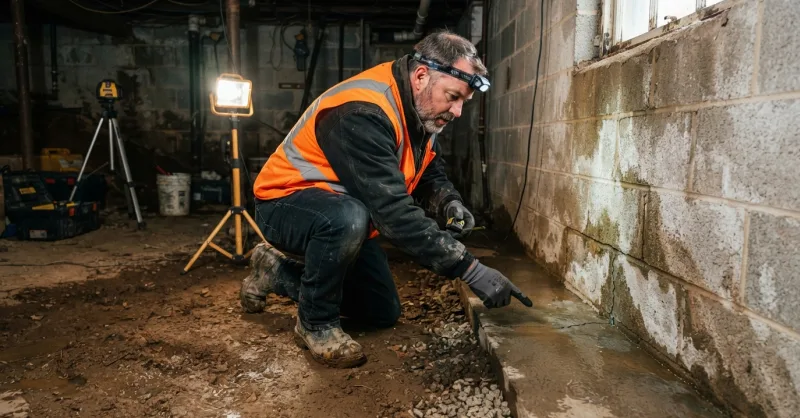
Water in saturated backfill builds pressure that gets worse the deeper you go. At the base of an 8-foot basement wall, that pressure is not trivial. It’s constantly pushing inward against mortar joints, cold pour lines, and any hairline the concrete already had.
A coating on the inside face does exactly nothing to that pressure. Water finds the next joint. The paint blisters, or worse, it holds the moisture inside the block where it drives efflorescence, freeze-thaw spalling, and eventually rot in the rim joist and sill plate you can’t even see.
You traded a wet basement for a quietly rotting one (and you paid a premium for the privilege).
The relief has to happen at footing elevation, on the outside, before the water ever has a chance to load the wall. That’s physics, not opinion. If you want to see how we handle that pressure permanently, our writeup on stopping hydrostatic pressure through basement walls walks through the actual sequence.
A quick reality check on “lifetime” wall coatings: the warranty is only good while the company still exists and the coating hasn’t been buried under new efflorescence. I’ve peeled two-year-old coatings off block that was already crumbling behind them.
How to Actually Read the Cracks in Your Wall
Not every crack is a crisis. Not every crack is harmless either. Before you spend a dollar, you need to know which one you have.
- Vertical hairlines in poured concrete: usually shrinkage from the original cure. Often benign. Mark them, watch them for a season.
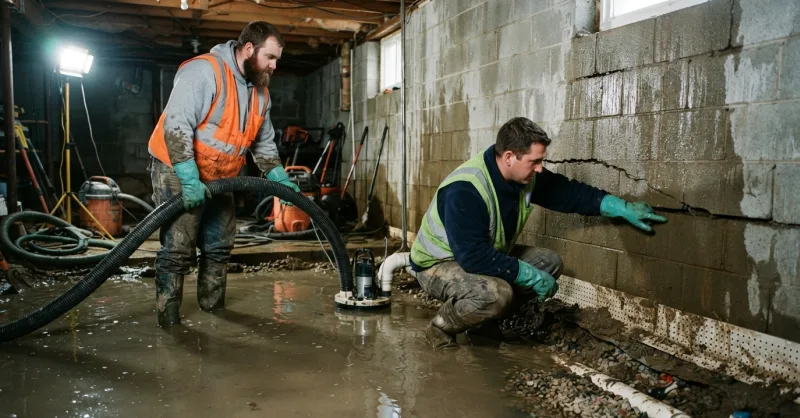
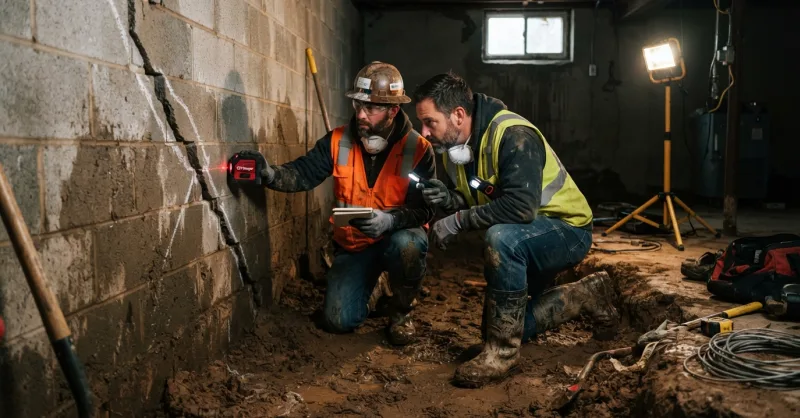
- Stair-step cracks in block: lateral earth pressure is pushing your wall inward. This is a load problem, not a moisture problem, even if you also see water.
- Horizontal cracks near mid-height: the wall is bowing. Serious. Carbon fiber straps or steel I-beam bracing sized to the actual lateral load, not a guess.
- Diagonal cracks from corners, sloping floors, sticking doors: differential settlement. Your footing is losing bearing capacity somewhere. That’s when underpinning piers or helical piles enter the conversation, driven past the failing soil to competent strata.
Under the 2021 IRC that New Castle County has adopted, residential footings generally need to be at roughly 32 inches depth to clear frost. Older homes, unpermitted additions, screened porches converted into rooms, they often don’t meet that. It’s not a paperwork issue. It’s the reason those specific areas move first.
A Pike Creek Basement That Taught Me to Slow Down
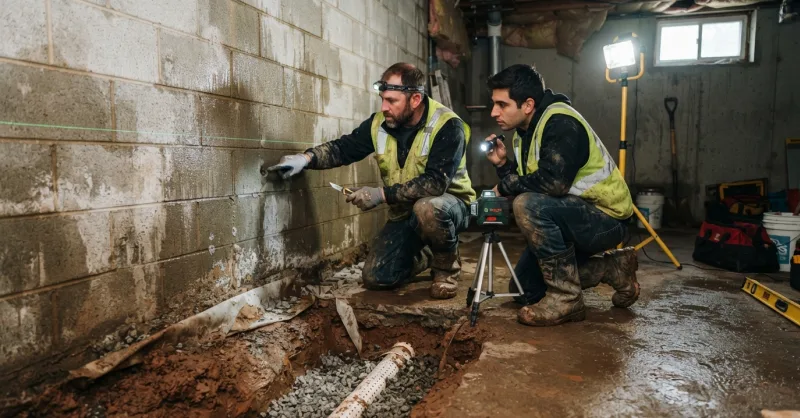
Couple years back I got called out to a home off Linden Hill in the 19808 zip, Pike Creek area. The owner had two quotes already, both for interior drain tile and a sump. Both quotes ignored the fact that her block wall was bowing inward roughly three-quarters of an inch at mid-height.
Nobody had measured the wall. Nobody had asked about the slope behind the house, which fed straight into her backfill from a neighbor’s regraded lot. Nobody mentioned the clay lens the auger hit at about four feet.
Honestly, the first hour I was frustrated. Not at her. At whoever taught the guys before me that a sump pump fixes lateral earth pressure.
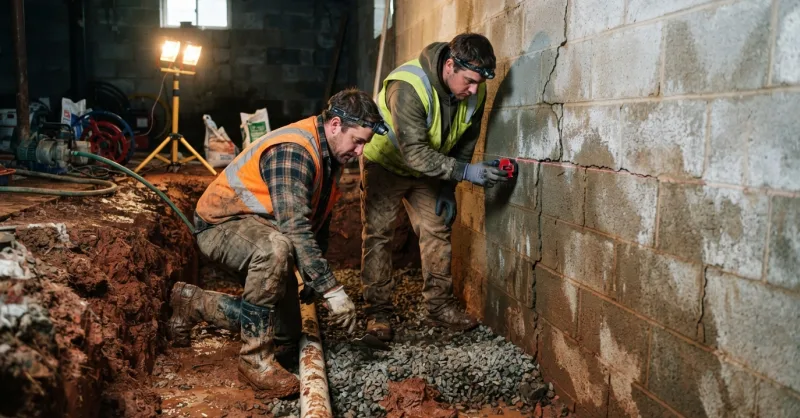
We ended up doing carbon fiber reinforcement on the bowed section, exterior excavation on the uphill side, a proper footing drain with a gravel envelope, and a regrade of the neighboring slope with the neighbor’s blessing (that part took two weeks of polite conversation, not construction). No interior drain tile. She didn’t need it once the water stopped loading the wall in the first place.
The wall hasn’t moved a millimeter since. The basement is dry. She still texts me every spring after the first heavy rain, just to confirm. I don’t mind.
The lesson wasn’t clean or dramatic. It was that two contractors quoted the wrong scope because they never measured anything, and the third one almost did the same because I nearly trusted their notes instead of my own auger. Almost. That’s the honest version.
What a Permanent Fix Actually Involves
A real repair addresses water, soil, and structure together. Skip any of the three and you’re paying twice.
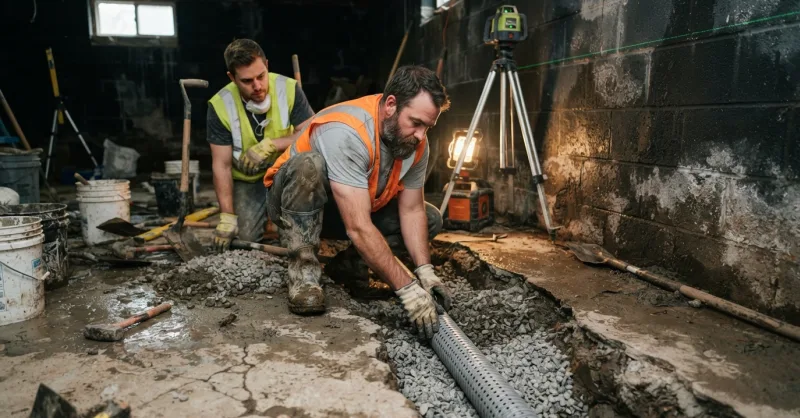
Hydrologic control: perimeter footing drains at or below footing elevation, wrapped in clean gravel, discharging to a point that actually gets rid of the water. Sump systems sized to the inflow you actually have, not the pump the truck happened to have on it. Downspouts extended so roof water stops feeding the basement.
Structural stabilization: carbon fiber for walls that have started to deflect, steel bracing when the deflection is past what carbon can hold, underpinning where the footing has lost the ground under it. Every element sized to the load, not the sales quota.
Moisture management: 10-mil vapor barrier on exposed soil in crawl spaces, a dehumidifier in the 50 to 70 pint range for most local basements, more where clay is holding moisture year-round. Delaware humidity doesn’t take summers off.
Everything gets checked against the 2021 IRC and IBC that New Castle County enforces. Not because the code office is fun to deal with, but because a repair that passes an engineer’s review at resale is worth doing once. If you want the numbers side of that conversation, the honest breakdown of permanent structural repair costs lays it out. And for the drainage-only piece, our basement waterproofing and foundation repair service pages get more specific.
How to Vet Anyone Who Walks Into Your Basement
Ask three things before you sign anything. What soil series is my house sitting on, and how does it behave when it’s wet? If they can’t answer, or if they change the subject to their warranty, they haven’t diagnosed anything yet.
The second question is where the water is going after the job is done. If the answer involves the word “paint” or “coating” as the primary defense, you already have your answer. The third question is whether the repair is engineered to the 2021 IRC and whether they’ll show you the deflection or elevation readings the scope is based on.
A contractor who measured your wall, identified your soil, and can explain the load path to you in plain English is doing the work. One who leads with a discount that expires today is running a script.
Homeowners in Wilmington’s older neighborhoods near the Brandywine often ask whether a 1920s stone foundation can even be waterproofed properly without destroying the historic character. Yes, but the approach is completely different from a poured concrete basement in a 2005 Middletown subdivision. Stone and rubble foundations need to breathe, which means lime-compatible repointing on the interior, exterior drainage relief, and absolutely no cementitious parging on the outside face. Parging traps moisture, spalls the stone, and destroys the wall you were trying to save.
A related one I get from Bear and Glasgow homeowners near the I-95 corridor is how long a proper exterior footing drain and grading correction should last before needing service. If it’s installed right, gravel envelope wrapped in filter fabric, positive discharge, no fines migrating into the pipe, you’re looking at decades of service, not years. What kills these systems early is silt intrusion from skipping the fabric, or a discharge line that dead-ends into the same saturated soil the water came from.
Permits, Code, and Why the County Actually Matters Here
New Castle County requires permits for most structural and basement work, and the inspectors do check. That’s a good thing, even when it’s annoying. It means the repair on your house has to hold up to somebody besides the guy who sold it to you.
The 2021 IRC governs footing depth, wall reinforcement thresholds, moisture control, and egress in finished basements. A contractor who doesn’t reference it during the walkthrough is either working around it or hoping you won’t notice.
Property managers running small multifamilies in Wilmington’s 19805 and 19806 zips ask me whether foundation and drainage work triggers a full re-inspection of unrelated basement systems like electrical panels or egress windows. Usually no, if the permit scope is written tightly around the structural and drainage work itself, but I’ve seen inspectors flag adjacent violations they happen to see. Worth knowing before you open the wall.
The last question I get from folks near Middletown 19709, especially in the newer subdivisions off Route 1, is whether a home built in the last fifteen years on coastal plain fill can really be settling already. Short of the point, yes, and it’s more common than the builders would like anyone to admit. Regraded ag land with organic layers left in place, or fill that wasn’t compacted in proper lifts, will show differential movement inside a decade. The fix isn’t dramatic, it’s usually helical piles on the affected corners, but you have to catch it before the framing above racks itself into new problems.
Who I Am, What We Do, and Where to Find Us
I’m Alex, and AVG Waterproofing LLC runs out of 500 Apple Rd, Newark, DE 19711, which puts us close to the Christina corridor and inside easy dispatch range of Wilmington, Bear, Pike Creek, Middletown, and across the state line into Chester and Cecil Counties. We work 7 days a week, 8 AM to 7 PM Monday through Saturday, and 8 AM to 3 PM Sundays, because basements don’t flood on a business schedule.
If telling you the truth about your foundation costs me a project, so be it. I’d rather sleep well at night than sell you a coating that lets me sell your neighbor the same problem two years from now.
You can follow the actual field work and diagnostics on LinkedIn and Instagram. Real jobs, real soil, real cracks. No stock photos.
Your foundation is a structural system sitting in a specific geology. Fix the geology and the water, and the structure follows. Fix the appearence, and you’ll be paying for it again, usually right before you try to sell.
Written by: Alex Velasquez
AVG Waterproofing LLC