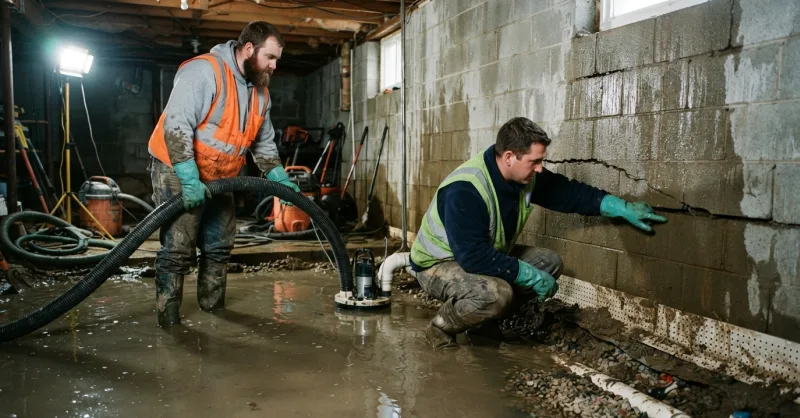




Why Does Saturated Clay Force Water Through Your Basement Walls in New Castle County?
I get calls every spring from facilities managers along the Delaware Industrial Park corridor who describe the same thing: water weeping steadily along the floor-wall joint, efflorescence blooming across CMU block, and humidity readings north of 70% in mechanical rooms housing HVAC air handlers worth six figures. They ask me to fix the symptom. I tell them we need to fix the geology.
The Cecil sandy clay loam that sits under most of New Castle County (NRCS map unit CdA, hydrologic group C) holds water like a sponge with no drain. When a nor’easter stalls over the Christina River Basin and dumps three inches overnight, that water doesn’t percolate. It pools. It builds lateral hydrostatic force against your below-grade walls at the 6-foot horizon where a low-permeability silty clay lens traps everything.
Hydrostatic pressure is the lateral force exerted by saturated soil water against a below-grade foundation wall. In our local clay-heavy Cecil soil, water becomes trapped and creates head pressure that infiltrates concrete pores and cracks, showing up as wall seepage, mineral deposits, or structural bowing. That’s the physics. The fix is a sequenced protocol I’ve refined over 25 years of structural work and 6 years specializing in tri-state soils from our base at 500 Apple Rd, Newark, DE 19711.
Step One: The Forensic Walkthrough That Most Contractors Skip
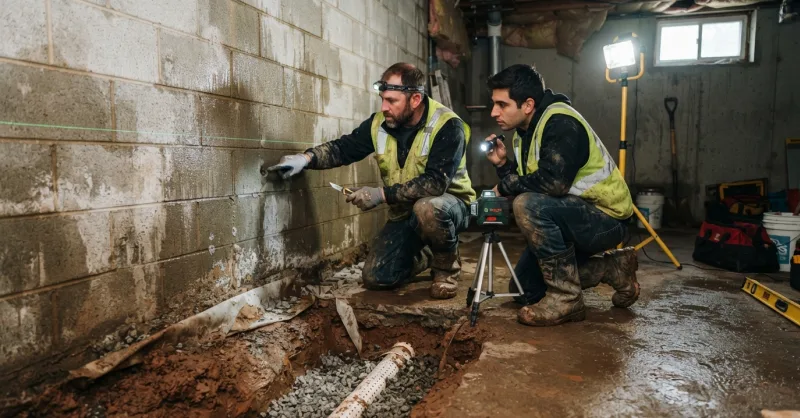
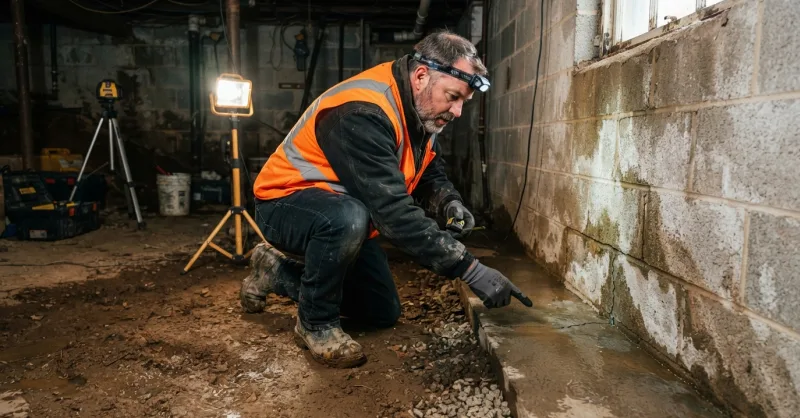
Before anyone picks up a jackhammer, I walk the basement with a pin-type moisture meter and a flashlight. I’m looking at the CMU block face for spalling, hairline cracks running horizontal (a sign of lateral soil surcharge, not settlement), and that telltale white mineral crust that tells me water has been migrating through the wall matrix long before anyone noticed pooling.
A pharmaceutical campus manager near Route 141 called us last fall after a Hurricane Ida remnant event overwhelmed their existing sump capacity. The basement mechanical room was holding half an inch of standing water. Their previous contractor had painted on an elastomeric coating and called it waterproofing. (I see this roughly once a month, and it genuinely frustrates me because the homeowner or facility manager paid real money for something that was never going to work.) The coating had delaminated in sheets. Behind it, the block was saturated clear through the core.
What does a proper basement water intrusion assessment actually involve? I measure moisture content at multiple wall heights, check for bowing with a 4-foot straightedge, and confirm whether the seepage pattern is hydrostatic (continuous weeping at the floor-wall joint, damp concrete cores) or something else entirely, like a failed lateral pipe or grading issue. Getting this wrong means you spend $15,000 solving a problem that doesn’t exist.
Soil Mechanics and Phreatic Surface Mapping
Once I confirm hydrostatic pressure is the culprit, we run a falling-head permeameter test on the native soil. We need the saturated hydraulic conductivity value to calculate how much water load that foundation is absorbing during peak events. I overlay USGS HUC-12 Christina River subbasin flood stage data to anticipate seasonal water table rise. For properties along the Brandywine Creek flood zone near Greenville, the phreatic surface can spike 18 inches in 72 hours during an atmospheric river event.
Skip this step and you’re guessing at pipe diameter, pump capacity, and drain slope. I won’t do that.
New Castle County Permits and Code Alignment You Cannot Ignore
Any exterior foundation drain modification requires a New Castle County building permit under IBC R405.1 (Foundation Drainage) and compliance with Delaware’s amended building code. If your property sits within 100 feet of the White Clay Creek Conservation Overlay District, the Land Use Department’s Sediment & Stormwater Regulation 40.10.130 mandates positive drainage slope calculations before you break ground.
- Sump pump discharge cannot connect to the sanitary sewer. New Castle County Municipal Code 26.03.002 is explicit. I’ve seen competitors tie into sanitary lines because it’s faster. The county will make you rip it out.
- We handle the permit filing (PL-2024-xxxx series) as part of our turnkey scope. No subcontractor fragmentation, no surprises on your capital improvement review.
- Pre-1985 homes in Pike Creek and North Star often have cast-iron lateral drains crushed by expansive Cecil clay. We remove and replace these during excavation, which some contractors conveniently leave out of their verbal estimates.
Can you install a basement waterproofing system without a permit in Delaware? Technically some interior-only modifications fall below the permit threshold, but any exterior drain tie-in or discharge line routing absolutely requires one. We pull permits on every job because a non-permitted system voids your warranty and creates a disclosure liability when you sell.
Exterior Foundation Drain and Positive-Side Membrane Installation
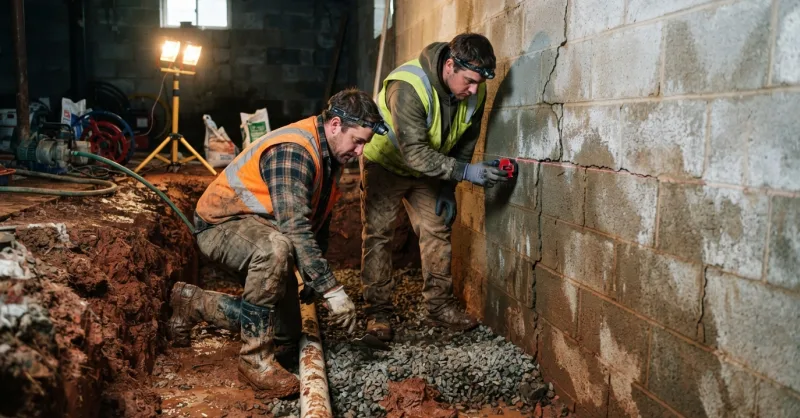
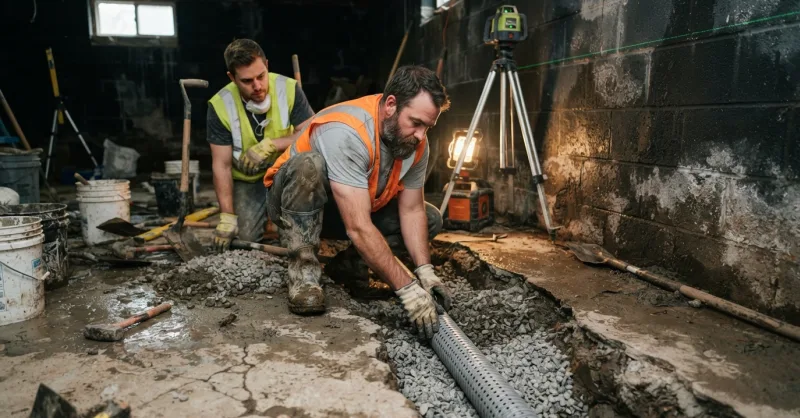
The permanent fix for hydrostatic pressure starts outside the wall. We excavate 24 to 30 inches from the wall face down to the footing, shoring per OSHA. At the footing invert, we install 4-inch perforated HDPE pipe sloped at minimum 1% toward the discharge point, surrounded with washed #57 stone and wrapped in geotextile filter fabric.
Then the membrane goes on. We apply a 60 mil HDPE dimple board or bentonite clay panel directly against the CMU, lapping 6 inches onto the footing. Termination bar locks the top edge. Every penetration gets sealed with two-component polyurethane sealant. No shortcuts, no spray-on coatings pretending to be membranes.
Backfill and Surface Grading
Aggregate backfill goes in to roughly 2 feet, then native soil on top. We grade the surface at 5% slope for 10 feet away from the foundation. The discharge line is rigid PVC (never corrugated, which crushes and silts within 3 years), terminating at least 5 feet from the footing. I had a job near Kirkwood Highway where the original contractor ran corrugated flex pipe and buried it 8 inches deep. A landscape crew punctured it with an edger six months later. The homeowner called us to fix the fix.
If your walls already show signs of bowing from sustained lateral pressure, the drain system alone won’t restore structural integrity. We address that with carbon fiber reinforcement or steel bracing depending on the deflection measurement.
Interior Weeping Tile and Dual-Pump Sump Basin: The Second Line of Defense
Exterior waterproofing handles 80% of the hydrostatic load. The interior system catches everything else and provides redundancy for the life of the building.
We cut the CMU floor slab along the perimeter and install 4-inch PVC weeping tile on a bed of #57 stone, sloped toward a central sump basin. The basin gets a Zoeller M53 submersible primary pump and a DC battery backup. Both wire to an AFCI-protected circuit. Basin penetrations are sealed against radon and vapor intrusion.
How much does it cost to install a sump pump system in a basement near Bear, Delaware? Pricing varies based on basement perimeter length, number of discharge lines, and whether you need battery backup. For a typical 1,200 square foot basement in the 19701 zip code, our itemized proposals (referencing RSMeans local data) run between $4,500 and $8,200. That binding flat-rate includes core drilling, electrical interconnection, and the hydrostatic test certificate. No “additional costs may apply” language.
For a broader look at our interior and exterior basement waterproofing systems, that page breaks down the full scope of what we install across New Castle County, Chester County PA, and Cecil County MD.
Flood Testing and Hydrostatic Compliance Verification
After installation, we flood test the exterior drain at 1 gallon per minute per linear foot for 30 minutes. Zero wall seepage is the only acceptable result. We issue a hydrostatic test certificate and log baseline moisture readings with a HygroTrac sensor.
The annual sentinel inspection happens every March before spring thaw. We log groundwater table position via piezometer, test sump pump runtime, and perform a battery load test. This data goes into your 25-year transferable system warranty file. When you sell the property, the warranty transfers to the new owner. (That detail alone has saved more than a few of our clients during home inspections.)
What Separates a Permanent Fix from a Temporary Patch
| Factor | Typical Competitor Approach | AVG Waterproofing Protocol |
|---|---|---|
| Emergency Response | 48-72 hour dispatch | 90-minute mobilization within New Castle County |
| Estimate Format | Verbal, excludes concrete cutting | Itemized line-item proposal, binding flat-rate |
| Warranty | 5-year limited, non-transferable | 25-year transferable, covers membrane and pump mechanicals |
| Post-Install Monitoring | None | Annual piezometer reading and battery load test |
Does waterproofing paint or sealant actually stop hydrostatic pressure? No. Negative-side coatings like elastomeric paint or crystalline sealers can slow vapor transmission through intact concrete, but they cannot resist active hydrostatic head pressure. The water finds the weakest pore or crack and pushes through. I’ve pulled delaminated coatings off walls where the block behind was so saturated you could squeeze water from the mortar joints with your hand. If someone tells you paint will fix hydrostatic pressure, walk away.
When Cracks Signal Something Worse Than Water
Not every wet basement is strictly a waterproofing problem. Horizontal cracks at the mid-height of a CMU wall, especially in homes along the Christina River Basin clay belt, often indicate lateral soil surcharge exceeding the wall’s design capacity. The wall is bowing inward under the combined weight of saturated Cecil clay and the hydrostatic load behind it.
I inspected a home in Trolley Square (Wilmington 19803) last winter where the owner had called three waterproofing companies before us. All three quoted interior drain systems. None of them mentioned the 3/4-inch horizontal deflection at the fourth course. That wall was failing structurally. A drain system would have managed the water while the wall continued to move inward until it collapsed.
We recommended structural crack repair and wall stabilization before any waterproofing work began. If telling you the truth costs me a project, so be it. I’d rather sleep well at night.
How can I tell if my basement wall crack is structural or just cosmetic? Measure the crack width at three points along its length and check again in 60 days. If the crack exceeds 1/8 inch, runs horizontal or stair-steps through mortar joints, or shows measurable growth, it’s structural. Vertical hairline cracks in poured concrete are usually shrinkage cracks and less concerning, but they still transmit water under hydrostatic load and should be injected with structural epoxy.
Get a Free Diagnostic Assessment Before the Next Storm Cycle
We serve New Castle County DE, Chester County PA, and Cecil County MD with free, no-pressure structural estimates. No sales scripts. No quick fixes. We tell you exactly what is failing and fix it permanently.
Before the next nor’easter saturates the Cecil clay lenses to field capacity across the Christina River watershed, get a proper forensic evaluation. We’ll run the diagnostics, pull the permits, install the system, and hand you a 25-year warranty backed by annual inspections.
Your home in good hands. Follow our work on LinkedIn and Instagram to see active projects across the tri-state corridor.
Written by: Alex Velasquez
AVG Waterproofing LLC