


Why Do Horizontal Cinder Block Cracks in New Castle County Demand Local Structural Experts?
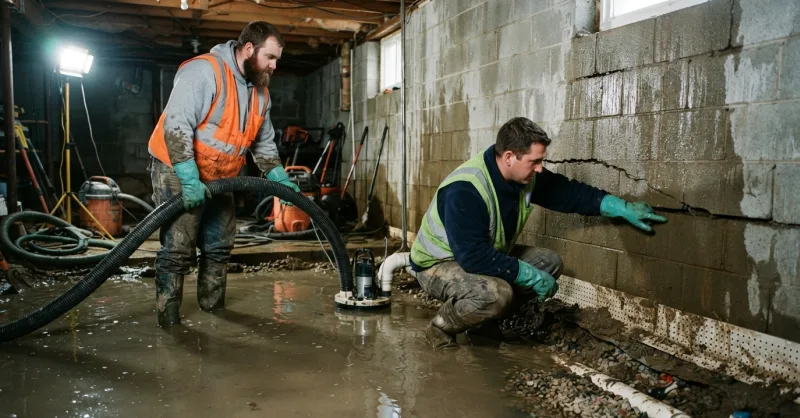
A horizontal crack running across your cinder block wall is not a cosmetic problem. It is a bending failure. The wall is losing its fight against lateral earth pressure from saturated Piedmont clay soil pushing inward, and every freeze-thaw cycle in Delaware widens the damage. I’ve seen homeowners in Pike Creek discover a hairline crack in October, ignore it through winter, and face a wall bowed inward over half an inch by March. That’s not a slow process. That’s structural collapse in slow motion.
AVG Waterproofing LLC operates from 500 Apple Rd, Newark, DE 19711 with 25 years of U.S. structural field experience and six years specialized in the tri-state soils that cause these failures. We serve New Castle County, Chester County PA, and Cecil County MD. No sales scripts. No commissioned estimators. We send a structural repair technician with a Schmidt hammer and crack gauge, not a guy with a clipboard and a quota.
The local contractors who matter for horizontal block crack repair understand one thing generic outfits don’t: your soil is the enemy, and it changes block by block across this county. The Coastal Plain to Piedmont Fall Line transition that runs right through our service area means a home in Hockessin sits on completely different geology than a home near Delaware City. Treating both the same is malpractice.
Saturated Piedmont Clay and the Physics Behind Block Wall Bending Failure
Manassas silt loam dominates the Pike Creek and North Wilmington suburbs. When it absorbs water from a Nor’easter, it swells and pushes against your foundation with tremendous lateral force. We’re talking roughly 110 psf per foot of wall depth. A typical eight-foot basement wall? That’s serious tonnage pressing inward along the mortar joints.
Wilmington and surrounding areas experience over 70 freeze-thaw cycles annually according to NOAA data from New Castle County Airport. Moisture trapped inside those mortar joints freezes, expands with up to 30,000 psi of force, and cracks the block face shell. One cycle chips. Seventy cycles per year for a few winters? You get a horizontal crack that runs the entire length of the wall at roughly the mid-height mortar joint. How does a homeowner tell the difference between a vertical shrinkage crack and a dangerous horizontal one? Vertical cracks typically follow a single block and result from concrete curing. Horizontal cracks follow the mortar bed joint across multiple blocks, and they signal the wall is deflecting inward under soil load. Completely different failure modes, completely different urgency levels.
I inspected a 1982 split-level in the Limestone Hills area last fall. The homeowner thought the crack was “just settling.” The wall had already rotated 0.6 inches inward. Another heavy rain season and that wall would have required partial demolition rather than reinforcement. The difference between a $4,000 carbon fiber stabilization and a $25,000 rebuild came down to about three months of hesitation.
What Goes Wrong When Generic Contractors Patch Horizontal Block Cracks
I’ve torn out enough failed repairs to have opinions about this. The typical pattern: a general handyman or a franchise outfit sends a salesperson who quotes a per-linear-foot price for epoxy injection. No soil excavation. No crack gauge monitoring. No permit pulled with the New Castle County Department of Land Use. The homeowner pays $1,500, feels good for six months, then watches the same crack reopen after the first hard freeze.
The failures share common traits:
- Standard epoxy that doesn’t meet ASTM C881 Type IV frost-impervious bonding specifications. Delaware winters destroy it.
- No assessment of hydrostatic pressure behind the wall. The water source driving the crack goes untreated.
- Zero mention of New Castle County’s 2018 IRC amendment 404.1.2, which requires an engineered repair plan for any foundation wall work that reduces lateral support. Unpermitted repairs create title problems when you sell.
- No radon pathway verification after injection. New Castle County sits in EPA Radon Zone 1. A poorly sealed crack repair can become a radon conduit straight into your finished basement (and nobody tells you that part).
If telling you the truth about a competitor’s botched fix costs me a project, so be it. I’d rather you understand why that $800 “repair” from last year is already crumbling than sell you something you don’t need.
AVG’s Six-Stage Structural Repair Protocol for Horizontal Cinder Block Cracks
We built this process over years of diagnosing block wall failures across the DE-PA-MD corridor. Each stage addresses a specific failure mechanism. Skip one, and the repair won’t last.
Stage 1: Exterior Soil Excavation and Pre-Triage
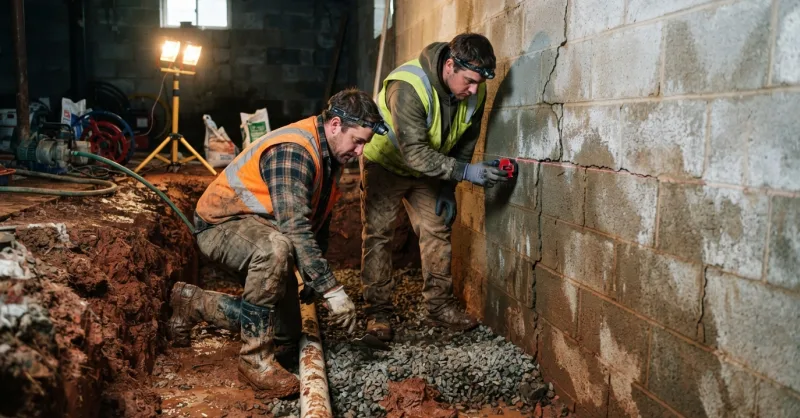
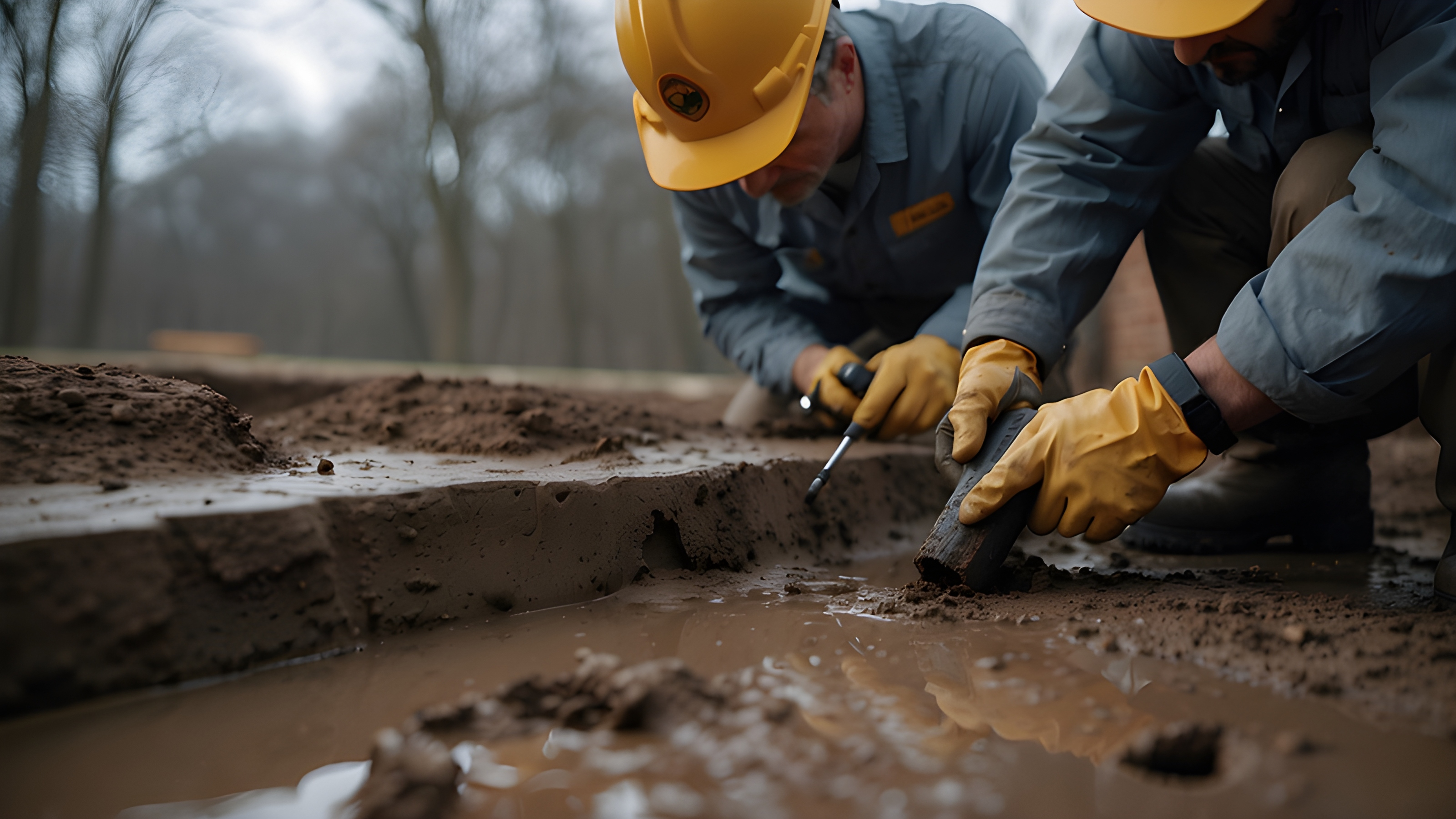
We dig. No shortcutting this. Removing saturated clay from the exterior wall face exposes the full crack apex and lets us measure hydrostatic head depth. We test soil moisture and density to calculate the actual lateral earth pressure load vectors your wall faces. Most competitors never touch a shovel.
Stage 2: Crack Apex Mapping and Deflection Monitoring
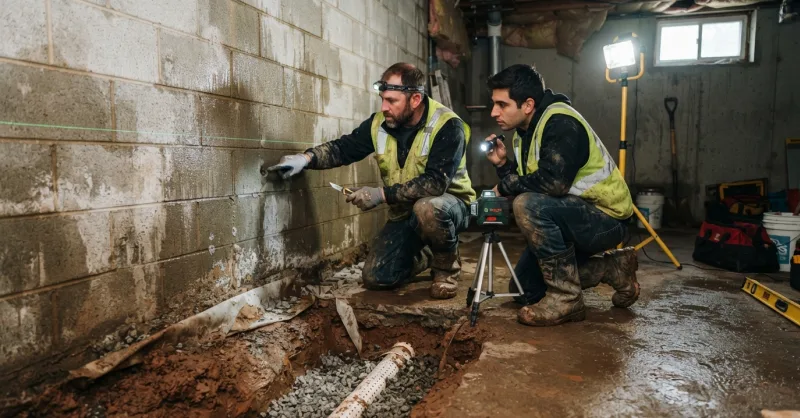
Crack gauges go in at 16 inches on-center along the collar joint. We monitor wall deflection for up to seven days before sizing the reinforcement. Why does a foundation repair company need a full week of crack monitoring before starting work? Because a wall that moves 0.02 inches under dry conditions but jumps to 0.08 inches after rain tells us the drainage system is failing too. Rushing past this step means undersizing the fix.
Stage 3: Helical Tieback Anchor Installation
Helical anchors drill 6 to 8 feet into undisturbed soil beyond the active clay zone. We tension each anchor to match Delaware’s 2,000 psf soil-bearing capacity and torque-test until wall rotation sits below 0.05 inches. This restores the lateral support the soil stole from your foundation. If your wall is already bowing inward and needs expert stabilization, the tiebacks pull it back toward plumb.
Stage 4: Carbon Fiber Staple Stitching and Epoxy Bond-Line Repair
Each ten-foot wall section receives five 48-inch 12K unidirectional carbon fiber staples spaced at 16 inches on-center. The epoxy meets ASTM C881 Type IV bonding standards, which means it holds through Delaware’s freeze-thaw brutality. This combination prevents interfacial bond-line failure at the block face shell. The tensile modulus of the carbon fiber laminate exceeds 33 MSI. That number matters because it determines whether the reinforcement actually arrests future wall rotation or just looks good for the inspection.
Stage 5: Perimeter Drainage and Hydrostatic Weep-Hole Retrofitting
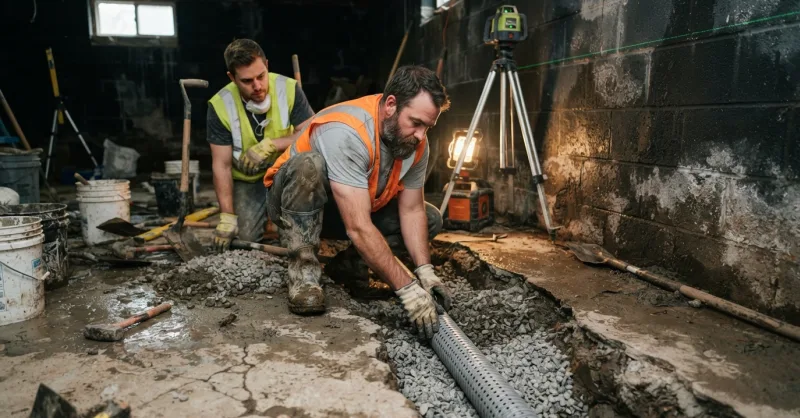
In high water table zones near the Delaware River and Delaware City, horizontal cracks often trace back to perched groundwater. We install 4-inch perforated PVC curtain drains wrapped in filter fabric and add hydrostatic weep holes to relieve future pressure spikes behind the wall. Without addressing the water, even perfect carbon fiber work will face accelerating loads. Our interior basement waterproofing systems integrate directly with this drainage work.
Stage 6: Permit Submittal, Final Inspection, and Radon Pathway Verification
We submit a stamped repair plan to New Castle County’s Department of Land Use before work begins. After completion, a county building official performs the final inspection and issues a certificate of compliance. Post-cure radon pathway integrity testing confirms the repair didn’t create a new radon entry point. The result is a lifetime transferable structural warranty backed by ICC Code Council certified workmanship standards and compliant with ACI 440.2R design life projections of 50 years for the carbon fiber reinforcement.
How Much Does Permanent Horizontal Block Crack Repair Actually Cost in Delaware?
I get this question on almost every call. The honest answer is that it depends on wall length, deflection severity, drainage conditions, and whether a third-party engineering seal is required under county code. But I can tell you what a transparent line-item proposal from us includes:
- Soil excavation and backfill labor and equipment.
- Carbon fiber staple grid materials with documented tensile modulus.
- Helical tieback anchor hardware and torque-verified installation.
- New Castle County permit fee and Department of Land Use plan submittal (the part competitors conveniently leave off their quote).
- Third-party engineer stamp if the scope triggers NCCO § 404.1.2 requirements. Some firms bury this as a surprise change order. We list it upfront.
Can you get a reliable cost estimate for cinder block foundation crack repair over the phone? Not from us. Anyone quoting a per-crack price without seeing the wall, testing deflection, and assessing drainage is guessing. We provide free, no-pressure structural estimates on site. That’s where the real numbers come from. You can read more about our approach to permanent foundation crack repair and what goes into an honest quote.
A repair we completed near the Route 40 corridor in Glasgow last spring ran about $6,800 for a 24-foot wall section with two helical tiebacks and full carbon fiber stitching. The homeowner had gotten a $2,200 quote from another company that didn’t include excavation, permit fees, or drainage assessment. That $2,200 “savings” would have cost her the wall within two winters. Sometimes the cheap number is the most expensive mistake you can make.
Structural Emergency or Can It Wait? Reading Your Block Wall’s Warning Signs
Not every horizontal crack requires a same-day emergency response. But some do. Here’s the dividing line I use after 25 years of field work:
A crack under 1/8 inch with no measurable wall deflection on a dry day? You have time to schedule a proper diagnostic audit. Get it on the calendar before winter, but you’re not in crisis mode.
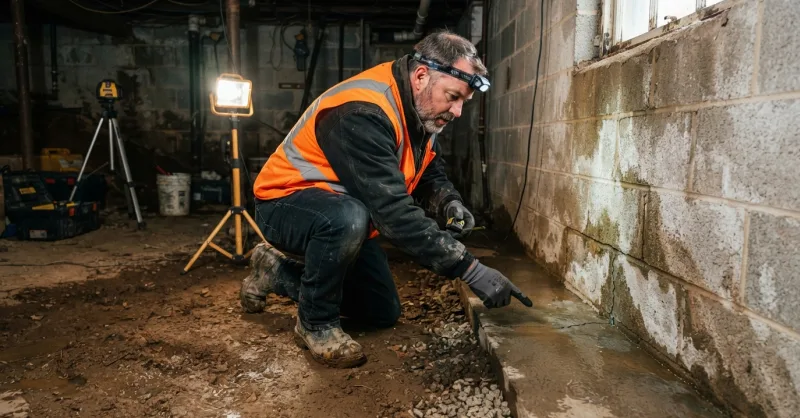
A crack at or above 1/4 inch, visible inward bowing, or water seeping along the crack during rain? That’s a structural emergency. What should a New Castle County homeowner do if they discover a new horizontal crack after a heavy storm? Call a certified structural repair specialist immediately. Do not attempt to seal it with hardware store epoxy or hydraulic cement. Those products mask the symptom and hide worsening deflection from future inspectors. We dispatch our rapid-response team from our Newark service center to Hockessin, Bear, Wilmington, and all of New Castle County for same-day triage on load-bearing wall emergencies.
The pre-sale inspection scenario hits hard too. I’ve watched $475,000 closings in Chalfonte stall for six weeks because a home inspector flagged “major structural defect” on a horizontal block crack and the seller had no documentation of proper repair. A permitted, code-compliant fix with a transferable warranty clears that title issue. An unpermitted patch job creates one.
Get a Zero-Nonsense Structural Assessment From AVG Waterproofing
We diagnose and permanently repair horizontal cinder block cracks across New Castle County, Chester County PA, and Cecil County MD. No sales scripts, no commissioned estimators, no generic per-foot pricing. Just a certified structural repair technician with precision diagnostic tools and a line-item proposal that accounts for soil conditions, code compliance, and long-term warranty coverage.
Your home deserves better than a cosmetic patch that fails next winter. Call AVG Waterproofing LLC for a free structural estimate. Follow our work and see real project documentation on LinkedIn and Instagram.
Your Home In Good Hands.
Written by: Alex Velasquez
AVG Waterproofing LLC