


Why Does a Positive-Side Waterproofing Membrane Outperform Every Interior Band-Aid in New Castle County Clay?
We get this question weekly from facilities directors and property managers across the tri-state corridor. The short version: interior systems manage water after it penetrates your wall. A positive-side exterior waterproofing membrane and weeping tile installation stops hydrostatic pressure from ever reaching the concrete.
That distinction matters enormously in New Castle County. The clay-heavy soils through the Pike Creek and White Clay Creek valleys expand when saturated and shrink during drought, cycling lateral pressure against foundation walls season after season. We’ve measured saturated clay exerting 300+ pounds per square foot against below-grade walls along the I-95 Wilmington corridor where the seasonal water table sits just four to six feet below grade.
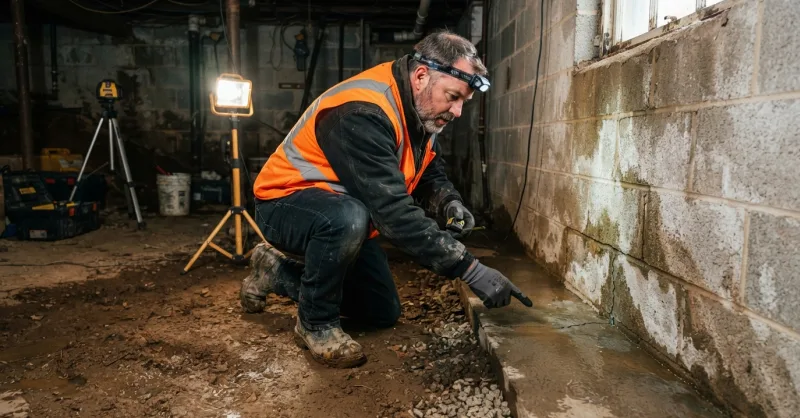
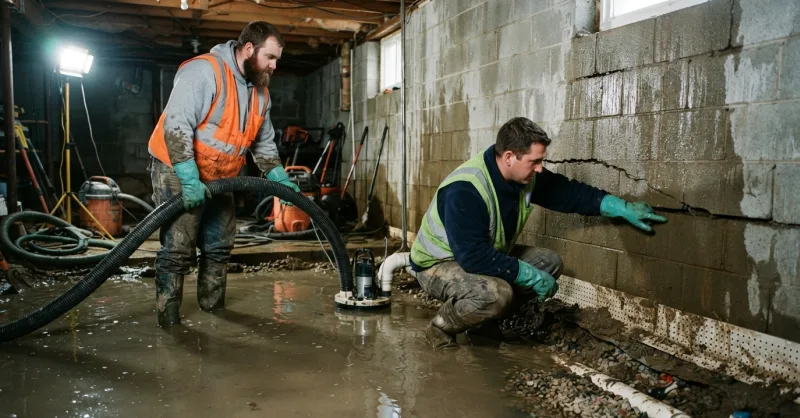
An interior French drain can redirect some of that seepage to a sump. But it never addresses the root cause. The wall stays wet. Rebar corrodes. Block joints deteriorate. And every freeze-thaw cycle between December and March (lows hitting 20°F to 25°F routinely) spalls another layer of masonry. We’ve opened up walls in Forty Acres where the interior “waterproofing” was installed three years prior and the block was already crumbling behind the vapor barrier. Nobody told the homeowner their wall was decaying in real time.
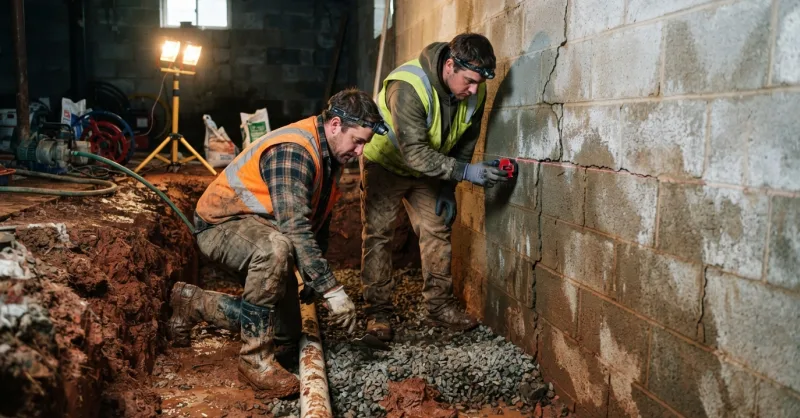
That’s the difference between treating a symptom and engineering a permanent fix. At AVG Waterproofing, we excavate to the footing, apply a fluid-applied polyurethane membrane with over 500% elongation to bridge future crack movement, install a dimple drainage composite, and set 4-inch SDR 35 perforated weeping tile in washed ASTM C33 stone. The system channels groundwater to a mechanical sump discharge before it ever contacts your foundation wall.
The Typical Contractor’s Playbook and Why It Fails Within One Nor’easter
I’ve been doing structural work for over 25 years across the U.S., and six of those years spent specifically in tri-state soils have shown me the same failure pattern dozens of times. A commissioned salesperson walks a damp basement with a flashlight, manufactures urgency, and pushes a today-only discount. They spray a single coat of asphalt emulsion over dirty concrete, lay corrugated unperforated drain line flat against the footing, and backfill with the same expansive clay they just dug out.
No soil profile. No water table mapping. No reference to New Castle County Code § 3304 (which requires foundation drainage for all habitable spaces). No DNREC sediment permit filed.
The result? A wet slab by the next nor’easter. A 5-year materials-only warranty buried in fine print. And an unreachable voicemail when spring thaw hits.
We refuse to operate that way. From our base at 500 Apple Rd, Newark, DE 19711, we serve New Castle County DE, Chester County PA, and Cecil County MD with a diagnostic-first approach. No scripts. No scare tactics. Your estimate comes from a structural expert, not a closer.
How We Actually Install an Exterior Foundation Membrane and Perimeter Drain Tile
People ask us all the time: what does an exterior waterproofing membrane installation actually involve from start to finish? Fair question, because most contractors gloss over the details. Here’s what happens on a typical residential job in the Newark or Bear area:
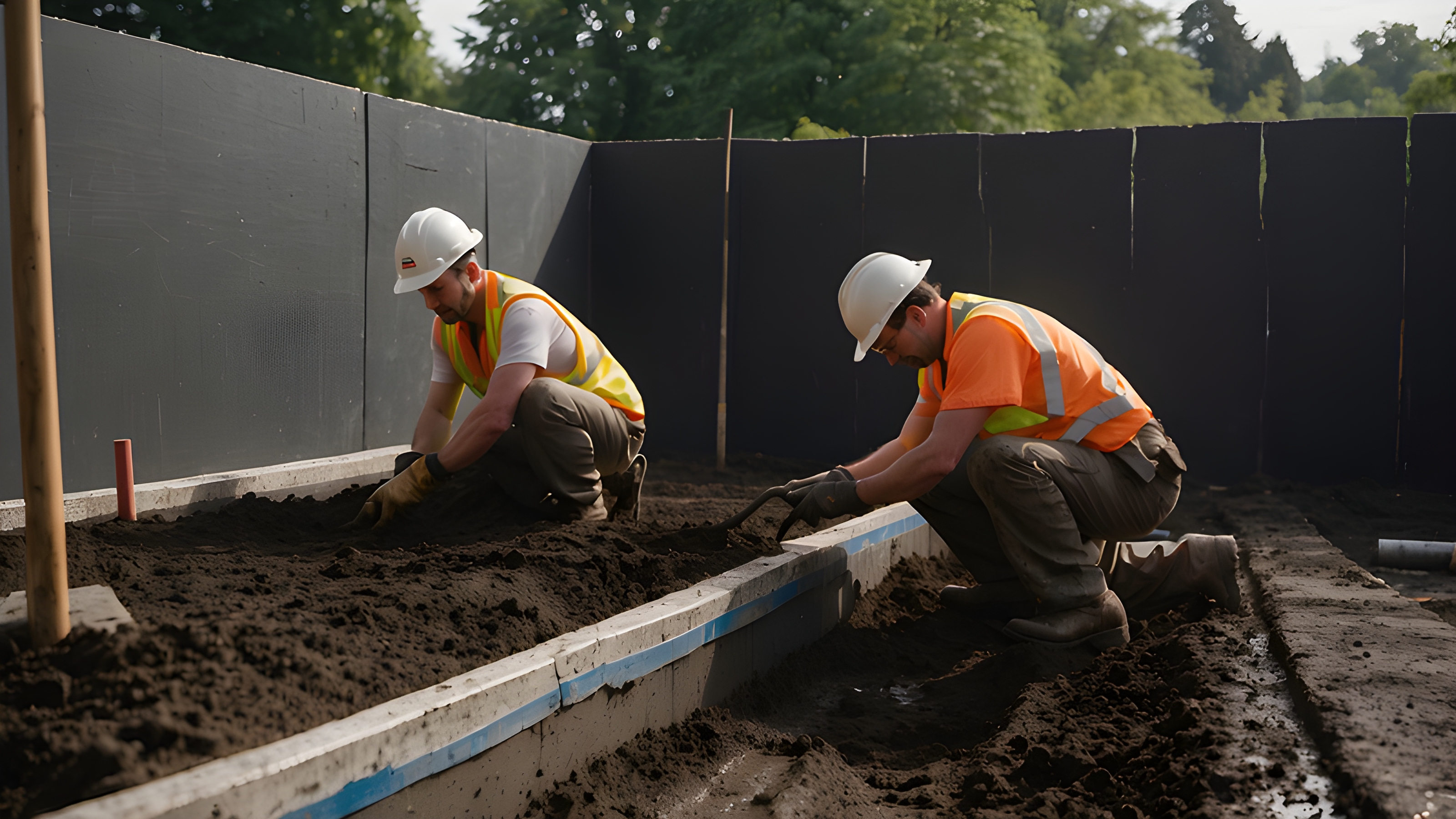
- We excavate the full perimeter down to the footing, exposing bearing soil. On a 1,500-square-foot foundation, this means moving 40 to 60 cubic yards of earth depending on depth.
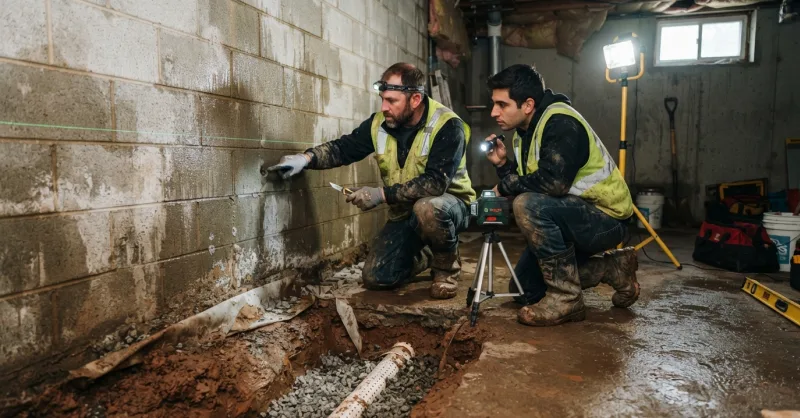
- The exposed wall gets power-washed and inspected for structural cracks. If we find horizontal cracking in cinder block (common in homes built 1960-1985), we flag it for bowing wall stabilization before proceeding.
- We apply a seamless, fiber-reinforced elastomeric polyurethane membrane from grade to footer. No seams, no weak points.
- A high-compressive-strength dimple drainage composite goes over the membrane, creating an unimpeded vertical water channel.
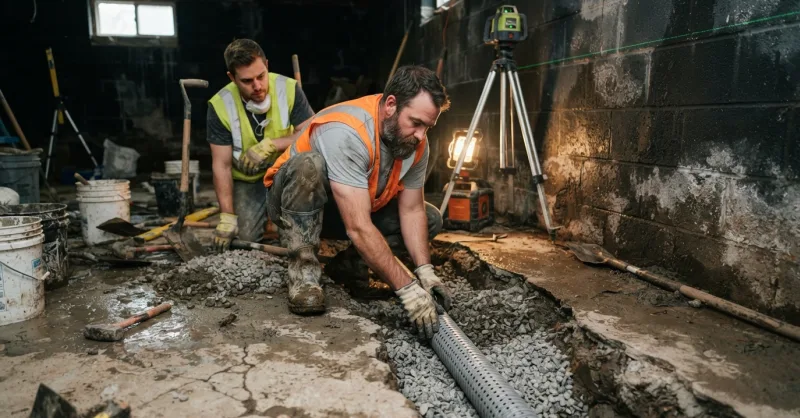
- At the footing, 4-inch SDR 35 perforated pipe wrapped in filter sock sits in a bed of washed ASTM C33 drain stone. This is your weeping tile, and it carries captured water to the sump basin for mechanical extraction.
Last spring we ran a job in Pike Creek where the previous contractor had used corrugated, non-perforated pipe (honestly, I still don’t understand the logic) and backfilled with native clay. The homeowner spent $9,000 on that install three years ago. We pulled out the old pipe and it was completely clogged with silt. No filter fabric, no gravel. The “drainage system” was functionally a buried garden hose.
Does Weeping Tile Actually Work in Delaware’s Expansive Clay Soil?
Yes. But only when installed correctly with the right aggregate and filter protection.
The Piedmont clay near Hockessin and the Coastal Plain deposits closer to Delaware City behave differently, but both share a characteristic that destroys improperly installed drain tile: fine particle migration. How do you prevent clay soil from clogging a perimeter weeping tile system? You surround the perforated pipe with a minimum 6-inch envelope of washed coarse aggregate (we use ASTM C33 gradation) and wrap the full assembly in non-woven geotextile filter fabric. The fabric blocks clay fines while allowing water to pass freely.
Skip the filter fabric and you get a plugged pipe within 18 to 36 months. We’ve pulled failed drain tile from properties near the White Clay Creek watershed where the pipe openings were completely sealed with clay. The homeowner assumed their sump pump failed. The pump was fine (it just never received any water because the pipe couldn’t drain).
In areas with shallow Piedmont bedrock, like upper Hockessin and parts of Centreville, excavation costs rise because we sometimes need rock chipping to reach proper footing depth. That’s an honest reality of working in this geology, and any contractor who quotes you a flat rate without assessing soil conditions is guessing.
Real Costs for Exterior Waterproofing and Drain Tile in Northern Delaware
What should exterior weeping tile installation cost in New Castle County? For an average 1,500-square-foot foundation, expect $8,500 to $15,000. That range covers full excavation to the footing, washed ASTM C33 drain stone, filter-wrapped 4-inch perforated pipe, fluid-applied membrane, dimple board, sump mechanicals, backfill, and grade restoration.
Where things get more expensive:
- Shallow bedrock districts near Hockessin require rock chipping and additional trucking, sometimes adding $2,000 to $3,500.
- High-groundwater zones along the South Wilmington wetlands corridor or near Old New Castle often mandate a dual sump pump configuration and DNREC sediment control permits, adding $1,200 to $2,500.
- Historic stone-rubble foundations (we see these in Centreville and parts of the Wilmington LOMA district) need coved waterproofing terminations at irregular wall surfaces, which adds labor hours.
We publish these numbers openly because the industry thrives on vague estimates. If telling you the truth about pricing costs us a project, so be it. Our free structural assessments come with written line-item breakdowns, and we’ll decline the job in writing if a permanent exterior excavation isn’t warranted yet.
New Castle County Building Codes and DNREC Permits Most Contractors Ignore
New Castle County Code § 3304 requires foundation drainage for all habitable spaces. That’s not optional guidance. It’s code. And most perimeter drain contractors we’ve followed behind never pulled the permit or scheduled the inspection.
Do you need a permit for exterior foundation waterproofing work in New Castle County, Delaware? If your project involves excavation below grade and discharge of dewatering effluent, you need to comply with Delaware’s Sediment & Stormwater Regulations administered by DNREC. Projects near the Chesapeake & Delaware Canal face additional discharge prohibitions under Delaware City Code of Ordinances § 315-15. We handle all permitting and inspection coordination as part of every exterior membrane and weeping tile project.
For commercial properties and multi-family buildings (we work with property managers at operations like Pettinaro’s industrial portfolio and medical office facilities near ChristianaCare), code compliance documentation matters for lease negotiations, insurance underwriting, and liability protection. A waterproofing system installed without proper permits and inspections has zero defensible value in a claim dispute.
The 5-Year Material-Only Warranty Trap and What We Do Instead
Most exterior waterproofing warranties cover materials only for five years. Read the fine print. Labor isn’t included. Drainage performance isn’t monitored. And the company that installed it may not answer the phone in year three.
AVG Waterproofing backs every exterior membrane and weeping tile installation with a 10-year system replacement warranty. That includes annual FLIR thermal camera inspections of below-grade walls and drainage performance verfication. We come back, scan your walls, and confirm the system is doing what we engineered it to do.
What kind of warranty should you expect from an exterior foundation waterproofing contractor? A warranty that covers the entire system, including membrane, drainage board, weeping tile, sump mechanicals, and labor for replacement if the system fails to perform. Anything less protects the contractor, not you.
We built this standard because insurance underwriters and corporate lease auditors require documented proof of ongoing waterproofing performance. A one-time install certificate with no follow-up doesn’t satisfy a facilities director at a medical campus or a property manager negotiating a 10-year commercial lease.
Waterproofing Stone-Rubble and Pre-War Foundations Without Destroying Them
The historic manors in upper Hockessin and the adaptive-reuse projects in Wilmington’s LOMA district present a unique challenge. Stone-rubble footings with lime-mortar joints don’t behave like poured concrete. You can’t just slap a membrane on an irregular surface and expect adhesion.
We’ve worked on a Centreville property where the original foundation stones had gaps up to two inches between them. The previous contractor tried a sheet membrane (the peel-and-stick kind) and it bridged over the voids without sealing them. Water ran behind the membrane like a hidden river. The homeowner didn’t discover it until the first-floor joists started rotting.
Our approach for irregular masonry: we parge the surface with a fiber-reinforced cementitious coat to create a uniform substrate, then apply the fluid membrane system with coved terminations at the wall-to-footing joint. It takes longer. It costs more. But the membrane actually adheres to something solid instead of floating over air pockets.
Mid-century brick veneer homes across Forty Acres and the US-202 corridor face a different issue. Brick wicks moisture through the wall assembly even when foundation cracks are repaired from the interior. The only permanent fix is positive-side membrane protection that creates a capillary break between soil moisture and the masonry.
Get a Diagnostic Assessment Before You Commit to Excavation
We don’t sell exterior waterproofing membrane and weeping tile installation as a commodity. We diagnose the failure first. If your foundation doesn’t need a full exterior excavation, we’ll tell you that and document it in writing. Our basement waterproofing approach starts with understanding your soil, your water table, and your specific foundation type before we ever price the work.
AVG Waterproofing LLC serves New Castle County DE, Chester County PA, and Cecil County MD. 25+ years of U.S. structural experience. Six years digging in the exact soils under your property. Free, no-pressure structural estimates delivered by the person who actually does the work.
Your Home In Good Hands.
Follow our project documentation and field insights on LinkedIn and Instagram.
Written by: Alex Velasquez
AVG Waterproofing LLC