


Why Do New Castle County Property Managers Trust Specific Crawl Space Encapsulation and Moisture Control Experts Over National Franchises?
Because national franchises send commissioned salespeople. We send a structural expert with 25 years of field diagnostics and zero interest in running a scare script on your maintenance director.
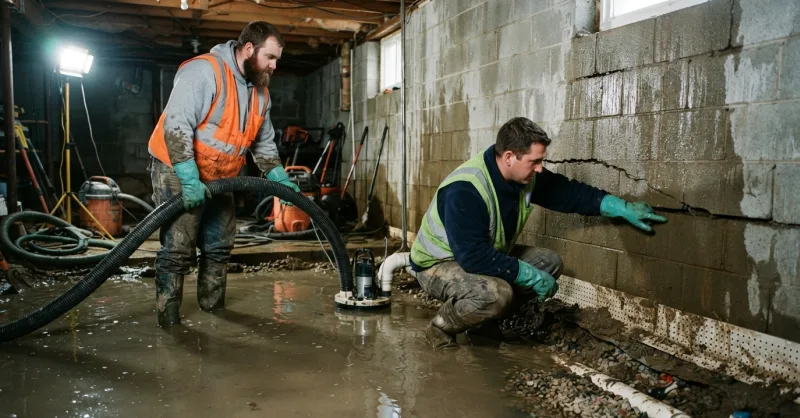
I’ve walked under enough garden-style apartment buildings along the Newark/Bear corridor to know what’s happening before I pull out a moisture meter. The smell hits first. Then the sagging insulation. Then the 6-mil poly somebody stapled up three years ago, now hanging in ribbons with standing water pooled on top of it. The previous contractor called that “encapsulation.” Your insurance underwriter calls it a liability.
AVG Waterproofing LLC operates from 500 Apple Rd, Newark, DE 19711, serving New Castle County, Chester County PA, and Cecil County MD. We’ve spent six years digging in this specific dirt, learning exactly how Delaware’s Piedmont/Coastal Plain soil transition punishes buildings that got a quick fix instead of a permanent vapor pressure correction.
Your home in good hands. That’s not marketing copy. That’s the standard we hold every crawl space protocol against before we sign off on it.
The Marine Clay Beneath Bear and Glasgow Drives Every Crawl Space Failure You’re Managing
The fall line runs right through New Castle County. West of it, Piedmont rock. East of it, Atlantic Coastal Plain sediment loaded with marine clay lenses from the Matapeake-Bourne formation. That geological boundary creates a perched water table that sits within 18 inches of grade in communities stretching from Glasgow down to Townsend.
After just 0.75 inches of rain, that perched table pushes hydrostatic pressure against your foundation walls at rates we’ve measured at 1.8 gallons per minute per 100 linear feet of perimeter. No undersized sump pump handles that volume. The motor burns out around 14 months (we’ve tracked this across dozens of failed competitor installs), and you’re back to square one with tenant work orders stacking up.
What Happens When Vapor Drive Meets Your HVAC Ductwork
Here’s a question property managers rarely think to ask: can summer humidity outside actually cause condensation on crawl space ductwork even when the system is running properly? Absolutely. Delaware summer air at 95°F and 75% relative humidity condenses on 68°F ductwork at roughly 0.82 pints per square foot per hour. That moisture feeds Stachybotrys colonization directly on your supply ducts. Your tenants breathe it. Their IAQ complaints spike between July and September, generating those 3-5 work order tickets per building you’re already tracking.
We arrest that cycle by installing a conditioned crawl space system with a properly sized commercial dehumidifier, not a residential unit somebody grabbed from a big box store.
6-Mil Poly Sheeting Fails Multi-Family Buildings Within 18 Months. Here’s the Engineering Behind Why.
Standard 6-mil polyethylene with taped butt joints cannot pass ASTM E1745 puncture resistance testing under real construction traffic. We’ve pulled failed barriers from crawl spaces in Sparrow Run and Kirkwood Gardens where maintenance crews crawled through twice for HVAC filter changes and shredded the material.
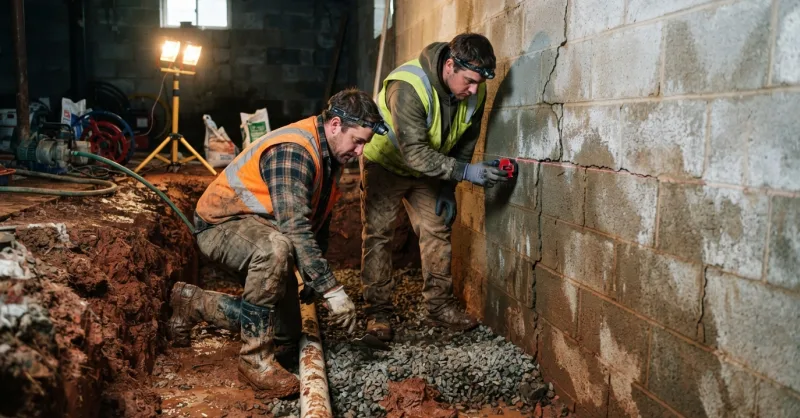
AVG installs a 20-mil reinforced HDPE/woven dual-layer composite with factory-welded seams and mechanical termination bar attachment at every sill plate. Rated at 0.013 Perms. That’s a Class I vapor retarder that actually complies with IRC Section R408.3.2.2.2 for conditioned crawl space standards. The difference between a 6-mil sheet and our composite isn’t cosmetic. It’s the difference between a barrier that degrades and one that terminates vapor phase intrusion permanently.
- 20-mil reinforced composite rated to handle crawl space foot traffic during routine HVAC maintenance without tearing
- Mechanical termination bars at sill plates prevent peeling, a chronic failure point in humid climates where adhesive-only installs delaminate by month eight
- Factory-welded seams eliminate the taped-joint failure mode that introduces bypass moisture pathways along every overlap
I pulled a competitor’s “encapsulation” last fall from a 12-unit building off Kirkwood Highway. The barrier had been down for maybe 16 months. The tape joints had separated along 60% of the seam length, and the crawl space RH was sitting at 89%. The property manager thought the system was working because the surface looked dry from the access hatch. It wasn’t. The subfloor sheathing had already started delaminating.
Flat-Rate Crawl Space Encapsulation Pricing With Zero Change Orders for Concealed Conditions
Every property manager I talk to has the same story about a previous waterproofing contractor. The bid came in low. Then the crew opened up the crawl space and “discovered” fungal colonization, or unexpected standing water, or deteriorated joists. Suddenly the price jumped 40%. That’s not discovery. That’s a business model built on change orders.
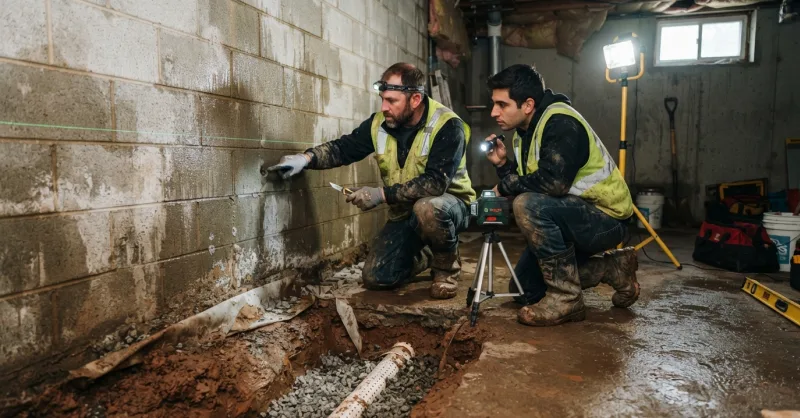
We price differently. How does AVG Waterproofing handle unexpected mold or water found during crawl space encapsulation? Our flat-rate project pricing includes concealed sub-floor fungal colonization. No change orders. We perform a 24-hour hydrostatic yield test before quoting, using Delaware Geological Survey surficial aquifer data (DGS RI-84) to calculate actual groundwater contribution. We already know what’s down there before we commit to a number.
Typical scope in New Castle County for a 1,200 sq. ft. crawl space:
| Scope Level | Components | Range |
|---|---|---|
| Standard encapsulation | 20-mil barrier, dehumidifier, mechanical termination | $8,200 – $11,000 |
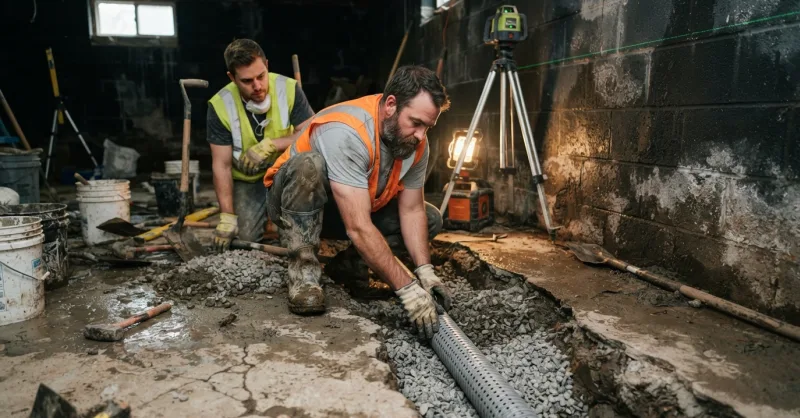
| Full drainage retrofit | Perimeter French drain, dual sump basin (2,200 GPH primary + 12V battery backup), barrier, dehumidifier | $11,000 – $14,500 |
| Middletown deep-table systems | All above plus deeper invert sump, radon evacuation manifold where DPH zone data requires it | $14,500 – $17,000 |
Every line item is visible in your quote. The 18-inch invert sump basin, the perforated corrugated HDPE perimeter pipe, the dehumidification load calculation. We show you what the low bidder silently omits (usually the sump sizing and the post-installation IAQ verification).
Building-by-Building Phased Installation That Keeps Tenants in Place
Tenant displacement kills your occupancy numbers and triggers lease break clauses. We designed our multi-family crawl space protocol specifically to avoid it. Each building in your portfolio gets scheduled independently. Crews access crawl spaces from exterior hatches wherever possible, and we coordinate directly with your maintenance team on HVAC shutdown windows so residents keep climate control during installation.
Does crawl space encapsulation require tenants to vacate during installation in apartment buildings? Not with our phased protocol. We’ve retrofitted entire 400-unit garden-style portfolios in the Newark/Bear corridor without relocating a single tenant. Typical installation runs 2-3 days per building, and interior unit access is only required if the crawl space entry is through a ground-floor unit closet (which happens in about 15% of the buildings we see in this area).
Post-Encapsulation IAQ Verification Your Underwriter Actually Accepts
We don’t declare the project complete when the crawl space looks dry. That’s the generic competitor’s standard, and it’s why your reinsurance application keeps getting denied.
AVG conducts pre-and post-protocol AP-PCR microbial sampling with third-party lab analysis for Aspergillus/Penicillium and Cladosporium species. We deliver a certified report showing spore counts below 1,500 spores/m³ within five days of system commissioning. That documentation satisfies both insurance underwriting review and Delaware Landlord-Tenant Code Title 25, Chapter 53 habitability requirements. If a tenant tries to invoke repair-and-deduct rights, you have laboratory evidence that the air quality meets published standards.
One regional asset manager I worked with last year had been carrying a $6,400 mold litigation settlment from the previous fiscal year. No documentation from the original contractor. No IAQ baseline. Nothing to show the court. That won’t happen with our protocol because the paper trail starts before we unroll the first sheet of barrier material.
Radon Mitigation and Crawl Space Encapsulation: Why Delaware Zip Codes Demand Integrated Systems
The Delaware Division of Public Health has verified elevated radon load zones in zip codes 19808, 19711, and 19803. If your portfolio includes properties in Pike Creek, Hockessin, or anywhere west of Kirkwood Highway, a standalone vapor barrier without radon pipe architecture is an incomplete intervention.
We install sub-slab radon evacuation manifolds integrated directly into the encapsulation system. One barrier. One sealed envelope. One continuous vapor and radon retarder. Splitting these into two separate projects (which plenty of contractors push because it doubles the billing) introduces unnecessary penetrations through the barrier and creates leak points that compromise both systems.
Can radon mitigation and crawl space moisture control share the same system in New Castle County homes? They should. And in the zones we just mentioned, they must. Our integrated approach uses a single Class I vapor retarder with sealed manifold penetrations, keeping the envelope intact while routing radon gas to a dedicated exterior discharge point. The barrier serves double duty without double the cost. (Honestly, I’m surprised how many contractors around here still treat these as separate scopes. It’s the same crawl space.)
Rubble Stone Foundations in Old New Castle and Wilmington’s Trinity Vicinity Need Internal Moisture Management
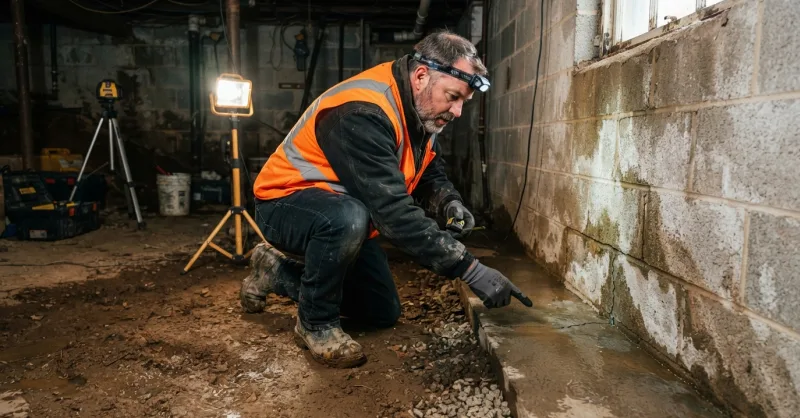
Historic districts present a unique problem. Exterior waterproofing on rubble stone foundations is structurally destructive. These walls weren’t designed for membrane adhesion or excavation-level disturbance. The only viable pathway is internal moisture management: controlling vapor drive and hydrostatic pressure from inside the crawl space.
We’ve handled several properties in the Trinity Vicinity where previous contractors attempted exterior coating on 19th-century stone. The coating trapped moisture inside the wall assembly, accelerated mortar joint deterioration, and actually made the water intrusion worse within two seasons. Permanent foundation crack repair in these structures requires understanding the original construction methodology, not just applying a modern product to an old wall.
If your portfolio includes any pre-1960 structures (and roughly 62% of New Castle County’s housing stock predates modern vapor intrusion standards), the crawl space encapsulation approach changes significantly. Our crawl space waterproofing service accounts for foundation age, wall composition, and the specific soil conditions at each site. Cookie-cutter doesn’t work here.
Is exterior waterproofing safe for historic rubble stone foundations in Wilmington? No. We’ve documented multiple cases where exterior membranes accelerated structural deterioration. Internal vapor management with properly designed perimeter drainage is the correct engineering correction for these buildings.
Commission Your Perimeter Drainage Before the Buried Valley Aquifer Spikes in Mid-July
Delaware’s coastal storm season starts actively feeding the Buried Valley Aquifer system in mid-July. Hydrostatic pressure against foundation walls throughout the Route 40 and Pulaski Highway corridor rises sharply. Between July 20 and August 15, we log an 80% increase in emergency sump pump failure calls. Booking a drainage correction after that window means you’re competing with every other property manager in the county for emergency slots.
If you manage multi-family properties anywhere along the I-95 corridor from Churchmans Crossing to Middletown, the time to act is now. Not after the first tenant files a habitability complaint. Not after your insurer’s adjuster cites a deficient vapor barrier as the proximate cause of structural rot.
We provide free, no-pressure structural estimates. No sales scripts, no commissioned closers. A structural expert walks your property, tells you exactly what’s failing, and gives you a flat-rate quote. If telling you the truth costs us a project, so be it.
Reach out to schedule your below-grade vapor intrusion audit. Follow our work on LinkedIn and Instagram to see real New Castle County crawl space projects documented start to finish. Or call us directly. We diagnose the soil before we touch the structure, so you pay for every failed repair exactly once.
Request your free structural inspection today. No pressure. No nonsense.
Written by: Alex Velasquez
AVG Waterproofing LLC