


What Makes a Wet Basement and Foundation Leak Specialist Truly “Zero-Nonsense” in New Castle County?
I’ve spent 25 years excavating alongside foundation footings across three states. And if there’s one pattern I keep seeing, it’s this: property managers call us after they’ve already paid someone else to fail.
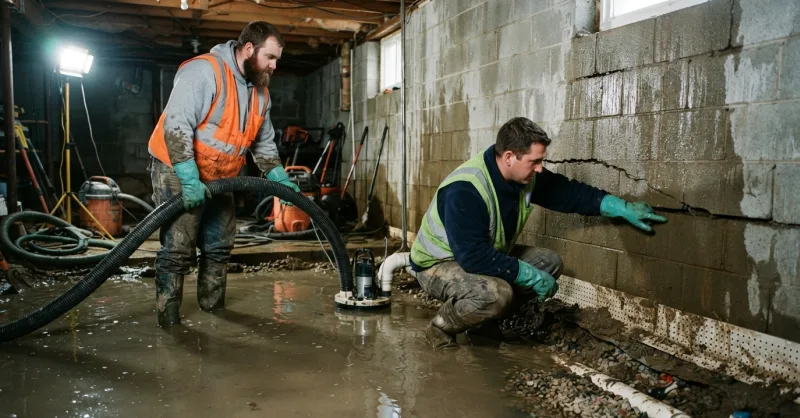
The franchise outfit showed up with a pin-type moisture meter, gave a verbal opinion, installed corrugated pipe and a plastic 1/3 HP sump pump, then vanished. Six months later, a 2-inch rain event overwhelms the system. Tenant inventory gets soaked. An insurance claim gets filed. The “waterproofing contractor” doesn’t return calls.
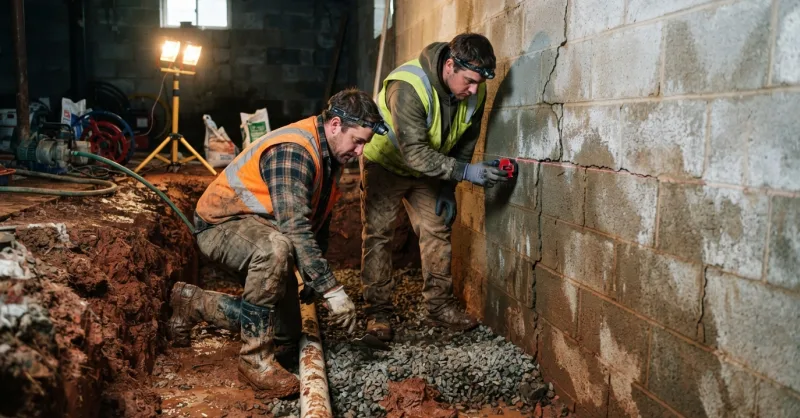
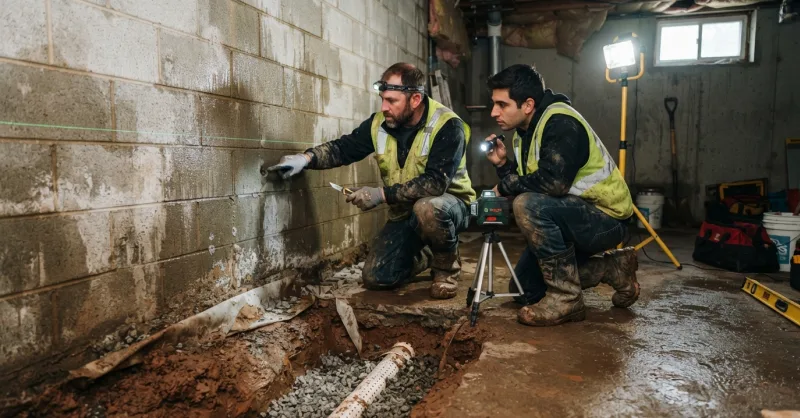
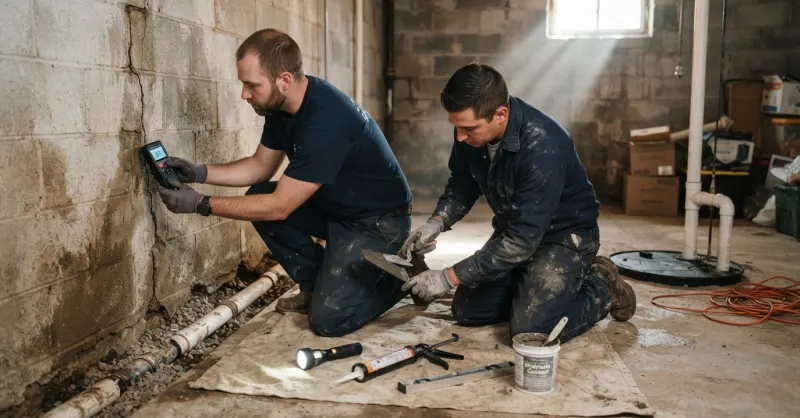
A zero-nonsense wet basement and foundation leak specialist doesn’t operate like that. At AVG Waterproofing LLC, we deploy digital manometers to measure negative floor pressure differential, piezometers for hydrostatic head readings, and ground-penetrating radar for void detection beneath your slab. You get a written findings report the same day, referencing IRC R405.1 and New Castle County code amendments. Not a sales pitch. A structural diagnosis.
We operate from 500 Apple Rd, Newark, DE 19711, covering New Castle County DE, Chester County PA, and Cecil County MD.
The Franchise Trap Is Costing You $40,000 in Tenant Claims
If you manage commercial flex spaces along the I-95 corridor between Newark and Claymont, you already know the drill. A nor’easter stalls over the Brandywine Valley, dumps 4 to 6 inches in 12 hours (the “Delaware wedge effect” is real, and it’s brutal), and your floor drains back up into three tenant suites simultaneously.
The national franchise you hired last year? Their corrugated ADS pipe collapsed under soil settlement. The single sump pump lost prime because nobody installed a check valve rated for the head pressure. And they left you to pull the plumbing permit yourself, which you never did, so now you’ve got a potential DNREC violation for unpermitted dewatering discharge into the MS4.
Why Repeated Emergency Pump-Outs Destroy Your Portfolio
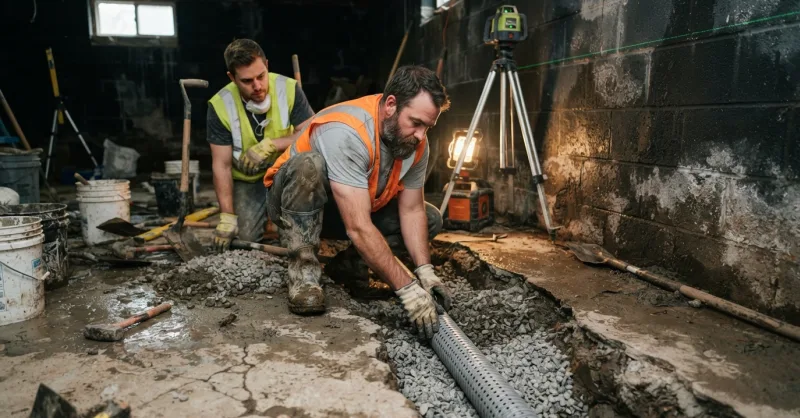
I ran numbers on a self-storage facility in New Castle last year. The owner had paid for emergency pump-outs four times in two years. Total cost including tenant damage claims, mold remediation, and lost rental income: just over $38,000. Our permanent interior drainage assembly with dual Zoeller M267 cast-iron pumps, ASTM F679 solid-wall PVC drain tile, and battery backup came in at $14,200. Fixed-price. Zero change orders.
That storage facility still runs dry through every storm cycle. The backup battery system provides 7 days of continuous dewatering during power failures, which matters when grid outages hit the dense residential zones around Elsmere and Newport during nor’easters.
You can keep scheduling pump-outs, or you can fix the building. We handle all municipal permit submittals as a condition of every contract, from the New Castle County plumbing permit application (Chapter 33, Article III) to the electrical permit for a dedicated sump circuit. The county inspector’s final sign-off is a deliverable we hand you before requesting final payment.
How Cecil Clay and Hydrostatic Pressure Wreck Foundations Along Route 40
People ask us all the time: why does my commercial building’s basement leak after rain but stay bone dry during summer? The answer lives in the dirt.
New Castle County sits on Cecil sandy loam clay subsoil. When rainfall hits, that clay saturates within about 45 minutes, creating a temporary perched water table above your foundation footing. Hydrostatic pressure builds and forces water through cold joints, mortar cracks, and tie-rod holes in poured concrete walls. The leak disappears 36 hours later as the soil drains. But each cycle expands micro-cracks through soil heaving. Your building is quietly deteriorating over multiple storm seasons.
Along the Route 40 Glasgow corridor, we see this constantly in residences and commercial properties built on poorly drained silty clay. The homes and flex spaces from the 1980s and 1990s relied on builder-grade perimeter drains that collapsed decades ago under soil settlement. Nobody notices until carpet padding is soaked or inventory is ruined.
Tidal Influence Near the Delaware River and C&D Canal
Properties in Claymont and the northern tier near the Delaware River face a different beast. Tidal influence and industrial-era fill create persistent humidity that climbs into living and working spaces. Down south, the Chesapeake & Delaware Canal’s east basin pushes shallow aquifer levels up seasonally, triggering foundation seepage in Summit and St. Georges that looks random but follows a predictable tidal calendar.
If you’re operating a converted industrial loft or warehouse near the Port of Wilmington, that musty odor driving away your Class A office tenants isn’t a ventilation problem. It’s sub-slab vapor transmission through an unsealed concrete floor, and it requires a properly engineered interior basement waterproofing system with vapor barrier, not an air freshener.
Our Diagnostic Protocol vs. the Industry’s Verbal Opinion
| Metric | Typical Franchise Contractor | AVG Waterproofing Protocol |
|---|---|---|
| Response Time | 3-5 business days for a free estimate | Veteran foreman dispatches a diagnostic van within 4 hours |
| Diagnostic Tools | Pin-type moisture meter, verbal opinion | Digital manometer, piezometer, ground-penetrating radar, written same-day report |
| Drainage Materials | Corrugated ADS pipe, single 1/3 HP plastic pump | ASTM F679 solid-wall PVC (4,200-psi crush rating), dual Zoeller M267 cast-iron pumps with 100-amp-hour AGM battery backup |
| Permit Management | Left to the property owner | All permits filed, managed, and inspected as contract deliverables |
| Warranty | 10-year limited on parts | 25-year transferable on the complete drainage assembly |
We had a facilities director from a regional REIT ask us last spring to audit a flex industrial park near the I-95/I-495 split. The previous contractor’s “waterproofing” was literally waterproof paint on the interior block walls and a sump basin with no lid, no check valve, and a discharge line running into a flower bed six inches from the foundation. I wish I was exaggerating. (The paint was already peeling, which was almost poetic.)
We ripped the whole thing out, installed a proper interior perimeter drain tile with rigid PVC catch basins sloped at 0.5% to daylight per IRC R405.1, and ran the discharge to an approved stormwater connection. Filed the dewatering permit with the Land Use Department. Got the inspector’s sign-off in 11 days. That building hasn’t had a single water event since, and the REIT used our 25-year transferable warranty documentation in their next tenant lease renewal package.
When Does a Property Manager Actually Need a Foundation Leak Specialist?
Not every damp spot means you need us. But certain triggers should make you pick up the phone immediately:
- A tenant lease renewal clause now demands a certificate of waterproofing warranty, and your current contractor never provided one.
- Your elevator pit floods during moderate rain events, stalling the cab and triggering safety complaints.
- A Phase I environmental assessment flags “water intrusion and potential vapor encroachment” on a property you’re acquiring, and the deal stalls without documented remediation.
- OSHA complaints about mold and indoor air quality in below-grade office suites. Once that paperwork starts, the clock is running against you.
We carry a current Delaware business license and $2 million aggregate general liability policy that specifically covers dewatering and excavation risks. That’s not a marketing bullet point. It’s what your insurance carrier and your tenants’ attorneys will ask for the moment something goes wrong with an unqualified contractor.
The Pike Creek Downspout Problem Nobody Talks About
Can buried downspout lines connected to footing drains actually cause foundation damage over time? Absolutely, and in Pike Creek, it’s one of the most common failure patterns we encounter. Underground downspout tie-ins to footing drains were standard practice in the 1970s and 1980s. Decades of soil settlement crushed those corrugated lines. Now rainwater backs up against the footing instead of draining away from it, and homeowners spend years blaming the gutters when the real failure is six feet underground.
We diagnose this with a camera scope of the lateral line. If the pipe is collapsed (and it usually is), we excavate to footer grade, replace with solid-wall PVC, and reconnect to a proper daylight discharge point. If we find structural cracking from the years of water pressure against the footing, we address that in the same scope of work. One mobilization. One fixed price.
Rubble Stone Foundations in Wilmington Require a Completely Different Approach
Do standard waterproofing methods work on pre-1930s rubble stone foundations? No. And I’ve watched contractors destroy these walls by slathering Portland cement parging over loose fieldstone in Cool Spring and Trolley Square. Portland cement is too rigid for rubble stone. It traps moisture, spalls the stone faces, and accelerates deterioration.
These foundations need lime-based grouting that breathes with the masonry. The joints flex slightly with seasonal movement instead of cracking and failing. We bring a mini excavator through rear alleys in zero-lot-line neighborhoods where standard equipment physically cannot reach the foundation perimeter, file a dewatering plan with the county Land Use Department, and handle the sediment control permit if groundwater pumping discharges into a public storm drain.
Last year, we worked on a converted row home in the Trolley Square area where the previous “fix” was a coat of Drylok on the interior and a dehumidifier plugged into an extension cord. The rubble stone walls were weeping through the paint. We documented the bore log, grouted with NHL 3.5 hydraulic lime, installed an interior curtain drain, and got the inspector’s sign-off. The owner’s tenant (a small architecture firm, funny enough) hasn’t reported a humidity issue since.
Suburban Newark presents a totaly different challenge. The 1970s split-levels with below-grade family rooms framed with untreated wood studs on slab demand immediate mold remediation the moment water contacts that framing. We see this pattern regularly in homes near Route 896 where high clay content causes seasonal heaving and pipes shear at slab penetrations.
Why a Single Sump Pump Is a Liability for Any Commercial Building in Delaware
A nor’easter knocks out grid power in Elsmere. Your single 1/3 HP plastic sump pump goes dead. Within three hours, hydrostatic pressure pushes groundwater through the cove joint and your below-grade parking garage floods. Your tenants’ vehicles are sitting in four inches of water. Sound familiar?
What kind of sump pump system actually survives a multi-day power outage in New Castle County? We install a dual-pump configuration: primary Zoeller M267 cast-iron pump paired with a battery-powered secondary running on a 100-amp-hour deep-cycle AGM battery. That secondary pump provides 7 days of continuous operation without grid power. Both units connect to a Wi-Fi leak detection monitor so you get alerts on your phone before water reaches finish grade.
New Castle County’s electrical code amendments require a dedicated circuit for the sump system, and older sections of Elsmere and Newport mandate a backwater valve for connections to combined sewer laterals. We file both the plumbing and electrical permits and manage the inspection process. If you’re a facilities director or plant engineer near the Port of Wilmington dealing with elevator pits that flood, this pump configuration paired with an oil-water separator (required by DNREC for commercial discharge) is the permanent fix.
When foundation wall bowing or horizontal cracking accompanies the water intrusion, we install carbon fiber stabilization straps rated for 65,000 psi tensile strength. That’s a non-invasive structural reinforcement that stops wall displacement caused by expansive Delaware clay without full excavation.
The Freeze-Thaw Cycle Is Turning Hairline Cracks Into Structural Breaches Right Now
When temperatures drop to 12°F for three consecutive nights along Wilmington’s riverfront microclimate, saturated soil expands roughly 9% volumetrically. That existing hairline stair-step crack in your block wall becomes a full-thickness structural breach by February. I’ve seen it happen on the same buildings year after year because nobody addressed it during the fall window.
The frost line in unheated basements across New Castle County reaches 30 inches. If your footing drain sits at 24 inches and the soil above it freezes solid, water has nowhere to go except through your foundation wall. Is there a way to lock a cracked foundation wall before winter freeze cycles make it worse? Yes. Low-temperature epoxy injection seals the crack at structural depth (not just cosmetically), and carbon fiber straps prevent further horizontal displacement. Both can cure properly even in cold conditions if applied by a crew that understands the resin chemistry.
We treat your foundation like the revenue-critical infrastructure it is. Diagnosed with field data. Repaired to New Castle County code. Warranted for 25 years so you never schedule another emergency pump-out.
If you want the honest structural assessment first, we offer free, no-pressure structural estimates with zero sales scripts. If telling you the truth costs us a project, so be it. I’d rather sleep well at night.
Follow our field work and project documentation on LinkedIn and Instagram. Your Home In Good Hands.
Written by: Alex Velasquez
AVG Waterproofing LLC