


What Causes a Foundation to Fail on Expanding Clay Soil and How Do You Actually Fix It?
I’ve been repairing foundations on Potomac Formation clay for over 25 years now, and the single biggest lie I keep hearing from homeowners is that someone told them “a little crack sealer will take care of it.” That’s not a fix. That’s a bandaid on a geological problem.
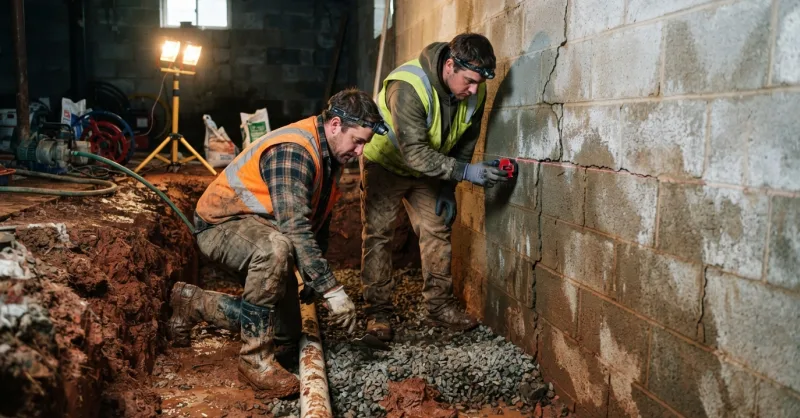
Repairing foundations on New Castle County’s expansive Potomac clays requires hydrological stabilization combined with deep underpinning. Our crews first mitigate moisture fluctuation using subsurface drainage and polyurethane soil injection polymers, then install helical or push piers socketed into stable glacial till beneath the active zone to permanently arrest differential settlement. The active zone around here runs 8 to 12 feet deep depending on proximity to the White Clay Creek watershed, and if your pier doesn’t get past it, you’re just bolting steel into moving dirt.
We operate out of 500 Apple Rd, Newark, DE 19711, covering the full DE-PA-MD corridor. Every job starts with a soil assessment, not a sales pitch.
Why Potomac Formation Clay Destroys Foundations Along the I-95 Corridor
The Piedmont clays underneath most of New Castle County carry plasticity indices above 25, sometimes north of 30 in areas like Hockessin and Pike Creek. That means volumetric swings of up to 10% between wet and dry seasons. Your slab doesn’t stand a chance.
We get roughly 45 inches of rain per year here, and the freeze-thaw cycles from November through March accelerate heave in ways that property managers along the DE-141 corridor know too well. I had a facilities director last spring call us about stair-step cracking in a CMU elevator shaft at an office park near the Concord Pike interchange. He’d already paid another company $9,000 for epoxy injection the year before. The cracks came back wider. (Surprise.)
The problem was never the crack. It was the cyclic shrink-swell in the active zone beneath his slab. You can’t seal your way out of geology.
How Seasonal Moisture Fluctuation Triggers Differential Settlement
Here’s what actually happens beneath your building:
- Spring rains saturate the clay, the soil expands, and your slab heaves unevenly
- Summer drought pulls moisture out, the clay shrinks, and voids form under the footing
- The foundation drops into those voids, and the cycle repeats with wider cracks each year, sometimes jamming egress doors hard enough to create ADA compliance problems
If you manage commercial properties and you’re seeing stuck doors or uneven flooring, you’re not dealing with “settling.” You’re watching active soil failure in real time.
The Diagnostic Protocol That Separates Permanent Repair from Expensive Guesswork
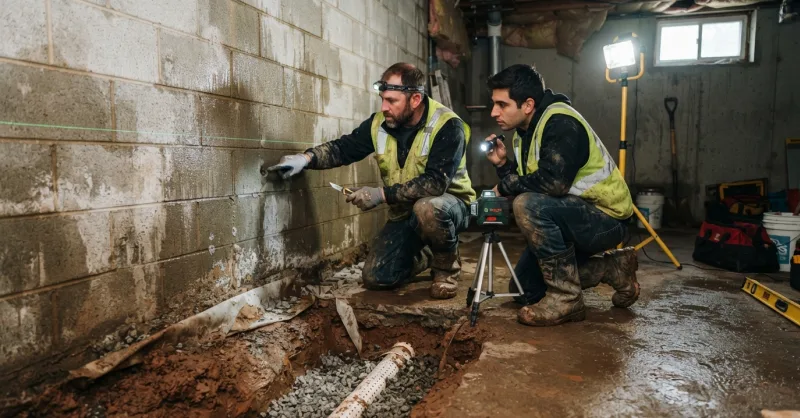
Most competitors send someone with a laser level and a pre-written estimate. We run on-site Atterberg limits testing, pull soil boring logs, and map floor elevation contours cross-referenced against New Castle County GIS soil surveys. That’s not us being fancy. That’s us figuring out what’s actually moving before we drill a single pier.
A property manager overseeing buildings along the I-95 commercial strip near the New Castle Airport district asked me once why we couldn’t just “quote it over the phone.” I told him the honest answer: because a push pier system designed for a plasticity index of 22 is completely wrong for a site with a PI of 34. The helix plate diameter changes, the torque spec changes, the refusal depth changes. Everything changes based on what the soil tells us.
That conversation cost me about two weeks of back-and-forth before he signed. But his building hasn’t moved a millimeter in four years since we finished the work. The previous contractor’s repair lasted eight months. You can see the kind of soil-specific foundation stabilization approach we take on every project.
Helical Piers vs. Push Piers: Which System Arrests Clay Heave in Delaware?
Both work. Neither works universally. The choice depends entirely on the load-bearing requirements and the depth to competent bearing strata beneath your specific site.
When Helical Piers Make Sense
We specify helical pile underpinning when we need to socket into the schist bedrock underlying the Potomac Formation clays. Variable helix plates get calibrated to the liquid limit index at the active zone boundary. Torque-correlated refusal tells us exactly when we’ve hit stable ground, usually between 25 and 45 feet in most of New Castle County.
The big advantage for commercial facilities: installation is relatively quiet. We’ve done overnight pier installations at office parks along US-202 without a single tenant complaint the next morning.
Push Pier Applications
Push piers work well for heavier structures where the building’s own weight provides the reaction force needed to hydraulically drive the pier segments. We use these frequently on older commercial slabs in the Wilmington central business district where access is tight and the bearing depth is predictable from neighboring boring logs.
Costs run $1,200 to $2,800 per pier installed to refusal, and a full perimeter underpinning on a 10,000 sq ft slab typically needs 18 to 30 piers. County permit fees and engineering assessments add $2,000 to $5,000 depending on structural complexity. For a detailed pricing breakdown on residential projects, we’ve published a transparent cost guide for slab leveling that covers the real numbers.
Stopping Water Intrusion Before It Reactivates Clay Expansion Under Your Slab
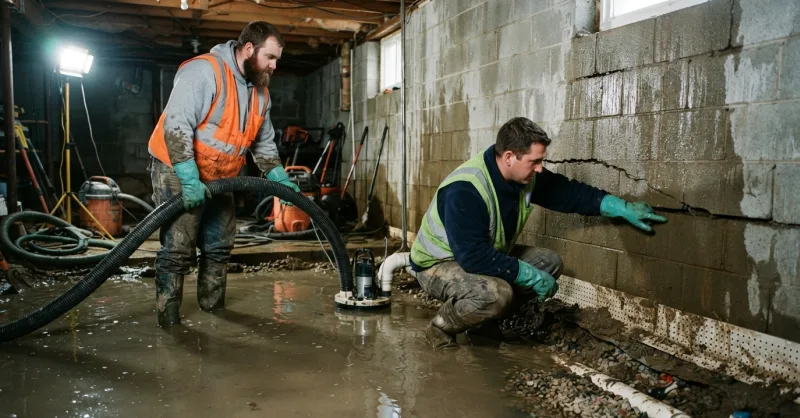
Piers alone don’t solve the problem if water keeps feeding the clay. I learned this the hard way on a Chester County project about five years ago where we installed a textbook helical pier array and the building still showed 3/16-inch seasonal movement. We’d addressed the structural failure but ignored the hydrological driver.
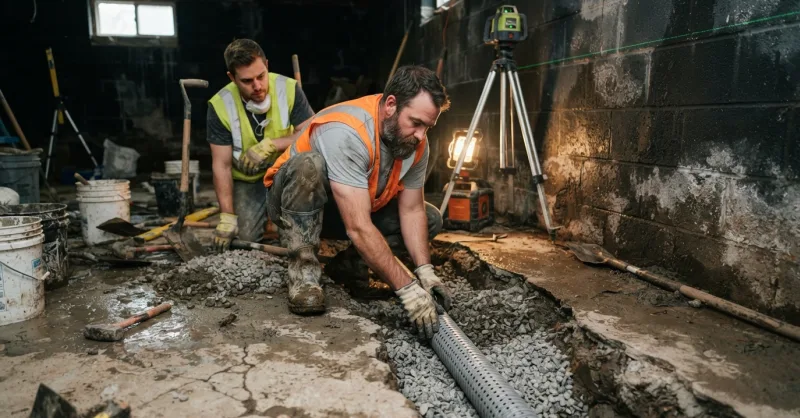
Now every underpinning project we run includes a moisture management component. Polyurethane soil injection at $3 to $5 per square foot neutralizes the cyclic shrink-swell by filling voids and reducing moisture migration. Perimeter drainage intercepts surface water before it reaches the active zone.
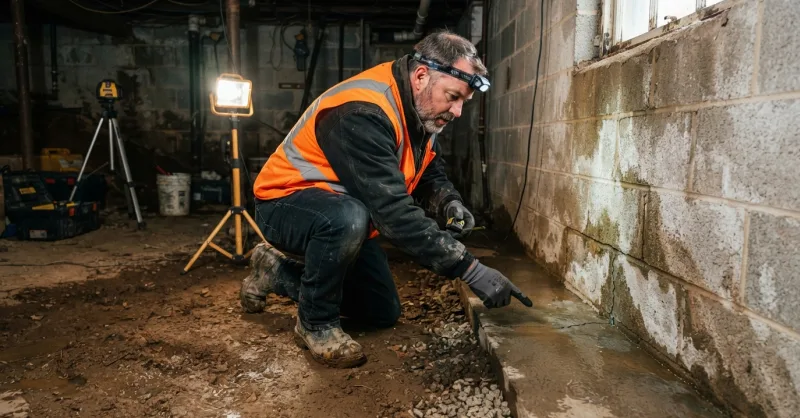
For properties in the White Clay Creek watershed, groundwater is a persistent factor. Can interior waterproofing systems actually protect a foundation from clay soil damage? They can, but only as part of a layered approach. Interior drainage channels relieve hydrostatic pressure, while exterior membrane systems block moisture at the source. We cover the full scope of that work on our basement waterproofing page, but the short version is: drainage without underpinning is incomplete, and underpinning without drainage is reckless.
New Castle County Building Code Requirements for Deep Foundation Underpinning
The county’s Chapter 6 International Building Code amendments require engineered deep foundation plans for any structure on expansive soils. You can’t just show up with a truck and start driving piers. The New Castle County Department of Land Use permit office wants to see an engineer-stamped remediation plan, torque logs proving refusal depth beyond the active moisture zone, and soil test documentation.
This trips up a lot of property managers during acquisition due dilligence. I’ve seen deals nearly fall apart on 1990s-era buildings in the Hockessin area when soil reports reveal PI values above 30 and there’s no record of foundation engineering.
Do you need a building permit for foundation pier installation in Delaware? Yes, absolutely. The county’s typical frost depth of 30 inches influences pier bracket placement, and any underpinning work requires a permit. We handle the full permitting process as part of our scope, and every project gets an engineer-stamped, code-compliant certification that county building officials accept without pushback. Our foundation repair service page walks through the regulatory steps we manage on your behalf.
The 25-Year Transferable Warranty and Why Annual Displacement Monitoring Matters
We back every underpinning project with a 25-year transferable structural warranty. But the warranty itself isn’t what makes it different from the hollow 10-year material guarantees floating around the market.
What makes it real: we run annual optical displacement monitoring on every pier system we install. We tie that data to county precipitation records. If a particularly brutal spring thaw triggers soil movement, we get an automatic alert and schedule a corrective audit and injection at no extra cost to the property owner. How does a foundation repair company monitor pier performance after installation? Through a settlement-monitoring database that tracks sub-millimeter vertical displacement over time, correlated against local weather events. It’s a system, not a piece of paper.
| Metric | Typical Competitor | AVG Waterproofing Protocol |
|---|---|---|
| Site Assessment | Visual inspection, laser level | Atterberg limits testing, boring log analysis, GIS cross-reference |
| Pier Calibration | Standard torque, no soil adjustment | Variable helix plates matched to site-specific plasticity index |
| Warranty | 10-year limited, materials only | 25-year transferable with annual optical monitoring |
What a Foundation Stabilization Project Actually Looks Like on Piedmont Clay
Last fall we got called to a retail strip along DE-141 where the property management team had been patching drywall cracks for three consecutive years. Tenant complaints about doors sticking, floor tile popping, the whole catalog of symptoms. Their insurance carrier was starting to ask uncomfortable questions about the exterior panel cracking.
We pulled soil borings and found the expected Potomac Group clay with a PI of 28. The active zone extended 10 feet below grade. The previous “repair” company had installed six push piers to only 18 feet of depth. Those piers were sitting inside the active zone, riding the clay up and down with the seasons. (That’s not underpinning. That’s just expensive furniture bolted to moving ground.)
We pulled the old piers, re-engineered the array with helical piles driven to torque-correlated refusal at 38 feet, added a perimeter polyurethane injection to stabilize moisture migration, and got the county permit closed in 11 days. How long does commercial foundation underpinning take to complete? For that particular 8,500 sq ft slab, we finished the pier installation in six working days with overnight shifts to avoid disrupting the tenants. Total project time from mobilization to county sign-off was about three weeks.
The building hasn’t moved. The insurance premiums dropped. But I’ll be honest, the drywall guy still had to come back twice because the original patches were garbage. Some things are outside our scope.
Why Waiting Until After the Spring Thaw Is the Most Expensive Decision You’ll Make
Every year between January and March, our phones light up with emergency calls from facility directors who waited “one more season” to address cracking. The freeze-thaw cycle in the Wilmington-Newark corridor accelerates clay heave dramatically, and slab fractures that were manageable in October become structural failures by April.
When is the best time to repair a foundation on expansive clay soil? Before the spring thaw hits. The ideal window is late fall or early winter, before the November-to-March freeze-thaw cycle starts compounding differential settlement. If you’re reading this in January or February, you’re not too late, but every week of delay increases the scope and cost of repair.
We offer free, no-pressure structural estimates across New Castle County, Chester County, and Cecil County. No sales scripts. No commissioned reps. Just a straight diagnostic assessment from someone who’s been reading soil boring logs since before most franchise repair companies existed. Follow our field work on Instagram or connect with us on LinkedIn to see what active clay soil damage looks like before and after permanent stabilization.
Your Home In Good Hands. That’s not a tagline. It’s the only standard we operate by.
Written by: Alex Velasquez
AVG Waterproofing LLC