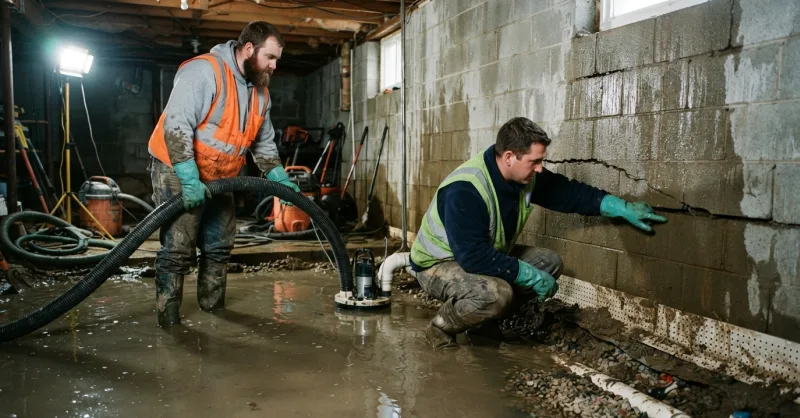



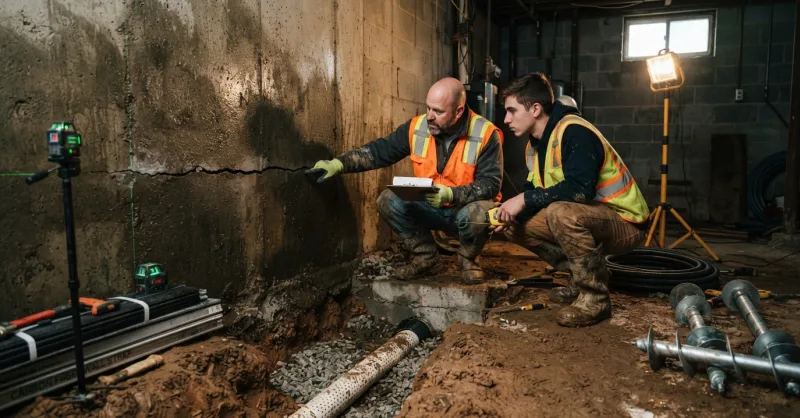
What Actually Works Instead of Epoxy Injections for Basement Wall Cracks in New Castle County?
Epoxy fills the crack. It doesn’t touch the pressure that opened it, and it sure doesn’t calm the soil that keeps shoving the wall around every spring.
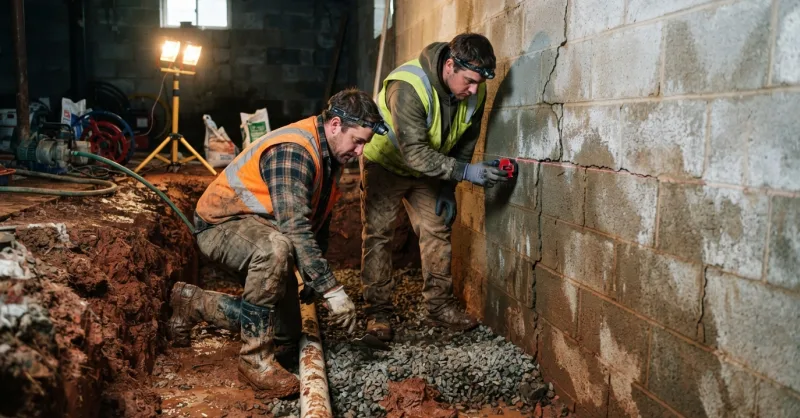
Around here, the permanent fixes look like this: interior footing drains tied to a sump, exterior excavation with a proper membrane, carbon fiber straps for bowing sections, and piers when settlement is the real culprit. Injection has its place, but rarely first, and almost never alone.
If you’ve paid to inject the same hairline twice, the product isn’t the problem. The wall is telling you something you haven’t listened to yet.
My Quick Take After 25 Years Doing This
I’ve walked into Wilmington basements where the homeowner shows me a receipt from three years ago, a receipt from last spring, and a fresh puddle. The resin held. The wall moved. Same story, different zip code.
Why Epoxy Keeps Losing Against Local Soil and Water
New Castle County sits on a patchwork of silt loam Ultisols (Reybold and Glenelg mostly) that push water sideways toward your foundation instead of soaking straight down. Then you’ve got Fallsington pockets and hydric soils that stay soggy for weeks after a decent rain.
Newark homes catch the worst of it. Clay-heavy layers with rocky sublayers expand when wet, shrink when dry, and cycle your footings up and down like a slow-motion pump. Rigid resin does not flex with a moving wall. The bond fractures at the seam within a season or two, sometimes faster.
The Freeze-Thaw Piece Nobody Mentions
We get roughly 241 frost-free days, which means the shoulder seasons hammer saturated soil against your foundation while it’s freezing and thawing. That’s lateral load working overtime.
Near the Christina River, Brandywine Creek, and White Clay Creek corridors (including mapped FEMA Zone A and AE areas), inland rain lifts the water table fast. That’s hydrostatic head shoving from outside. No injection resin on the market is engineered to resist it.
How do I know if my crack is structural or just cosmetic in an older Wilmington rowhome near the I-95 corridor? Orientation tells you almost everything. Vertical and hairline usually means shrinkage. Horizontal or stair-step means the wall is bending or shearing, which is a load problem, not a sealant problem.
Reading the Crack Before Choosing the Fix
Not every crack deserves the same response. I’ve seen contractors quote the same $600 injection package for a hairline shrinkage crack and a half-inch horizontal shear crack. That’s not diagnosis, that’s a menu.
- Vertical shrinkage cracks in a poured wall that’s plumb and dry: injection can be legitimate, but only after grading and downspouts are corrected.
- Horizontal cracks mean lateral earth pressure beat the wall’s bending capacity. Resin does nothing here. You need structural reinforcement for a bowing wall or partial rebuild.
- Stair-step cracks in block follow mortar joints under shear stress. This is a structural signal.
- Recurring leaks at the cove joint (where wall meets floor) are almost always drainage failures pretending to be crack failures.
One thing I wish more homeowners knew: a wet cove joint after every storm is not a crack issue at all. It’s water riding up under hydrostatic pressure through the footing. Injection there is genuinely pointless (I’ve watched crews do it anyway).
The Alternatives That Actually Hold, Ranked by Root Cause
Interior Footing Drains with Sump Systems
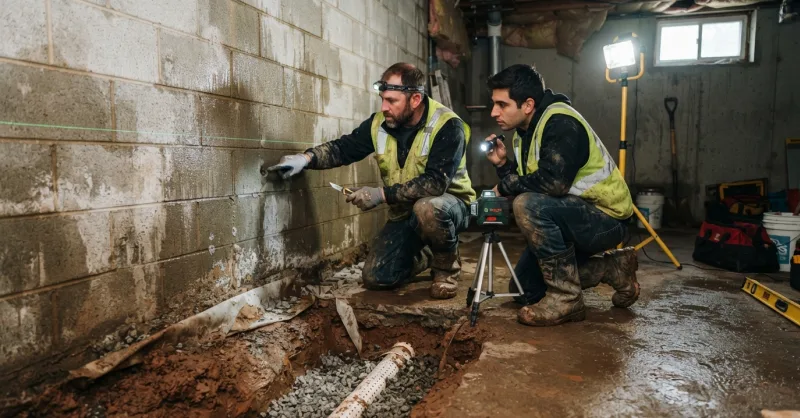
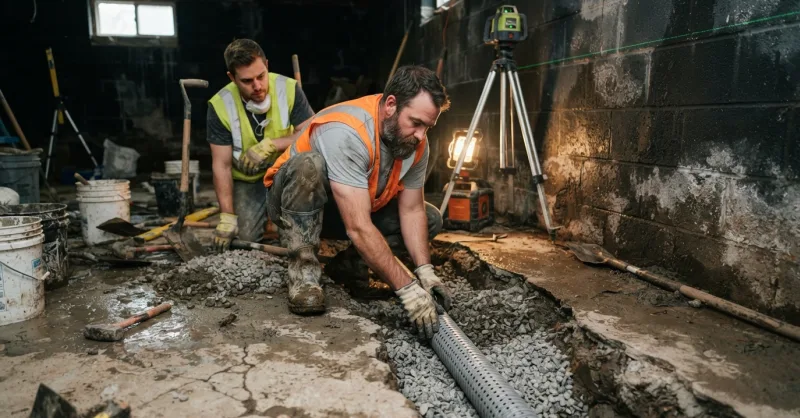
A perforated line inside the footing perimeter, tucked below the slab, catches groundwater before it reaches the wall base. It routes to a sump basin and out. This lowers hydrostatic head at the most vulnerable spot on your foundation.
For Route 9 corridor homes with shallow water tables, or anything sitting in Fallsington soil, this is usually where the honest conversation starts. If you want a written scope, get a quote for French drain and sump pump installation and see what a real proposal looks like.
Exterior Excavation and Membrane Systems
Where access allows, digging to the footing, applying a proper waterproof membrane, adding drainage board, and installing a footing drain is the only method that stops water before it ever touches the wall. It’s disruptive. It’s more expensive. For river-adjacent Zone AE properties, it’s often the only fix that lasts.
Carbon Fiber Straps and Anchors
For block or poured walls showing inward deflection, carbon fiber straps anchored to floor and rim joist arrest movement. They hold the wall where it is. They don’t straighten it. When horizontal cracking shows active lateral load, this is your move.
Helical or Push Piers
When cracks trace back to footing settlement (common in Newark’s clay-and-rock profile), piers transfer load down to stable strata. Crack sealing over a settling footing is theater.
The Cheap Work That Multiplies Every Repair Above
Grading that slopes away from the foundation. Downspout extensions discharging five to ten feet out. Clean gutters. None of it is exciting. All of it reduces the volume of water reaching your footing before you spend a nickel on structural work.
I’ve seen a $28,000 interior drain quote drop to a $9,000 quote after a homeowner regraded one side of the house and extended two downspouts. That’s not a marketing story, that’s a Tuesday.
What’s a realistic price range for permanent alternatives in the Wilmington and Newark market right now? Interior perimeter drains with a sump usually land between $6,000 and $14,000 depending on linear footage and slab condition. Carbon fiber straps run roughly $650 to $900 per strap installed. Full exterior excavation on one wall can move past $18,000 fast. Piers vary widely by depth. Anyone quoting without measuring is guessing.
Permits, Paperwork, and Why It Matters at Resale
New Castle County requires permits for most foundation and structural repairs. Basement alterations fall under county rules, including egress requirements if the space is habitable. The building department handles this out of the county offices in the New Castle area.
A scope that ignores permitting creates problems at resale, appraisal, and insurance review. Engineered repairs with documented inspection records hold their value. A crumpled receipt for an epoxy injection does not. Lenders don’t care what you paid, they care what an inspector can verify.
Do I really need a permit if the crack repair is on a non-load-bearing interior finish in a Chester County-adjacent Newark home? If you’re touching structural elements, drainage, or egress, yes. Cosmetic surface work often does not, but the moment you cut concrete or alter the wall, you’re in permit territory. Ask before you start, not after.
How to Spot a Band-Aid Sale in Ten Minutes
If a contractor quotes injection without measuring wall plumb, without asking crack orientation, and without a word about your soil or flood zone, you’re buying a sealant. Not a repair.
If the proposal promises a “lifetime dry basement” from one product, ask what happens when the wall moves again. It will. That’s the part the sales script skips.
The honest sequence: diagnosis first. Crack mapping. Deflection measurement. Drainage review. Soil and hydrology context. Then a scope that addresses pressure and load. Injection, where it fits, comes last, as a sealant on a wall that’s no longer moving.
A Quick Comparison
| Approach | What It Actually Does | When It Belongs |
|---|---|---|
| Epoxy Injection | Fills the crack void | Stable, plumb, dry poured walls with corrected drainage |
| Interior Footing Drain + Sump | Relieves hydrostatic head | Wet basements, high water tables, Fallsington soils |
| Exterior Membrane System | Blocks water outside the wall | Zone AE homes, accessible exteriors, recurring failures |
| Carbon Fiber Straps | Arrests wall bowing | Horizontal cracks, active deflection under 2 inches |
| Helical or Push Piers | Transfers load to stable strata | Settlement-driven cracks, clay-and-rock profiles |
A Newark Basement I Still Think About
Older split-level near White Clay Creek. Previous contractor (out-of-state franchise, subcontracted crew, cookie-cutter scope) had injected three vertical cracks and painted the whole wall with a waterproof coating. Sold as a lifetime fix.
Two winters later, the paint bubbled off in sheets, one crack reopened wider than the original, and a fresh horizontal crack ran across the north wall at about mid-height. That horizontal one was the tell. Lateral pressure had been building the whole time behind a cosmetic patch.
We mapped the cracks, measured deflection at just over an inch, pulled soil observations, and pieced together the drainage story. Clay-heavy fill against a block wall with no exterior membrane and a downspout dumping four feet from the foundation. Not a mystery.
Scope ended up being carbon fiber on the bowing wall, an interior perimeter drain with a sump and battery backup, and downspout extensions. We punted on exterior excavation because the deck made it a nightmare and the interior system solved the pressure problem. The homeowner was frustrated (understandably) that he’d essentially paid twice. I told him plainly: the first job was designed to sell, not to solve. If sharing that costs me a referral, so be it.
He still calls every spring just to say the basement’s dry. That’s the whole job.
For a broader read on staged repairs, our basement waterproofing page lays out how we sequence work, and this piece on permanent crack repair gets into the reinforcement side.
How Local Geography Shapes the Right Fix
Wilmington’s older housing stock near the Brandywine sits on tighter clay with limited original drainage. Many of those walls are rubble stone or early block, which behave differently than modern poured concrete when water pressure climbs. Injection on rubble stone is almost always the wrong tool.
Newark’s suburban belts, especially near the White Clay Creek watershed, mix clay layers with rocky sublayers that hold water in unpredictable pockets. Footing movement here is seasonal and stubborn. If you’re seeing a failing foundation from expanding clay soil, sealant chemistry isn’t the fight.
New Castle proper along Route 9 has marsh-influenced pockets and shallow water tables. High groundwater is the constant, not the exception. Interior drainage systems tend to be the anchor of any real fix out there.
Do you handle emergency water intrusion the same day for homes along the Route 9 marsh corridor near the Delaware River? Yes. Our crews run seven days a week, and when a storm pushes water through a wall, we’re on-site fast enough to stop it before the mold clock starts. Our shop sits at 500 Apple Rd, Newark, DE 19711, which keeps us close to almost every job we take.
If You’re Staring at a Cracked Wall Right Now
Take a photo with a coin next to the crack for scale. Note whether it’s vertical, horizontal, or stepped. Check if it’s damp, actively leaking, or just visible. Look at your downspouts while you’re at it.
Then get someone out who will measure, not just quote. If they don’t bring a plumb line or ask about your soil, keep looking. We do free structural assessments across New Castle County, Chester County, and Cecil County, and we’ll tell you plainly if injection is the right answer or if it isn’t.
Follow us on LinkedIn or Instagram for real jobsite footage, not stock photos. You’ll see the difference between structural work and cosmetic theater within about thirty seconds.
Your home deserves a diagnosis, not a script.
Written by: Alex Velasquez
AVG Waterproofing LLC