


What Actually Separates the Best Sump Pump Backup System Installers Near Me From the Rest?
Most sump pump backup systems in New Castle County fail the same way. They get sized for a plumbing emergency, not for what Delaware groundwater actually does during a nor’easter.
Here’s the truth I’ve learned running crews across Newark, Wilmington, and Bear for the past six years. When your primary pump quits at 2 a.m. mid-storm, a battery backup isn’t a luxury add-on. It’s the only thing standing between your finished basement and a five-figure loss.
But the backup itself is only as good as the groundwater diagnosis behind it. If nobody tested your soil, measured your water table, or timed how fast water enters your sump basin, you don’t have a system. You have a guess with a battery attached.
Why Newark’s Clay Soils Change Everything About Sump Design
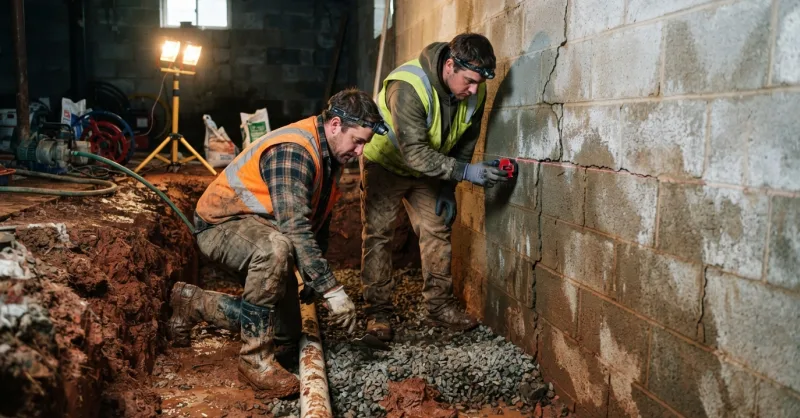
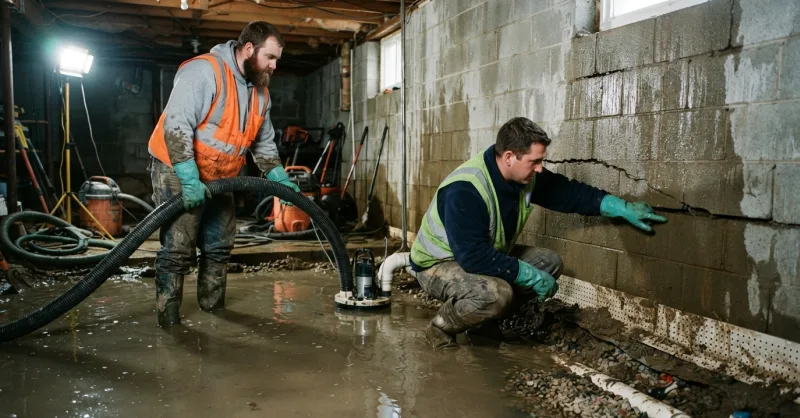
I’ve spent years diagnosing basements from Kirkwood Highway out toward White Clay Creek, and the pattern repeats itself. A homeowner calls after a two-inch rain. Water shows up at the floor-wall joint roughly 90 minutes later. Not right away, 90 minutes.
That delay tells me something specific. The water isn’t surface runoff finding a hairline crack. It’s groundwater migrating laterally through Ultisol silt loam and heavy Piedmont clay, building hydrostatic head against your foundation until it finds the weakest joint.
In the 19711 and 19702 zips, the water table often sits two to eight feet below grade. Many basements around here are essentially parked in the phreatic zone. Your sump pump isn’t handling occasional leaks. It’s managing continuous seepage from soil that never really drains.
Clay with permeability under half an inch per hour doesn’t shed water. It holds it. It swells. And it keeps pushing against your block until something gives. If you want to understand the mechanics behind that pressure, I wrote a longer breakdown on how hydrostatic pressure pushes water through basement walls.
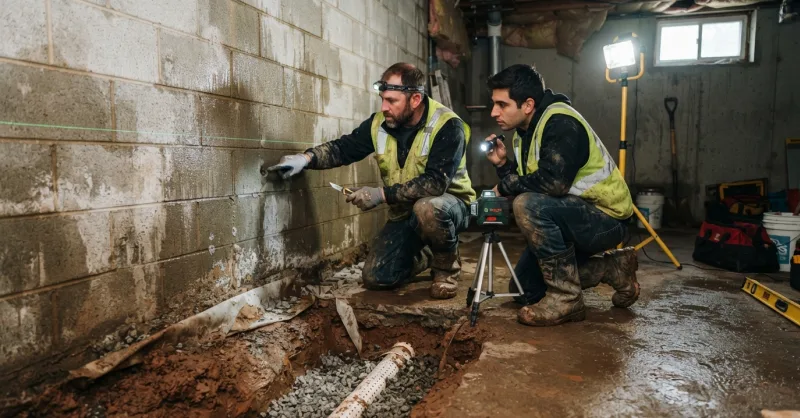
The 5-Step Diagnostic I Run Before Quoting a Single Pump
Before I write a proposal, I walk the same sequence on every basement in New Castle County. Skipping any step is how installers end up with a homeowner calling them back three storms later.
- Downspout discharge distance. If your downspouts dump within three feet of the foundation, you’re recycling roof water back into already-saturated clay. IRC R401.3 wants that grade sloping away at roughly 2 percent for at least ten feet. Most homes I inspect miss this by a wide margin.
- Grade slope verification. I check actual pitch with a level, not what the mulch beds look like. Negative grade against a block wall in Reybold or Glenelg soil is a direct feed line to your footing.
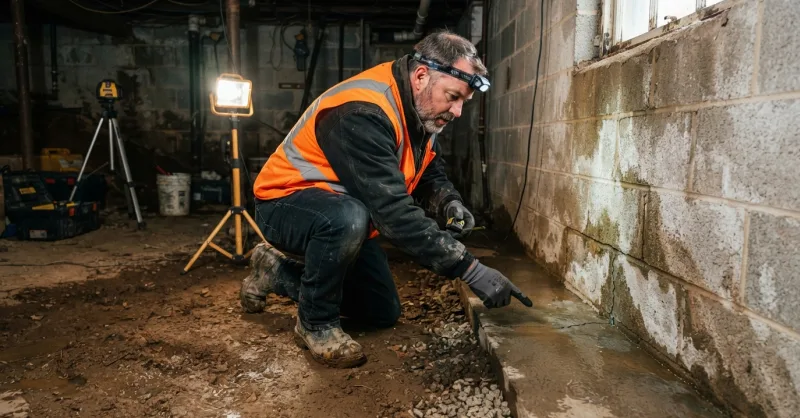
- Efflorescence height. That white mineral staining on your wall isn’t cosmetic. Its height tells me how far the water column has climbed inside the block. That’s your hydrostatic head, written on the wall in salt.
- Water table probe at four feet. Confirms saturation depth. This determines whether a standard basin works or you need a deeper, higher-capacity setup with a second pump staged above the first.
- Sump cycling rate. I time how often the pump runs after rain stops. A pump cycling every few minutes in dry weather means groundwater is feeding continuously, which changes your battery runtime math completely.
Only after those five checks do I talk about equipment. Anyone quoting you a pump over the phone hasn’t earned the job.
What a Real Backup System Looks Like in Delaware Basements
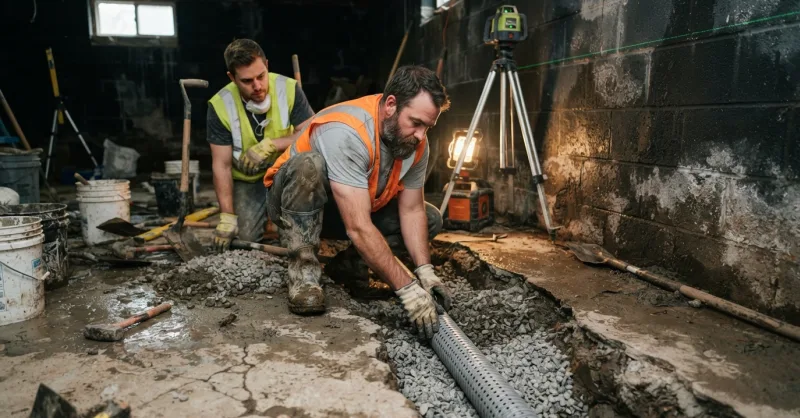
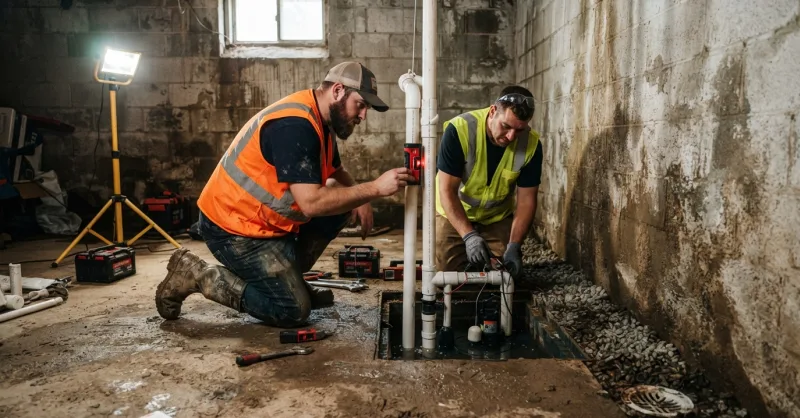
A properly designed setup for this region starts with a footing-level perforated PVC drain embedded in ASTM C33 aggregate, tied into a sealed sump basin. The primary pump gets sized to your required GPM at your actual head height, not a generic spec sheet number some rep pulled off a shelf.
The battery backup is a deep-cycle bank with documented runtime at design load. Not a vague “up to 8 hours of protection” claim printed on the box.
Then come the parts most installers skip:
- A high-water alarm with float or sensor staging, so you know the moment the primary fails instead of finding out from wet socks
- Dual-pump redundancy for homes in hydric soil pockets or near Zone AE corridors along the Christina and Brandywine
- Discharge routed at least ten feet from the foundation, never into the sanitary sewer (which is prohibited across most of New Castle County anyway)
If your current setup discharges into a floor drain that ties into the sewer line, that’s not a system. That’s a code violation waiting to back up during the next municipal surcharge event. I’ve seen exactly this on a Claymont job last spring, installed by a white-label crew subcontracted through a national franchise. The homeowner paid twice: once for the illegal install, once for us to reroute it properly. For the full picture on drainage integration, our sump pump installation and battery backup page lays out the components in detail.
The Battery Runtime Question Nobody Answers Straight
Homeowners ask me this constantly. How long will the backup actually run?
The honest answer depends on three variables: your pump’s amp draw, your basin’s inflow rate, and the battery bank’s amp-hour capacity. In clay-heavy Newark soils where pumps cycle often, a single deep-cycle battery might give you four to six hours. During an extended outage after a tropical system rolls up the coast, that’s not enough.
So I size battery banks against your measured cycling rate, not a marketing number. If your pump runs every four minutes during a storm, we calculate runtime against that reality. Sometimes that means two batteries wired in parallel. Sometimes it means a second pump on a separate circuit fed by an inverter. The number gets derived from your basement, not from a brochure.
(One of my Middletown clients last fall wanted the “biggest battery you sell.” Wrong question. Her pump was oversized for her basin and short-cycling itself into an early grave. We swapped to a smaller primary and got her runtime up without adding a single amp-hour of storage.)
What Skipping This Actually Costs You
Groundwater doesn’t negotiate. When a pump fails during an outage and the backup isn’t there, you’re looking at saturated drywall, ruined LVP, mold colonization inside 48 hours, and a homeowner’s insurance conversation that usually ends with the phrase “groundwater exclusion.” That’s how a $2,500 backup system turns into a $15,000 remediation bill plus a claim denial letter.
If you’ve already finished the basement without addressing drainage and backup first, you’ve built living space on top of a problem that inspectors and appraisers will flag the second you list the house. I’ve walked away from more than one job where the honest answer was “you needed this five years ago, before the drywall went up.” If telling the truth costs me a project, so be it. I’d rather sleep well at night.
You can dig deeper into related structural fixes on our basement waterproofing services page if you’re weighing a full interior system alongside the backup install.
Questions Homeowners Actually Ask Me on Site Visits
A quick note on how I answer these: I get asked the same handful of things across every zip code I work, from properties near the Delaware Memorial Bridge industrial corridor down to subdivisions off the Route 1 commuter belt. So instead of parking them in a boring FAQ block, here they are woven where they belong.
How quickly can your crew reach my house after I call? Our footprint runs the I-95 corridor from north Wilmington down through Middletown, and we operate seven days a week (8 a.m. to 7 p.m. Monday through Saturday, 8 a.m. to 3 p.m. Sundays). Most Newark, Bear, and Claymont calls get an on-site diagnostic within 24 to 48 hours. Emergency water intrusion moves faster.
When a homeowner off Route 40 near the Glasgow area asks about permits, the answer varies. Do I need a permit from New Castle County to install a sump pump and battery backup? For a like-for-like replacement inside an existing basin, usually no. When we’re cutting new interior drainage, installing a new basin, or modifying electrical circuits for the backup inverter, yes, and the discharge routing gets reviewed against local stormwater rules.
Can the discharge tie into my existing downspout line? Only if that downspout line already carries roof water away from the foundation to daylight or a proper drywell. If it dumps at the foundation, you’re just recycling water into your sump. I’ve seen this exact setup on a 1980s build near Pike Creek, and the pump was running 22 hours a day fighting itself.
Newark homeowners near the University of Delaware campus corridor often ask about older builds. What’s different about installing a backup system in a 1950s stone or block foundation versus a newer poured concrete build? Older block foundations transmit moisture through mortar joints and porous CMU under hydrostatic load, so we usually pair the sump with interior perimeter drainage and sometimes carbon fiber reinforcement on walls showing deflection. Newer poured walls hold up better against pressure but frequently lack functional footing drains, so the sump becomes the primary defense.
Will a battery backup protect me if my basement is in a Zone AE floodplain along the Christina River? Partially. A backup handles groundwater and pump failure during grid outages. It cannot fight surface flood water that overtops your foundation wall or comes through window wells above the base flood elevation. For AE properties, we design redundancy (dual pumps, sensor alarms) but I’m upfront about what the system controls and what it doesn’t.
The Bottom Line for New Castle County Homeowners
If you’re searching for the best sump pump backup system installers near me, the right question isn’t “who’s cheapest” or “who can install tomorrow.” It’s who will test your soil, measure your water table, and size the system to what your basement actually does during a nor’easter.
That’s the difference between a backup system and a backup guess.
We run diagnostics out of 500 Apple Rd, Newark, DE 19711, and our crews cover New Castle County, Chester County PA, and Cecil County MD. You can follow the field work and job-site breakdowns on LinkedIn or Instagram, where I post the actual diagnostics, not staged before-and-afters.
The groundwater is coming whether the grid is up or not. The only variable is whether your system was built to handle it.
Written by: Alex Velasquez
AVG Waterproofing LLC