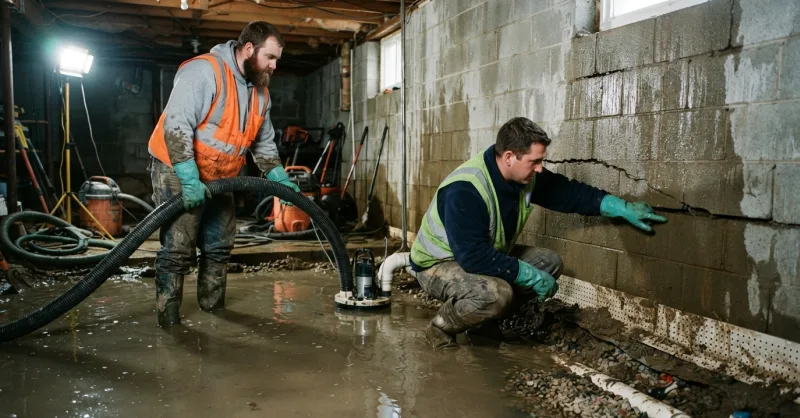




What Makes a Real Crawl Space Encapsulation and Moisture Control Expert in New Castle County?
Not the contractor with the best Google ad. Not the guy who shows up with a roll of 6-mil poly and a caulk gun. A genuine crawl space encapsulation and moisture control expert meters every sill plate, pulls fungal spore air samples, and cross-references your foundation type against county-adopted IRC 2018 Section R408 before quoting a single dollar.
I run AVG Waterproofing LLC from 500 Apple Rd, Newark, DE 19711, and I’ve spent 25 years in U.S. structural work. Six of those years right here, digging into the specific clay-heavy soils of Delaware, Chester County PA, and Cecil County MD. We tell you exactly what is failing and fix it permanently. No sales scripts, no upsell theater.
If you manage 500 rental units across Newport, Elsmere, and Newark, or you oversee maintenance for a county school district, you already know the pattern: musty odor complaints spike every July, buckled hardwood shows up in October, and your insurance carrier sends a letter about fungal loss ratios by December. That cycle ends when someone actually diagnoses the crawl space instead of just covering the dirt floor.
Why 10-Mil Poly Fails by August in the Mid-Atlantic Humidity Cycle
June through September, outdoor dew points in New Castle County routinely sit above 70°F. That warm, saturated air pushes moisture through every gap in a vented crawl space with real force. The physics term is vapor drive, and it does not care about your stapled plastic.
I crawled under a 1960s ranch in Brookside last summer where a previous contractor had installed a “complete encapsulation.” The liner was 6-mil unreinforced poly, no mechanical attachment at the walls, seams overlapped maybe four inches with no tape. The rim joists? Completely untouched. Raw, open wood sitting at 28% moisture content. (Fungal colonization starts at 16%. Twenty-eight percent is basically an invitation.) The dehumidifier they’d sold the homeowner was a residential box store unit rated for a bedroom, not a 1,200 square foot crawl sitting on Kirkwood formation clay.
The HVAC evaporator coils in the crawl-mounted air handler had visible corrosion. Return plenums were pulling unconditioned, spore-laden crawl air into the living space. The tenant’s kid had been on a nebulizer for six months.
What a Sealed Crawl Space System Actually Requires
- A 20-mil fiber-reinforced liner that meets ASTM E1745 Class A and ASTM E84 fire rating, overlapped 8 inches minimum with seams mechanically sealed.
- Closed-cell spray foam at every rim joist to eliminate the thermal bypass that generic crews always skip.
- A commercial dehumidifier sized to 70 pints per day at 60°F saturated air, ducted to the crawl space and not just dropped on the floor. We guarantee relative humidity at or below 55%.
- A proper sump pump assembly (Zoeller M53 class, cast-iron volute, tethered float) with a discharge line routed to daylight drain, plus a check valve so backflow doesn’t refill the basin every cycle.
That Brookside job cost the property owner twice what it should have, once for the failed install and once for us to rip it out and do it right. The facilities manager on that account now sends us every crawl space in his portfolio before summer.
Does New Castle County Require a Permit to Encapsulate a Crawl Space?
Yes. When you convert a vented crawl space to an unvented, conditioned system, you alter the building envelope’s thermal boundary. New Castle County Department of Land Use requires a building permit for that change, and the work must comply with IRC Section R408 and N1102.2.10 moisture control provisions.
Here’s where it gets worse for facilities managers who hired the wrong crew: all of New Castle County sits in EPA radon Zone 1. If your encapsulation contractor doesn’t rough in sub-slab depressurization piping and a sump basin sediment boot during installation, you’ll need a separate radon permit and post-test verification later. That’s two mobilizations, two permit fees, and two disruptions to your tenants. We handle it in one pass because we already know the code interaction, and we procure the permits ourselves.
What humidity level is safe for floor joists in New Castle County during summer? Wood moisture content must stay below 16% to prevent fungal colonization. We meter every joist, girder, and sill plate during our pre-encapsulation assessment and log the readings. If your property sits in the White Clay Creek basin or anywhere near the tidal influence zones along the Delaware River, seasonal water tables can ride within 18 inches of grade. That saturated soil pushes moisture through bare dirt floors at rates that overwhelm any passive vapor barrier.
Kirkwood Clay, Tidal Groundwater, and Why Your Soil Type Dictates the Fix
I can’t stand when a contractor applies the same spec sheet to every crawl space in the county. A pier-and-beam foundation in Hockessin sitting on Kirkwood formation clay behaves nothing like a concrete block crawl in the Route 9 industrial corridor near the Delaware River where brackish groundwater intrusion is the primary threat.
In Mill Creek Hundred, the clay-rich soils and stormwater management gaps cause seasonal flooding that overwhelms undersized sump pumps every July. I’ve pulled failed tethered floats out of basins caked with sediment because nobody installed a sediment boot. The pump ran dry, burned out, and the crawl flooded during a thunderstorm while the homeowner was on vacation. The property management company ate a $14,000 mold remediation bill.
Pre-Encapsulation Site Assessment: What We Actually Measure
We deploy digital moisture meters at every structural wood member, pull ASTM D7338 fungal spore air samples through a third-party lab, and run infrared thermography to map thermal bypasses. This isn’t a 10-minute walkthrough with phone photos. It’s a quantitative record that satisfies insurance carrier documentation requirements and holds up in claim review.
When you manage properties across multiple zip codes, we provide a bound report per crawl space: psychrometric graphs, a code deficiency matrix, and a fixed-price scope matched to the specific foundation type. Post-and-beam in Fairfax gets a different drainage matting configuration than a stone-wall crawl near the Christina River. If your foundation has structural concerns beyond moisture, our team handles foundation repair across the same service area.
Crawl Space Autopsy: What We Find Under Homes Where “Encapsulation” Already Happened
About 40% of the encapsulation work we do now is corrective. Someone already paid another company. The crawl is still wet.
A property management group in Newark brought us in last fall to inspect three rental units in the 19711 zip where tenants were complaining of persistent musty smell despite an encapsulation completed eighteen months prior. The previous contractor’s liner was already delaminating at the wall attachment points because they’d used adhesive instead of mechanical fasteners on a damp block wall. (Adhesive doesn’t bond to wet masonry. Every experienced installer knows this.) The seam tape had separated across twelve linear feet of overlap. No rim joist sealing whatsoever.
The sump pump had no check valve on the discharge. Every time it shut off, half the water ran back into the basin. The unit was cycling every ninety seconds during moderate rain.
We stripped it, installed a 20-mil reinforced liner with 12-inch overlap and mechanical fastening at the walls, sealed the rim joists with closed-cell foam, replaced the pump with a proper cast-iron unit, and deployed a commercial dehumidifier. Twelve months later, the remote hygrometer we installed reads 48% RH average. No tenant complaints since.
Can I encapsulate my crawl space without a dehumidifier in northern Delaware? You can install a liner without one, but you won’t maintain the 55% RH threshold that prevents wood decay and fungal growth during the summer humidity ramp. A conditioned crawl space without mechanical drying in our climate is a sealed container that traps moisture instead of expelling it. We size every unit to the crawl’s volume and worst-case dew point conditions.
What Crawl Space Encapsulation Costs in New Castle County (With a Real Breakdown)
Facilities managers and property directors need line-item clarity. Your capital improvement budget doesn’t have room for “excavation-stage upcharges,” and neither does your patience.
For a typical 1,500 square foot crawl space in zip code 19711, our fixed-price scope includes:
- 20-mil fiber-reinforced antimicrobial liner, mechanically fastened at walls and columns, seams overlapped 12 inches and sealed.
- Closed-cell spray foam at all rim joists and sill plate transitions.
- Zoeller-class cast-iron sump pump assembly with tethered float, check valve, and discharge routed to daylight.
- Commercial dehumidifier sized to 70 pints/day at 60°F, ducted.
- County building permit procurement and final inspection coordination.
- Optional radon sub-slab depressurization rough-in (strongly recommended since the entire county is Zone 1).
We publish the materials-and-labor split so you see where every dollar lands. Multi-property contracts get a fixed unit price with a performance bond option. The humidity guarantee is in writing. If relative humidity exceeds 55% at 70°F, we come back at our cost. Not many sealed crawl space contractors in the tri-state area will put that on paper.
If your properties also show signs of foundation settling or soil movement, we diagnose that during the same site visit. One mobilization, one crew, one report.
Remote Monitoring and the 12-Month Humidity Proof You Can Hand to Your Insurance Carrier
We install a remote hygrometer in every crawl space we encapsulate and grant you read-only access to real-time relative humidity, temperature, and sump pump actuation logs for the first twelve months. When your insurance carrier or risk management team asks for documentation that the moisture control remediation is actually working, you hand them a twelve-month data export. No guesswork, no “it seems drier down there.”
Our annual re-inspection covers seam integrity verification, drain line jetting, pump load testing, and hygrometer calibration check. We re-tape any seam separation and document it photographically. How often should a crawl space sump pump be load-tested in a high water table area? We load-test at every annual inspection and recommend the property manager or facilities team run a manual test quarterly, particularly in the White Clay Creek basin and Route 9 corridor where hydrostatic pressure fluctuates with tidal cycles and storm events.
Your post-project deliverable package includes moisture content logs at every wood member, third-party fungal spore lab results (pre and post), infrared images, permit closure documentation, and the hygrometer access credentials. That package is structured for insurance submission and ASTM E2018 property condition assessment compliance.
We’ve built 25 years of structural experience and six years of local soil knowledge into a process that treats your crawl space like a building envelope system, not a weekend project. Our crawl space waterproofing service covers New Castle County DE, Chester County PA, and Cecil County MD.
Your home in good hands. Connect with us on LinkedIn or Instagram to see current project documentation and seasonal moisture advisories.
Written by: Alex Velasquez
AVG Waterproofing LLC