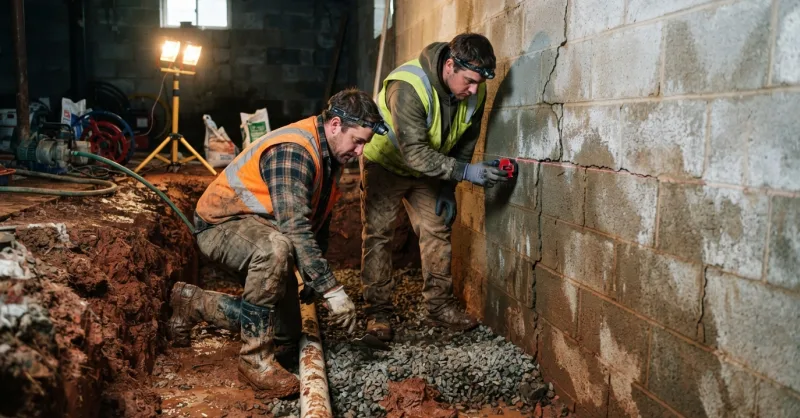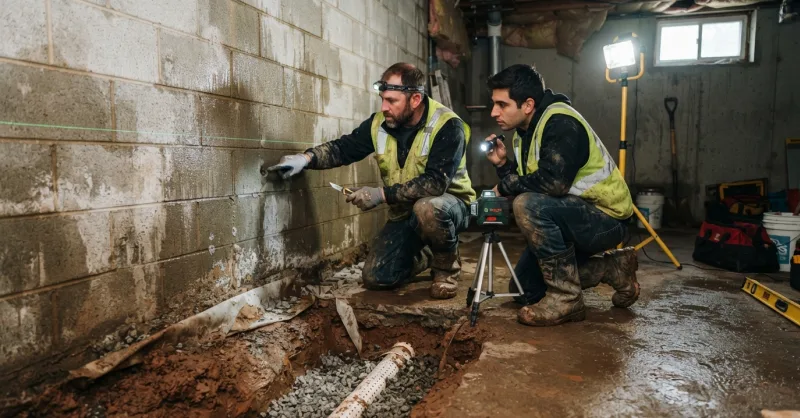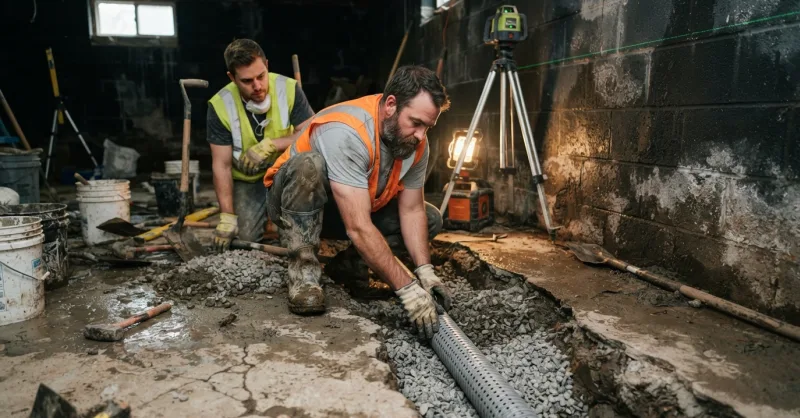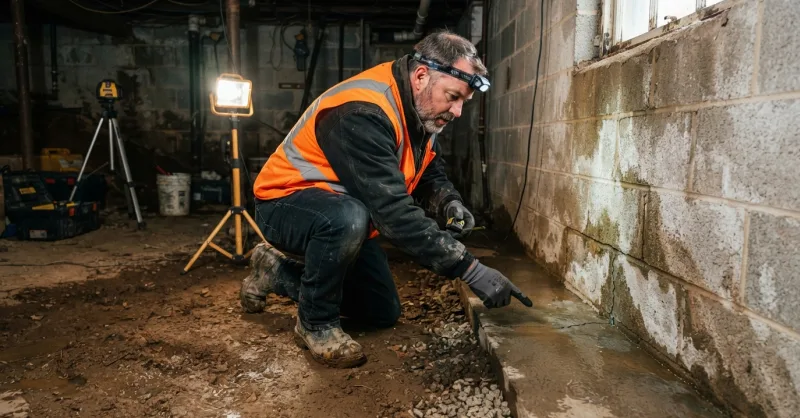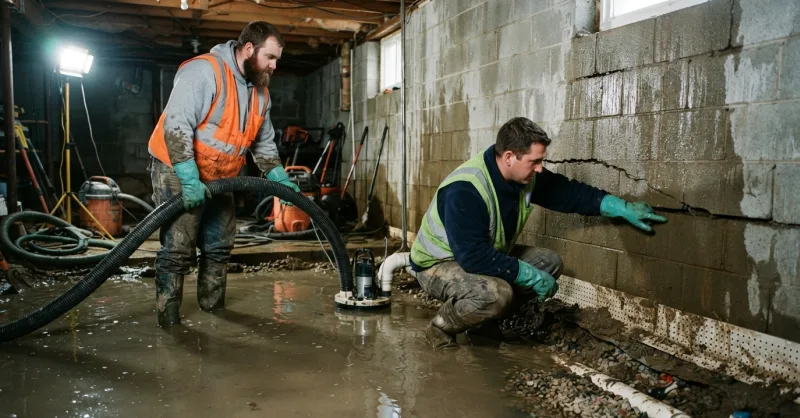



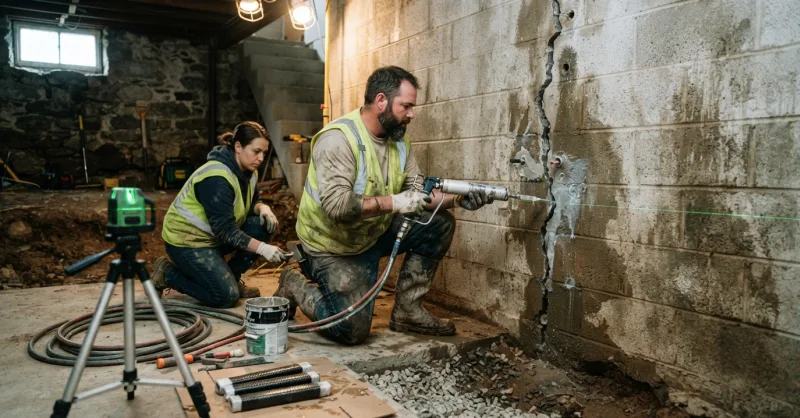
What Actually Makes Foundation Crack Repair Permanent in New Castle County?
Here’s the honest truth after 25 years of doing this work: a foundation crack repair is only permanent when three things happen at once. Water entry stops. Structural continuity gets restored. And the reason the crack opened in the first place gets corrected.
Skip any one of those, and you’re patching symptoms.
I’ve walked into basements in Newark, Wilmington, and Bear where a homeowner already paid twice for the same crack. First for waterproof paint. Then for hydraulic cement. The crack came back both times because nobody bothered to check the exterior grade, the footing drain, or whether the clay soil was pushing the wall inward every spring.
Permanent structural foundation crack repair means matching the fix to the failure mode, not selling a package. Epoxy for dry structural cracks. Polyurethane for active leaks. Carbon fiber or wall anchors for movement. Drainage correction when hydrostatic pressure is the driver.
That’s the whole framework. Everything else is noise.
Reading the Crack Geometry Before Anyone Quotes You a Number
The size of a crack doesn’t tell you much on its own. The geometry does. I want you to be able to read your own basement wall before a contractor walks in with a clipboard and a script.
Stair-Step Cracks Through Mortar Joints
Signature of differential settlement or lateral soil pressure. The crack follows mortar because that’s the weakest plane in block or brick. Wider at the top? The wall is getting pushed inward from outside, usually saturated clay after a wet week. Wider at one end of the wall? One corner of the footing is dropping faster than the rest.
Horizontal Cracks Near Mid-Wall Height
Almost always hydrostatic pressure. Saturated soil against the exterior creates lateral force, the wall bows inward, and the horizontal crack opens at maximum deflection. In clay-heavy pockets near White Clay Creek and the Christiana River corridor, I see this pattern every spring after extended rain. Older neighborhoods off Route 273 get hit hard when the water table climbs.
Vertical Hairlines at Corners or Mid-Span
Often shrinkage from original curing. Cosmetic if the width is stable, there’s no lateral displacement, and no water is entering. A crack that’s been 1/16 inch for a decade is not the same problem as one that opened from 1/16 to 1/4 inch across two winters.
Diagonal Cracks From Window or Door Corners
Movement at the opening. Frost heave, footing shift, or both. Freeze-thaw cycles in the mid-Atlantic push and pull soil against the foundation, and openings are stress concentrators.
Three Questions I Ask Before I Ever Quote Anything
You can do this yourself in about ten minutes. No tools required except a pencil and honesty about what you’re seeing.
- Is there displacement? Run your hand across the crack. If one side is proud of the other, even by 1/8 inch, the wall moved in shear. That’s structural.
- Is the width changing? Mark it with a pencil, write today’s date next to the mark. Check after the next heavy rain. Check again after a hard freeze. A crack that widens with the seasons is under active load.
- Is water getting in? Water entry doesn’t automatically mean the wall is failing structurally, but it does mean your exterior drainage plane has failed somewhere. In block foundations, water inside the cores erodes mortar from within and spalls the block faces over time.
Those three answers usually tell me more than a full inspection report full of buzzwords.
Why the Cheap Fixes Keep Failing in Older Basements
Hydraulic cement, waterproof paint, surface caulk. They get sold as repairs. They’re concealment.
In a block wall, water behind the coating migrates to the next mortar joint or block core and finds a new exit. I pulled a chunk of “waterproofed” wall apart in a 1962 Wilmington rancher last spring and the block cores were soaked through, the rebar was rust-jacketed, and the homeowner had been repainting the interior every two years thinking she was winning.
She wasn’t. She was trapping moisture deeper into the wall every cycle.
Stone foundations common in older Chester County homes have the same problem in a different form. Repointing without addressing the footing drain just reroutes the water. It shows up two joints over, six months later. (I’ve seen this fail enough times to stop being surprised by it.)
Foam injection as a cure-all is another one. Foam stops active leaks. It does not restore structural continuity. If the wall is bowing, foam in a crack does nothing to resist the lateral pressure that caused the bowing. You need carbon fiber reinforcement or a wall anchor system for that, plus drainage relief on the exterior.
Matching the Repair to the Actual Failure
Here’s the working matrix I use in the field. It’s not fancy. It works.
| Crack Condition | Correct Repair | Wrong Repair |
|---|---|---|
| Dry vertical crack, no displacement, stable width | Epoxy injection to restore tensile continuity | Hydraulic cement, paint |
| Active water leak, no wall movement | Polyurethane injection (flexible, accepts small movement) | Epoxy alone (rigid, will fracture) |
| Stair-step crack with displacement | Epoxy plus drainage correction; carbon fiber or anchors if bowing | Caulk or foam only |
| Horizontal crack with inward bow | Carbon fiber or wall anchors plus exterior drainage relief | Injection by itself |
| Water entering but wall stable | Footing drain, perimeter drain, sump discharge correction | Interior sealer or paint |
A 1/4-inch stair-step with displacement is a more serious signal than a 1/8-inch vertical that’s held steady for years. Pattern beats size every time.
Clay Soil, Freeze-Thaw, and What Actually Drives Movement Here
New Castle County soils are not uniform. Some blocks in Hockessin sit on decent draining substrate. Others two streets over sit on clay that swells like a sponge from November through May. I’ve watched two identical 1970s ranchers a quarter mile apart behave completely differently because one had a downspout dumping right against the corner and one didn’t.
Clay shrink-swell is the invisible engine behind most of the horizontal cracks I diagnose. Wet clay expands and pushes the wall. Dry summer clay contracts and pulls away. Repeat that across ten winters and a block wall that started plumb is now bowed 3/4 of an inch at mid-height.
How do I know if the crack in my basement wall is from soil pressure or just from the house settling normally? Settlement cracks tend to be vertical or diagonal, usually widest at the top, and they stabilize once the house finds its resting elevation. Soil pressure cracks are horizontal or stair-step, they widen after heavy rain, and they keep progressing across seasons. If you’re seeing seasonal change, it’s pressure, not settlement.
For homes dealing with recurring hydrostatic issues, our foundation repair diagnostics start with the soil and water path, not the wall.
Permits, Code, and the New Castle County Reality
If your repair touches interior drains, sump discharge, or connected plumbing, you’re inside the 2021 IPC with Delaware amendments. Structural work may need review through the county building office. A contractor who doesn’t bring up permits or code before quoting isn’t giving you a complete scope, and any warranty they hand you afterward is probably worth less than the paper.
We’re based right here at 500 Apple Rd, Newark, DE 19711, which means our crews aren’t dispatching from four hours away when a March storm dumps six inches on your neighborhood.
Does permanent foundation crack repair need a permit in New Castle County? Structural reinforcement work and any repair involving interior drainage tied to plumbing generally require permitting through the county building office at 87 Reads Way. Simple epoxy or polyurethane injection on a non-structural crack usually does not, but the answer depends on scope and what’s disturbed. When in doubt, we pull the permit. It protects the homeowner at resale.
A Newark Basement That Taught Me to Slow Down
A homeowner off Chapel Street called me last February. Stair-step crack running through two courses of block, wet at the bottom, a previous contractor had told her she needed a full perimeter interior drain system and a battery-backup sump for around $18,000. She had the estimate in her hand when I walked in.
I spent forty minutes in the basement and another twenty outside. The grade on the west side of the house sloped toward the foundation. A downspout extension had cracked off at ground level and was dumping directly into the soil eighteen inches from the wall. The clay was saturated. The wall was under seasonal lateral pressure from the same corner every wet cycle.
She didn’t need $18,000 of interior drainage.
She needed grade correction, a proper downspout extension, epoxy injection on the crack, and one strip of carbon fiber to hold the wall against future pressure. Total came in under a third of what she’d been quoted.
I’ll be honest, part of me hated writing that estimate because the bigger scope was easier to sell and would have paid better. If telling the truth costs me a job now and then, so be it. I sleep fine. She calls me for everything now, and she’s referred four neighbors, so the math works out anyway.
(That’s not a lesson I want to package up neatly. It’s just how the work goes when you actually diagnose before you quote.)
When You Actually Need Underpinning and When You Don’t
Underpinning and pier systems are real fixes for real problems. They’re also the most oversold repair in this industry.
You need underpinning when the footing itself has failed or the soil beneath it has lost bearing capacity. Signs include a corner of the house visibly dropping, doors and windows racking out of square across multiple rooms, and cracks that step diagonally across load-bearing walls above grade, not just in the basement.
You do not need underpinning for a horizontal crack from hydrostatic pressure. You do not need underpinning for a stair-step crack from lateral soil push. Those are wall problems, not footing problems. If someone’s quoting you piers for a bowed basement wall, get a second opinion. Honest settlement diagnostics should always precede a pier proposal.
How long does a properly done foundation crack repair actually last in the Delaware climate? A correctly matched repair should last the life of the structure. Epoxy on a properly prepped dry structural crack bonds stronger than the surrounding concrete. Carbon fiber and wall anchors carry manufacturer warranties measured in decades. The failures I see coming back after five or ten years are almost always jobs where the drainage cause was ignored, not jobs where the repair method itself was wrong.
What I’d Do If This Were My House
If you’ve got a stair-step, a horizontal, or any crack with displacement, get it looked at before the next wet season. Not next year. Before the ground saturates again.
If you’ve got a vertical hairline that hasn’t budged and isn’t leaking, mark it, date it, and check it after the next freeze. Monitoring is a legitimate strategy for cracks that aren’t moving.
If you’re seeing water enter after every hard rain, the drainage plane outside your wall has failed. Fix that first. Hydrostatic pressure correction is often cheaper than most homeowners expect once you stop treating it as a wall problem and start treating it as a water path problem.
Can I sell my house with an unrepaired foundation crack in Wilmington or Newark? Yes, but expect it to come up in inspection, and expect the buyer’s agent to negotiate hard against it. Sellers who fix cracks properly before listing, with documentation and transferable warranties, usually recover the repair cost in avoided concessions and shorter time on market. Buyers finance houses. Banks scrutinize foundations. A documented permanent repair moves the deal forward.
We offer free structural estimates with no pressure and no scripts. If your problem is small, I’ll tell you it’s small. If it’s big, I’ll show you exactly why on the wall itself, not on a sales sheet.
You can find our work and homeowner updates on LinkedIn and Instagram. Real basements, real repairs, no stock photos.
Written by: Alex Velasquez
AVG Waterproofing LLC