



Why Do Basements in New Castle County Flood Every Single Time It Rains Hard?
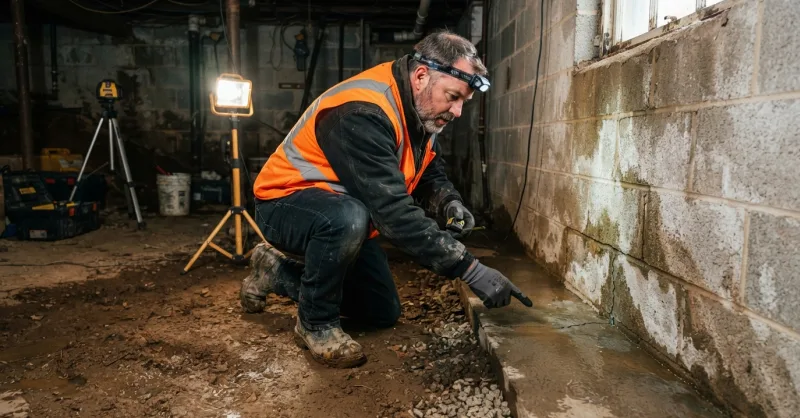
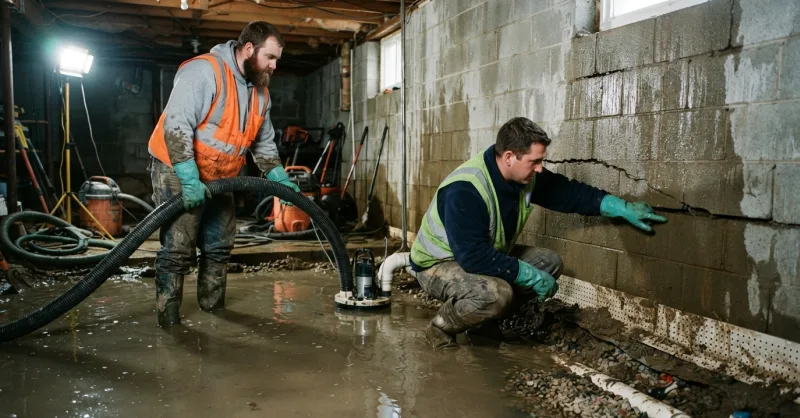
I’ve walked into basements where the homeowner swore the problem was “just a little seepage.” Then I pull back the carpet and find six inches of standing water that’s been cycling in and out for three years. The real issue isn’t the rain. It’s what sits underneath your foundation.
New Castle County sits on the Coastal Plain. The soil here carries high clay content with a percolation rate so low that a 2-inch rain event over 24 hours can generate 18 inches of hydrostatic pressure against your basement walls. That pressure doesn’t politely wait for dry weather. It pushes water through every crack, cold joint, and porous block it can find.
Areas like southern Newark and Bear sit on water tables sometimes just 2 to 4 feet below grade. I’ve done estimates on split-level homes along Kirkwood Highway where the ground-level garage acts like a funnel, routing surface water straight toward the foundation. Warehouses in the Christiana Industrial Park? Insufficient grade beams that were fine in 1987 but can’t handle today’s storm intensity.
The permanent solutions for flooded basements during heavy rain aren’t about slapping sealant on a wall. They require understanding the hydrology directly beneath your building, and that’s where 25 years of structural experience changes everything.
Interior Sub-Slab Drain Tile: The Backbone of Any Lasting Basement Fix
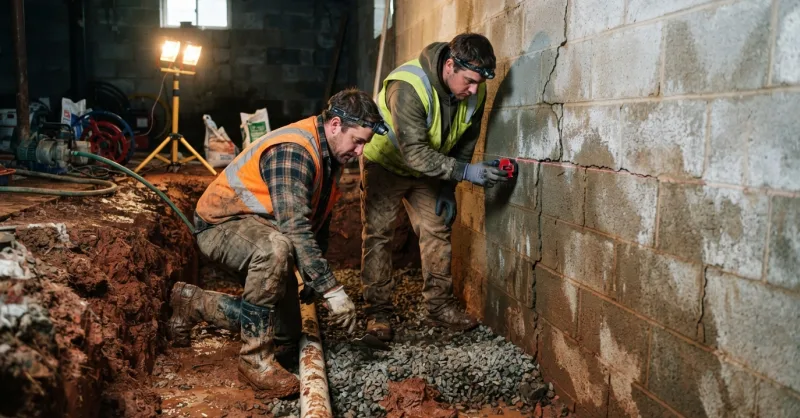
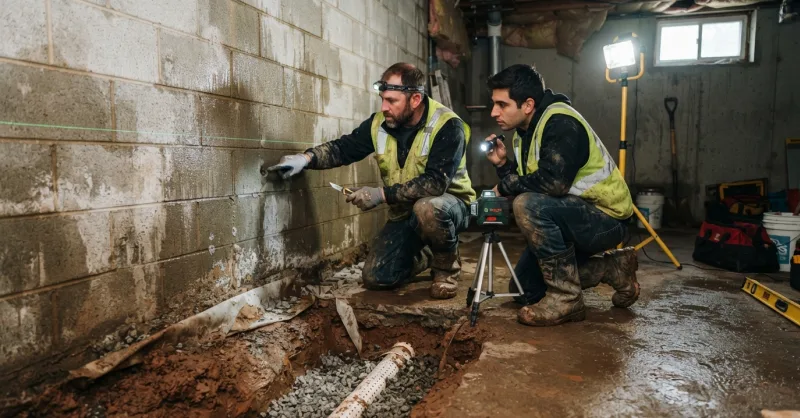
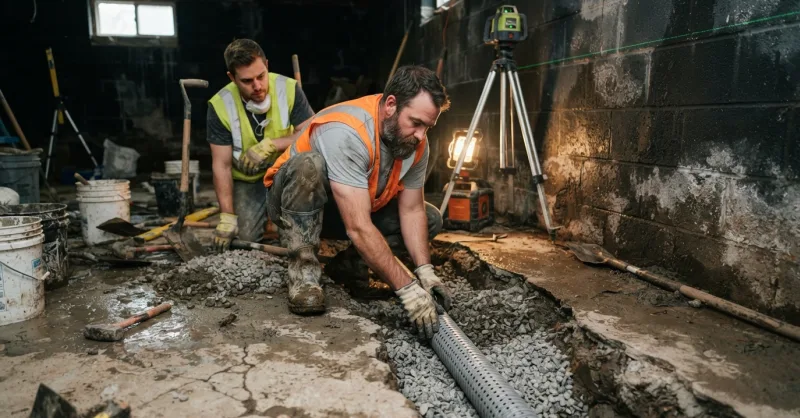
A permanent interior waterproofing system starts below the concrete. Our crews cut along the perimeter, excavate to the footing, and install a hydrostatic pressure relief channel using perforated pipe bedded in washed gravel. Water that builds up beneath and around the slab gets intercepted before it ever reaches your floor.
What Goes Into a System That Actually Works
- Perforated corrugated pipe embedded in crushed stone, pitched to drain toward the sump basin
- A cast-iron primary sump pump (we spec the Zoeller M98 for residential and light commercial) paired with a battery-operated backup unit and WiFi flood alarm
- Vapor barrier encapsulation along the walls to cut moisture migration and prevent mold colonization in finished spaces
- Discharge line routed to an approved municipal storm sewer connection or daylight outlet, never to a dry well or the sanitary sewer. Per New Castle County’s Unified Development Code §40.10.320, getting this wrong means a code enforcement notice and a system that backs up when you need it most.
I had a property manager call us about a multi-tenant office building off Route 9 near Delaware City. Previous contractor installed a sump pump with no backup and discharged it into the foundation perimeter. During a nor’easter remnant last October, the pump overwhelmed and the discharge line pressurized. Twelve inches of water in the lower level. Two tenants activated lease termination clauses that same week.
We ripped the old system out, installed a dual-pump configuration with battery runtime rated for 8 hours continuous, and tied the discharge into the storm sewer with a stamped plumbing plan. That building stayed dry through three heavy rain events the following spring. (The property manager told me he slept through one of them. First time in four years.)
If you’re dealing with recurring basement water intrusion, the fix isn’t a band-aid. It’s engineered water management below your slab.
Exterior Excavation and Barrier Defense Against Groundwater Intrusion
Interior systems manage water once it reaches your foundation. Exterior waterproofing stops it from getting there.
We excavate to footing depth, apply a fluid-applied polyurea membrane or bentonite clay panels, and backfill with washed gravel to achieve a hydraulic conductivity barrier in the range of 10⁻⁷ cm/s. That gravel pack acts as a drainage plane, directing water down to the footer drain instead of letting it press laterally against your wall.
When Does Exterior Work Make Sense?
Not every property needs full exterior excavation. If foundation cracks show active water tracking from the outside, or if your building sits in the Brandywine Creek floodplain or the White Clay Creek watershed where peak flows during remnant storm events push groundwater levels well above normal, exterior defense becomes non-negotiable. Can you waterproof a basement permanently without excavating outside? Sometimes yes, if the hydrostatic pressure is manageable and the interior drain tile system has adequate capacity. I’ve seen plenty of basements in Pike Creek where a properly installed interior system handles everything. But in Bear, where the water table sits high and the clay won’t drain, you need both layers working together.
A MiraDRAIN 2000 dimple board on the exterior wall creates an air gap that prevents soil contact and channels water downward at a flow rate of 15 GPM per linear foot. We pair that with the membrane beneath it. Two layers of protection, zero reliance on the wall itself staying watertight.
Our approach at AVG Waterproofing LLC, based out of 500 Apple Rd, Newark, DE 19711, covers New Castle County DE, Chester County PA, and Cecil County MD. We bring 25 years of U.S. structural experience and 6 years of specialized knowledge of tri-state soils to every job.
Sump Pump Systems That Don’t Fail When the Power Goes Out
A sump pump without battery backup is a decoration during a heavy storm. Power outages and heavy rain go hand in hand in the Delaware River basin.
How long does a backup sump pump run during extended power outages in Delaware? A quality battery-powered backup unit runs 5 to 8 hours under continuous cycling. We install dual-vortex impeller pumps rated for the volume, not the cheapest unit from a big box store. The primary handles normal groundwater. The backup kicks in during power loss or if the primary can’t keep pace during a 3-inch-per-hour downpour.
WiFi flood sensors alert you the moment water rises above the expected level in the basin. I’ve seen facility managers get a push notification on their phone at 2 AM, call us, and have the situation assessed before any damage occurred. That’s the difference between a reactive scramble and a controlled response.
Iron Ochre: The Silent Sump Killer
Here’s something most waterproofing contractors in this area never mention. Iron ochre bacteria thrive in the iron-rich groundwater common across the Coastal Plain. The bacteria produce a reddish-orange sludge that coats the inside of drain tile pipes and sump basins, slowly choking flow capacity until the system backs up during the one storm you can’t afford it to. We build iron ochre mitigation into every installation and include annual inspection protocols in our service agreements. Skipping this step is how “permanent” systems fail in year three.
New Castle County Drainage Permits and Discharge Compliance You Can’t Ignore
If your sump pump discharges to an unauthorized location, you’re not just risking a flooded basement. You’re risking a code violation.
New Castle County’s Unified Development Code, Chapter 17, governs stormwater management. A positive drain tile system must discharge to an approved daylight outlet or municipal storm sewer. What happens if a contractor routes sump pump discharge illegally in Delaware? You get a municipal code enforcement notice. You pay to redo the work. And if the illegal discharge caused erosion or contamination on an adjacent property, you’re potentially liable for remediation costs too.
We handle the Land Use permit for stormwater discharge authorization as part of every project. Our proposals include the county permit fee schedule, a stamped plumbing plan showing the discharge path, and a compliance certificate referencing UDC Chapter 17. One contractor, one point of accountability. No mid-project surprises about permit costs nobody mentioned during the estimate.
If your foundation has cracks contributing to water entry, those need structural attention before or alongside any waterproofing work. We address that through our permanent residential foundation crack repair process, which ties directly into the waterproofing system design.
Planning Basement Flood Prevention Before Atlantic Hurricane Season Hits Delaware
The April-through-September heavy rain window in our region isn’t a suggestion. It’s a deadline.
Remnant tropical systems track up the I-95 corridor and dump 3 to 5 inches of rain in 6 hours over the Brandywine Creek and White Clay Creek watersheds. If your basement waterproofing system isn’t installed and tested before peak season, you’re gambling with inventory, tenant retention, and insurance premiums that already climb every year.
Does homeowners or commercial property insurance cover basement flooding from heavy rain in Delaware? Most standard policies exclude groundwater intrusion and hydrostatic pressure damage. Flood insurance through FEMA covers some scenarios, but deductibles are steep, and claims history raises your premiums permanently. The capital expenditure for a properly engineered waterproofing system pays for itself after one avoided loss event, without the insurance headaches.
Our Estimate Process: Zero Pressure, Full Transparency
We provide free structural estimates. No sales scripts. No pressure. I walk your basement, identify exactly what’s failing, and tell you what it takes to fix it permanently. If the problem is something we don’t handle, I’ll say so. (If telling you the truth costs me a project, so be it. I sleep better that way.)
Every proposal includes line-item detail: material specs, labor scope, permit fees, and a 5-year warranty against hydrostatic pressure ingress. You see what you’re paying for before we touch a shovel.
How much does a permanent basement waterproofing system cost in New Castle County? Interior drain tile with a dual-pump sump system typically runs between $5,000 and $12,000 depending on linear footage and soil conditions. Full exterior excavation and membrane application adds $8,000 to $20,000 based on depth to footing and site access. We quote fixed-cost lump sums that fit annual budget cycles. No change orders mid-project because someone “forgot” about permits.
Connect with us on LinkedIn or Instagram to see project documentation, soil condition updates, and real work from properties across the tri-state corridor.
Your home. Your commercial property. Your warehouse along the I-95 distribution corridor. We fix it right the first time, because there shoudln’t be a second time. That’s AVG Waterproofing LLC. Your Home In Good Hands.
Ready for a free structural inspection without a sales pitch? Call us. We’ll show up, diagnose the problem, and give you the facts.
Written by: Alex Velasquez
AVG Waterproofing LLC