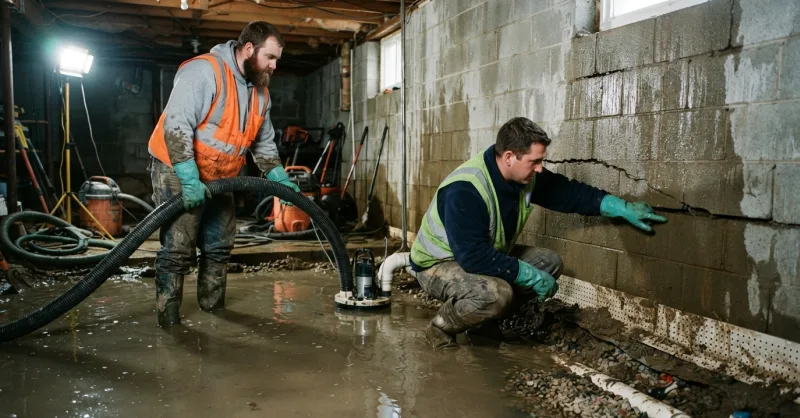




Why Does a Below-Grade Mechanical Room in New Castle County Need a Battery Backup Sump Pump?
Because your primary pump will fail during the exact storm that demands it most. I’ve pulled enough dead Zoeller units out of flooded electrical rooms along the I-95 corridor to know the pattern by heart: a nor’easter knocks Atlantic City Electric offline for 10 hours, the primary pump sits idle, and by morning there’s 3 inches of water lapping at the base of your main switchgear. That’s not a hypothetical. That’s a Tuesday night in November for facilities directors managing Class A office space near Churchmans Crossing.
The Delaware Coastal Plain water table sits perched at 3 to 8 feet below grade through much of the Wilmington-Arden corridor. If your mechanical room drops 8 feet below finished grade, you’re essentially sitting inside the water table from November through April. A single primary pedestal sump pump with no secondary system isn’t a cost savings. It’s a countdown.
We run our operations out of 500 Apple Rd, Newark, DE 19711, and our vans stay pre-loaded with dual-AGM battery backup modules, 18-inch and 24-inch HDPE basins, and primary pumps ranging from ⅓ HP to ½ HP. Average dispatch from our Newark depot to anywhere in the 19701 through 19809 zip code band runs about 28 minutes. Not 90 to 150 like you’re used to hearing.
The Hydrologic Site Assessment Nobody Else Bothers With
Here’s where most sump pump contractors lose me. They show up, eyeball the basin, swap the pump, bill you hourly, and leave. No water-table data. No inflow measurement. No idea whether the replacement pump can actually handle what the ground is throwing at it.
We start every project by pulling your property’s well-permit water-table record from the New Castle County online database and cross-referencing it against the University of Delaware Geological Survey’s groundwater mapping. We want to know the static water level relative to your slab before we touch a single pipe.
Then we drop a pressure-transducer data logger into the existing basin for 24 hours. That logger records peak inflow in gallons per hour under real conditions. How do you properly size a sump pump for a commercial basement in Delaware? You measure the actual water coming in. You don’t guess. We take that peak GPH reading, add a 40% capacity buffer, and select a primary pump rated to handle the total at a 10-foot vertical head. A Zoeller M267 pushing 2,200 GPH at that head height handles most commercial mechanical rooms we encounter in the Pencader Corporate Center and Churchmans Marsh vicinity, but I’ve spec’d ½ HP cast-iron units for properties closer to the Delaware City tide gates where hydrostatic pressure spikes unpredictably during tidal surges.
I’ll be honest, the 24-hour audit adds a day to the project timeline. Some facilities managers push back on that. But I’d rather lose a day upfront than install an undersized system that cycles every 45 seconds during a heavy rain and burns out its float switch in 14 months (which is exactly what I found last spring in a Governor’s Square property where the previous contractor had jammed a ⅓ HP pump into a basin that needed a ½ HP minimum).
New Castle County Drainage Code and Permit Requirements You Can’t Skip
If your sump pump discharges directly into the sanitary sewer without an air gap, you’re in violation of New Castle County Code § 25.03.003. I see this constantly in buildings constructed between 1987 and 1995 near Wilmington’s South Bridge, where combined sewer systems mean a surcharge event can push stormwater right back through your discharge line and into the basin.
The code requirements stack up fast on a commercial retrofit:
- Air-gap discharge termination per § 25.03.003, with the discharge line ending at least 20 feet from the foundation wall.
- A dedicated GFCI-protected 120V circuit per NEC 210.8(G) for any sump pump in a wet location. You can’t share a circuit with your boiler controls.
- Master-plumber licensure under Delaware Code Title 24 Chapter 18 for sump pump and backflow installation. If your contractor can’t produce that license number, walk away.
- New Castle County Land Use Department permit for the new electrical circuit and any storm sewer discharge connection. We handle the permit procurement as part of our flat-rate scope, not as a surprise change order after demolition starts.
The 2018 International Residential Code R317.1, as adopted by Delaware with local amendments, requires sump pumps in basements where groundwater rises to within 6 inches of the floor slab. That covers a massive percentage of below-grade construction along the Kirkwood Highway zone through Elsmere, Prices Corner, and Milltown.
What a Red-Tagged Discharge Actually Costs You
A county inspection citation for non-compliant discharge doesn’t just mean a fine. It means an immediate retrofit under expedited permit review, tenant notifications, and sometimes temporary dewatering measures while the new line cures. I watched a property manager near the Route 40 Glasgow belt spend nearly triple what a compliant install would have cost because the original contractor ran the discharge into a sanitary line to save 30 feet of PVC.
How to Select the Right Battery Backup Sump Pump for High Water Table Properties
Evaluate the backup pump’s continuous run time at your building’s average groundwater inflow rate. In the Delaware Coastal Plain, select a system with at least one 120 Ah AGM battery providing a 7-hour continuous duty cycle. Pair it with a primary pump capable of 2,500 GPH at a 10-foot head, both installed with a hi-lo float logic controller.
We install Liberty Pumps 441 backup units mated to dual 120 Ah deep-cycle AGM batteries. AGM chemistry matters here, not flooded lead-acid. Why does AGM outperform flooded lead-acid in a New Castle County basement environment? The slightly acidic groundwater from the Potomac Formation aquifer accelerates corrosion on exposed terminals, and Delaware’s humid summers drive sulfate buildup that kills flooded cells in 2 to 3 years. AGM cells in a sealed enclosure with terminal grease push 4 to 5 years reliably.
The dual-battery configuration provides a minimum of 48 hours of intermittent pumping during extended power outages. That number isn’t marketing fluff. It’s based on the 8-to-12-hour grid failures we document every late-summer derecho season across Milltown and the Hockessin-Pike Creek geological break, where the Piedmont Fall Line fracture trace creates sudden subsurface permeability shifts that spike pump cycling rates during heavy rain.
A smart float-relay controller manages switchover between primary and backup pumps at a preset voltage threshold. The Wi-Fi remote monitoring module logs every pump cycle and sends real-time SMS alerts for high-water events or battery voltage drops below 12.1V under load. You get visibility from your phone, not a panicked 2 AM callback from a tenant who smells mold.
What Does a Full Sump Pump Installation and Battery Backup Upgrade Actually Include?
I publish our full scope because I want you to compare it line-by-line against whatever quote you’re holding from another contractor. Here’s every component in a flat-rate commercial retrofit:
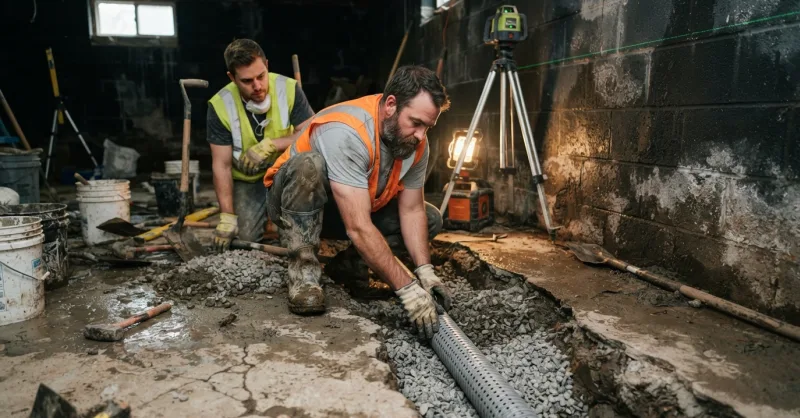
- Basin excavation to 24 inches below the footer, intercepting the static water table before it reaches the slab. We install a perforated corrugated HDPE basin with a gas-tight radon cover compliant with ASTM E2121.
- Primary pump mounting with vertical magnetic hi-lo float switch logic to prevent rapid cycling under sustained inflow.
- Dual 120 Ah AGM battery backup integration with smart relay controller and LED status panel.
- Schedule 40 PVC discharge line with 1½-inch check valve, exterior air gap per county code, and freeze-proof termination 20 feet from the foundation. A freeze-relief valve prevents ice-plug failures during the first November ice event.
- Dedicated GFCI-protected 120V circuit wired to a UL-listed control panel with fault buzzer.
- Wi-Fi remote monitoring with trip log and SMS alerts.
- County permit procurement included. No surprise line items.
Every one of those items shows up in the pre-installation quote. What maintenance does a battery backup sump pump need after installation in New Castle County? Every 90 days, simulate a power outage, verify float switch operation, clean the pump intake screen, and perform a battery load test with a digital hydrometer. Inspect battery terminals monthly for sulfate corrosion, especialy after summer thunderstorm season. Replace AGM cells every 4 to 5 years or after any discharge cycle that drops voltage below 12.1V under load. We schedule a professional discharge-line inspection each October before the autumn nor’easter pattern begins.
That seasonal service calendar isn’t optional. We build it into every project: November freeze-hardening with insulation jacket and heater pad, April flood-season diagnostics including float-rod corrosion checks, and a 5-year battery lifecycle replacement plan with automatic reminders. You can see the monitoring dashboard and the service schedule from day one. If your current contractor doesn’t offer that transparancy, ask yourself what happens to your system between install day and the next flood.
The Value-Engineering Trap That Floods Commercial Basements
I need to say this plainly because it keeps happening.
Contractors strip battery backups from commercial bids to undercut pricing. They know the building needs secondary drainage protection. They know the mechanical room sits below the water table. They submit the lower number anyway, the facilities director awards the contract based on install price alone, and 18 months later a nor’easter takes out the grid and the primary pump sits dead in a rising basin. The electrical room floods. Switchgear trips. An entire wing goes dark for 16 hours.
The cost of a dual-AGM backup array runs roughly 40 times less than a single 16-hour facility shutdown once you factor in switchgear replacement, emergency water extraction, mold remediation, and tenant downtime claims. I’ve done that math for three different Churchmans Crossing properties in the last two years and the ratio holds every time.
We refuse to issue quotes that exclude battery backup for below-grade mechanical rooms. If telling you that costs me a project, I’d rather sleep well at night. That’s not a sales line. It’s a liability position. A previous contractor’s decision to value-engineer the backup out of a Pencader Corporate Center building left a facilities director dealing with a mold complaint that traced back to a saturated sump basin nobody had checked in 11 months. The backup pump wasn’t missing because it failed. It was missing because it was never installed.
Can a single-source contractor handle hydrology sizing, permitting, electrical work, and ongoing sump pump service in Delaware? We do. Every aspect from the initial 24-hour dewatering measurement through permit procurement, UL508A-grade electrical panel interface, and recurring lifecycle service runs through one team. No subcontractor coordination on your end. No finger-pointing when something needs attention at 2 AM during a power outage. One phone number, one dispatach, one accountability chain. Learn more about our full basement waterproofing systems approach.
Pike Creek to Hockessin: Why Local Geology Dictates Your Pump System
The Piedmont Fall Line fracture trace running beneath the Hockessin to Pike Creek corridor creates conditions that generic pump specs can’t address. Crystalline bedrock transitions into weathered gneiss, and perched groundwater behaves differently here than in the Marshallton clay deposits along Route 40. Pump cycling surges spike during heavy rain events because subsurface permeability changes abruptly at the geological break.
Every subdivision built after 1990 in the 19707 and 19711 zip codes effectively requires a sump system. The homes constructed in 2009 in that corridor are now 16 years old. We’re pulling primary pumps from those basements with dielectric corrosion on the float rods caused by the aggressive, slightly acidic groundwater of the Potomac Formation aquifer. A 15-year-old pump in this geology isn’t aging gracefully. It’s corroding from the inside out.
Down in the Route 40 Glasgow-Bear industrial belt, former farmland converted to large-lot developments sits on shallow water table in Marshallton clay with significant power-outage history during nor’easters. These are exactly the properties where a 48-hour battery backup runtime isn’t a luxury. If the foundation is showing stress from that same clay movement, our team handles foundation repair alongside sump system upgrades so you’re not managing two separate contractors for related problems.
Twenty-five years of U.S. structural experience and six years focused specifically on tri-state soils means we’ve dug through every soil profile this region throws at us. The diagnosis comes from the dirt, not from a manufacturer’s brochure. Follow our field work on Instagram or connect with us on LinkedIn to see the actual soil conditions we encounter across the DE, PA, and MD corridor.
Your Home In Good Hands. No quick fixes, no sales scripts, zero nonsense. Just permanent results backed by measured data and a seasonal service commitment that doesn’t expire after the check clears.
Written by: Alex Velasquez
AVG Waterproofing LLC