


What Actually Separates Honest Foundation Repair Contractors in New Castle County DE From Sales Reps?
A real foundation guy walks your yard before he walks your basement. That’s the tell. If someone shows up in Wilmington, Newark, or Bear and heads straight for the crack in your block wall without looking at your gutters, grading, or downspout discharge, you’re getting a sales pitch dressed up as an inspection.
I’ve been doing structural work in the U.S. for 25 years, six of them buried in the specific quirks of DE, PA, and MD tri-state soils. The problem in northern New Castle County isn’t mysterious. Piedmont clay loam and silt loam compact hard, hold water, and shove that pressure straight against your foundation walls. Delaware clay infiltrates at under half an inch per hour when saturated. Water has to go somewhere, and if your grading dumps it against your footing, no amount of interior paint fixes that.
Honest diagnostics tie visible symptoms to soil load, hydrostatic head, and code reality. Everything else is a package deal someone memorized from a script.
The Clay Soil Reality Nobody in a Sales Truck Wants to Explain
Here’s what happens under your house in Hockessin or Pike Creek during a heavy spring rain. The clay saturates. It swells. It pushes laterally on your basement wall with force that block was never engineered to hold. That’s why you see stair-step cracks in the mortar joints, or a horizontal bow starting about mid-wall.
A vertical hairline crack in poured concrete is usually just curing shrinkage. Monitor it. A 1.25-inch bow with stair-stepping? That’s structural, and it needs real reinforcement, not epoxy.
I had a homeowner off Kirkwood Highway last spring, 1970s block basement, sump running every eight minutes during a Nor’easter. Previous “waterproofer” had sold him a $9,000 interior drain package two years earlier. Never touched the grading. Never extended the downspouts (which were dumping four feet from the wall, by the way). The drain worked exactly as designed, and the wall kept bowing because nobody addressed the source.
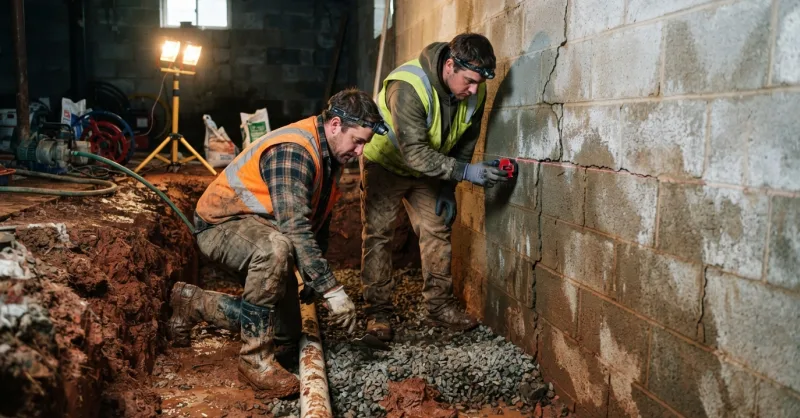
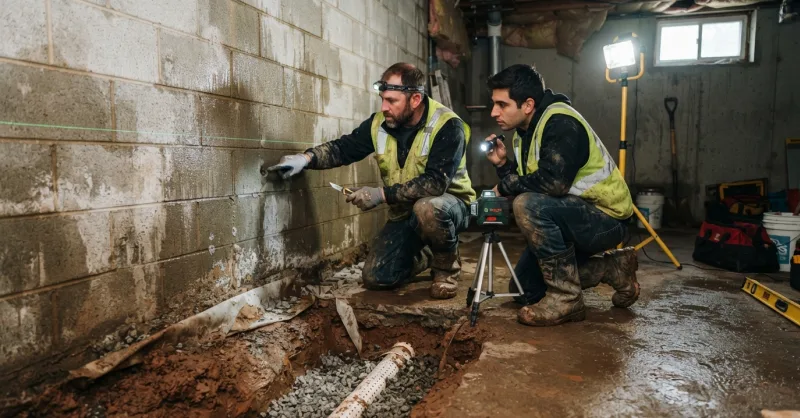
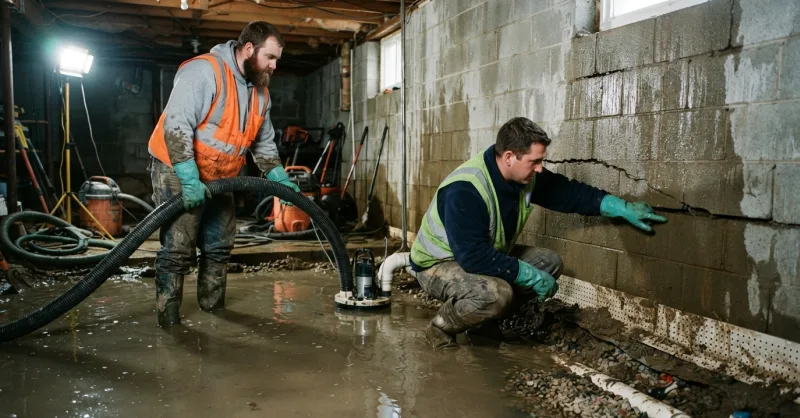
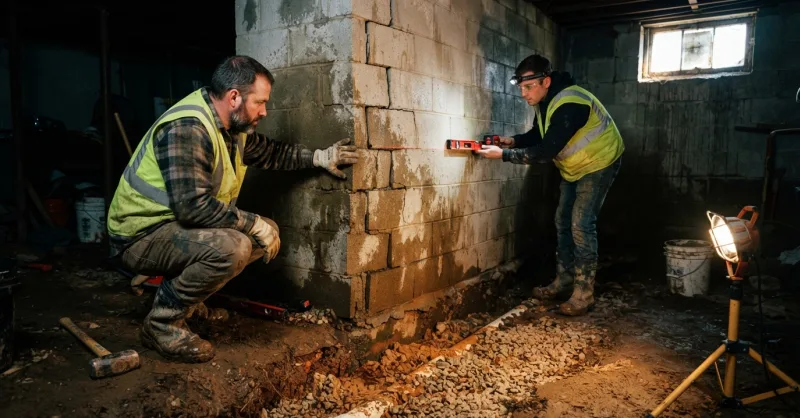
We ran level measurements, mapped the crack pattern, pulled the downspouts out fifteen feet, regraded the side yard, added carbon fiber straps at the bow, and tied his existing drain into a properly discharged sump line. His pump cycles maybe once an hour in a hard rain now. The fix wasn’t more product. It was fixing what the first guy skipped.
Why Waterproof Paint and Hydraulic Cement Are Making It Worse
I need to be blunt about this because it’s the single most expensive mistake I see in older Wilmington rowhomes. Coating a wet block wall with waterproof paint doesn’t waterproof anything. It traps the moisture inside the masonry, drives efflorescence from behind, and hides shear cracks that keep moving where you can’t see them.
Same with hydraulic cement smeared into a crack. It’s a bandage over an active load path. When the wall shifts again (and it will, because clay pressure doesn’t stop), the crack opens somewhere else.
Cosmetic patches don’t fix hydrostatic pressure. They just delay when you find out how bad it got.
If your contractor’s answer to river-influenced groundwater from the Christina or Brandywine is a five-gallon bucket, he doesn’t understand what’s actually pushing water through your wall. That’s not opinion. That’s physics. There’s a full breakdown of the mechanics in this piece on how hydrostatic pressure works against basement walls if you want the deeper read.
A Real Job: The 1880s Stone Foundation Nobody Wanted to Touch
Not everything we do is in Delaware. Last year we took on an 1880s farmhouse outside West Chester, PA, rubble stone foundation, mortar joints eroded to the point you could pull chunks out with your fingers. Spring seepage every year, mold blooming on the north wall, homeowner had been quoted a full interior drain system by two national outfits. Neither one mentioned repointing.
Which was frustrating, honestly. You can’t waterproof a wall that’s structurally deteriorating from the outside in. We excavated the exterior (which was a nightmare because of a mature dogwood the owner refused to lose, and I don’t blame her). Repointed with lime-based mortar because Portland cement on 1880s stone causes worse problems than the original erosion. Installed a proper exterior membrane, free-draining aggregate backfill, and a footing drain tied to daylight discharge.
The interior stayed dry that next spring for the first time in decades. Cost more than a slap-a-drain-in job? Yeah. But she’s not paying us again in five years.
Different foundations need different protocols. Anyone selling you the same package for a stone basement, a block basement, and a poured concrete basement isn’t diagnosing anything.
Questions I Get Every Week From New Castle County Homeowners
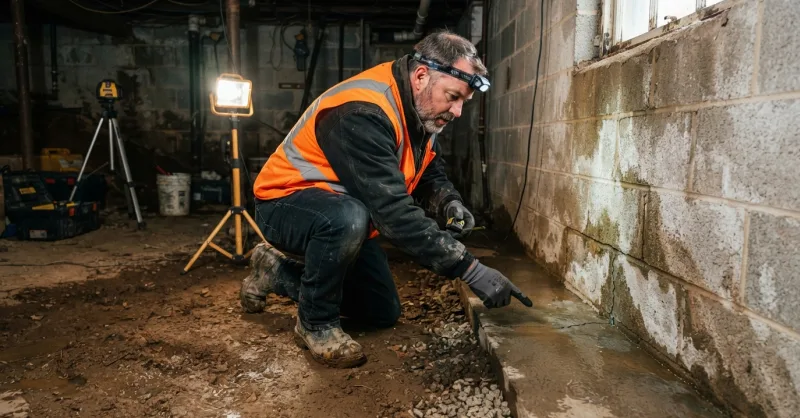
These come up so often I might as well address them here. How long does a real structural inspection actually take for a typical Newark or Bear basement? Plan on 60 to 90 minutes if we’re doing it right. That includes exterior grading and downspout review, interior wall measurements with a laser level, crack mapping and photo documentation, sump system evaluation, and a flood zone check against FEMA maps. If someone’s in and out in 20 minutes with a quote in hand, they measured nothing.
Another one that comes up constantly, especially from folks near the Route 1 corridor: do I need to worry about AE flood zone rules if I’m just fixing a foundation crack? Depends on the scope. Cosmetic crack repair usually doesn’t trigger anything. Substantial improvements (roughly 50% of the structure’s value) can trigger NFIP compliance, elevation requirements, and material limits below Base Flood Elevation. Middletown properties near tidal corridors get flagged for this more than people expect. Always worth a call to the county floodplain administrator before major work.
Property managers hit me with this one a lot: can you standardize a repair protocol across a small portfolio of aging Wilmington rentals? Yes, and we do. Mixed foundation types (stone, block, poured) need different diagnostic templates but the same principles apply. We build a per-property baseline, then track wall movement and moisture readings on scheduled intervals so you’re not getting emergency calls at 11pm during a storm.
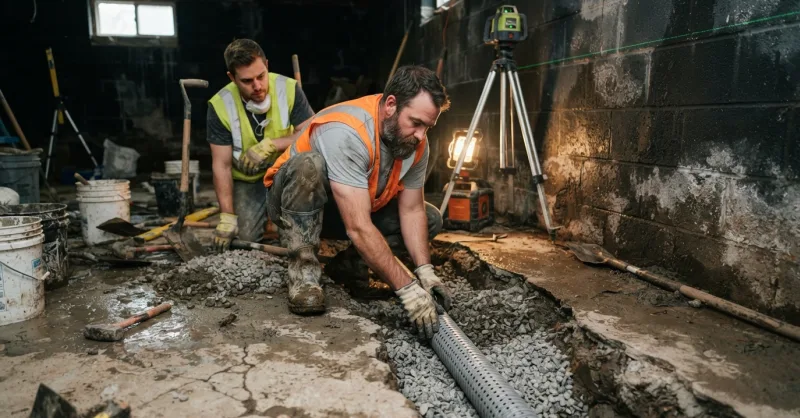
And one more that comes up on almost every free assessment: what’s the honest cost range for a real interior perimeter drain and sump system with battery backup in a 1,200 square foot basement? Realistically, you’re looking at somewhere in the $8,500 to $16,000 range depending on wall type, access, discharge routing distance, and whether we’re tying into existing footing drains or starting fresh. Anyone quoting a flat $4,995 “special” isn’t installing what you need.
The Repairs You Probably Don’t Need (And Nobody Will Tell You)
This is the part that costs me jobs, and I’m fine with it. If telling you the truth means I don’t book the work, so be it. I’d rather sleep well.
Things I regularly tell homeowners to skip or delay:
- Vertical hairline cracks in poured concrete walls, especially near corners. Usually curing shrinkage. Mark the ends with a pencil, check them in six months. If they haven’t moved, they’re not moving.
- Minor efflorescence on one wall section. Nine times out of ten it’s a clogged gutter or a downspout dumping too close. Fix the water source first, then reassess.
- A sump pump that cycles a few times an hour during a hard storm. That’s a working sump pump. If it’s running every 90 seconds in dry weather, that’s a different conversation.
- Damp corners in a stone basement that’s been damp for 80 years. Sometimes dehumidification and better air movement solve what a $20,000 excavation would also solve, for a fraction of the cost. Not always. But sometimes.
Underpinning, piers, and full exterior excavation are real solutions for real problems. They’re also wildly oversold. If someone’s quoting you $30,000 in structural work off a 15-minute walkthrough with no measurements, get a second opinion. And a third.
How We Actually Run Assessments Across DE, PA, and MD
Our shop sits at 500 Apple Rd, Newark, DE 19711, which puts us within striking distance of most of northern New Castle County, the Chester County line, and Cecil County MD on the I-95 corridor. When a basement floods at 6am after an overnight storm, we’re not dispatching a truck from three states away.
We run 8am to 7pm Monday through Saturday, and 8am to 3pm Sundays. Estimates are free, and there’s no commission structure pushing our guys to upsell you into work you don’t need. You’ll get a written cause analysis, a line-item scope, and honest guidance on what needs fixing now versus what can be monitored.
If you want to see how we approach specific problems, our full basement waterproofing services and foundation repair work pages break down the systems by scope. Or check what we’re posting on LinkedIn and Instagram for real job photos and diagnostic breakdowns.
Your home is yours. Get the truth about it, then decide what to do. That’s the whole job.
Written by: Alex Velasquez
AVG Waterproofing LLC