


What Actually Fixes a Wet Crawl Space in New Castle County?
Sealing a damp crawl space without correcting the water source is the fastest way to rot your own framing. I’ve been doing structural work in this country for 25 years, six of those spent nose-deep in the specific soils under Newark, Bear, Hockessin, and Wilmington. The pattern here is consistent: crawl space encapsulation and moisture control only works when drainage, humidity, and vapor pressure get addressed together.
Wrap a vapor barrier around an active groundwater problem and you’ve built a sealed room around a leak. That liner will look pristine at year one. The sill plate underneath will be another story by year three.
Homeowners around here get sold the shiny part first (the white liner, the encapsulation photo op) while the mechanical cause of the moisture keeps working in the dark.
Why Local Crawl Spaces Stay Damp No Matter What You Do
New Castle County sits inside the Christina River Basin. Brandywine Creek, Red Clay Creek, White Clay Creek, Naamans Creek, and Shellpot Creek all feed a groundwater table that responds fast to every storm cycle. When those creeks run high after a spring soaker, the ground pressing against your foundation is already saturated.
Add Piedmont clay soils that drain slow and hold water for days, and you get two mechanisms that show up in almost every damp crawl I open:
- Capillary migration pulling water up through block and mortar, leaving that chalky white efflorescence on walls and sill plates.
- Vapor diffusion turning ground moisture into humid air that condenses on cooler joists and insulation.
Open vents make it worse. In our Mid-Atlantic summers, vent air is warm and heavy with moisture, and it condenses the second it hits the cool crawl space. Vent-only advice is a slow-motion framing failure dressed up as building code from 1978.
Do crawl space vents actually help with humidity in Delaware homes near the White Clay Creek corridor? No. In this climate they raise humidity most of the year and only help during a narrow window in dry winter weeks.
Why Waterproof Paint and Caulk Keep Failing Here
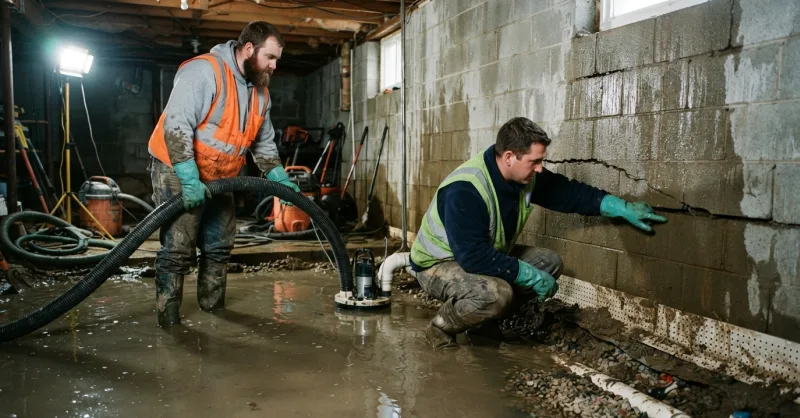
Waterproof paint and surface hydraulic cement are the two most common band-aids I pull off walls in this county. The mechanical flaw is simple: they seal the face of the wall while hydrostatic pressure keeps building behind it. Coating blisters. Coating spalls. Water finds the next mortar joint and keeps moving.
Interior caulk has the same issue. It fills a gap; it doesn’t relieve pressure. If the source is groundwater, no sealant on earth stops it.
I opened up a crawl in the Red Clay Creek corridor last spring where a previous contractor (I won’t name them, but they run those “free inspection” scripts) had installed a loose-laid liner over an actively weeping stone foundation. The liner looked showroom-clean. The sill plate above it was black and crumbly to the touch. The homeowner had paid mid-five figures two years earlier. The whole thing had to come out.
That’s the part that eats at me honestly, watching a family write a second check because someone sold them the pretty photo instead of the mechanism.
The Repair Sequence That Actually Holds
A crawl space that stays dry for decades in New Castle County gets built in a specific order. Skip a step and the whole system underperforms.
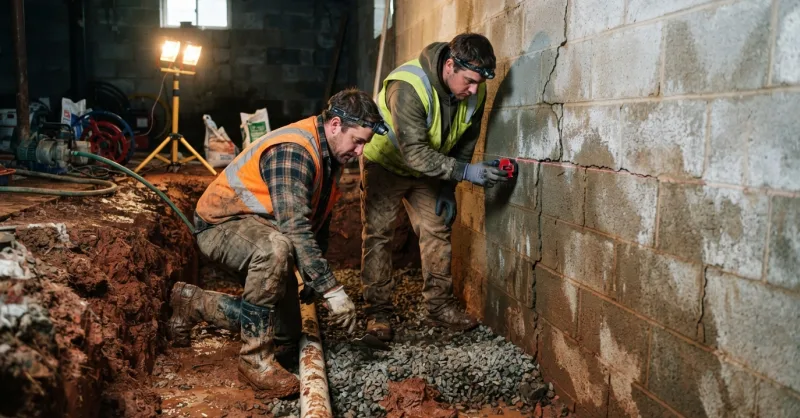
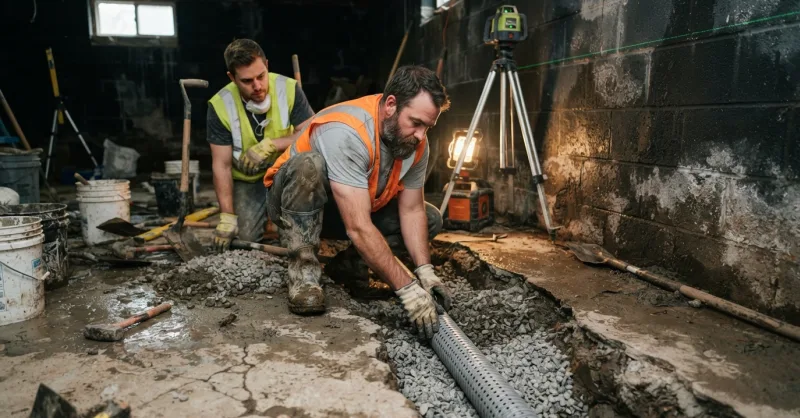
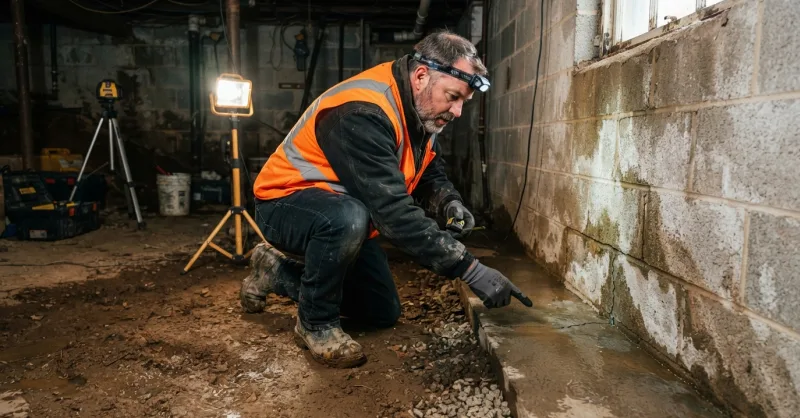
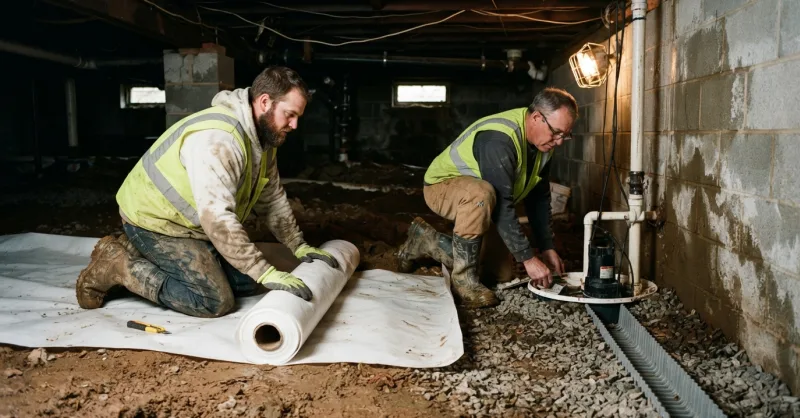
Drainage first, always. Interior perimeter drainage means perforated pipe set in clean drainage aggregate along the footing, catching water at the base of the wall before it can rise. The sump basin ties in, and the discharge line has to route water well away from the foundation. I’ve seen discharge lines dumping six feet from the house, recycling the same water back in during heavy rain. That’s not a system; that’s a loop. If you want the deeper version on how we relieve hydrostatic pressure on foundation walls, it’s the same physics applied to a crawl space footing.
Then the sealed envelope. A reinforced vapor barrier liner, mechanically fastened and seam-sealed to the walls, floor, and piers. Not loose-laid. Loose-laid is cosmetic.
Humidity control next. A properly sized crawl space dehumidifier holds relative humidity in the safe range year-round, including shoulder seasons when outdoor air is cool but soaked.
Structural repair where the damage already happened. Bowing block walls need carbon fiber reinforcement. Settled footings need pier and beam stabilization. Rotten sill plates get cut out and replaced, not covered up. Our full crawl space waterproofing service walks through each component.
Foundation Type Changes the Entire Scope
New Castle County has one of the most mixed housing stocks I’ve worked in. A 1920s stone foundation in old Hockessin behaves nothing like a 1965 cinder block basement in Bear, and neither behaves like a slab-on-grade addition off Route 40.
- Stone and brick foundations weep at mortar joints. They often need exterior footing drain correction alongside the interior work.
- Cinder block walls show efflorescence early and can bow inward under clay expansion pressure. Carbon fiber straps handle most of these before they progress.
- Newer crawl spaces built cheap in the 90s and early 2000s often have thin plastic sheeting the builder called a “vapor barrier.” It isn’t one.
Permits matter here too. Interior drainage, sump installation, and structural repair are regulated work in most county jurisdictions, and a scope that ignores permitting creates real headaches at resale.
What permits are typically required for interior drainage and sump work in the 19711 and 19713 areas? New Castle County generally requires a plumbing permit for sump discharge tie-ins and a building permit for interior perimeter drainage that alters the slab or footing edge. We handle that paperwork because inspectors ask specific questions and vague answers stall closings.
Questions You Should Ask Before Signing Anything
Before a quote for encapsulation makes any sense, a contractor should be able to answer these with actual measurements:
- Is the moisture from groundwater, vapor diffusion, condensation, or a slow plumbing leak? Each one has a different fix.
- Where does the water physically go during a two-day soaking rain? Not “we’ll figure it out”; a real answer with grading, downspout, and footing drain observations.
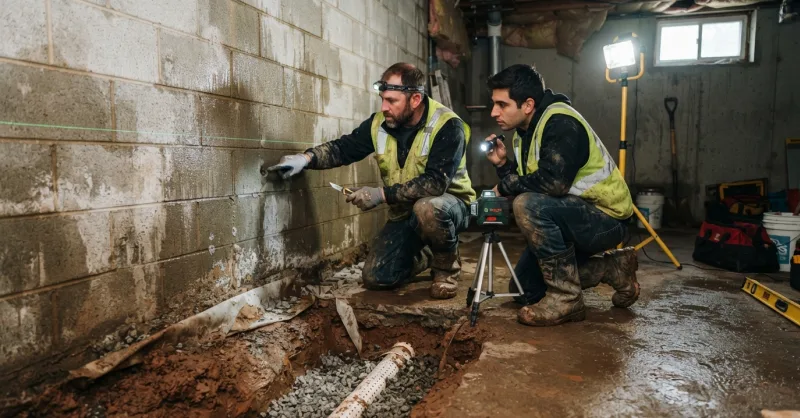
- Is there active wall movement or just staining? A crack width map and floor elevation reading tells you.
- What’s the relative humidity reading at the sill plate itself, not at the access hatch where air mixes with the house?
If you’re comparing “packages” instead of mechanisms, you’re being sold to, not diagnosed. That’s how families end up paying twice.
Is a free structural inspection actually free, or is it a sales script? Ours is genuinely no-pressure, and if you want the reasoning behind why we do it that way, read our take on structural inspections without the sales pitch. If telling you the truth costs me a project, so be it. I’d rather sleep at night.
Is Encapsulation Worth the Money in Delaware?
Yes, when the crawl space is chronically damp and the system gets built in the right order. In clay-heavy, watershed-fed neighborhoods like ours, sealing air leaks alone doesn’t cut it. The durable answer is drainage correction, a sealed vapor barrier envelope, humidity control, and structural repair where framing has already taken damage, all sized to the actual conditions on your property.
The alternative is what most homeowners end up paying for anyway a few years later: framing replacement, mold remediation, and structural stabilization, after the cosmetic fix failed and the moisture had time to compound.
How long does a properly installed crawl space system last in the I-95 corridor freeze-thaw conditions? A correctly specified system, meaning drainage, liner, dehumidifier, and any structural repair matched to the foundation type, should perform for the life of the home with basic dehumidifier maintenance. The failure point in most systems isn’t the liner; it’s the drainage design behind it.
How to Reach Us and What Happens Next
We work seven days a week across New Castle County, Chester County, and Cecil County. On-site assessments are free and honest, no pressure, no scare scripts, no same-day discount pretending to be a favor. If your issue is grading and downspouts instead of a full system, I’ll tell you that on the spot. You can visit our shop at 500 Apple Rd, Newark, DE 19711 or catch our field notes and jobsite photos on LinkedIn and Instagram.
The house is worth protecting. So is your negotiation leverage at resale. Let’s fix the cause, not the symptom.
Written by: Alex Velasquez
AVG Waterproofing LLC