


What Exterior Weeping Tile Installation and Grading Actually Fix in a New Castle County Basement
If your basement only leaks during heavy rain, no bucket of sealer will save you. Water is stacking up against your foundation from saturated silt loam and floodplain soils, and the only permanent relief is a footing-level exterior drain paired with yard grading that pushes stormwater away from the house.
I’ve been calling foundations honest or failing for 25 years across the country, and the last six of those years I’ve spent knee-deep in New Castle County dirt. The soil here has opinions. Reybold, Glenelg, Fallsington series, they all drain slow once they’re loaded, and after a two-inch downpour the water table near White Clay Creek can climb faster than most homeowners realize.
My office sits at 500 Apple Rd, Newark, DE 19711, so I’m not driving in from three states away pretending to know your dirt.
Why Water Wins Against Foundations Around Newark, Bear, and Middletown
Most of the county sits on Ultisols with a silt loam skin. That skin holds water like a wet sponge. In the flatter coastal plain neighborhoods around Bear and Middletown, storms perch water inches below the surface for days. Along the Christina, Red Clay, and Brandywine corridors, groundwater rises fast enough that homes that had been dry for 40 years suddenly aren’t.
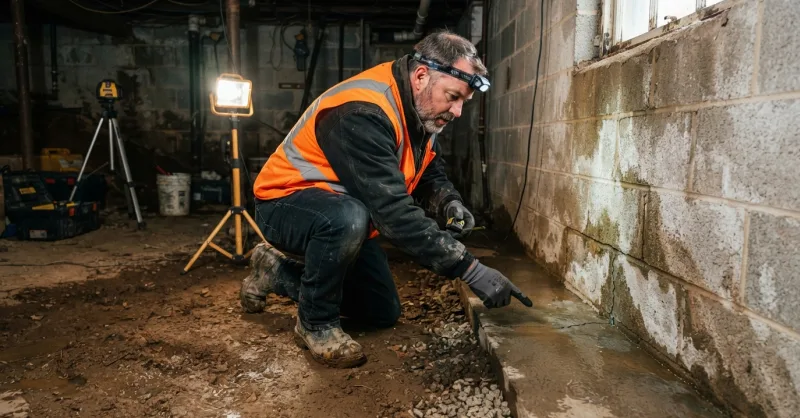
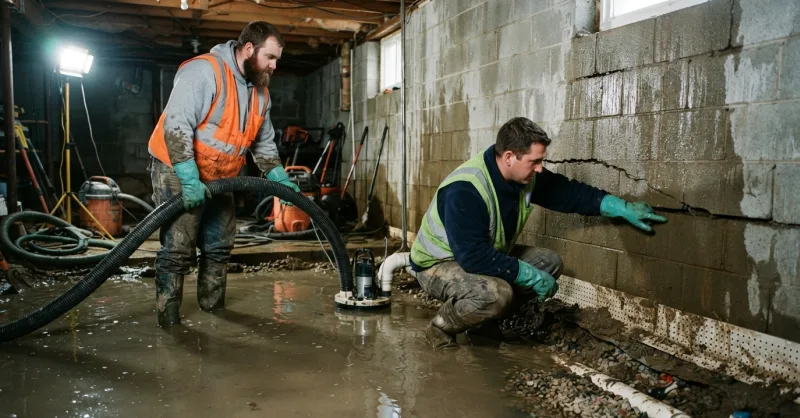
That water builds hydrostatic head. A column of pressure pushing sideways on your walls and upward under the slab. Block walls weep at the floor-wall joint. Older stone basements north of Wilmington lose mortar at the seams (I saw one on the west side last spring where the mortar had turned to paste behind a finished wall the owner didn’t know was ruined).
Interior coatings fail because they’re fighting from the dry side. That’s a losing argument every time.
What a Real Exterior Weeping Tile System Looks Like
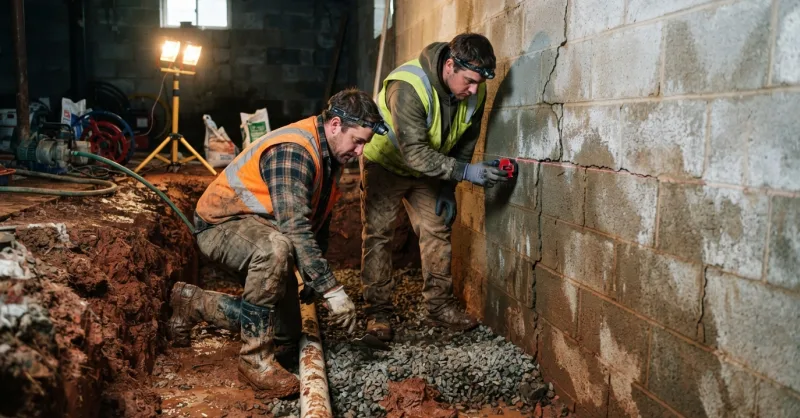
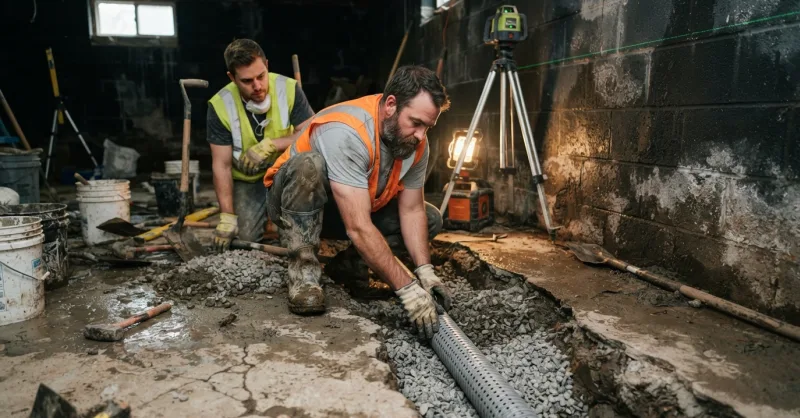
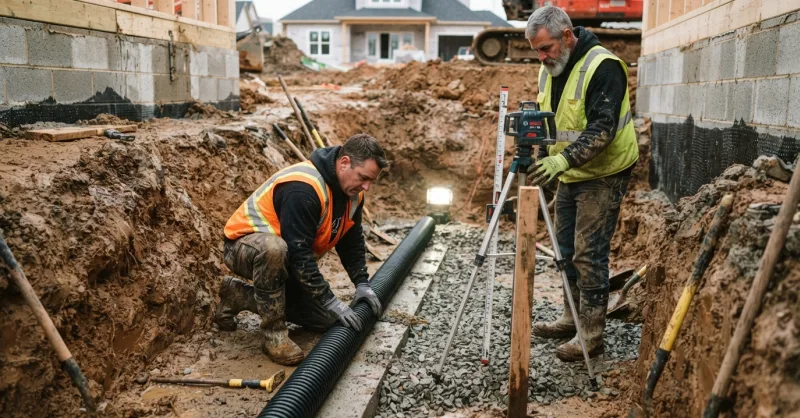
A proper weeping tile isn’t a piece of black pipe tossed in a shallow trench. It’s a continuous perforated drain sitting at or below footing elevation, buried in washed stone, wrapped in geotextile, and discharged somewhere the water can’t come back.
Here’s what actually belongs in the ground:
- Perforated pipe set at or below the base of the footing. Catch the water before it climbs against the wall.
- A washed gravel envelope extending roughly 12 inches beyond the footing and 6 inches over the pipe, so the water moves freely instead of choking on silt.
- Filter fabric wrapping the stone. Skip this and within a few seasons you’ve got a mud tube pretending to be a drain (I’ve dug up plenty of five-year-old “systems” that were already dead).
- A gravity outlet to daylight, a storm connection, or an engineered sump. Never tie the discharge into a downspout line that dumps back near the house. That’s just water recycling.
Depth is not up for debate. Delaware frost runs about 30 to 32 inches, and the drain has to sit below that line or freeze-thaw will crack the pipe and heave the whole assembly. People sometimes ask how we handle excavation depth near an older footing when the neighbor’s driveway is right there. We shore the trench in short sections, keep the load path intact, and never open more wall than we can backfill the same day. If a wall is already bowing, that changes the whole sequence, and we handle it more like a structural stabilization job first.
Yard Grading Is Half the Job, and Most Contractors Skip It
A perimeter drain without corrected grading is a half finished system. If your yard slopes toward the house, every storm dumps surface water right into the trench you just spent good money on.
Good grading does three things at once. It creates continuous fall away from the foundation (aim for about 6 inches of drop over the first 10 feet). It shapes swales so roof and driveway runoff runs around the house instead of pooling at the wall. And it respects what the road and the watershed are already doing.
Near I-95, DE-1, DE-273, and DE-896, paved surfaces shed enormous volumes of water into whatever’s downhill. The New Castle Conservation District already flagged the need to regrade roadside swales and upsize undersized culverts in low-lying pockets around Townsend and Clayton, because when the roadside pipe backs up, that water ends up on private property. If your lot sits in a mapped AE or A flood zone along the Christina, grading has to work with base flood elevations, not fight them.
Why Waterproof Paint and Interior Panels Can’t Do This Job
Interior sealers, epoxy injections, wall panels, they all share the same fatal flaw. They treat symptoms on the dry side while the actual load, saturated soil pressing on the wall, keeps building. Paint blisters. Injections hold until the next wet season opens a new seam. Panels hide water that’s still moving through block cores and rotting the sill above.
None of it relieves pressure. If your issue is genuine hydrostatic pressure pushing water through the walls, exterior drainage is the only permanent answer. Interior systems have their place as a companion, but they aren’t the fix.
Homeowners near Paper Mill Road often ask whether an interior French drain is enough when the wall is already staining. Sometimes it manages the water that gets in, but it never lowers the pressure outside. You’re managing a leak, not stopping it.
The Honest Scope of a Permanent Exterior Fix
A real project on a New Castle County home usually runs like this:
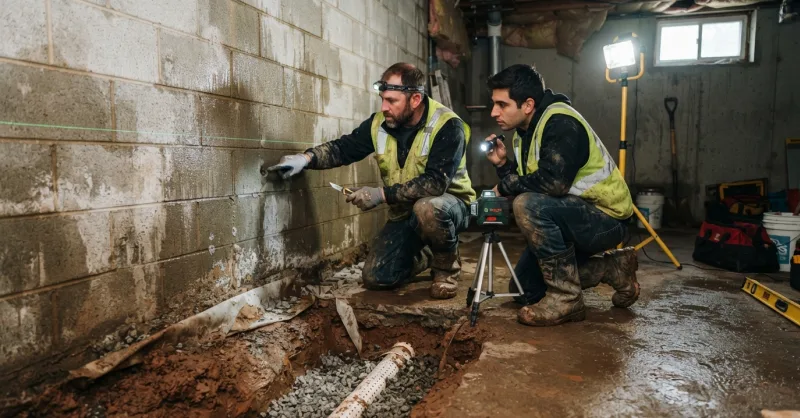
- Excavation to footing depth along the affected walls, with shoring where needed and careful attention to not undermining the load path from roof to footing to soil.
- Installation of perforated pipe in a washed stone envelope, wrapped in filter fabric, tied to a verified outlet.
- An exterior membrane on the wall itself if the block or stone warrants it (full details on that in our basement waterproofing service page).
- Backfill graded to shed surface water, then yard regrading and swale shaping with downspouts extended to safe discharge.
Timelines run a few days to a couple weeks depending on access, weather, and whether swale or culvert work is in scope. Anyone promising a one-day fix with a lifetime warranty is selling you a coating, not a drainage system. If telling you that costs me the job, so be it. I’d rather sleep well.
A property manager in Wilmington asked me last year whether we could phase the work across three buildings without shutting down tenant parking. We staged it in 40-foot sections, kept two spots open per unit at all times, and had the exterior drains and regraded lot done in about nine working days. Not glamorous, but the calls from tenants stopped, which is what he was paying for.
Before You Buy Another Bucket of Sealer
If water shows up in your basement during storms near White Clay Creek, the Christina River, or anywhere the silt loam gets loaded, the problem is structural. Not cosmetic. Understand your soil, your watershed, and your load path, then build a drain and grading system that relieves pressure permanently.
We run seven days a week, 8 AM to 7 PM Monday through Saturday and 8 AM to 3 PM Sundays, because water doesn’t wait for business hours. If you want to see the kind of work we post, we’re on LinkedIn and Instagram.
Homeowners along the DE-896 corridor sometimes wonder how a New Castle County permit inspection treats an exterior drain discharge into a municipal storm connection. Rules vary by jurisdiction, but the discharge point almost always has to be shown on the scope, and inspectors want proof it terminates somewhere approved, not into a neighbor’s yard. We handle the permit prep on our jobs so you’re not stuck arguing with the county on a Friday afternoon.
If your situation is already ugly, honest diagnostics start with a real look at the site, not a scripted pitch. We do free assessments and we’ll tell you if grading alone might solve it before we ever quote a full exterior dig.
Written by: Alex Velasquez
AVG Waterproofing LLC