


What Actually Stops a Basement Water Leak in New Castle County, Delaware?
Stopping a basement water leak here means relieving hydrostatic pressure at the footing, not painting over the symptom. Perimeter drains, a properly sized sump with battery backup, and honest exterior grading do the work. Waterproof paint doesn’t.
I’ve been diagnosing foundations across the DE, PA, and MD corridor for 25 years, with the last 6 spent elbow-deep in the specific soils of New Castle County. The physics don’t change. Water follows the path of least resistance, and in Newark, Wilmington, and Bear, that path usually ends at your wall-floor joint.
Here’s the blunt version: if a contractor hasn’t talked to you about your water table, your backfill, or where your downspouts actually discharge, they’re selling you a coat of paint with a fancy warranty attached.
Why Your Basement Leaks After Every Storm (and It’s Not the Crack)
New Castle County pulls roughly 45 inches of rain a year, and August tends to be brutal. That water saturates the disturbed backfill around your foundation, which never returns to its original density after construction. It behaves like a sponge pressed against your wall.
The Wilmington water table often sits 2 to 8 feet below grade. Delaware fine sandy loam sits over clay lenses that create weird, unpredictable flow paths (I’ve seen water enter a Newark basement 30 feet from where the actual soil failure was). Lateral migration is the rule, not the exception.
When clay-heavy subsoil saturates and expands, it loads your wall with thousands of pounds per square foot of lateral force. That’s hydrostatic pressure, and it doesn’t respect Drylok.
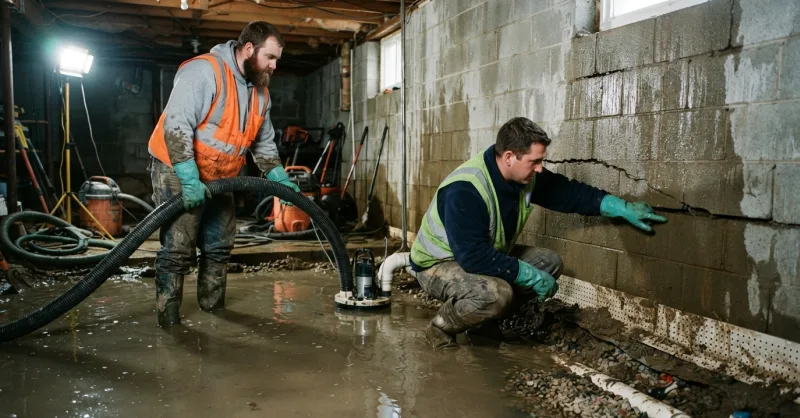
A homeowner in Pike Creek called me last spring after his third “lifetime waterproof” coating failed. The wall behind it was spalling so badly you could crumble the block with a screwdriver. He’d paid twice already. The real fix took one weekend and a proper interior perimeter drain tied to a sump discharging 12 feet from the house.
The Warning Signs I See Weekly in Older Rowhomes
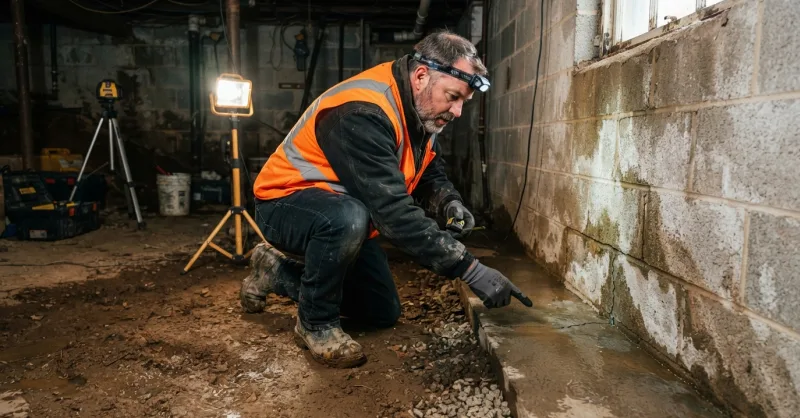
- Efflorescence (that white chalky residue on block or stone) means water is actively moving through your masonry right now, leaving mineral salts behind as it evaporates.
- Seepage at the wall-floor joint, which is the single most common complaint in mid-century block basements from 19713 to 19805.
- Musty odors that no dehumidifier can beat, because you’re fighting groundwater, not humidity.
- Stair-step cracking in block walls signaling shear stress from soil that swells and shrinks with every freeze-thaw cycle.
- A sump pump cycling every three minutes during dry weather (that’s a footing drain screaming for help).
Why Waterproof Paint and Hydraulic Cement Keep Failing Here
Waterproof coatings are vapor barriers. They trap moisture inside the wall instead of relieving the pressure behind it. When hydrostatic head keeps loading the block, water finds a new exit, usually three feet over or straight up through the slab.
We’ve torn out these cosmetic patches in homes from Hockessin to Claymont. The block behind them is often mush. Homeowners often ask how do I know if my basement waterproofing contractor is being honest with me before I sign anything? Ask them to show you the discharge path on a diagram, then ask what happens during a power outage. If they can’t answer both cleanly, walk away. Our own approach to honest structural inspections without sales pitches starts with those two questions in reverse.
Foam injection for a hairline crack in a wall that’s still being pushed by saturated clay? That’s caulking a door someone’s still kicking.
What Permanent Basement Water Leak Repair and Drainage Solutions Look Like
Real repair is a system, not a product. Here’s the sequence I follow on every job across New Castle County, whether it’s a stone basement off the Brandywine or a 1990s block foundation near DE-896.
Diagnose the Water Source First
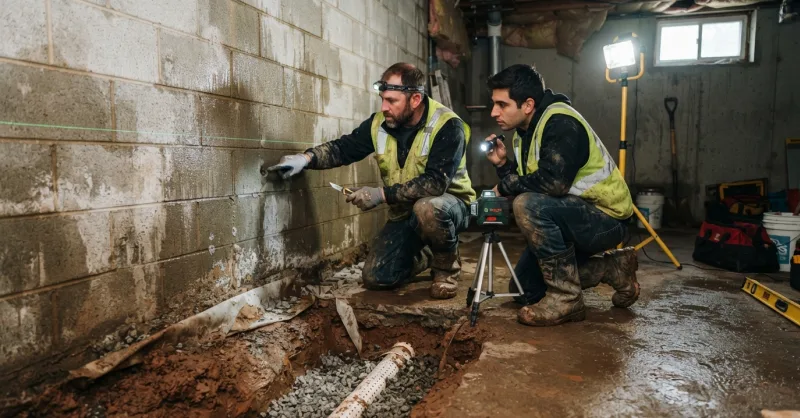
Moisture mapping, exterior grade survey, downspout audit, and a hard look at floodplain proximity. A leak in Bear near the Christina floodplain is not the same problem as a leak in a Pike Creek home sitting on Piedmont clay. Different soils, different water paths, different fixes.
Relieve Pressure at Footing Level
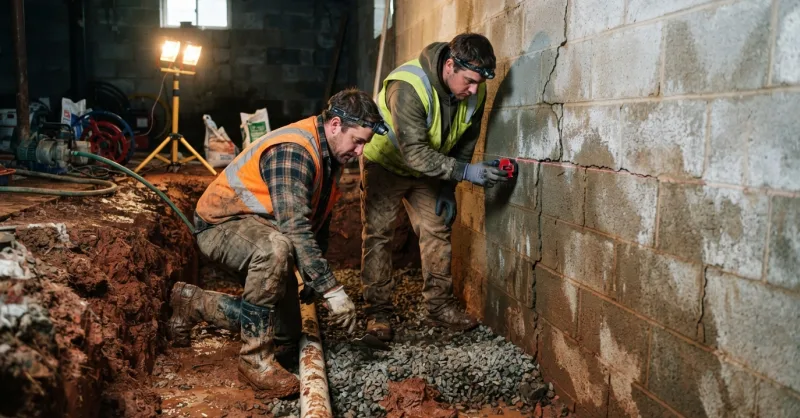
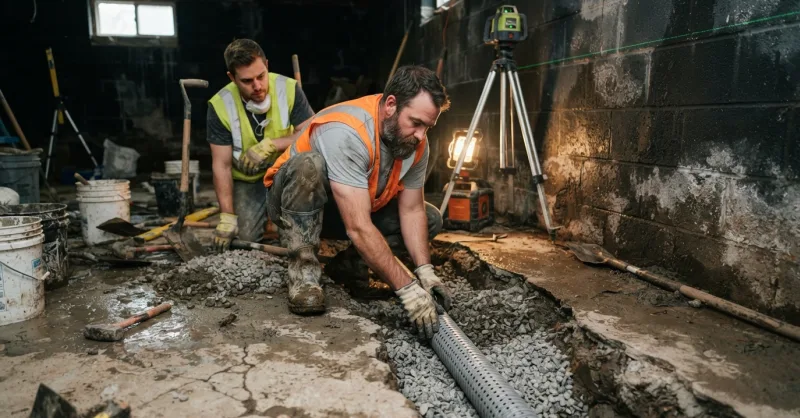
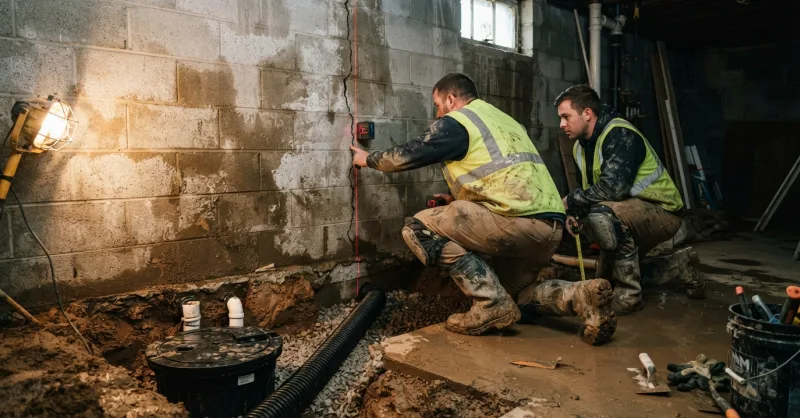
Perforated 4-inch PVC at the base of the footing, wrapped in ASTM C33 aggregate, sloped at minimum 1/8 inch per foot toward a sump basin. That’s IRC R405.1 drainage. Not a shallow trench filled with pea gravel and optimism.
Manage the Collected Water
Sump pump with battery backup and high-water alarm. Discharge routed at least 10 feet from the foundation, to an approved point that won’t flood your neighbor or violate county drainage regs. New Castle County treats grading and drainage as regulated site work, so permits matter.
Fix the Surface Before It Becomes Groundwater
Exterior grade at 2 to 6 percent pitch away from the house. Downspout extensions carrying roof water well past the footing. Swales where the yard demands them. In a county that catches 45 inches of rain, this isn’t optional (it’s the cheapest part of the whole system, and the most ignored).
Structural Repair Comes Last
If the wall has already bowed, carbon fiber reinforcement stabilizes it, but only after drainage stops the soil from loading it. Reinforcing a wall while it’s still under active hydrostatic push is a losing bet. Our full breakdown on fixing hydrostatic pressure through basement walls covers the sequence in more depth.
A Real Job in Wilmington That Didn’t Go According to Plan
Last October, a property manager called about a duplex off Kirkwood Highway. Two tenants, active seepage, mold showing up along the baseboards. The previous contractor (a national franchise dispatched out of Pennsylvania) had installed an interior drain but tied the discharge line into the sanitary sewer, which is a code violation almost everywhere.
We showed up expecting a straightforward re-route. Then we opened the sump pit.
The pit was 8 inches deep. Eight. It should have been at least 24. The pump was short-cycling itself into an early grave, and the check valve was installed backwards. Whoever did the original work either didn’t know what they were doing or didn’t care. Probably a mix of both. That kind of sloppy subcontracted work is more common than I’d like to admit, especially from outfits that white-label the labor to whoever’s cheapest that week.
We rebuilt the pit, ran a proper discharge line 12 feet out to a daylight point, regraded a 15-foot section along the driveway, and added a battery backup. Total time on site: two and a half days. The tenants stopped complaining, and the property manager stopped getting 2 a.m. calls during rain events.
Was it a perfect job? The regrade required us to move a hydrangea the owner loved, and it didn’t survive the transplant. Small loss in the scheme of things, but she wasn’t thrilled. Real work has real trade-offs.
Questions to Ask Before Anyone Touches Your Foundation
Homeowners in Newark and New Castle often ask me what’s the difference between an interior perimeter drain and an exterior footing drain in an older Delaware foundation? Interior drains sit inside the basement at the base of the footing and are less invasive but rely on water already reaching the wall. Exterior systems intercept water before it touches the foundation but require excavation. Which one fits depends on your finished space, landscaping, and budget. Both are valid when engineered correctly.
Property managers running rentals near I-95 sometimes ask do I need a permit for basement drainage work on a rental property in New Castle County? Most drainage and grading projects here require permits, especially when discharge lines cross property boundaries or tie into public systems. Skip the permit and you’ll pay for it at the next sale or inspection.
Ask about power outages. Ask about warranty scope (is it on the paint, or the drain system?). Ask to see drawings before anyone breaks ground. If you’re weighing full excavation, our page on basement waterproofing systems lays out both interior and exterior approaches.
Why Local Response Actually Matters Here
When a Nor’easter hits Wilmington on a Saturday night, you don’t have three days to wait for a franchise truck to route down from somewhere in Pennsylvania. Our crews run out of 500 Apple Rd, Newark, DE 19711, which puts us on-site fast anywhere from Hockessin to Middletown. We work 8 AM to 7 PM Monday through Saturday, and 8 AM to 3 PM Sundays, because water doesn’t take the weekend off.
People sometimes ask how quickly can a local contractor respond to an active basement flood in the New Castle County area during a major storm? Realistically, if you call during operating hours, we can usually have someone assessing within a few hours in the Newark, Wilmington, Bear, and New Castle zones. Farther out toward Chester County or Cecil County, it depends on crew availability. We don’t overpromise dispatch times we can’t hit.
The Bottom Line for Homeowners Tired of Guessing
Your basement isn’t leaking because it needs another coating. It’s leaking because water is being pushed through your foundation by pressure that starts in the soil. The repair is structural, and it starts at the footing.
If telling you the truth about your foundation costs me a project, so be it. I’d rather sleep well at night than sell you a paint job that fails by next spring. We build drainage systems that answer to physics and local code, not to a commission structure.
One last question I get from homeowners preparing to sell: will a properly installed drainage system show up favorably on a home inspection or appraisal in the New Castle County market? Yes, when it’s documented, permitted, and installed with visible discharge points and a functioning sump. Buyers’ inspectors look for exactly that. A permitted system with drawings is a selling point. A painted wall is a red flag.
Follow us on LinkedIn or Instagram for real jobsite photos and honest updates from around the tri-state area.
Written by: Alex Velasquez
AVG Waterproofing LLC