


What Actually Stops Hydrostatic Pressure in a New Castle County Basement?
If groundwater is pushing against your foundation, sealing the inside of the wall won’t fix it. Hydrostatic pressure relief for wet basements means giving that water a controlled exit route around the footing, through gravel, into a drain, and out to daylight or a sump discharge line well away from the house.
That’s the whole game. Everything else is decoration.
I’ve been diagnosing foundations in the Tri-State corridor for 25 years, with the last 6 dedicated almost entirely to the soils under Newark, Wilmington, Bear, and Middletown. The soil here doesn’t forgive shortcuts.
Why Basements Around Newark and Wilmington Stay Damp
The Piedmont clay under most of New Castle County holds water like a sponge that never dries. Permeability often sits under half an inch per hour. Rain doesn’t soak in, it stacks up against your foundation wall.
Water tables around Wilmington commonly rest 2 to 8 feet below grade. Your basement slab is often sitting right at that natural water line, sometimes below it. Add the floodplain corridors along the Christina River, White Clay Creek, Brandywine Creek, and Red Clay Creek, and you get sustained hydrostatic head that spikes hard after every nor’easter.
Homes near the White Clay Creek watershed that had never flooded in 40 years suddenly had water pouring through cold joints after Ida. I walked one of those basements in 19711 the week after. The homeowner kept saying “but it’s never done this.” The ground changed. Their drainage didn’t.
How Hydrostatic Load Wrecks a Foundation
Water weighs 62.4 pounds per cubic foot. When saturated clay swells against a block wall, lateral pressure can push past several thousand pounds per square foot. That’s not a theoretical number, that’s a wall bending inward.
Here’s what shows up in the field:
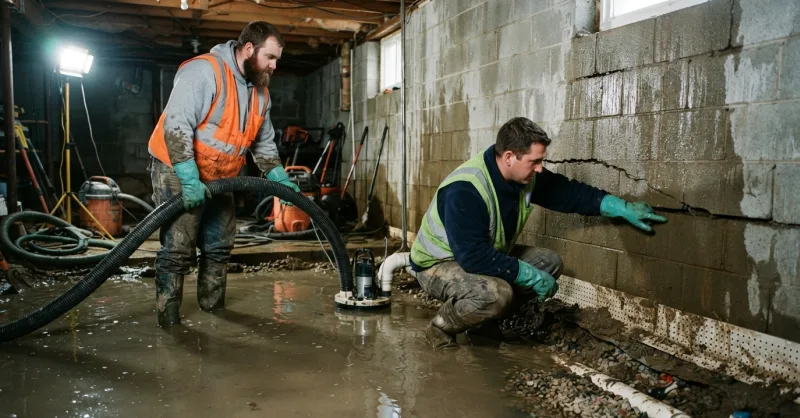
- Horizontal cracks running through the middle courses of block walls
- Bowing or leaning walls, usually the long unbraced runs
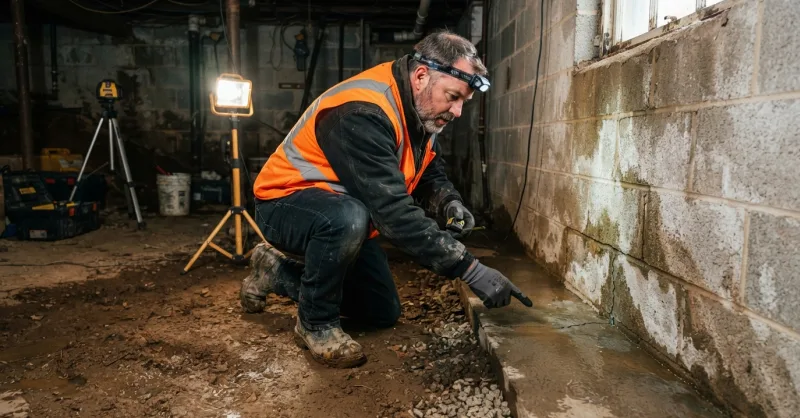
- Standing water right at the wall-slab joint (water is moving under your footing)
- Slab heave, floor cracks, and that white efflorescence dust on the block
- Rim joist rot you don’t see until the drywall comes down
Older Wilmington rowhomes with fieldstone foundations near the Brandywine take the worst of it. Newer poured concrete in Middletown subdivisions isn’t safe either. Cold-joint seepage and floor-wall interface leaks show up constantly when the original builder skipped proper footing drainage. If you’re watching a wall move, get a structural expert on the bowing wall before you talk drainage.
Why Waterproof Paint and Hydraulic Cement Keep Failing
Walk into any big-box store on Kirkwood Highway and you’ll see stacks of “basement waterproofing” paint. Those are vapor barriers. They don’t lower the water table. They don’t intercept groundwater. They don’t reduce hydrostatic head one bit.
Hydraulic cement patches pop off inside a season. Interior caulk traps moisture behind it and speeds up block spalling (I’ve chiseled out plenty of it during exterior excavations, and the wall behind is always worse than the homeowner expected). Epoxy injections can close one crack, sure, but water with nowhere else to go just finds a new door.
Is a lifetime warranty on interior sealer worth anything? Only if the company stays in business and only if the fix addressed the actual pressure, which it usually didn’t. I’ve seen homeowners in Bear pay $8,000 for a system that failed inside two winters, then pay again for the real fix. This is a common byproduct of the sales-funnel outfits that subcontract to whoever bid lowest that week.
What a Real Hydrostatic Relief System Looks Like
Permanent work moves water before it touches your foundation. Here’s what I actually install:
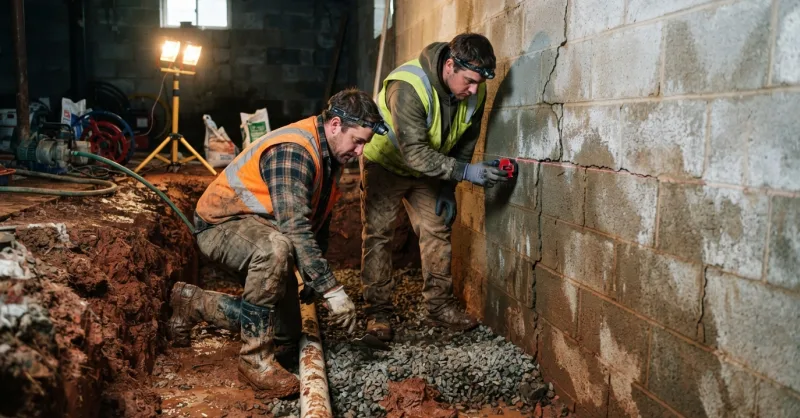
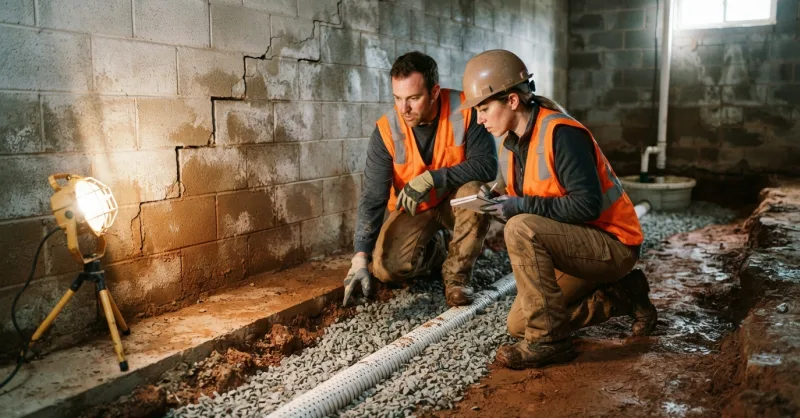
Exterior footing drains set at or below the slab, wrapped in washed gravel and filter fabric. In northern Delaware, these need to sit below the local frost line, roughly 30 to 36 inches, so freeze-thaw doesn’t wreck the system every February.
Positive grading and buried downspouts. A minimum 2% slope pulling water 10 feet from the house, with downspout extensions carrying roof water past the foundation line. Cheap. Non-negotiable. Skipped by almost every builder.
Exterior waterproofing membrane from footing to grade on walls facing the worst hydrostatic loads, especially properties near the Christina or White Clay corridors. If you want the real numbers, look at what full exterior excavation and waterproofing actually costs before anyone quotes you.
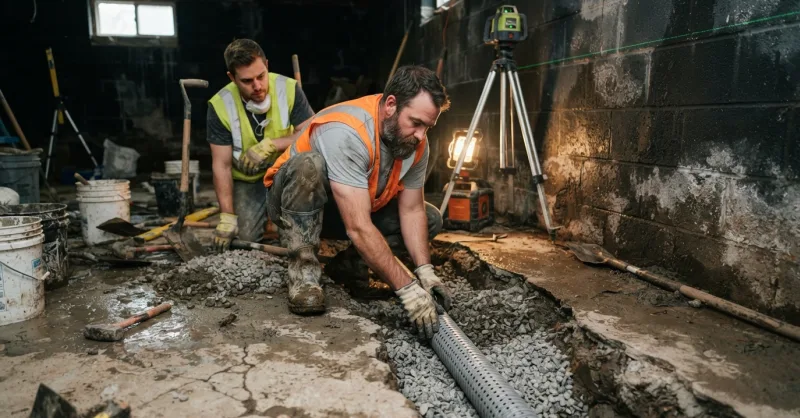
Interior perimeter drains feeding a properly sized sump with battery backup. The storms that flood your basement are the same ones that kill your power. Discharge lines have to reach far enough that water doesn’t just recirculate through the clay back to the footing.
Carbon fiber straps or wall anchors when the wall has already moved. Drainage won’t straighten a bowed wall. That takes structural work.
Full drainage and pump systems can be scoped through our basement waterproofing services.
How an Honest Diagnostic Actually Runs
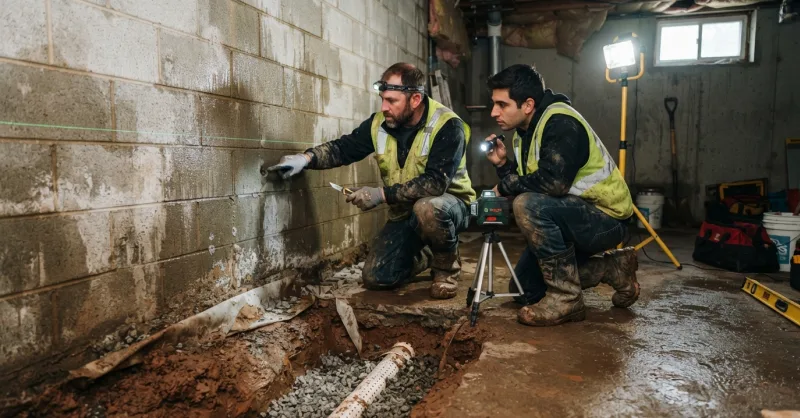
Before anyone hands you a quote, they should be measuring. Not pointing at stains.
- Grading slope and downspout discharge points, walked and photographed
- Soil type and permeability at the foundation perimeter
- Crack orientation, width, and whether the wall has displaced
- Water table indicators, floodplain proximity, seasonal patterns
- Foundation type: stone, block, poured, and its condition
A contractor who walks in with a moisture meter and a tablet loaded with a financing app is running a sales script. That’s not a diagnosis. If telling you that costs me the job, fine. I’d rather sleep.
Homeowners in 19702, 19711, and 19713 ask me constantly whether they need exterior drains or just an interior system. Honest answer: it depends on where the water is coming from, how the yard drains, and whether your walls have already started to move. Sometimes interior is enough. Sometimes it’s malpractice.
Permits, Code, and the Stuff Contractors Skip
Grading, site work, and basement structural modifications typically need permits through the New Castle County building department. Footing drains should follow IRC-style drainage standards, and anything in an AE flood zone along the river corridors carries additional requirements.
A contractor who waves off permitting as “minor work” is handing you a problem at resale or during an insurance claim. Common question I get from Middletown clients selling their homes: will an unpermitted basement waterproofing job show up on inspection? Yes, and it usually kills the appraisal or forces a price reduction.
Another one from property managers on the Route 40 corridor near Glasgow: how long does a full exterior footing drain install take on an average single-family home? Typically 4 to 7 working days, weather depending, plus curing time on any wall repair.
Local Crews, Local Soils, Real Response Times
When a mid-Atlantic storm dumps three inches overnight, waiting a week for a national franchise to route a truck from out of state is how basements turn into mold problems. Our crews work the I-95 corridor daily and can be on site across New Castle County the same week for most assessments. We run 8 AM to 7 PM Monday through Saturday and 8 AM to 3 PM Sundays.
Base of operations: 500 Apple Rd, Newark, DE 19711. We cover New Castle County, Chester County PA, and Cecil County MD.
One property manager in 19805 asked me last spring whether a sump discharge line could tie into the municipal storm sewer near the Wilmington rail district. Short version: not without checking local ordinance and getting it approved. Most jurisdictions want the discharge daylighted or routed to an approved outlet, not into the storm system.
Follow the work on LinkedIn or Instagram if you want to see actual excavations, not stock photos.
The Bottom Line on Wet Basements in Clay Country
Hydrostatic pressure relief isn’t about sealing a basement from the inside. It’s about managing water in the soil, intercepting it at the footing, and pushing it somewhere it can’t come back. In New Castle County’s clay-heavy ground and flood-prone corridors, that means engineered drainage installed at footing depth. Not paint. Not caulk. Not a lifetime warranty on a bucket.
If your basement floods after every serious rain, or your walls are crackling and moving, get a second set of eyes from someone who understands what’s under your house.
Written by: Alex Velasquez
AVG Waterproofing LLC