


What Does Full Exterior Foundation Excavation and Waterproofing Actually Cost in New Castle County?
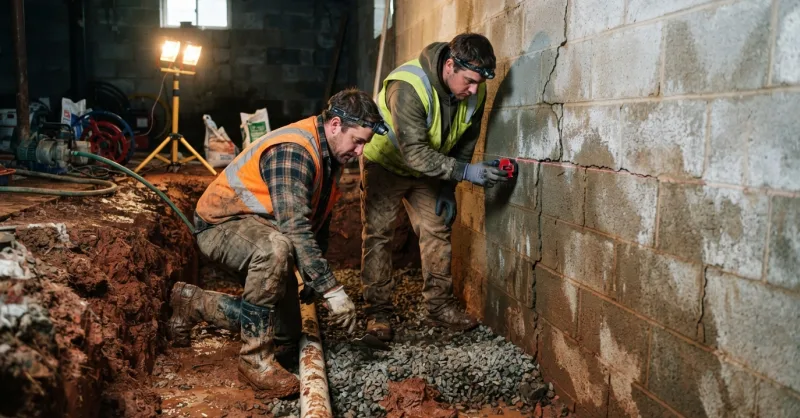
I’ll give you the number first. Full exterior foundation excavation and waterproofing in New Castle County runs $180 to $290 per linear foot. For an average 1,200-square-foot ranch foundation, total project bids land between $13,000 and $37,000. That range covers full-footing-depth trenching, cold-fluid polymer-modified bitumen membrane, dimple drain board, a 4-inch PVC-U perimeter drain with geotextile sock, soil disposal, and your county permit filing.
Now, the number means nothing without context. And context here is everything.
We operate out of 500 Apple Rd, Newark, DE 19711, and after 25 years of structural work across the U.S. and six years diagnosing the specific soils in this tri-state corridor, I can tell you the spread between $180 and $290 is not arbitrary. It reflects real site conditions that change block by block.
Why Exterior Waterproofing Bids Swing by $110 Per Linear Foot
A job on a quarter-acre lot in Green Valley near Newark looks completely different from one in Graylyn Crest up in North Wilmington. The soil changes. The access changes. The risk profile changes.
- Clay-silt soils with a plasticity index above 15 (common in the Chewacla and Codorus series running through central New Castle County) force deeper benching and dewatering. That alone can add $20 to $40 per foot.
- Zero-lot-line excavations demand Delaware 811 utility clearances for gas, electric, and Fios/Comcast lines. Concrete cutting tolerance to protect a neighbor’s fence or shared driveway isn’t cheap, and it isn’t optional.
- Permit Type 101-FND through New Castle County Department of Land Use requires engineered shoring plans and sediment-erosion control documentation if you’re within 50 feet of a drainage conveyance like Shellpot Creek or Mill Creek tributaries.
I quoted a strip center off Route 40 last spring, near the Fox Run Shopping Center corridor. The facilities manager assumed the job was straightforward. The bore log came back showing ML-CL silty clay with a water table sitting 26 inches below the parking surface. We had to spec dewatering pumps, a full traffic control plan for the access lane, and radon-compatible membrane to satisfy the zone 1 designation. His original “budget number” from another contractor was about 40% too low. (That contractor hadn’t pulled a soil boring. Surprise.)
How Deep Must You Excavate Under New Castle County Frost and Building Codes?
The county adopts the 2021 IRC, and Section R406 dictates the waterproofing standard for concrete and masonry foundations. Combined with the 30-inch frost depth mandate, your excavation must reach a vertical depth of roughly 8 feet 2 inches below grade to fully expose the footing haunch.
That depth is not negotiable. You need it to install a minimum 6-mil polyethylene layer over a drainage panel, bond your bitumen membrane properly, and seat a frost-heave isolation collar that keeps the system intact through January-to-March freeze-thaw cycles. Does the excavation depth change if your foundation sits on Wissahickon schist bedrock in northern New Castle County versus coastal plain soils near Bear? Yes. Schist contact zones in areas around Hockessin and Centerville can require rock saws or pneumatic breakers to achieve full footing exposure, which adds both time and cost.
The point is, if someone quotes you an exterior waterproofing job without mentioning excavation depth, trench shoring, or a compaction plan for backfill, they’re not quoting the same job I’m quoting.
Permit Requirements and Radon Obligations for Foundation Excavation in Delaware
You need a permit. Full stop. Can you legally excavate around a foundation in Delaware without one? No. New Castle County’s Permit 101-FND application requires three things at minimum:
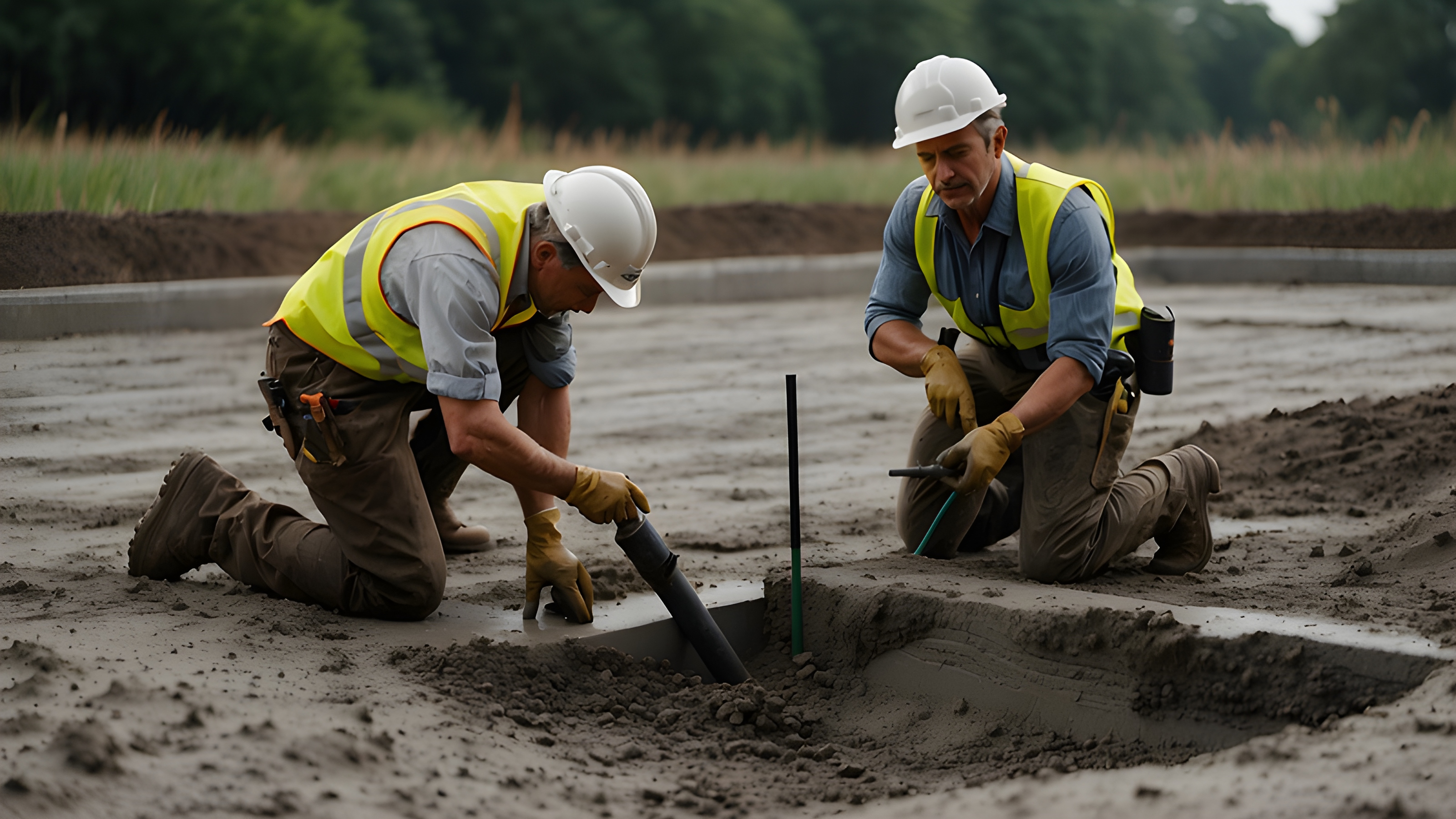
- An engineered shoring plan that complies with OSHA 1926 Subpart P trench protective systems. We use manufactured steel trench shields (Speed Shore or equivalent) stacked to 8 feet with engineering certification.
- A sediment and erosion control sheet meeting Delaware DNREC requirements, mandatory for any site near a drainage conveyance.
- A radon mitigation tie-in design per ASTM E2121, because New Castle County sits in EPA Radon Zone 1. Your waterproofing membrane doubles as a soil-gas barrier, and the design has to prove it.
I’ve watched contractors try to skip the permit on residential jobs. It catches up with them. The county inspector shows up, work stops, the homeowner eats standby costs, and the re-inspection timeline pushes the project into wet season. We build permit fees and the engineering plan cost right into our line-item bids. No change orders.
Exterior Foundation Waterproofing vs. Interior Drain Tile: Which One Actually Works in Delaware Clay?
This is the question I get from almost every facilities director managing 1980s-era garden-style apartments along Old Baltimore Pike or commercial buildings in the Christiana Mall outparcel zone.
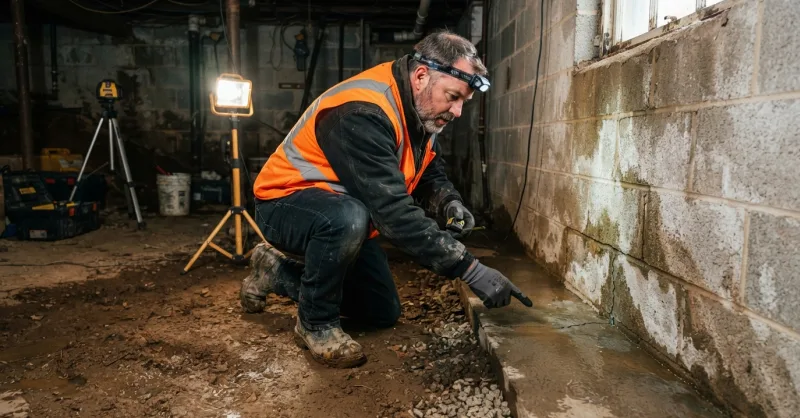
Interior drain tile manages water after it enters your wall. Exterior waterproofing stops it from reaching the wall in the first place. That distinction matters enormously in New Castle County’s expansive silt-clay soils.
During the freeze-thaw cycle from January through March, soil matrix suction forces moisture through foundation walls with relentless hydrostatic pressure. Interior systems can handle the symptom. They cannot handle the disease. The Hatboro and Codorus soil series that dominate the Route 40 corridor and the Bear-Glasgow belt retain water like a sponge, and when temperatures swing 35 degrees in a week, that retained water becomes a piston pushing against your foundation.
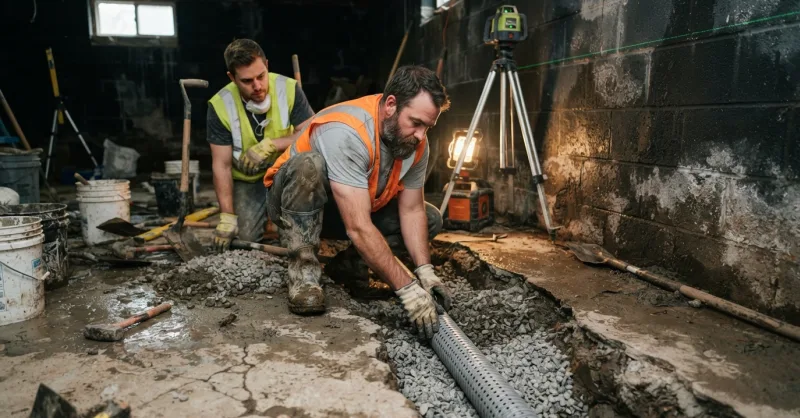
The only permanent remediation path requires excavating to the footing base, injecting structural cracks with low-viscosity polyurethane, bonding a three-course polymer-modified bitumen membrane to the exterior wall, installing a dimple drainage board for hydrostatic pressure relief, and anchoring a 4-inch perimeter drain in washed #57 stone that daylights to a sump pump or gravity outfall. Manufacturers warrant these systems for 25-plus years when installed correctly. We back that with a 5-year labor warranty, transferable at sale.
If your property condition assessment flags foundation waterproofing as a deficiency tied to refinancing, or your insurer is requiring a waterproofing certification for flood-prone locations near the Appoquinimink River, interior band-aids will not satisfy those requirements. I wrote about the broader permanent crack repair process in a separate piece that gets into the injection chemistry.
Coordinating Exterior Excavation on Occupied Commercial Properties
A regional REIT manager called us about a tenant lease violation claim at a strip center near the I-95 corridor. Water was coming through a fire-rated stairwell wall in a garden-style apartment complex. The property management company had patched the interior three times. The tenants were done.
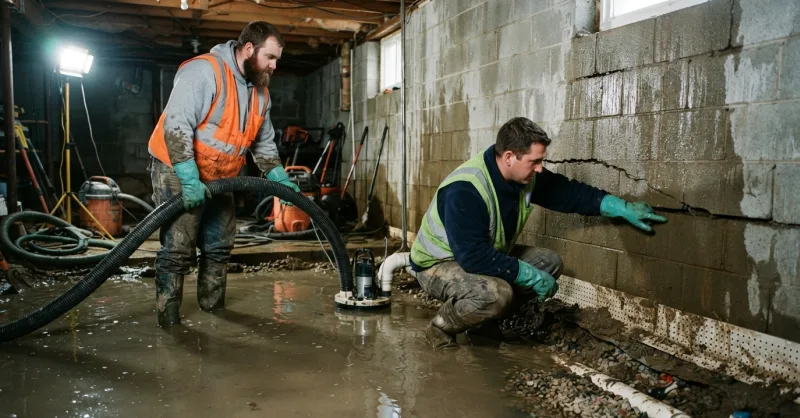
The real challenge wasn’t the waterproofing. It was logistics. The building sat on a lot with 12 feet of clearance between the foundation wall and the parking lot curb. We had to coordinate asphalt saw cutting, trench shield placement, membrane application, and parking lot restoration without closing the retail tenants’ access. The material staging route ran along DE-273 / Christiana Bypass for heavy haul delivery. We had the aggregate trucked in at 5:30 AM to avoid the morning Route 40 commuter backup.
What kind of vibration monitoring do you need when excavating next to occupied commercial space? We deploy seismograph monitors on adjacent structures within 25 feet of the trench line. On that stairwell job, the vibration threshold was set at 0.5 inches per second peak particle velocity. We never hit 0.3. But if we hadn’t monitored it, and a tenant had filed a structural damage claim, the building owner would have had zero documentation to refute it.
Single-source scheduling is the only way to keep these projects from becoming a nightmare. You don’t want four subcontractors pointing fingers at each other while your retail tenants lose foot traffic. We handle asphalt cutting, excavation, membrane work, drain tile, backfill compaction with third-party testing, and surface restoration under one contract. If you’re dealing with structural foundation damage underneath the waterproofing issue, we diagnose that during the same site visit.
How to Get a Legitimate, Line-Item Quote Without the Sales Pitch
We offer free, no-pressure structural estimates across New Castle County, Chester County PA, and Cecil County MD. That’s not a marketing line. It’s how we oprate.
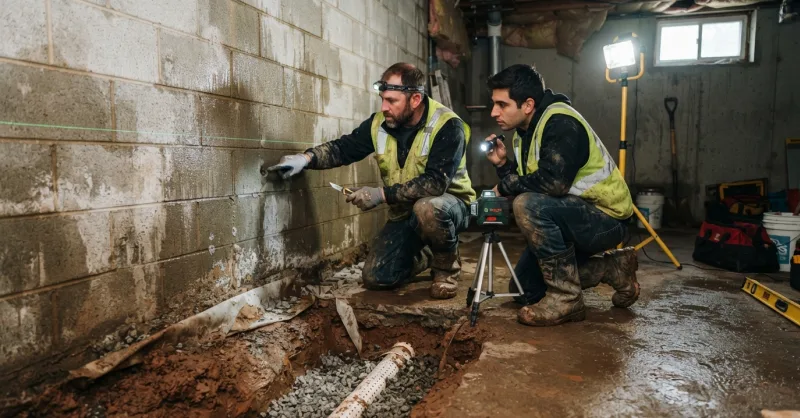
Within 24 hours of your call, our project lead arrives on site with a penetration moisture meter, grade-level survey tools, and access to bore-log data for your soil classification. The bid you receive itemizes every cost:
- Permit 101-FND filing fee and engineered shoring plan
- Trench shield rental and OSHA-compliant crew setup
- Membrane material, radon-barrier certification, and manufacturer warranty registration
- Soil off-haul classified as clean fill per DNREC standards
- Third-party geotechnical compaction certificate for every backfill lift
You also get a full HD video scan of the dried-in membrane and drain tile invert before we backfill a single shovel of stone. That video becomes part of your permanent property file. If you sell the building in eight years, the buyer’s inspector can see exactly what’s behind the dirt.
I don’t do verbal ballpark figures. I’ve seen too many homeowners and facility managers get burned by a $9,000 “estimate” that ballooned to $22,000 once the trench was open and the contractor suddenly discovered shoring requirements and permit fees. (That’s not a discovery. That’s negligence.) If you want a free structural evaluation without the script, start here.
We’re active on LinkedIn and Instagram if you want to see recent project documentation and basement waterproofing walkthroughs from actual job sites in the area.
Your home in good hands. That’s not a tagline we throw around loosly. It’s a standard we hold every excavation, every membrane application, and every backfill lift to. No quick fixes. No sales scripts. Permanent results.
Written by: Alex Velasquez
AVG Waterproofing LLC