


What Makes a Zero-Nonsense Wet Basement and Foundation Leak Specialist Different from Every Other Contractor?
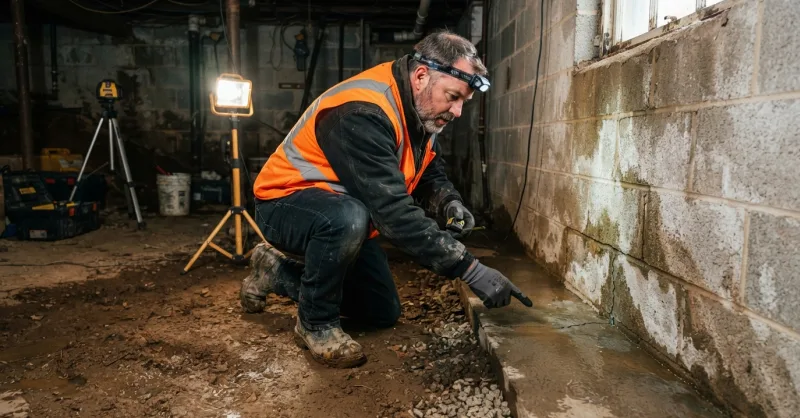
A zero-nonsense wet basement and foundation leak specialist diagnoses soil behavior first, not symptoms. We excavate the actual failure mechanism beneath your slab or behind your wall, identify the hydrostatic pressure source, and repair it permanently with documented materials and line-item pricing. No sales scripts. No bundled quotes hiding contingencies. No commissioned closer sitting at your kitchen table.
I’ve run structural repair crews across the U.S. for over 25 years. Six of those years have been spent specifically diagnosing the clay-heavy, high-water-table soils across New Castle County, Chester County, and Cecil County. That local soil knowledge changes everything about how we approach a wet basement.
The national franchise model sends a salesperson to your home with a rehearsed pitch and a single interior solution. We send a structural expert with an infrared camera and calcium chloride test kit. The difference between those two visits is the difference between a repair that holds through the next nor’easter and one that fails before your warranty card arrives in the mail.
AVG Waterproofing LLC operates from 500 Apple Rd, Newark, DE 19711, dispatching across the DE-PA-MD corridor. Your Home In Good Hands isn’t a tagline we picked from a branding agency. It’s the standard we hold every single crew member to on every job.
Why Soil Behavior Dictates Every Wet Basement Fix in the Tri-State Corridor
Most contractors look at the crack. We look at the dirt pushing against the wall that caused it.
New Castle County sits on a geological collision zone. The Piedmont Plateau’s crystalline bedrock meets the Coastal Plain’s Cretaceous sediments right along a fall line that runs through Wilmington and Newark. Homes built on the Piedmont side deal with perched water tables that spike after two inches of rain. Properties south toward Middletown sit on expansive clay lenses in the Appoquinimink watershed that swell when wet and shrink when dry, generating lateral thrust against block walls season after season.
The Iron Ochre Problem in North Wilmington Split-Levels
Last spring we pulled the original interior drain tile out of a 1960s split-level in Brandywine Hundred. The pipe was completely choked with iron ochre, a rust-colored bacterial sludge that forms when iron-rich groundwater meets oxygen inside a drainage system. The homeowner had called three other companies before us. Two recommended waterproof paint on the basement walls. One suggested a dehumidifier. (A dehumidifier. For a hydrostatic pressure problem.)
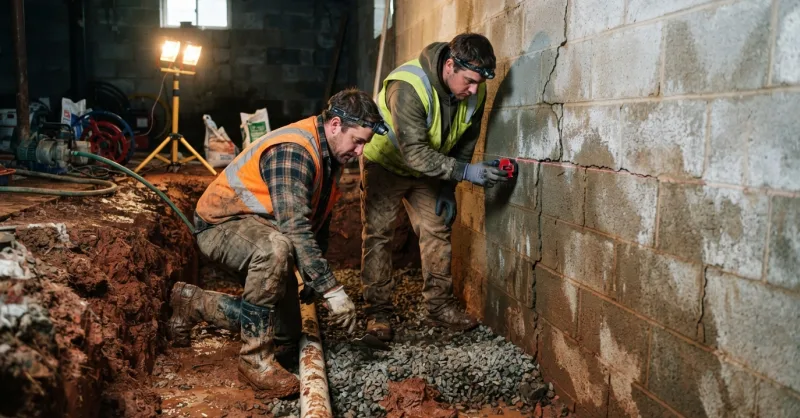
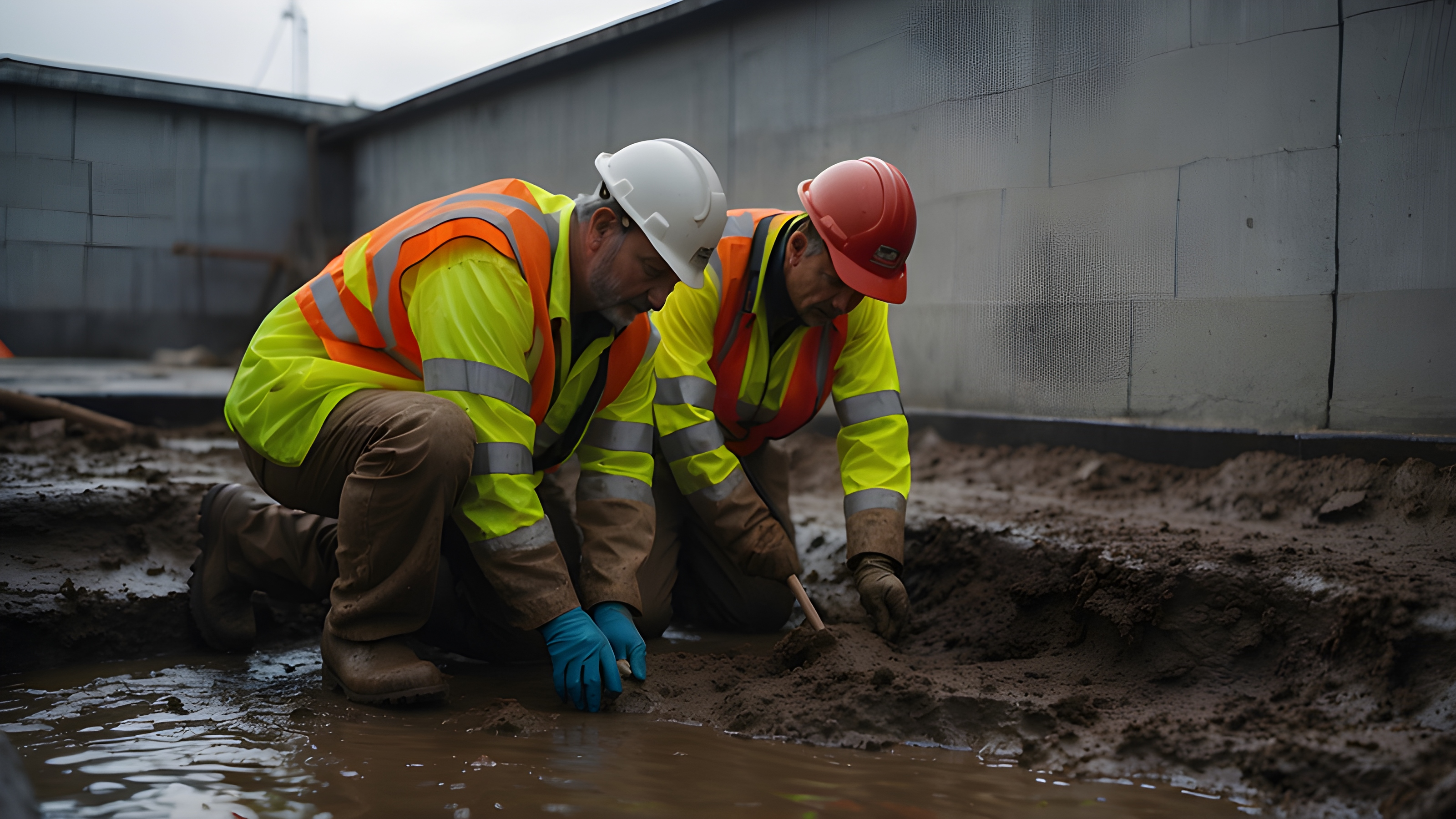
We excavated the exterior footing, applied an elastomeric positive-side membrane, installed a new perimeter French drain with cleanout ports, and tied the discharge into a compliant line per New Castle County Unified Development Code Section 40.10.310. The basement has stayed dry through two major storm cycles since. That’s not marketing language. That’s measurable results from understanding what iron ochre does to 60-year-old drain tile in Piedmont fall-line soils.
If you manage properties along the Concord Pike corridor or in the older Arden-Bellefonte neighborhoods, the iron ochre pattern repeats constantly. We’ve documented it on our Instagram feed with real excavation photos from these exact neighborhoods.
Commercial Basement Water Intrusion: When Downtime Costs More Than the Repair
Facility directors and property managers already know the math. A flooded electrical room in a Churchmans Crossing office building doesn’t just mean a pump-out bill. It means evacuated tenants, emergency generator rental, potential lease termination triggers, and an insurance adjuster who’s about to raise your premium for the third consecutive year.
We work with commercial and multi-family property teams across New Castle County who need phased scheduling that doesn’t shut down an entire building. A recent project at a multi-tenant retail property near Pencader Business Park required us to waterproof 140 linear feet of below-grade foundation wall while keeping three ground-floor tenants fully operational. We excavated in 20-foot sections, applied the membrane, backfilled, and moved to the next segment. The tenants never lost a business day.
Sump Pump Failures During Nor’easters: A Predictable Crisis
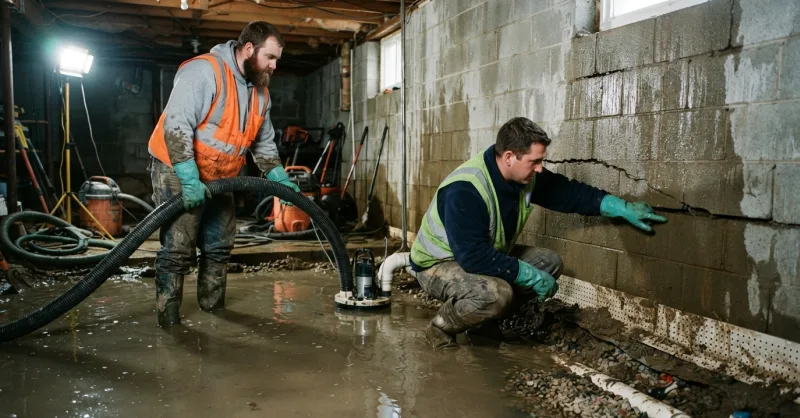
I’ve responded to enough emergency calls during coastal storms to know the pattern. Power goes out. Primary sump pump dies. Backup battery wasn’t maintained or was undersized for the flow rate. By the time someone calls us, there’s four inches of water in the mechanical room.
What type of sump pump actually survives New Castle County’s clay-rich groundwater? A submersible cast-iron unit with a 1/2 to 3/4 HP motor and a vortex impeller. The vortex design handles the silt and mineral deposits that clay water carries without clogging, unlike standard pedestal pumps. Pair that with a battery backup rated at 10 gallons per minute or higher, and you’ve got a system that keeps running when the grid fails during a coastal storm. We install these with WiFi alert modules so facility managers get a phone notification the instant water levels rise, not a tenant phone call at 2 AM.
If your property sits in the Delaware City industrial zone or along the Route 13 corridor from Claymont south, saltwater intrusion from the Delaware River estuary adds corrosion risk to every metal component in your drainage system. We spec marine-grade stainless hardware for those zones. It costs a bit more up front. It saves you from replacing corroded pump housings every 18 months.
Interior Drain Tile vs. Exterior Positive-Side Waterproofing: Which One Fixes the Actual Problem?
Both have legitimate applications. But one gets sold far more often because it’s cheaper to install and easier to upsell.
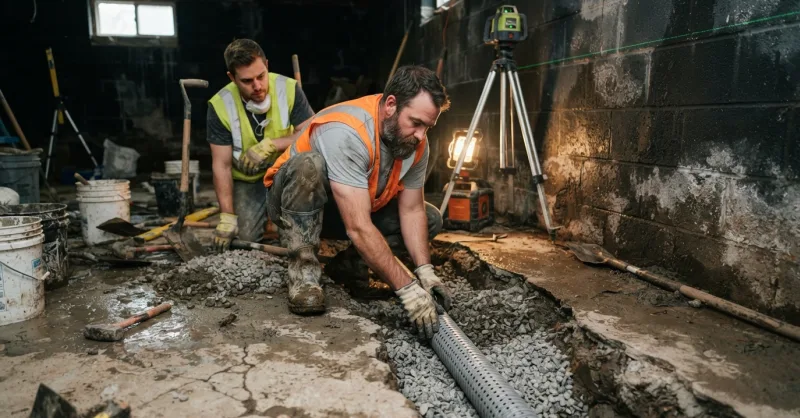
Interior perimeter French drains manage water after it enters the foundation. They relieve hydrostatic pressure beneath the slab and route water to a sump basin. For properties where exterior excavation is impossible (think row houses in downtown Wilmington, or commercial buildings with zero-lot-line construction along Market Street), an interior system is the correct solution. We install these with cleanout ports every 8 feet so the drain can be maintained without tearing up concrete. Our basement waterproofing service page breaks down the full system specs.
Exterior positive-side waterproofing stops water before it touches the foundation. We excavate down to the footing, apply a liquid-applied membrane or bentonite clay sheet, install a drainage composite board, and backfill with washed gravel. This is the permanent solution for properties where you have access to the exterior walls. It addresses the root cause: water migrating through soil and contacting concrete.
Does it matter which method a contractor recommends first? Absolutely. If someone walks into your basement, looks at a wet wall, and immediately recommends interior weep holes without ever discussing soil conditions, drainage slope, or exterior access, they’re selling the cheapest job. Not the right one. We diagnose the failure path, then recommend the system that matches your geology, building footprint, and county code requirements.
Why Epoxy Injection Alone Won’t Hold in Sulfate-Rich Delaware Soils
Epoxy crack injection creates a structural bond stronger than the original concrete. That’s a verifiable fact. The problem is what happens around the injection when the soil keeps attacking.
Newark’s older neighborhoods, especially the blocks between Main Street and the University area, have a high concentration of concrete block foundations from the 1940s and 1950s. The mortar joints in these walls have been degrading for decades under acid rain exposure and sulfate attack from the surrounding soil. You can inject epoxy into a crack and watch a new one open six inches away within a year because the mortar matrix is failing systemically.
We approach block wall repair differently. On a recent project off Capitol Trail, we discovered horizontal cracking across 8 courses of block, a classic sign of lateral soil pressure. The homeowner had already paid another contractor $1,400 for an epoxy injection that cracked again within four months. We excavated the exterior, relieved the soil pressure, installed a drainage board to prevent future hydrostatic loading against the wall, and then addressed the structural bow with carbon fiber reinforcement strips. The full process for stabilizing bowing basement walls is something we’ve refined over hundreds of these repairs.
One detail from that job still bugs me. The previous contractor’s injection ports were still visible in the wall, perfectly spaced, textbook application. The epoxy itself wasn’t the failure. The failure was ignoring 4.5 psi of hydrostatic pressure pushing against a 70-year-old mortar joint. Technique without diagnosis is just expensive guesswork.
Open-Book Estimates: Every Line Item Visible Before We Start
I publish this because I’m tired of watching homeowners get burned by bundled quotes that hide the real costs.
When we deliver an estimate, you see every component:
- Linear feet of excavation and depth
- Membrane type and manufacturer (TPO vs. liquid-applied elastomeric vs. bentonite sheet)
- Sump pump model number, HP rating, and backup battery specs
- Drainage aggregate quantity and pipe diameter
- New Castle County permit fees and NCCIS inspection scheduling
How much does foundation waterproofing actually cost in New Castle County? It depends entirely on your soil profile, foundation type, and the linear footage involved. An interior French drain system for a standard 1,200-square-foot basement typically runs between $4,500 and $8,000. Exterior positive-side waterproofing with full excavation ranges from $8,000 to $18,000 depending on depth to footing and site access. We don’t give ballpark numbers over the phone. We give free, no-pressure structural estimates on site. If telling you the truth costs me a project, so be it. I’d rather sleep well.
Our free structural inspection process exists specifically to give you a written diagnostic report with a moisture map before anyone talks about money. That’s the order it should happen in. Diagnosis first. Scope second. Price third.
New Castle County Drainage Code: What Your Current Contractor Probably Skipped
Section 40.10.310 of the New Castle County Unified Development Code requires a graded site plan showing positive slope away from the structure for any exterior drainage work. The Delaware International Building Code 2018 amendments add specific requirements for foundation waterproofing membranes and discharge line routing.
I can’t tell you how many properties I’ve inspected where a previous contractor installed an exterior drain line that discharges directly onto the neighboring lot or into a flower bed three feet from the foundation. No permit pulled. No inspection scheduled. No compliant tie-in to the municipal storm drain.
Can a facility manager get cited for non-compliant foundation drainage in New Castle County? Yes. NCCIS code enforcement can issue violation notices for improper discharge, inadequate positive grading, and unpermitted subsurface drainage work. We’ve seen this happen to commercial property owners in the Churchmans Crossing area and along the I-95 corridor where stormwater management is under increasing municipal scrutiny. Every project we touch goes through the county inspection process. Full stop.
Connect with us on LinkedIn where we share code updates and seasonal maintenance alerts for property managers across the tri-state region.
90-Minute Emergency Dispatch Across New Castle County
Our Newark base puts us within rapid response range of every major commercial corridor in New Castle County. I-95 north to Claymont. Route 13 south toward Odessa. DE 141 through the Hockessin and Pike Creek corridors. A pump-out crew with submersible diesel pumps and moisture mitigation gear dispatches the moment you call. No answering service. No weekend surcharge.
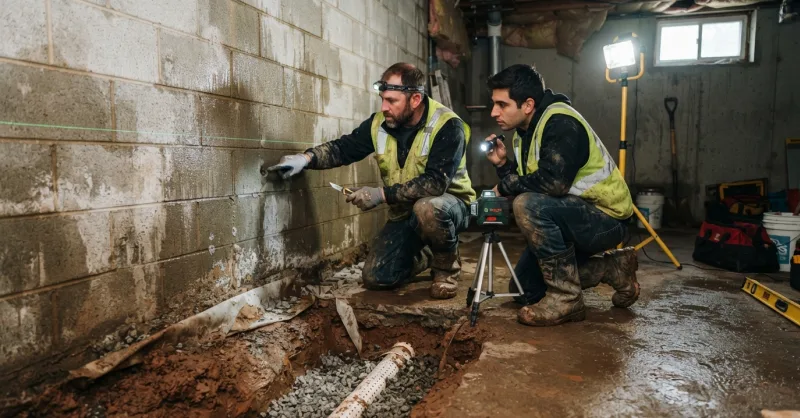
Thermal imaging and calcium chloride moisture testing happen within the first 30 minutes on site. You get a written diagnostic report with a moisture intrusion map before we discuss any repair scope. That’s the standard. Every time.
What should a property manager do immediately when a basement floods during a storm? Kill power to the affected area at the breaker panel if water is near any electrical components. Do not enter standing water in a room with energized circuits. Call us. We bring OSHA-compliant confined space entry equipment, commercial-grade dewatering pumps, and enough hydraulic cement and injection material on every truck to perform emergency stabilization on the same visit. Document everything with photos for your insurance adjuster. We’ll have a moisture map and forensic report ready for them within 24 hours.
If your property sits in the Chesapeake & Delaware Canal groundwater regime, south of the canal toward Delaware City and St. Georges, tidal surge seasons compound the flooding risk. A single failed backflow preventer on your foundation gravity drain can send canal-influenced groundwater into your entire ground floor. We perform pre-storm perimeter drain certifications for commercial properties in that zone. One inspection can prevent a six-figure loss. AVG Waterproofing LLC: Your Home In Good Hands.
Written by: Alex Velasquez
AVG Waterproofing LLC