



Why Does Professional Sump Pump Installation With Battery Backup Fail So Often in New Castle County?
I’ve pulled more dead sump pumps out of basements across this county than I care to count. Cast iron volutes corroded through, undersized batteries that gave up three hours into a nor’easter, discharge lines frozen solid because somebody ran PVC straight through an uninsulated rim joist. The pattern repeats itself.
The typical failure isn’t the pump itself. It’s the installation. A contractor drops a unit into the basin, wires it to the nearest outlet (rarely GFCI-protected), and walks away. No inflow measurement. No dynamic head calculation. No discussion about what happens when Delmarva Power goes dark for 18 hours during an ice storm and that little 40 Ah battery is the only thing standing between your mechanical room and four inches of groundwater.
We run AVG Waterproofing LLC out of 500 Apple Rd, Newark, DE 19711, and after 25 years of structural work across the U.S. and six years specializing in tri-state soils, I can tell you the root cause is almost always the same: nobody diagnosed the site before selling the equipment.
Assess Site Risk and New Castle County Code Requirements Before Anything Else
Felsic-gneiss bedrock runs beneath Pike Creek and Hockessin. After a coastal front pushes through, perched water tables spike fast. I’m talking hours, not days. Properties sitting above the Fall Line get hit with rapid groundwater rise that overwhelms a standard single-pump setup.
New Castle County Code Chapter 40 governs stormwater connections. The 2018 amendment added a requirement that catches most homeowners off guard: if you have a finished basement, your sump pump battery backup needs an audible alarm that triggers when the battery drops below 50% state-of-charge. I’ve watched inspectors red-tag installations that missed this single detail.
Verify Your Flood Zone and Permit Status
Properties along the Christina River and Delaware Bay tributaries fall into mapped flood zones. Check whether your municipal stormwater permit (SDP-101 through the Department of Land Use) requires battery backup as a condition. Most property managers I work with in the Riveredge Industrial Park corridor didn’t realize this until a compliance notice showed up.
And here’s something that trips up even experienced facility directors: New Castle County prohibits sump pump discharge into sanitary sewer lines. If your current system ties into sanitary, you’re already out of compliance. We see this more than you’d think in older commercial buildings near Kirkwood Highway.
Measuring Basin Capacity and Simulating Storm Inflow: The Steps Most Installers Skip
Gallons-per-inch. That’s the number that drives every calculation downstream. If you get basin capacity wrong, your amp-hour projections land 20-40% off target. I learned this the hard way on a commercial retrofit near the Greater Wilmington Industrial Park heavy utility corridor, where the original installer had estimated basin volume by eyeballing it. The backup battery lasted exactly two hours and forty minutes during a moderate rain event. The tenant lost a half-day of operations.
How to Log Actual Inflow Data
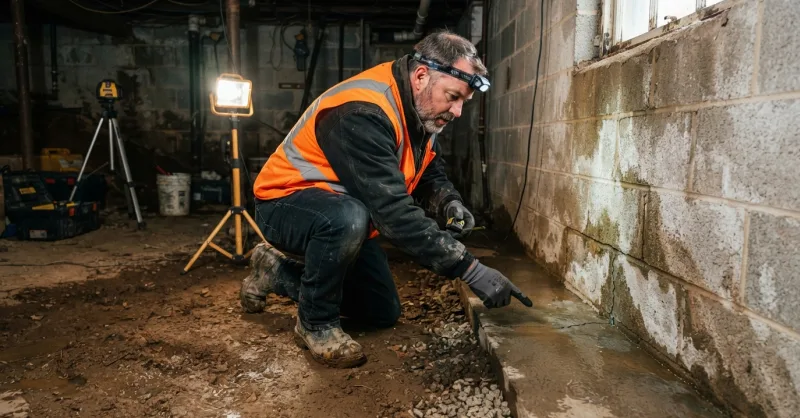
- Record basin diameter and depth with a weighted tape measure. Note pipe invert elevation and clearance to the stone reservoir below.
- Connect a temporary data logger to your existing pump. We use 48-hour monitoring periods to capture at least one significant rain cycle.
- Run four 5-minute high-flow simulations and capture GPM. Extrapolate those numbers against an 8-hour storm surge scenario (the kind of event that hits our area two to four times annually).
This data becomes the backbone of your runtime projection. Without it, any quote you receive is guesswork dressed up as engineering. How long does a battery backup actually last during a Delaware nor’easter? That depends entirely on your site-specific inflow rate, total dynamic head, and the amp-hour capacity of the battery. A generic answer doesn’t exist. Anyone who gives you one without measuring your basin is selling you something, not solving a problem.
Total Dynamic Head and Battery Sizing: Where the Real Engineering Happens
A Zoeller M53 moves 2,850 gallons per hour at 10 feet of dynamic head and draws 8.2 amps doing it. Those numbers matter because runtime is a straightforward calculation: battery amp-hours divided by pump amp draw. A 40 Ah battery at 8.2 amps gives you roughly 4.8 hours on paper, less in practice because AGM batteries shouldn’t discharge below 50% if you want them to survive more than a couple seasons.
Practical runtime on a 40 Ah unit? About three hours. During a nor’easter that knocks power out for 12 to 36 hours, that’s not a backup system. That’s a delay.
The 125 Ah Protocol We Use Across New Castle County
We size battery backup installations around the Lifeline GPL-31XT at 125 Ah. At 8.2 amp draw, that delivers approximately 15 hours of autonomous pumping before hitting the 50% SOC threshold. For properties in high-water-table zones along Red Clay Creek or in the 19808 corridor, we stack a dual-DC pump configuration using the Zoeller Aquanot 508, which adds redundancy without doubling battery drain.
I had a facilities director at a multi-tenant office near the I-95 and US-13 interchange ask me last fall why his previous contractor never ran these numbers. (The honest answer? Running load calculations takes time, and time doesn’t fit into a cookie-cutter sales model.) His building had flooded twice in eighteen months. Both times, the 40 Ah battery died before the storm peaked. We replaced the entire system, ran a full inflow simulation, and delivered a runtime-versus-state-of-charge graph he could hand to his insurance carrier.
The outcome? The system ran 14.5 hours during the next extended outage. Not a drop on the floor. But I’ll admit the install took a full day longer than we quoted because the existing basin had been set at the wrong depth, and we had to extract and reset it with confined-space protocols. That’s the kind of thing you don’t discover until you’re physically in the pit.
Air-Gap Discharge, GFCI Circuits, and the Alarm That Inspectors Always Check
Three items land at the top of every New Castle County inspection checklist for sump pump installations:
- A code-compliant air-gap discharge with backflow preventer, installed four pipe-diameters above grade. This prevents contaminated water from siphoning back into the basin and keeps your system separated from the sanitary sewer.
- A dedicated 20-amp GFCI circuit for the pump and alarm. I can’t count how many installations I’ve seen daisy-chained off a shared basement circuit. One tripped breaker during a storm and the pump goes silent.
- An audible alarm wired to the battery monitor relay, set to trigger at 50% SOC. This is the 2018 amendment requirement for finished basements, and inspectors enforce it.
Does New Castle County code require a sump pump battery backup in every home? Not universally, but finished basements with living space now carry the audible alarm mandate, and most code officials strongly recommend (and increasingly require during plan review) backup power for any property in a mapped flood zone. We include the alarm as standard on every installation because the cost is negligible and it prevents a re-inspection.
Salt-laden air near Delaware City accelerates corrosion on exposed components. For installations in the 19706 refinery zone, we mount battery systems inside zone-rated NEMA 4X enclosures and swap standard hardware for stainless. It adds maybe $180 to the project cost and extends equipment life by years. Small detail, big payoff.
The Compliance Binder: Why We Hand You Documentation, Not a Handshake
After every sump pump and battery backup installation, we compile a full AHJ compliance binder and deliver it on-site. This isn’t a sales gimmick. It exists because I got tired of watching property managers scramble for paperwork when inspectors showed up.
The binder includes:
- New Castle County Land Use Department permit tag and SDP-101 reference (where applicable)
- Photographic documentation of the air-gap discharge connection
- GFCI test certificate with date and circuit identification
- Alarm system integration test log showing the 50% SOC trigger point
- Copy of the local code amendment cross-referencing the sump discharge prohibition into sanitary lines
We accompany the inspector on the final walkthrough if needed. First-pass approval matters to facility directors managing multiple properties across the Christina Hundred or along the I-95 corridor. A failed inspection doesn’t just cost a re-visit fee. It delays tenant move-ins and triggers questions from corporate risk managers who are already watching your flood claim history.
If your building has a fire alarm panel (common in retail corridors near Kirkwood Highway), we can tie the sump pump monitoring into the BMS through a dry contact relay. Can a sump pump backup system integrate with a commercial building management system? Yes, and for properties with fire marshal oversight, it’s often the only way to satisfy device supervision requirements in commercial sump pits.
What Professional Sump Pump Installation With Battery Backup Actually Costs in This Market
In New Castle County, a professional installation of a cast-iron primary pump with an AGM battery backup system runs $1,680 to $2,350. That includes the permit, check valve, dedicated GFCI circuit, and code-mandated air-gap discharge. Final price depends on basin depth, existing drain configuration, and whether you need a secondary DC pump stacked for redundancy. High-water-table areas like Hockessin almost always need the dual setup.
For commercial properties, costs scale with complexity. Tie-ins to fire alarm panels, confined-space basin extractions, and multi-pump arrays push the number higher. We provide a detailed scope before signing anything. No lump-sum mystery quotes.
Emergency Dispatch and Storm Season Availability
Our service vans stage near the DE-141 and I-95 merge. We maintain a 120-minute mobilization window for emergency sump pump failures, and we pre-position crews before DelDOT-declared storm warnings. What’s the fastest emergency sump pump response time available near Bear or Newark, Delaware? We commit to 120 minutes from dispatch during active storm events, which is when most competitors go dark or push calls to voicemail.
A flooded mechanical room during a nor’easter isn’t a scheduling inconvenience. It’s a ticking clock. Every hour of water exposure compounds damage to HVAC equipment, electrical panels, and stored inventory. We show up with Zoeller cast-iron pumps and fully charged AGM batteries already on the truck. (I’ve seen competitors show up with the wrong pump model twice in one season. That kind of thing burns your trust fast.)
Sump Pumps Are Part of a Larger Waterproofing System, Not the Whole Answer
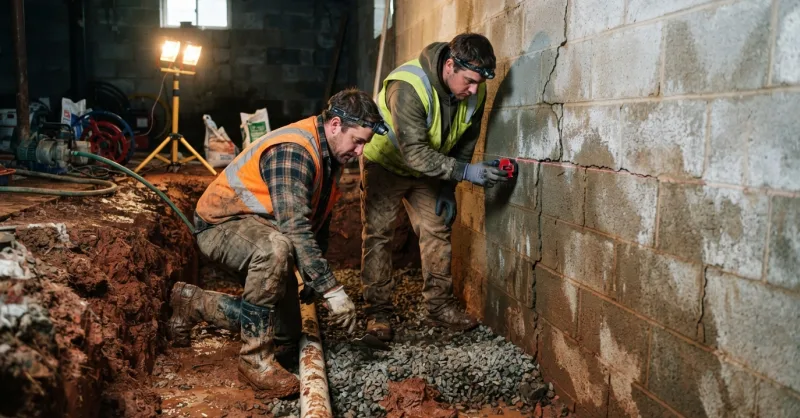
A sump pump handles the water that reaches your basin. But why is water reaching your basin in the first place? That’s the question most contractors never ask. If your foundation has active cracks feeding water into the basement, or if hydrostatic pressure is pushing moisture through a deteriorating exterior membrane, the pump is just managing symptoms.
We diagnose the full picture. Our interior basement waterproofing systems address the source of water intrusion, not just its destination. And when we find foundation cracks feeding groundwater into the basement, we fix the structural issue permanently before upgrading the pump system. Anything else is a band-aid on a broken bone.
25 years of structural experience taught me that water problems and foundation problems are almost never separate issues. The same expansive clay soils in New Castle County that cause slab settlement also channel water toward your foundation walls during every rain event. Treating one without evaluating the other is how you end up calling a contractor back every 18 months.
Connect with us on LinkedIn or Instagram to see real project documentation from installations across New Castle County, Chester County, and Cecil County. No stock photos. No staged before-and-afters. Just the actual work.
Your home in good hands. That’s the promise, and the diagnostic protocol behind every sump pump installation and battery backup upgrade we deliver is how we keep it.
Written by: Alex Velasquez
AVG Waterproofing LLC