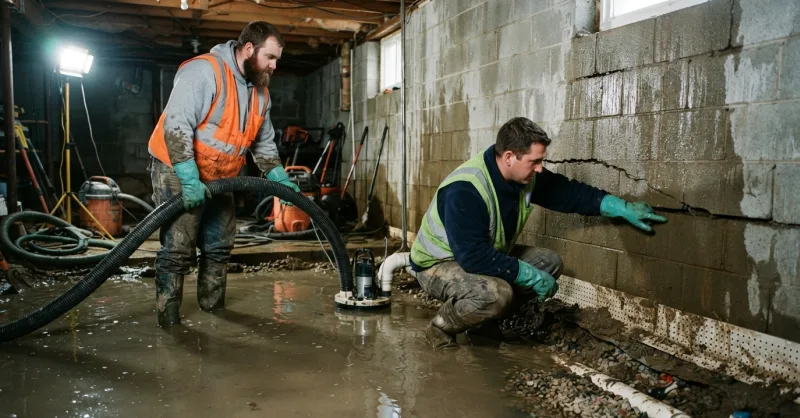



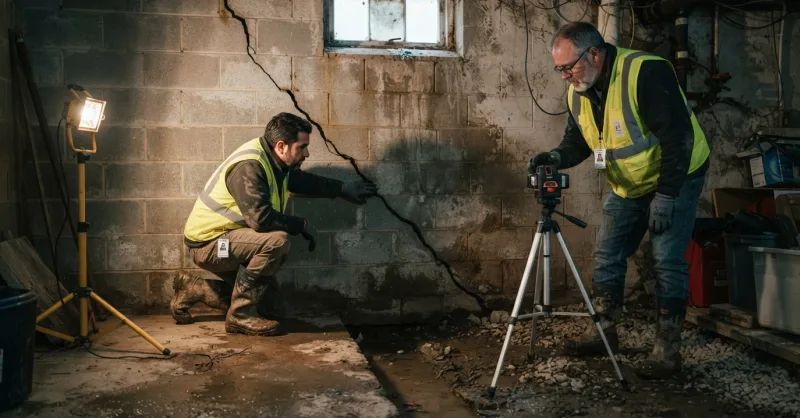
What Actually Fixes Foundation Repair and Slab Leveling Near Me in New Castle County?
If you’re typing “foundation repair and slab leveling near me” into your phone at 11 p.m. because your basement smells like a wet basement again, I’ll save you the runaround.
The crack in your wall isn’t the problem. The soil and water underneath your house are the problem. The crack is just the messenger.
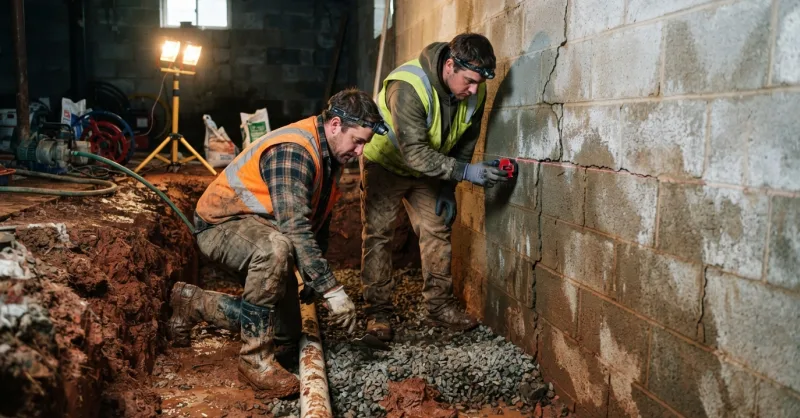
I’ve been doing structural work in the U.S. for over 25 years, and the last six of those have been spent knee-deep in New Castle County soil (specifically the clay pockets around Newark, Hockessin, and the corridor running down toward Bear). Here’s what I’ve learned: most foundation “repairs” sold in this county aren’t repairs at all. They’re cosmetic delays wrapped in a lifetime warranty that nobody reads.
The real fix is a water-management and load-transfer job. If your contractor isn’t talking about both, they’re guessing.
Why Foundations Move Here, Specifically
New Castle County straddles two geologic worlds. Up north (Hockessin, Greenville, Pike Creek) you’re sitting on Northern Piedmont clay and silt loam that swells when it’s wet and shrinks when it’s dry. Down south (Middletown, Odessa) you’re on Middle Atlantic Coastal Plain soil, which is sandier, holds more water, and washes out easier than people realize.
A slab job in Bear and a slab job in Claymont are not the same job. Anybody quoting you the same fix without walking the property is guessing at your expense.
The Watershed Nobody Warns You About
White Clay Creek, Red Clay Creek, the Christina, Brandywine, Naamans, they all concentrate runoff into corridors where soil stays saturated for weeks after a storm. If you live within a mile of any of them, your foundation is fighting groundwater every rainy season. That’s the mechanism behind most of what I see:
- Differential settlement (one corner drops, doors bind, drywall cracks in a stair-step pattern)
- Slab voids where soil has washed out from underneath
- Hydrostatic pressure bowing basement walls inward
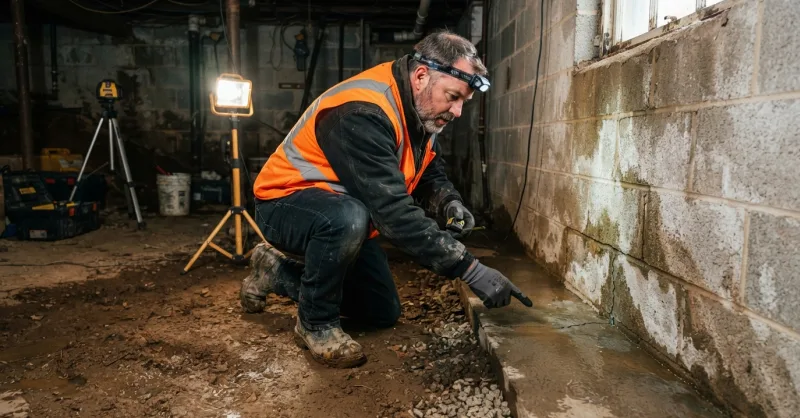
- Cove joint seepage, which is water finding the seam where the wall meets the floor
Older housing stock makes it uglier. A lot of the mid-century homes off DE-52 and around Brandywine Hundred were built with cinder block basements and no footing drain at all. The builders back then didn’t know what we know now (and honestly, drainage codes were basically a suggestion).
Two “Fixes” That Waste Your Money
Let me get blunt for a second.
Waterproof paint and hydraulic cement. These trap moisture inside the wall. The hydrostatic pressure doesn’t vanish because you painted over it. It just finds the next weakest path, usually the cove joint or a mortar line six feet away. You’ve hidden the evidence and sped up the damage.
I had a homeowner in Newark call me last spring after another company sold him three coats of a rubberized interior coating. His block wall was efflorescing so badly it looked like frost. When we pulled a moisture reading behind the paint, it was pegged. The paint was holding the water in the block like a sponge.
Cosmetic caulk and foam injection on an active crack. If the wall is still moving, filling the crack does nothing. It’ll reopen by the next freeze-thaw cycle. Foam injection has a legitimate place on stable, non-structural cracks. Selling it as a fix for active movement is either ignorance or dishonesty. Take your pick.
Neither approach touches the soil, the water, or the load. That’s why they fail. That’s also why you’re reading this at 11 p.m.
What Permanent Correction Actually Looks Like
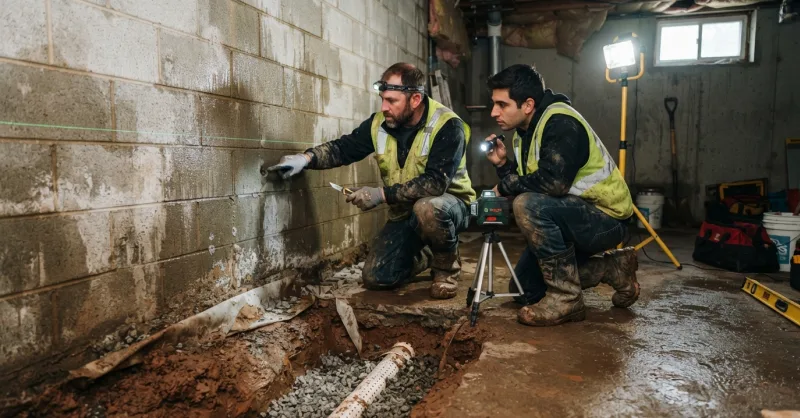
Before anyone quotes you a number, they should be able to answer four questions: Where is the water coming from? Is the wall moving, and how fast? Is the footing still supported, or has soil washed out beneath it? What are your gutters, downspouts, and exterior grade doing?
If they can’t, they’re not diagnosing. They’re pitching.
Step One: Stop the Water
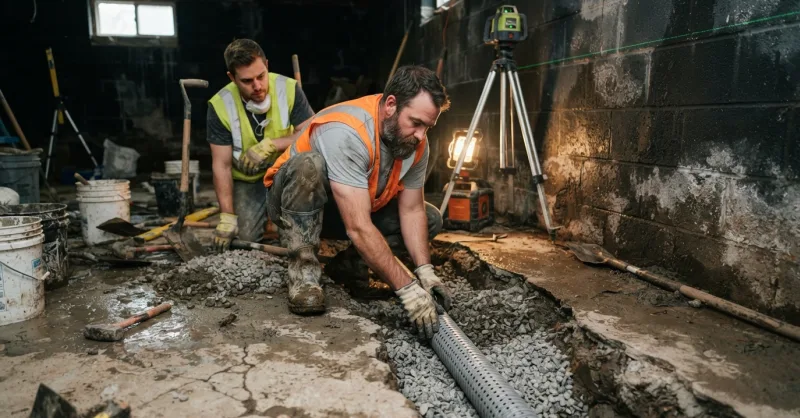
Exterior perimeter drainage and footing drains intercept groundwater before it ever reaches the wall. A properly sized sump basin with a real discharge line (not the flimsy 1.5-inch stuff I keep pulling out of jobs subcontracted by out-of-state franchises) handles what gets through. Downspout extensions and regrading fix the surface water problem at its source.
If your property sits in a mapped floodplain zone, the county will want a look before grade changes happen. An honest contractor will tell you that upfront instead of finding out mid-dig.
Step Two: Stabilize the Structure
Carbon fiber reinforcement stops active wall bowing when the wall is still sound enough to save. Piering or underpinning transfers the load to stable strata when the footing itself has lost support. Neither one is an upsell. They’re prescribed only when the diagnosis calls for them, and you deserve a straight answer about which you need. Or don’t.
I’ve talked homeowners out of piering jobs. If telling you the truth costs me a project, so be it. I’d rather sleep well at night.
Step Three: Restore the Load Path
Slab void filling re-establishes support under a settled slab. This isn’t the same as slab leveling on its own. You can jack a slab back to flat and feel like a hero for six months, but if the soil underneath is still washing out, that slab drops again. Permanent slab work means addressing what’s under the concrete, not just the concrete itself.
A 1950s Cinder Block Basement Off Kirkwood Highway
Real one from last year. Newark homeowner, cinder block basement, house from ’56. She called us because the sump was cycling every 90 seconds during a storm and there was a stair-step crack on the east wall that had grown about a quarter inch over eighteen months.
The previous contractor (a big-name outfit, I won’t name them) had sold her interior waterproofing paint and a decorative crack seal. Nine hundred bucks. Held up about a season.
When we walked the property, three things jumped out immediately. Her downspouts on the east side dumped water three feet from the foundation. Direct hit. The exterior grade sloped toward the house, not away. And the sump discharge line ran about eight feet and then daylighted right back into the saturated soil next to the footing. Whoever installed it either didn’t care or didn’t know. Common byproduct of the sloppy work I keep seeing from crews that get subcontracted out and never inspected.
We mapped the downspouts, ran a sump drawdown test, and pulled soil probes on the east side. The clay was fully saturated to about four feet down. The stair-step crack wasn’t from settling. It was hydrostatic pressure pushing the wall inward.
Fix was three-part: exterior footing drain along the east and north walls, high-capacity sump with a proper discharge run to daylight thirty feet out, and carbon fiber reinforcement on two bays of the east wall where movement had started. No paint. No caulk theater.
Eighteen months later, the crack telltales haven’t budged. That’s the difference between diagnosing and pitching.
The One Question That Filters Every Contractor
Ask them this: “What’s causing this, and what stops it from happening again?”
If the answer is a product name, walk away. If the answer is a story about water movement, soil behavior, and load transfer, in plain language, you’re talking to somebody who actually understands the problem. That’s the whole test.
Does homeowners insurance cover foundation repair in New Castle County? Almost never. Standard policies exclude gradual settlement, hydrostatic pressure, and soil movement. They cover sudden events like a burst pipe under a slab. If a contractor tells you insurance will pay for their piering job, get a second opinion (and probably a third).
How long the actual work takes depends on the scope. A straightforward interior sump and cove joint job runs two to three days. Exterior excavation with membrane, footing drain, and regrading around a full perimeter is typically five to nine days depending on access and how many downspouts we’re rerouting. Piering can add a day or two per pier.
Permits, Timing, and the Stuff Nobody Mentions
Do I need a permit for foundation work between Newark and the Route 40 corridor? Usually yes, especially if the work touches structural elements, exterior grading in a mapped hazard zone, or drainage that ties into municipal systems. New Castle County’s land use office reviews these. A legitimate contractor pulls the permit and includes it in the scope. If somebody’s dodging the permit conversation, they’re dodging the inspection too.
Timing matters more than most people think. If you know you have an active problem, don’t wait for the next heavy rain to force the decision. Saturated soil during a job means more excavation issues, longer dry-out times, and higher costs. Late summer and early fall are usually the cleanest windows in this county.
Can slab leveling handle a garage floor that’s sunk near an industrial area like the Pencader Corporate Center? Yes, but only if we also address why it sank. Older commercial and light-industrial slabs around Pencader and the New Castle Corporate Commons often sit on fill that wasn’t compacted to modern standards. Leveling without addressing the void underneath means you’ll see the same drop again within a year or two. Void filling has to come first.
We run seven days, 8 a.m. to 7 p.m. Monday through Saturday, 8 to 3 on Sundays. Storm calls get priority because active water intrusion doesn’t wait.
How We Actually Work
We’re based at 500 Apple Rd, Newark, DE 19711, which means our crews are on-site fast across New Castle County, Chester County, and Cecil County. No dispatching from three states away.
No commissioned closers. No same-day-signing pressure. No vague warranties. If you want a structural inspection without a sales pitch, that’s what we do. If your problem turns out to be a $400 downspout fix instead of a $14,000 exterior job, we’ll tell you that too.
What’s the average cost range for permanent foundation work in this area? It swings wide. Interior crack repair with proper structural reinforcement typically runs $600 to $1,800 per crack. A full exterior footing drain with membrane and regrading on a mid-sized home is usually $12,000 to $28,000 depending on access. Piering runs $1,500 to $3,000 per pier, and most jobs need somewhere between three and eight. Anybody quoting you rock-bottom prices sight-unseen is either lowballing to get in the door or planning to cut corners you’ll pay for later. Real pricing needs real diagnosis. Full breakdowns live on our foundation repair page and in our slab leveling cost guide.
You can also find our recent field work and before/afters on LinkedIn and Instagram. Real jobs, real conditions, no stock photos.
If your slab’s uneven, your wall’s cracking, or your basement’s damp after every storm, the problem is active. It won’t fix itself and it will show up on an inspection report the day you try to sell. Book the assessment. Get the straight answer.
Written by: Alex Velasquez
AVG Waterproofing LLC