


Why Does Every Failed Basement in New Castle County Trace Back to Missing Exterior Membrane and Drain Tile?
I’ve pulled apart enough failed waterproofing jobs along the I-95 corridor between Wilmington and Newark to answer this one flatly: the exterior waterproofing membrane and weeping tile installation was either skipped, botched, or buried without inspection. That’s the pattern. Not sometimes. Every single time.
AVG Waterproofing LLC operates out of 500 Apple Rd, Newark, DE 19711, and I’ve spent 25 years diagnosing structural failures across the U.S. and 6 years doing it specifically in the clay-heavy soils of Delaware, Chester County PA, and Cecil County MD. The marine clay belt running between Wilmington and Newark destroys unprotected foundations on a schedule you could set a watch to. We see it, we excavate it, and we fix it permanently.
New Castle County Code Section 18.18.040 mandates a continuous exterior waterproofing membrane on all habitable basement and crawlspace walls, plus a perforated drain tile at footing level routed to an approved sump or daylight discharge, inspected before backfill. Membrane termination must extend a minimum of 6 inches above final grade. That’s county law, not a suggestion.
The Marine Clay Belt Between Wilmington and Newark Destroys Drainage Systems in 18 Months
If you manage a multi-family property near the Piedmont/Coastal Plain geological contact zone, you already know the soil fights you. The fine Piedmont silt migrates through any unfiltered pipe opening. Corrugated black HDPE without geotextile wrap? Dead in about 18 months. I’ve pulled runs near Glasgow and Bear (zip 19702) that were completely occluded with grey clay slurry, and the system was only two years old.
How Hydrostatic Pressure Builds Against Cast-in-Place Walls
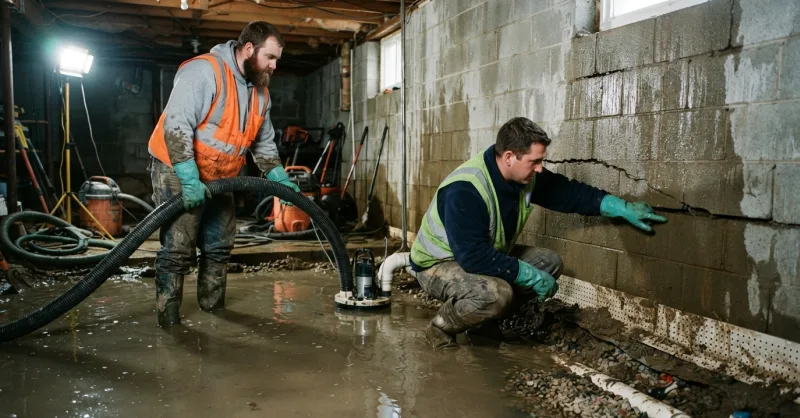
The Piedmont metamorphic bedrock contact with Coastal Plain unconsolidated sediment creates a geological shelf. Groundwater follows gravity along that shelf and pools against your foundation wall. After a 3-inch July convective storm (the kind that dumps in 24 hours and overwhelms every mechanical room along I-95), hydrostatic pressure pushes water through every cold joint, cove joint, and pipe penetration. I watched an elevator pit dewatering pump in downtown Wilmington run 47 minutes out of every hour for three straight days last summer. The exterior drain tile had collapsed under the backfill. Nobody had scheduled the COE-FD inspection before burial.
Interior waterproofing alone cannot fix a positive-side failure. It manages symptoms. Our basement waterproofing systems integrate both interior and exterior solutions depending on what the soil boring data actually shows.
What a County-Inspected Exterior Waterproofing Membrane and Weeping Tile System Actually Looks Like
Here’s the specification we install and the one you should demand in writing from any contractor bidding your project:
- Excavate to footing grade. Full exposure. No shortcuts, no “partial digs.”
- Power-wash the wall, let it cure, verify ambient temperature above 40°F before membrane application (a real constraint from late November through early March in Delaware that most crews ignore).
- Apply a fully-adhered SBS-modified bitumen membrane, lapped 4 inches minimum at every seam. Cap the termination with a two-piece extruded aluminum compression bar anchored every 12 inches. All pipe penetrations get sealed with 12-inch butyl flashing tape primed with a liquid polyurethane boot extending 8 inches up the pipe per ASTM D7832.
- Install HDPE dimple drainage board over the membrane as a hydrostatic relief course and protection layer.
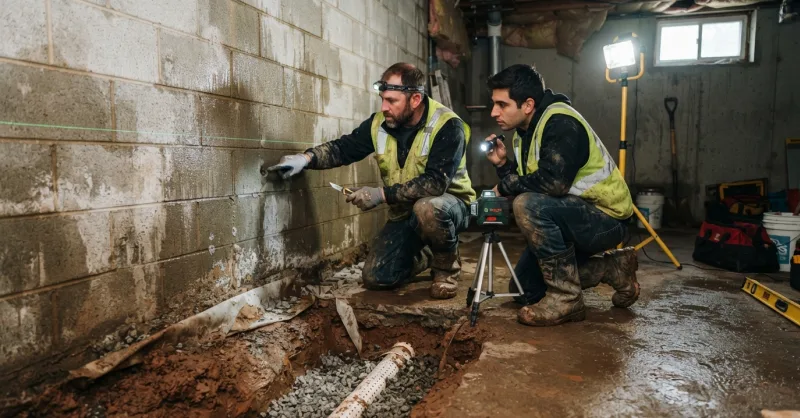
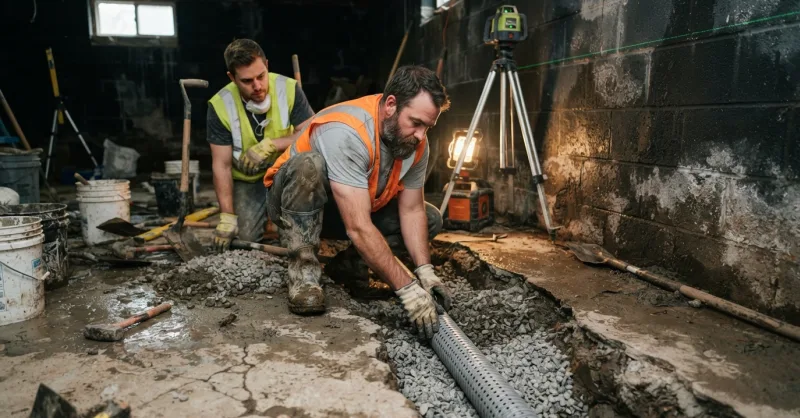
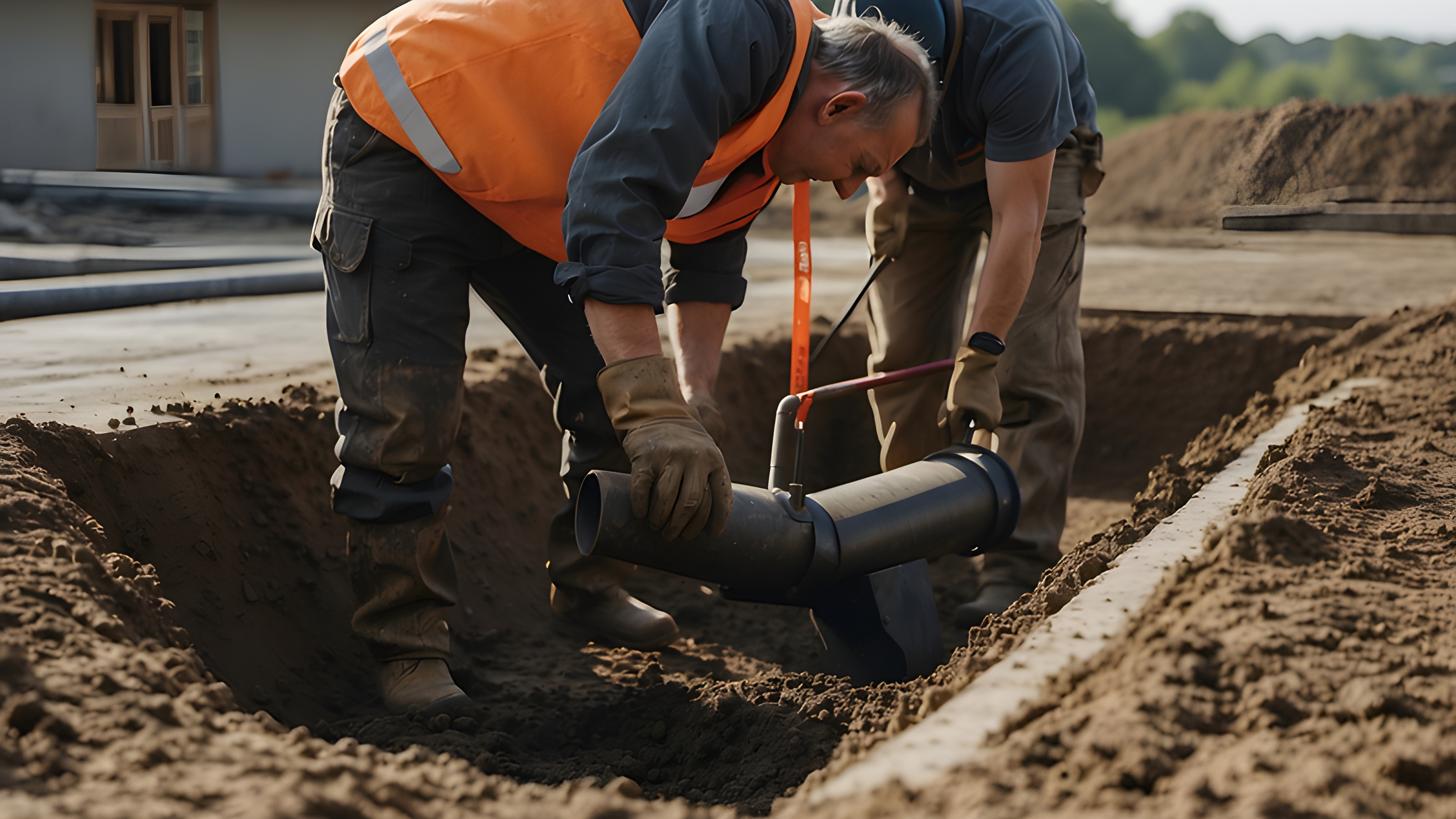
- Bed SDR 35 rigid PVC drain tile on 3 inches of washed gravel with perforations oriented at 4 and 8 o’clock, wrapped in 4 oz. nonwoven geotextile filter fabric. Verify 0.5% positive grade with a laser-level survey. Install sealed cleanout risers every 50 linear feet.
Discharge runs through a 6-inch gravity line to a lighted exterior sump basin fitted with a 1/2 hp cast-iron solids-handling pump, check valve, and battery backup. The system remains independent of the storm sewer per NCC utility separation requirements.
We schedule the NCC COE-FD footing drain inspection before a single yard of backfill goes in. The 2023 county code amendment now requires cleanout access on all exterior weeping tile discharge lines. If your current contractor doesn’t know about that amendment, you have a problem.
Forensic Autopsy of a Failed I-95 Corridor Drainage System
Last year we got called to a garden-style apartment complex near the Christina River floodplain in Wilmington, 19801. The property manager had already lost two tenants to mold-related lease terminations and the insurance carrier was threatening non-renewal after three flood claims in 18 months. A pre-acquisition PCA flagged active water intrusion and recommended immediate positive-side waterproofing to meet ASTM E2128 compliance.
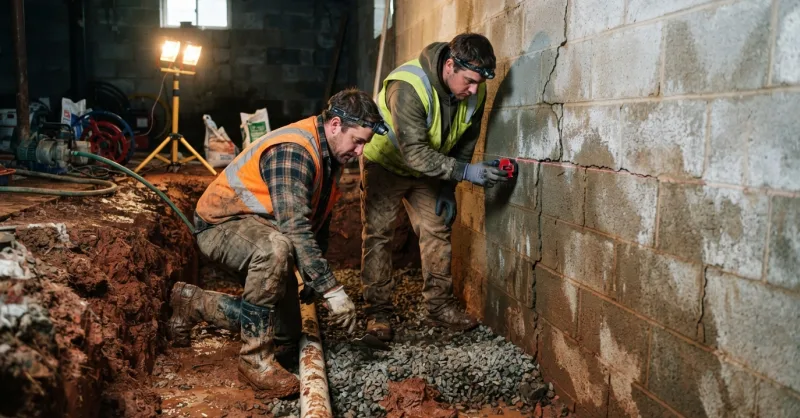
We exposed the cast-in-place wall on the east elevation. What we found was, frankly, predictable but still frustrating. Single-component asphalt emulsion, brush-applied, no mechanical termination bar. The coating had delaminated in sheets. Freeze-thaw cycles (January lows average 24°F in the Piedmont uplands) had spalled the exposed concrete beneath. The “weeping tile” was 4-inch corrugated HDPE with no grade verification, no cleanout ports, and no filter wrap. The pipe was sitting in native clay, not gravel. It was functionally a buried tube full of mud.
We installed the full assembly: SBS membrane with compression bar termination, dimple board, SDR 35 PVC on laser-verified grade, geotextile wrap, the whole spec. The sump pump runtime dropped from 47 minutes per hour to under 6 minutes per hour during the next significant rain event. (That’s not a neat victory lap; the east elevation was one of four, and we’re still finishing the north side because the loading dock phasing plan requires tenant coordination that takes weeks to sort out.)
If you’re dealing with foundation cracks alongside water intrusion, the membrane installation often reveals structural failures that need to be addressed simultaneously.
Phasing Excavation Around Occupied Loading Docks and Tenant Access
This is where most national franchise operations fall apart. They can’t stage a commercial excavation without shutting down a facility.
We file the 811 “dig safe” Delaware Miss Utility ticket 48 hours in advance. We set vibration monitors near utility interceptor zones, especially in the Brandywine Hundred combined sanitary-stormwater sewer interceptor zone where a misplaced bucket tooth can get expensive fast. Trenching phases around truck access so the loading dock never fully closes. Dust control keeps the site OSHA-compliant without triggering a silica-dust abatement order, something interior emergency waterproofing jobs regularly cause when crews cut concrete without containment.
When we worked a property near the Pencader Corporate Center, the asset manager’s top priority was zero tenant disruption during receiving hours. We excavated in 30-foot sections, backfilling each segment before opening the next. It added two days to the schedule. Nobody lost dock access. That’s 6 years of digging in tri-state backyards and commercial properties teaching us exactly how the logistics work in this corridor.
Weeping Tile vs. French Drain in Delaware: They Are Not the Same System
I get this question constantly from facilities directors and project managers who’ve been sold a “French drain” when they needed a code-compliant foundation drainage system. What is the difference between a weeping tile and a French drain installation in Delaware? A weeping tile is a perforated pipe bedded in washed gravel along the exterior footing, engineered to collect groundwater and relieve hydrostatic pressure against the foundation wall. A French drain is a shallow trench drain that handles surface water runoff. NCC inspectors treat the weeping tile as part of the foundation drainage system subject to a COE-FD inspection. Surface French drains fall under stormwater management regulations. Completely different jurisdictions, completely different standards.
If someone proposes a French drain to solve your basement flooding, they’re either confused or hoping you are.
What a Real Waterproofing Warranty Costs and Why a Verbal Promise Is Worth Nothing
How much does a properly bonded exterior waterproofing and weeping tile installation cost in New Castle County? The material cost for fully-adhered SBS membrane alone runs significantly higher than brush-applied emulsion. Add the labor hours for a laser-verified tile bed, the premium for carrying a $5M aggregate insurance certificate, and the cost of a 10-year surety-bonded workmanship warranty recorded with the New Castle County Recorder of Deeds and transferable on property title. That’s real money. A competitor offering a verbal three-year warranty on a generic invoice carries none of those costs. You get what you pay for.
Our digital dossier includes time-stamped imagery of every membrane lap, gravel bed thickness measurement, and tile perforation orientation. That documentation package transfers with the property. A 15-year manufacturer material warranty backs the membrane. The 10-year workmanship bond is underwritten by a Delaware-licensed surety. If telling you the truth about what this actually costs loses me a project, so be it. I’d rather sleep well at night.
Can exterior waterproofing membrane adhesion be verified during Delaware’s winter months? Manufacturer data sheets require ambient temperatures above 40°F for proper membrane adhesion. Delaware’s late November through early March window regularly drops below that threshold, especially in the Montchanin-Greenville hillsides where seasonal perched water tables saturate backfill within 48 hours of a nor’easter. We log adhesion temperatures on every project and won’t apply membrane when conditions compromise the bond. Some contractors skip this entirely because they don’t read the spec sheets. We record the temperature data in the project dossier alongside every other inspection hold point.
Schedule your exterior waterproofing and weeping tile installation before the Piedmont ground hardens. Excavation costs climb when ambient temperatures drop below 30°F and ground-thawing blankets enter the equation.
Stop Accepting Corrugated Pipe as a Drainage System
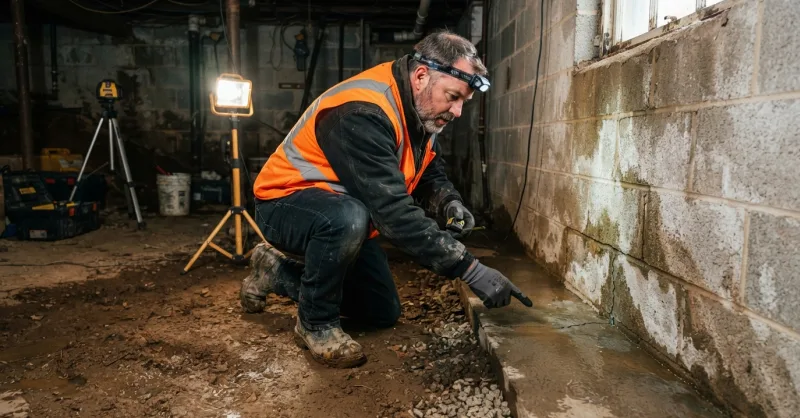
We do not send salespeople into your basement. Ever. Our structural assessments come from field diagnosticians who read soil boring logs, interpret Piedmont water table behavior, and inspect lapped membrane terminations under a 700-lumen inspection light. No scripts, no scare tactics, no commissioned closers.
Does New Castle County building code require an exterior waterproofing membrane on new foundations? Yes. NCC Code Section 18.18.040 mandates a continuous exterior waterproofing membrane or approved dampproofing for all habitable basement and crawlspace walls and an exterior perforated drain tile at footing level routed to an approved sump or daylight discharge, inspected before backfill.
Any property owner can demand the AVG specification standard in writing from any contractor:
- SDR 35 rigid PVC at 0.5% positive grade, laser-verified
- Cleanout risers every 50 linear feet
- 4 oz. nonwoven geotextile wrap
- 3-inch washed gravel bedding
- 6-inch gravity discharge to a lighted sump basin, independent of storm sewer
If your current contractor can’t produce that spec in writing, you already have your answer. Request a free, no-pressure structural estimate from AVG Waterproofing. We operate across New Castle County DE, Chester County PA, and Cecil County MD. Your home in good hands.
Follow our work on LinkedIn and Instagram. Or call us. If a sudden hydrostatic failure is pushing silt through your cove joint right now, our crew departs the Newark yard within 4 hours.
Written by: Alex Velasquez
AVG Waterproofing LLC