


Why Does Water Keep Seeping Through Your Basement Floor in New Castle County?
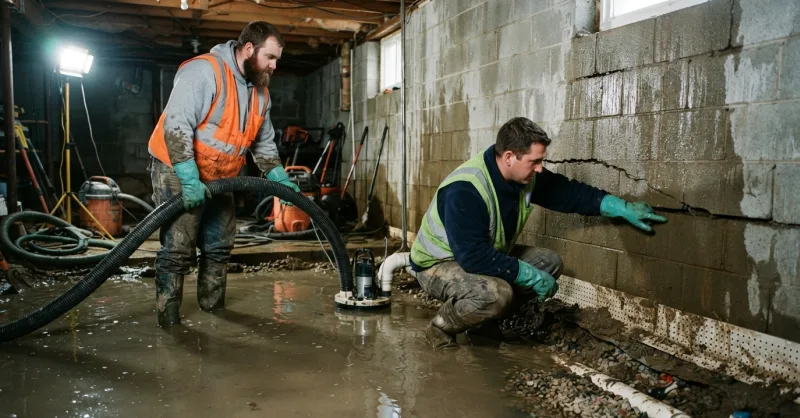
I’ve crawled under enough slabs in Bear, Pike Creek, and south Wilmington to know this: most “waterproofing” jobs that fail were never waterproofing jobs to begin with. They were band-aids. Somebody slapped hydraulic cement on a crack, maybe ran a dehumidifier, and called it done. Six months later the facility manager calls us because tenant complaints are stacking up again and the insurance adjuster won’t stop asking about efflorescence on the CMU walls.
The real issue sits 18 to 36 inches below your slab. New Castle County sits on the Delaware Coastal Plain, and the clay-heavy soils around the White Clay Creek basin trap what we call a perched water table. That trapped groundwater builds hydrostatic pressure directly beneath your concrete. It doesn’t care about your sealant. It pushes up through every cold joint, hairline crack, and capillary pore until your basement floor is wet again.
We operate out of 500 Apple Rd, Newark, DE 19711, and after 25 years in U.S. structural work and 6 years obsessing over tri-state soils, I can tell you the only way to stop water seeping through a basement floor permanently is to depressurize what’s underneath it. Everything else is temporary.
Diagnosing Sub-Slab Hydrostatic Pressure Before You Spend a Dollar
Last spring a property portfolio manager in Newark called us about a 12-unit apartment complex off Kirkwood Highway. Ground-floor units had chronic dampness. Two tenants had already broken leases. The previous contractor installed a single sump pump in one corner and walked away. No perimeter drain. No soil analysis. Just a pump sitting in a hole.
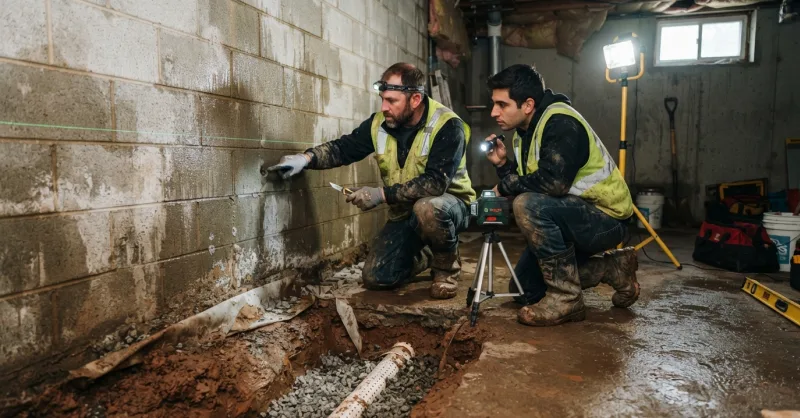
We ran a laser-level slab deflection map and found the floor dipping nearly 3/8″ toward the northeast wall. Relative humidity under the slab read 89%. The capillary fringe was sitting barely 20 inches below grade, classic for that stretch between Route 4 and the Muddy Run floodplain.
What a Real Assessment Looks Like
- Laser-level mapping across the entire slab surface to identify deflection, settlement, and low points where water pools first.
- ASTM D4263 humidity probe readings at multiple locations. We need numbers, not guesses. If your contractor isn’t quantifying moisture content, they’re selling you something they can’t verify.
- Capillary-fringe depth measurement to determine how close the water table sits to your slab underside. In Hockessin and Pike Creek Valley, clay lenses routinely hold water at 18 inches below grade after a heavy rain.
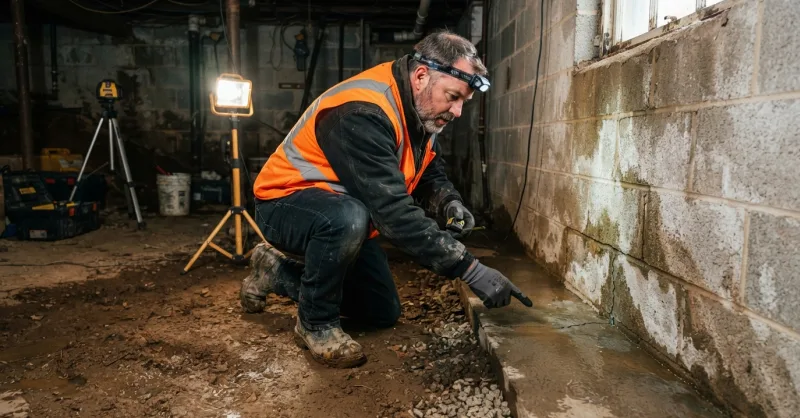
- Crack pattern documentation with epoxy-taggant markers so we can monitor whether cracks are active or dormant before cutting into anything.
We offer this structural assessment free, no sales pitch attached. If your slab doesn’t need a full interior system, we’ll say so. (I’ve walked away from jobs where regrading the exterior solved 90% of the problem. If telling you the truth costs me a project, so be it.)
How an Interior Perimeter Drain Eliminates Groundwater Beneath Concrete Slabs
The engineered fix has a specific sequence, and skipping steps is where most failures originate.
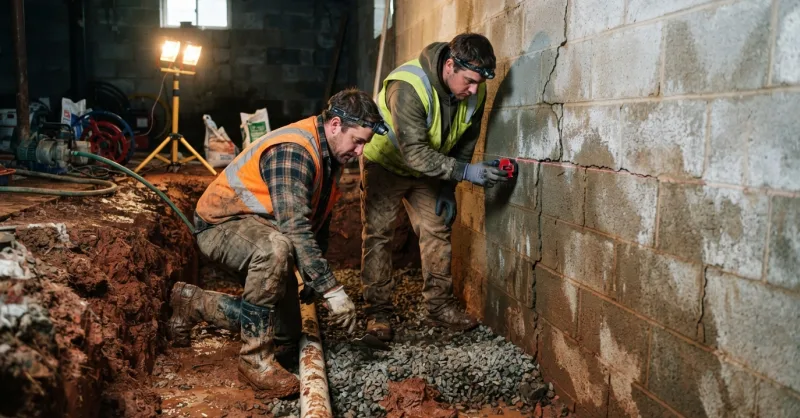
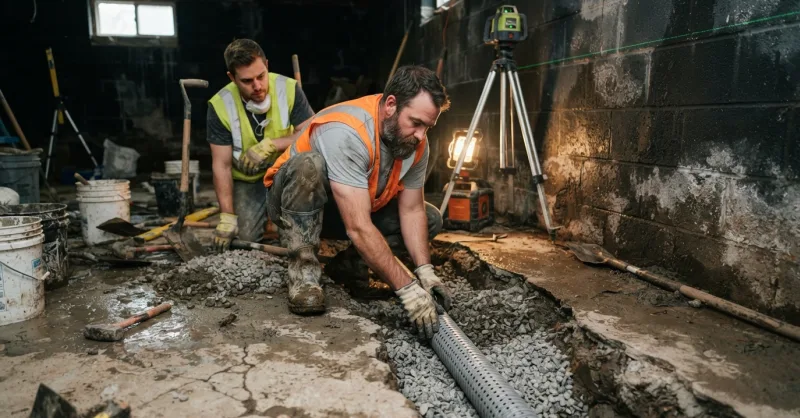
We saw-cut along the slab perimeter, 4 inches deep, and excavate a 6″×6″ trench beneath the slab edge. This trench becomes the relief channel for all that hydrostatic head pushing upward. We backfill with #57 clean washed stone and bed a 4-inch Schedule 40 PVC drain pipe on 2 inches of aggregate, pitched at a 1:50 fall toward the sump location.
Can you install a French drain inside a basement without violating New Castle County code? Yes. County Code Section 1807.2.2 requires exterior foundation drains for new construction, but explicitly permits interior remedial drainage systems when exterior excavation isn’t practical. We handle the retrofit permit application and schedule the final inspection ourselves. That documentation matters when your lender requests a Property Condition Assessment or you’re preparing resale paperwork.
The Sump Basin Setup That Actually Survives a Nor’easter
We set an 18-inch sump basin connected to a dual-stage submersible pump. Battery backup isn’t optional. During tropical remnants and coastal storms, the water table in Riverside and South Wilmington rises to within 6 inches of slab undersides. Power goes out. Your primary pump dies. Without battery backup and a high-water alarm, you’re looking at a flooded server room or ruined archival storage.
The sump lid gets a radon-tight gasket. New Castle County sits in EPA Radon Zone 1. If you’re waterproofing without addressing radon sub-slab depressurization, you’re creating a sealed environment that can actually concentrate radon gas. We couple the sump system with IRC Section 3305 requirements so you don’t fail a HUD radon re-test six months later and stall a property sale.
Crystalline Slurry and Vapor Barriers: The Two Layers Most Contractors Skip
Once the drain system is live, we trowel-apply a quarter-inch coat of ICC-ES AC377-certified cementitious crystalline slurry over the entire slab surface. This isn’t paint. The crystalline compounds penetrate capillary pores in the concrete and form insoluble structures that physically block reverse water migration. It also inhibits mold growth at the slab level, which is something your tenants’ lungs will thank you for.
Over that goes a 6-mil reinforced polyethylene vapor barrier with 12-inch taped overlaps, extended 4 inches up the foundation walls. This stops residual vapor transmission and radon ingress. It also gives you a clean, uniform surface for any future flooring installation.
Does waterproofing a basement slab from the inside actually work long-term in clay soil? It does when the system relieves pressure rather than just resisting it. Negative-side waterproofing fails when contractors rely solely on coatings to hold back hydrostatic head. Our approach depressurizes the sub-slab water column first with the perimeter drain and sump, then seals capillary pathways with the crystalline membrane, then blocks vapor with the poly overlay. Three layers, each handling a different moisture transport mechanism. We’ve measured slab moisture content dropping below 5% within 72 hours on jobs across the I-95 corridor, from the Delaware Memorial Bridge industrial zone up through Trolley Square brownstone foundations in Wilmington.
Why Sump Discharge Lines Freeze in January and How to Prevent System Failure
A detail that separates a permanent installation from a seasonal headache: your sump discharge line. County stormwater management ordinance requires the discharge to terminate at least 10 feet from the foundation with an air gap. Most contractors run a PVC line straight out and call it a day.
In January, that line freezes solid. Your pump cycles against a blocked discharge. Motor burns out. Basement floods.
We run heat-traced pipe on every discharge line and terminate it with an ice guard. It costs a bit more upfront but eliminates the single most common point of failure we see in existing systems across Bear-Glasgow and the Route 7 corridor in Hockessin. I replaced three burned-out pumps in one week last February, all from frozen discharge lines on systems other contractors installed. (One homeowner had been through two pump replacements in three years and nobody ever mentioned the discharge line. That’s the kind of thing that makes my blood pressure spike.)
If your current system doesn’t have freeze protection on the discharge, you might want to get that addressed before the next cold snap hits, regardless of who installed it.
Lifetime Transferable Warranty and Code Compliance for Asset Protection
What happens if the sump pump fails five years after installation? Our lifetime transferable warranty covers both materials and workmanship. We replace the sump pump every 5 years as part of the warranty terms. We also perform an annual moisture-content re-inspection using ASTM D4263 humidity probes at no additional charge and document everything in a compliance report. That report becomes part of your property transaction disclosure package.
For facility directors managing multi-tenant portfolios, this eliminates one of the biggest pain points I hear about: unpredictable emergency repair costs eating into Net Operating Income. You know what the system costs. You know the warranty covers it. You know we’ll be back annually to verify performance. No suprises.
Commissioning and Verification
After installation, we run full pump tests, recheck humidity at 72 hours, and don’t activate the warranty until everything reads below threshold. If a reading comes back higher than expected, we diagnose why before walking off the job. I’ve had exactly two installations where post-commissioning numbers didn’t hit target on the first pass. Both times it was an uncharted utility penetration through the footing that we missed on initial assessment. We found them, sealed them, re-tested, and moved on. Nobody’s perfect on the first cut every single time, but we don’t leave until the numbers are right.
If you’re managing properties in New Castle County, Chester County PA, or Cecil County MD, and you’re dealing with recurring slab water intrusion, our interior basement waterproofing systems address the root cause rather than the symptom. We also handle foundation crack repair when settlement cracking is contributing to water pathways, and full foundation repair when structural issues run deeper than moisture alone.
Emergency Basement Flooding Response Across the I-95 Corridor
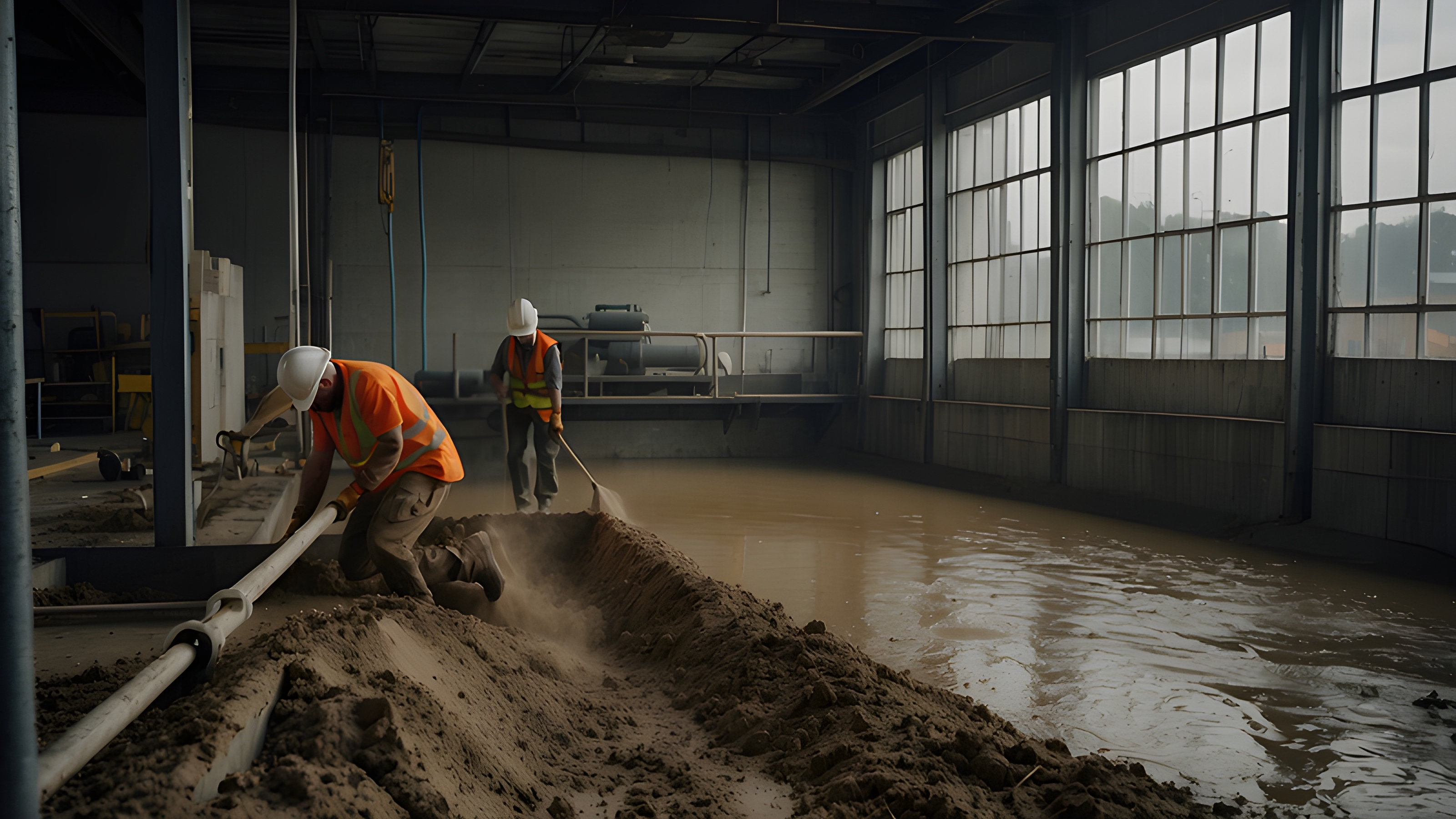
How fast can a waterproofing crew respond during an active basement flood in Wilmington? We dispatch a two-person crew with a truck-mounted extraction pump, submersible sump, and floor saw-cutting capacity. Our target is under 60 minutes from call to arrival, and we confirm crew location relative to I-95 or Route 1 so you get a real-time ETA, not a vague “we’ll be there this afternoon.”
During last summer’s convective storms, municipal drainage near Kirkwood Highway and Route 4 got overwhelmed within 40 minutes of the first downpour. We had three simultaneous dispatch calls from property managers in Bear and Newark. Two were apartment complexes with ground-floor units already taking water. The third was a commercial building near the Wilmington Riverfront where an archival records basement was flooding. We got crews to all three within the hour. Not because we’re superhuman, but because we pre-stock trucks and keep crews on rotating standby during storm season.
If you need us, call. We’ll pick up.
Follow our work and project updates on LinkedIn and Instagram.
Your Home In Good Hands. Request your free on-site hydrostatic pressure audit and structural integrity assessment. No sales scripts. No pressure. Just an honest answer about what’s failing and how to fix it permanently.
Written by: Alex Velasquez
AVG Waterproofing LLC